Biomedical scientist and scientific communicator. Postdoc @BiomaterialsUPC PhD in Mechanobiology @IBECBarcelona Fueled by rock music, books and carbs 🤘🏾📚 🍝
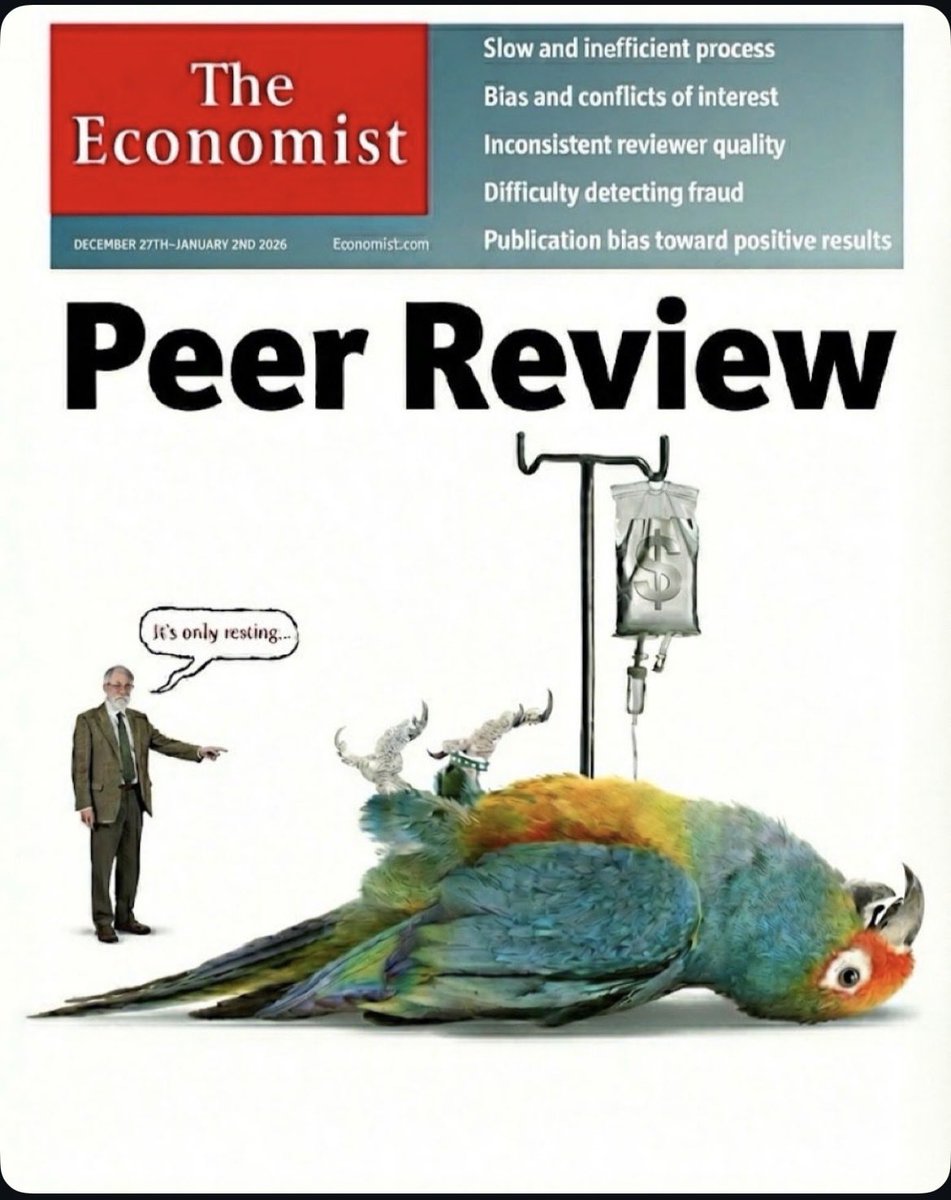
For decades, peer review has been treated as the gold standard of scientific validation.
Yet many scientists know the reality: the system is far from perfect. Peer review is broken and sometimes even corrupted.
The process can be slow, inconsistent, and vulnerable to bias. Reviewers are sometimes asked to judge work outside their true expertise. In other cases, they may be evaluating ideas that challenge the very paradigm in which they were trained. And occasionally, reviewers are simply competitors.
Ironically, the most prestigious journals can also be the most conservative. Truly new ideas are often met with skepticism, while safer work that fits the current narrative moves more easily through the system.
Increasingly, papers are judged less by the originality of the idea and more by the volume of data, the sophistication of statistics, and the beauty of the figures. Science risks becoming data-rich but idea-poor.
But there is an important reality to remember: journals do not ultimately decide the impact of scientific work. Impact is decided later, by the community. By the scientists who read it, test it, debate it, and cite it.
In the end, citations and ideas determine the legacy of a paper, not the impact factor of the journal that first published it.
Science has always advanced by questioning assumptions. Perhaps it is time we also question the system that filters scientific ideas.
The goal of a PhD is not to learn some facts or read a few papers or learn a bunch of techniques. The goal of a PhD is to learn independence, problem solving, how to finish things you start, resilience, & gain the ability to adapt & think creatively. Learning these things is hard
Keep your eye on the donut and not on the hole.
In memory of David Lynch, we will continue to explore the otherworldly and the unknown. We will focus not on the loss, but on what we gained from the years we shared this planet with you. We will see you in our dreams.
🚨 Excited to share our new paper: “Long-range organization of intestinal 2D-crypts using exogenous Wnt3a micropatterning”! 🔗 https://t.co/cJ6v2CRXFY
Let’s dive into how we used Wnt3a micropatterning to control intestinal epithelial organization. 🧵👇
@realDonaldTrump You're such a clown, l still can't believe why so many people still support you and your ideas. It's 2024 and the world is going backwards!
#whoiswhotuesday with PostDoc Fellow @GiuliaFornabaio, working in @SaludISCIII-funded project PlasmaBOOST: Biomimetic hydrogels delivering oxidative stress from cold plasmas to boost tissue regeneration (@PlasmaMedLab). Also: tomorrow is her B-Day... Tanti auguri, bellissima!!
��� JOB OFFER ALERT 📢 Postdoctoral Position on Biomimetic Hydrogels to assess the effects of Atmospheric Plasmas for Tissue Regeneration ➡️https://t.co/17PgCmUJWo
Out today in @NatureMaterials, the updated version of our work on nuclear jamming in organogenesis 👁️🧠 Thanks to the reviewers (yes, thanks 😊), we have added a lot of new data. Check below for the new results... 🧵
➡️https://t.co/iLAdn8x2q2
🔥New perspective: Can we trust the forces of plastic grown cells?
Cells on plastic face unique pressures, altering their genome and mechanobiology. We explore how these changes affect cell forces, their reversibility, and propose mitigation strategies
https://t.co/YvHtjxSN97
📢Hot off the press: our review on "tissue active matter"
Together with @EdouardHannezo, we review theoretical approaches for tissue dynamics, integrating active mechanics, cell-cell interactions and biochemical signaling
Now out in CSH Perspectives:
➡️https://t.co/Tn7hTLdmiP
📢We are recruiting! 3y postdoc position available in our interdisciplinary team @institut_curie#Paris.
Join us if you're interested in live imaging, quantitative biology & (opto)genetics of Drosophila epithelia during morphogenesis.
https://t.co/uNmshuk1YI
Please RT!
The team is currently attending the 3rd Annual Meeting of the @CostPlasTHER@COSTprogramme Action, held in Budapest. 4 days of Fruitful conversations, great science and really good friends around the continent!!
Grazie di tutto Prof! Senza di lei, probabilmente, non sarei quella che sono oggi. Grazie infinite per averci trasmesso l'amore per la ricerca e per la biochimica ❤️
È scomparso Lanfranco Masotti, professore di Biochimica del nostro Ateneo.
Masotti ha dato un impulso fondamentale alla fondazione delle ricerche Biotecnologiche non solo all'Università di Bologna, ma nel più ampio contesto nazionale e internazionale.
https://t.co/gsuEEuiA2h