Great work https://t.co/zZ9WZkDico @ISMEJournal@ISME_microbes by Nguyen, Qing-Lin Chen, Ji-Zheng He & Hang-Wei Hu @UniMelb, Michael Bonkowski & @KDumack@UniCologne. Find my commentary entitled Protist predation selects for the soil resistome https://t.co/yLcnNcSLqM
The magic of microbial VOCs and fantastic interactions with @Alex_Jousset@EisenhauerLab@idiv and George Kowalchuk @UniUtrecht. Bravo! Waseem Raza @ Nanjing Agricultural University.
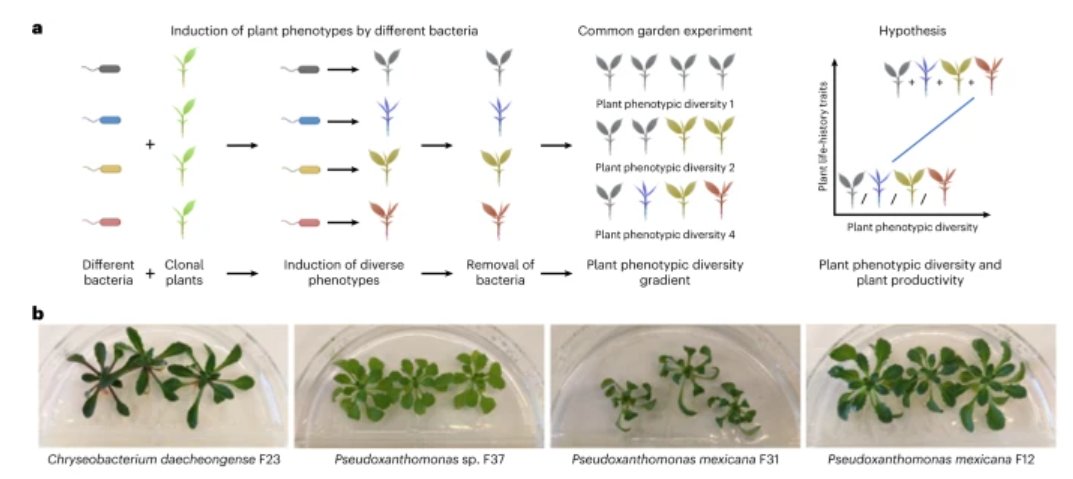
Microbe-induced phenotypic variation leads to overyielding in clonal plant populations https://t.co/a7hc025je2
Exposing plants to volatiles produced by microbes, the authors show that different phenotype combinations induced by this exposure can lead to biomass overyielding
Microbe-induced phenotypic variation leads to overyielding in clonal plant populations https://t.co/a7hc025je2
Exposing plants to volatiles produced by microbes, the authors show that different phenotype combinations induced by this exposure can lead to biomass overyielding
Using a random barcoding approach, Jiang et al. investigate how plant root permeability limits the invasion and population bottlenecks of a phytopathogenic Ralstonia.
@gjiang06@PeyraudR@Alex_Jousset@FDiniAndreote
https://t.co/dUdIHCU5Ap
Mol Plant Pathologist: Defining essential processes in plant pathogenesis with Pseudomonas syringae pv. tomato DC3000 disarmed polymutants and a subset of key type III effectors | @scoopit via @SuayibUestuen https://t.co/qg4tDdZAJY