En la India, se reunieron mujeres víctimas del machismo para contar sus experiencias y posar con sus cicatrices, les arrojaron ácido a la cara solo por rechazar a un hombre o negarse a casarse con ellos.
Esta es la cara de la misoginia patriarcal, el machismo es un crimen que debe ser perseguido y no fomentado por los algoritmos de las redes sociales.
Estos ataques no son aislados, según organizaciones como Acid Survivors Trust International, cada año hay más de 1.000 ataques con ácido a las mujeres en La India por rechazar a hombres, puro terrorismo machista.
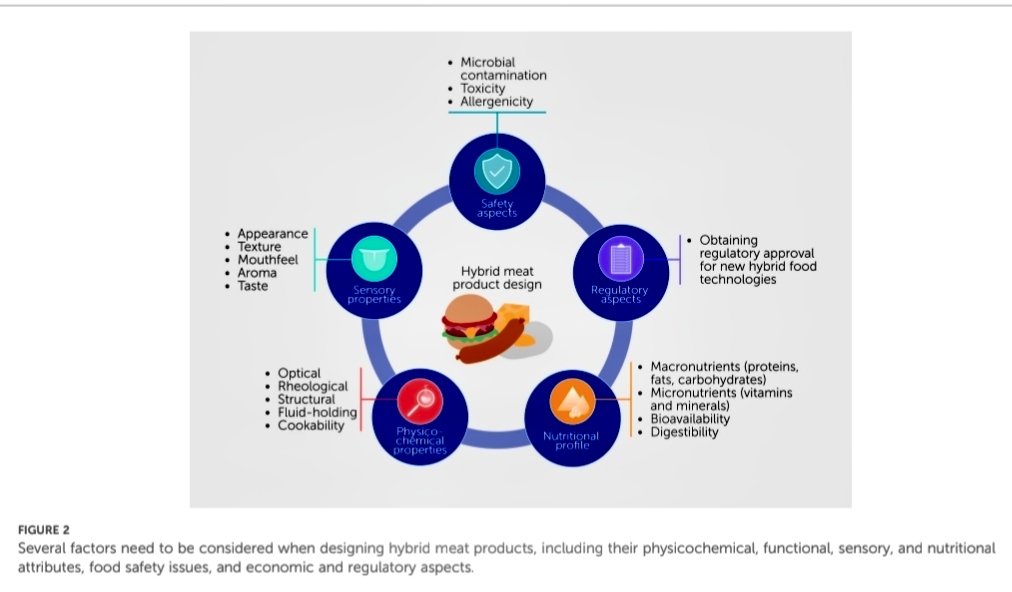
¿Te imaginas una hamburguesa que combine distintas fuentes de proteínas alternativas, como ingredientes vegetales, micelio de hongos o carne cultivada? 🌍🌱🍔
Este paper analiza los alimentos híbridos basados en proteínas alternativas y su potencial para contribuir a un sistema alimentario más sostenible, nutritivo y ético. 🔬
🔍 Puntos clave: 👇🏻👍🏻
- 🧪 Diversidad de fuentes: plantas 🌿, insectos 🦗, micelio 🍄, células animales cultivadas y productos obtenidos mediante fermentación microbiana pueden combinarse para diseñar nuevos alimentos híbridos.
- 👅 Propiedades sensoriales y nutricionales: textura, sabor, apariencia, composición nutricional y seguridad son factores esenciales para desarrollar productos competitivos y aceptables para los consumidores.
- ⚖️ Retos actuales: siguen siendo importantes la reducción de costes 💰, la escalabilidad, la evaluación del impacto ambiental, la regulación y la aceptación del consumidor.
🔗👇🏻 https://t.co/ARJLTOvQ91
#Sostenibilidad #InnovaciónAlimentaria #FuturoDeLosAlimentos #ProteínasAlternativas #Biotecnología #Nutrición #AlimentosHíbridos #CarneCultivada #FermentaciónDePrecisión #CienciaYSociedad
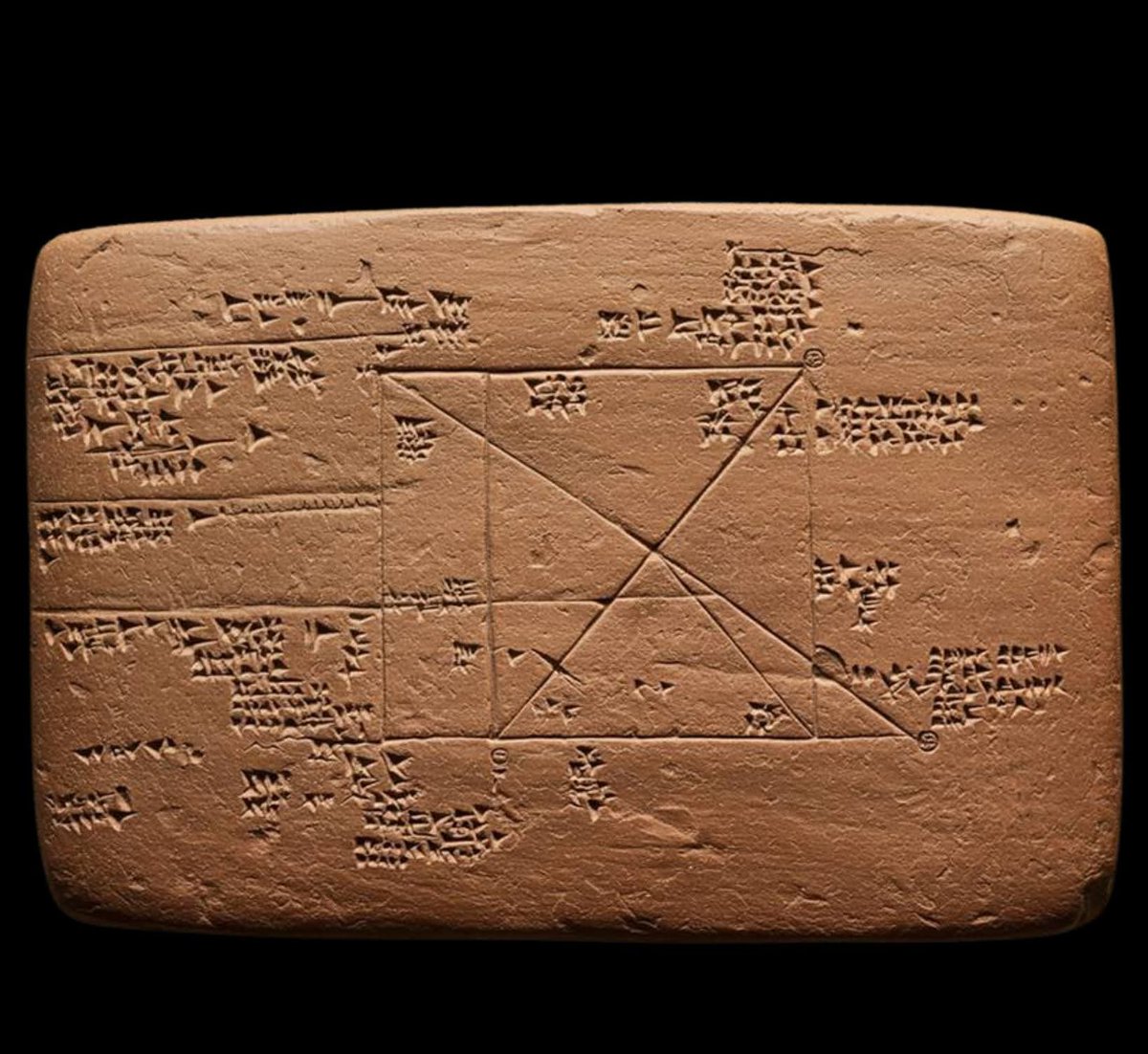
Imagine delving into the dusty archives of ancient Mesopotamia, where clay tablets reveal a mathematical sophistication that outshines classical Greece by more than a millennium.Around 1770 BCE, Babylonian scholars carefully inscribed tablet IM 67118 with a clever geometric challenge: determining the sides of a rectangle given its area and diagonal. Their solution explicitly employs what we now know as the Pythagorean theorem—verifying that a2+b2=c2a^2 + b^2 = c^2a^2 + b^2 = c^2
—all calculated in their brilliant base-60 (sexagesimal) system. This very system lives on in our 60-minute hours, 60-second minutes, and 360-degree circles.Even older, the renowned Plimpton 322 tablet from around 1800 BCE lists dozens of Pythagorean triples, such as 3-4-5. These sets were generated systematically, likely serving as teaching tools for scribes or practical aids for land surveying and astronomy.This was no abstract theory: the knowledge powered real-world tasks like dividing fields, constructing buildings, and tracking the stars. These artifacts dismantle the long-held notion that advanced geometry began with Pythagoras (who lived around 570 BCE). Instead, they unveil a vibrant Mesopotamian mathematical tradition—practical, precise, and profoundly influential—that laid the deep foundations for the modern STEM https://t.co/qbIBkMNqug the cradle of civilization, numbers were not mere tools; they were the keys to unlocking the secrets of the world.
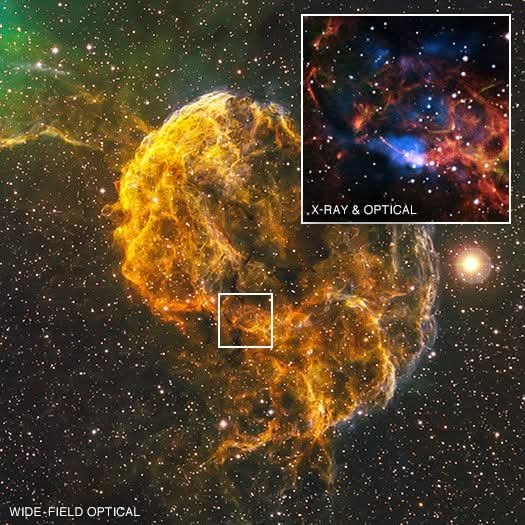
IC 443: The Jellyfish Nebula (Shortened Version)The Jellyfish Nebula (IC 443) is a supernova remnant located about 5,000 light-years away in the constellation Gemini. New Chandra X-ray Observatory observations have likely found its long-sought neutron star — a rapidly spinning pulsar called CXOU J061705.3+222127 (J0617 for short) — on the southern edge of the remnant.The explosion of a massive star left behind this dense, spinning neutron star. Chandra data reveal a small ring around J0617, possibly a shock where the pulsar wind slows abruptly, and a jet-like feature shooting particles at high speed. The surrounding diffuse X-ray emission has a comet-like tail, suggesting the pulsar is moving through the remnant.Although the tail’s direction is offset from what would be expected if the pulsar had traveled straight from the explosion center, this can be explained by interactions with dense material in the nebula pushing the tail aside.These observations support an age of several tens of thousands of years for IC 443 (closer to ~30,000 years than the younger ~3,000-year estimates from some earlier studies).A new composite image combines optical data showing the nebula’s beautiful filaments with Chandra’s X-ray view (blue) highlighting the pulsar and its https://t.co/WK8tOpU9XK: X-ray: NASA/CXC/MSFC/D.Swartz et al.; Optical: NSF/NOIRLab/DSS; Paper: Swartz et al. (Astrophysical Journal).
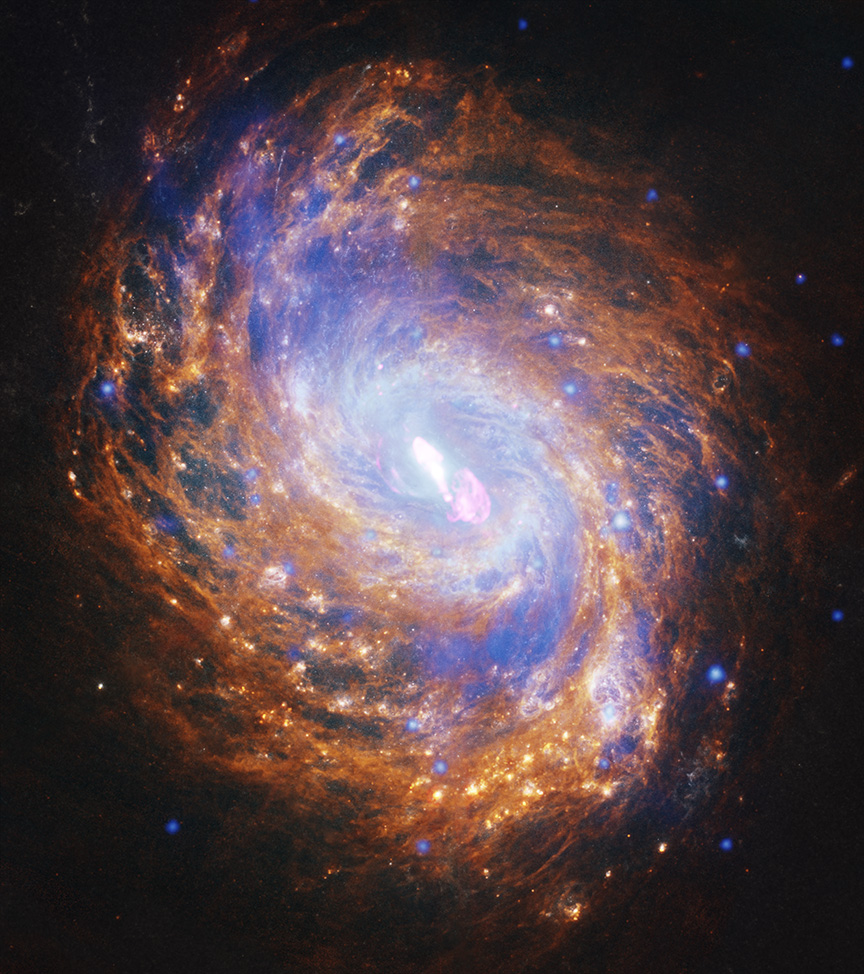
Take a spin around a spiral galaxy!
@ChandraXray, @NASAHubble, and @NASAWebb studied this galaxy with a black hole at its center that is twice as massive as the Milky Way’s.
Notably, a million-mile-per-hour wind being driven from the black hole lights up the galaxy's center.
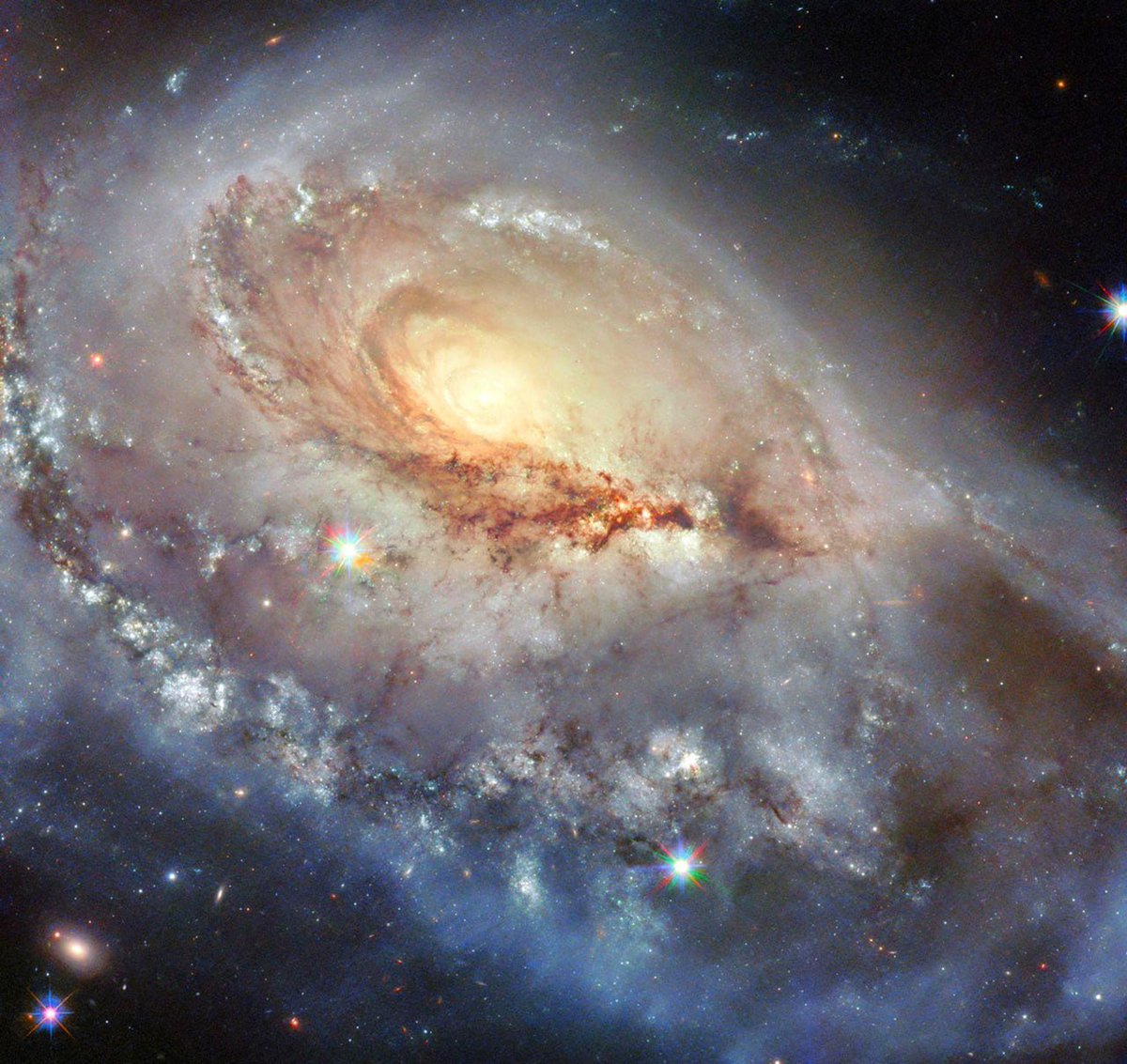
NGC 1961: A Ravaged Spiral BeautyThe Hubble Space Telescope has captured one of the most dramatic and chaotic spiral galaxies ever seen: NGC 1961.This majestic, yet violently distorted spiral spans nearly 200,000 light-years, larger than the Milky Way, and glows with the fierce light of intense star formation. Its arms are torn, twisted, and flung outward in luminous arcs, as if the galaxy has been gripped by an invisible cosmic hand and wrenched apart.What caused this spectacular destruction?Astronomers believe NGC 1961 recently plowed through a dense cloud of intergalactic gas or suffered a close gravitational encounter with a companion galaxy (now possibly hidden or destroyed). The impact triggered a firestorm of starbirth: brilliant blue clusters of newborn massive stars blaze along the shredded arms, while dark ribbons of dust trace the shockwaves of the catastrophe.Despite its chaotic appearance, NGC 1961 remains surprisingly intact at its core, where a bright, active nucleus hints at a supermassive black hole quietly feeding amid the turmoil.This is not a dying galaxy, but a galaxy in furious rebirth, violently reshaping itself in a blaze of creation.
Credit: ESA/Hubble & NASA, J. Lee and the PHANGS-HST Team
Last year in Science, researchers reported the characterization of a previously unidentified route by which breast cancer cells metastasize to the leptomeninges in mice. The findings could inform future therapies.
Learn more in this #SciencePerspective: https://t.co/Qz1SWYvmDx #ScienceMagArchives