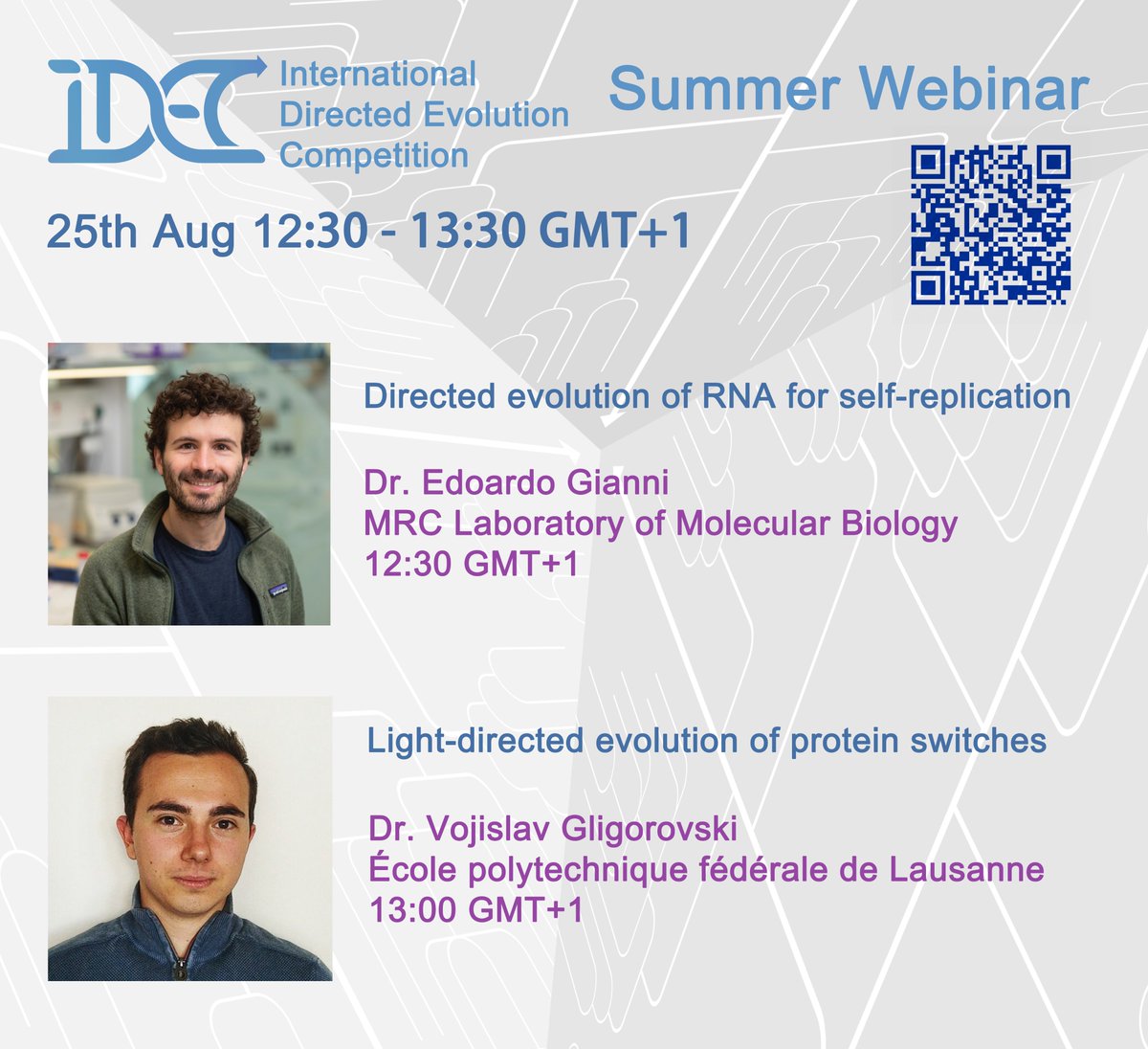
iDEC Summer Webinar 2026 is coming!
🧬 Edoardo Gianni — evolving a 45-nt RNA polymerase ribozyme toward self-replication
💡 Vojislav Gligorovski — light-directed evolution of dynamic protein switches
open to all: QR code for reg
Open — scan the QR code to register!
New paper from the lab!
https://t.co/g9fWFJzv3X
We find that protein degradation is broadly slower in human segmentation clock cells than in mouse cells, regardless of the degradation pathway or protein category!
1/
1/28 How do you optimize a dynamic protein property that emerges from multiple states? Our finally published paper in @NatureComms takes on one of the hardest problems in protein engineering with phage assisted evolution: evolving allosteric switches 🧵
Out now @CellCellPress: Many proteins are tiny computers, switching states in response to signals.
But how do you evolve such dynamic behaviors?
We created optovolution, a light-driven continuous evolution method that selects for switching dynamics:
https://t.co/6Fhvbxl3BG
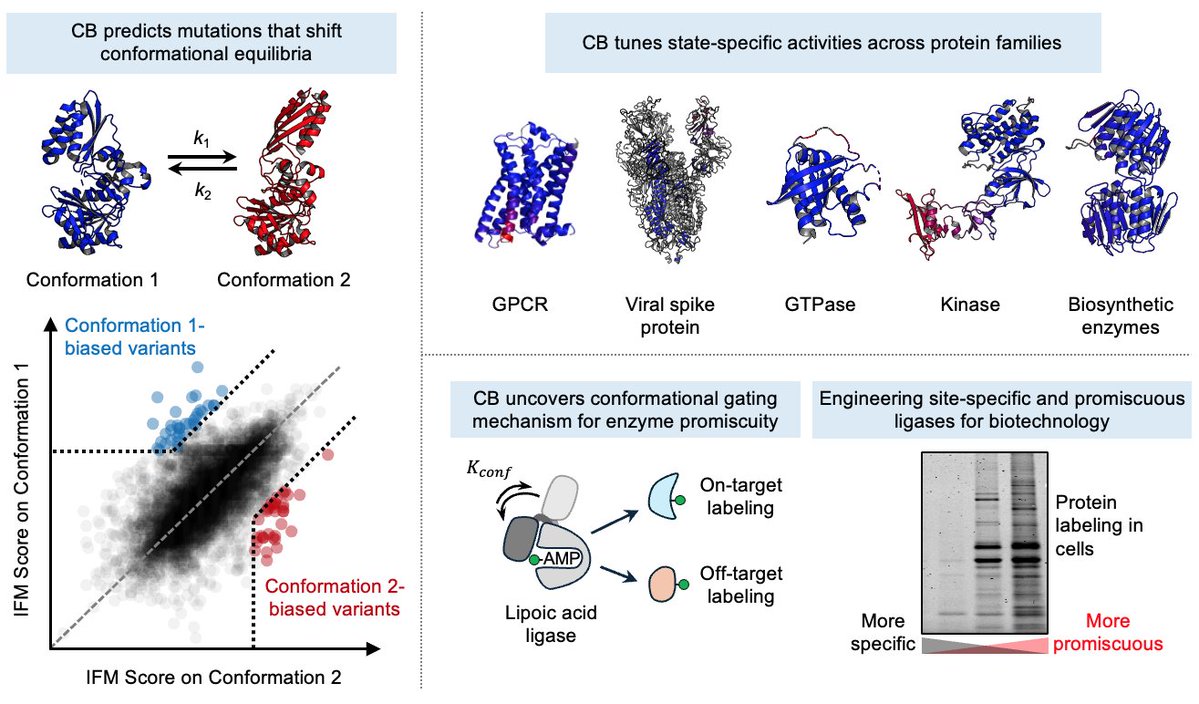
Can we design mutations that predictably bias proteins towards desired conformational states?
Today in @ScienceMagazine, we introduce Conformational Biasing (CB), a simple and scalable computational method that uses contrastive scoring by inverse folding models to identify conformation-biasing mutations.
https://t.co/lbWzHNdMRJ
New preprint from the lab! We discovered transient fluidization in the basal region of human forebrains by tracking microdroplets in cerebral organoids.This “basal fluidization”, absent in gorilla and mouse, may contribute to surface expansion in humans 1/
https://t.co/AWQ54cahj4
I am delighted to share this work, led by Miguel Alcantar and done in collaboration with Amgen, on the OrthoRep-driven evolution of computationally designed minibinders. Here, we focus not only on getting to high affinity, but also on mapping sequence-affinity landscapes of diverse evolutionary outcomes. One way we arrive at diverse evolutionary outcomes is through "neutral drift" where we take one binder and diverge it into many by selecting for the maintenance of (but not improvement of) binding. This is very easy to do with OrthoRep because rapid mutation of the binder occurs autonomously. The result is a rich sequence-affinity dataset spanning both a range of sequences and affinities. We are now scaling these approaches, including to antibodies and a broad array of targets, to get the right distribution and volume of data for training generative models for binder design. https://t.co/SK2w7ziwnI
In #G3journal, @sjrahi and team developed PIPOline to create the shortest DNA sequences, avoid manual design errors, specify the amount of homology, and customize restriction sites. Learn more about how this tool can streamline genome editing in #yeast: https://t.co/yUClDcNb2n
Stoked to share TWO preprints on mitochondrial pearling! 🎉
We uncover how spontaneous #mitochondria pearling drives #mtDNA nucleoid distribution (https://t.co/Q9OcuMZBvH), and @sturm_gav et al. dissect the biophysics behind it (https://t.co/qIVsxYiXDh). Details below! 🔬🧵
Could one envision a synthetic receptor technology that is fully programmable, able to detect diverse extracellular antigens – both soluble and cell-attached – and convert that recognition into a wide range of intracellular responses, from transgene expression and real-time fluorescence to modulation of innate cell behavior (excitation or inhibition of neurons, induction of cell migration, etc.)?
Today we report in Nature a new technology platform that provides a step in that direction: PAGERs, for Programmable Antigen-gated G protein-coupled Engineered Receptors, convert recognition of extracellular soluble or cell-attached antigens into diverse user-selected responses. PAGERs are based on G-protein coupled receptors (GPCRs), which themselves are not structurally modular, but we were able to build in modular antigen gating by fusing an antagonist peptide to the extracellular N-terminal end, and then gating the antagonist with a fused antigen-binding nanobody. When antigen binds, it sterically interferes with the antagonist, leading to relief of receptor inhibition. Drug or agonist can then turn on PAGER.
https://t.co/Clt8yjyk2y
Integrase-assisted transformation allows OrthoRep-driven evolution to start from very big libraries. Efficiency is even higher than the transformation of normal nuclear plasmids into yeast, because OrthoRep is cytosolic. Great job Olek, Yutong and team! https://t.co/vdlZLhjLHe
It was a long time (18 years!) waiting for this demonstration, but it's out, thanks to the leadership of @chancao123 and the great work of Verena Rukes, Mathieu Rebeaud and Louis Perrin.
Entropic Pulling at single molecule resolution!
https://t.co/ziwuDVpeVj
Why are there so many fitness metrics in microbial ecology? I was confused - with @Michael_Manhart , I developed a framework that unifies existing statistics of relative fitness and shows how they all derive from a few basic principles. Preprint is up! https://t.co/eDFACDlJCP
Congrats @yuichi_furuhata and team for streamlining yeast genetic code expansion through OrthoRep-driven evolution of aaRSs. Several evolved aaRSs give high translational efficiency with unnatural amino acids. A neat self-regulating aaRS is also found. https://t.co/GQ3kFz0MqD
Huge update to Convpaint, and preprint out on bioRxiv!
We develop a pixel classifier similar to Ilastik, but built for napari & with technical improvements. Now even works on animals! 1/10
A ribozyme can self-integrate into and hydrolyze ss- and dsDNA, offering a new avenue for the development of protein-free genome editing tools, and hinting at the possibility of a pre-translation origin of group II introns (G2Is). 🧵 (1/6)
https://t.co/b0Zpj9lJPY
Want to efficiently create large-scale dynamic models of metabolism that fit experimental data and reliably predict metabolic responses to various perturbations? Our new method does just that! Check it out here: https://t.co/d757bhiFC8.