@andyzengineer Was it really wired wrongly or did you rely on /dev/tryUSB* paths that change on reboot?
If the latter, consider using the symlinks under /dev/v4l/by-path/*
We are also releasing self-contained lecture notes that explain flow matching and diffusion models from scratch. This goes from "zero" to the state-of-the-art in modern Generative AI.
📖 Read the notes here: https://t.co/RULWDgn9pm
Joint work with @EErives40101.
Dear Mr Letta. The Commission's proposal unfortunately is not a 28th regime.
It is a partial national harmonization proposal that fails to clear the bar necessary for Europe's entrepreneurs to actually adopt it.
For global competitiveness, we need more.
@LeRobotHF That looks really cool!
Is this made on top of rerun? And how does the dataset visualizer and rerun are supposed to be used in a typical lerobot workflow?
If the Netherlands can tax "Unrealized Profit," citizens should be able to claim "Unrealized Welfare."
Unborn Child Benefits:
"I’m planning to have 3 kids eventually. Pay me now."
Pre-emptive Unemployment:
"I might lose my job next year, pay me now."
Future Pension:
"I am 7 years old, but I identify as retired"
@DominiqueCAPaul If what you said was true, then deep imitation learning would be nothing but a glorified look up table which is incapable of any generalization. Right?
@DominiqueCAPaul Great demo. But I would challenge the statement: "A correction at timestep 20 teaches nothing about timestep 19 or 21."
DL models learn continuous mappings from states to actions. Therefore, given that nearby states are highly correlated, a correction in one affects the others.
President Ursula von der Leyen officially announced the EU–INC today at Davos!
A single legal entity for all European founders to grow massive companies in Europe. Online incorporation in 48 hours. No more bureaucratic mess across European borders.
All of you made this happen!
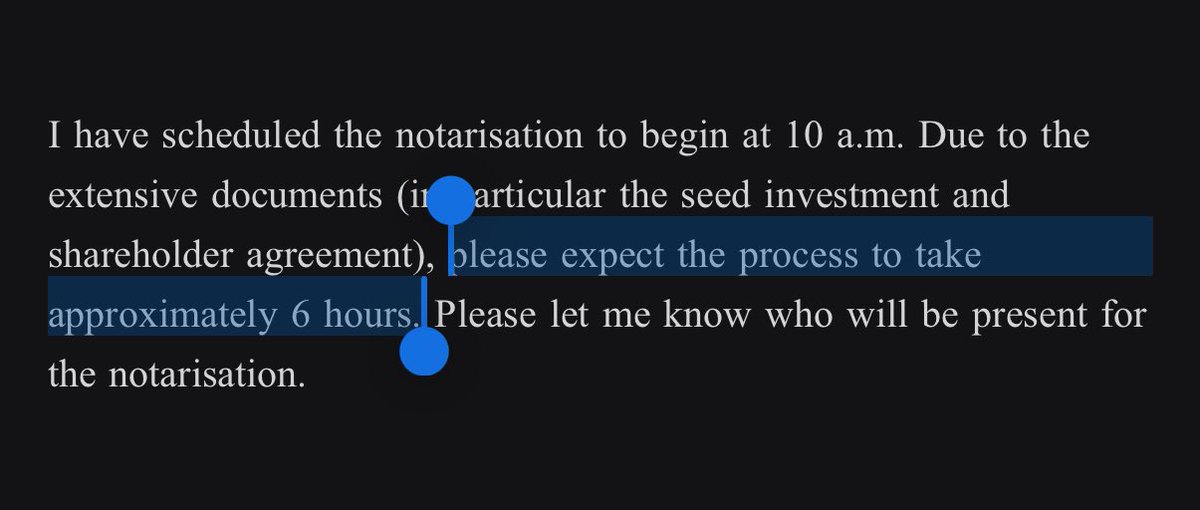
another German investment, another 6 hours of a notary reading every single word of all the documents out loud to each party to the transaction after we’ve all agreed on the docs
Suppose that once a week, ten men go out for beer and the bill for all ten comes to £100.
If they paid their bill the way we pay our taxes, it would go something like this:
The first four men (the poorest) would pay nothing.
The fifth would pay £1.
The sixth would pay £3.
The seventh would pay £7.
The eighth would pay £12.
The ninth would pay £18.
And the tenth man (the richest) would pay £59.
So, that’s what they decided to do.
The ten men drank in the bar every week and seemed quite happy with the arrangement until, one day, the owner caused them a little problem.
“Since you are all such good customers,” he said, “I’m going to reduce the cost of your weekly beer by £20.”
Drinks for the ten men would now cost just £80.
The group still wanted to pay their bill the way we pay our taxes.
So the first four men were unaffected.
They would still drink for free but what about the other six men?
The paying customers? How could they divide the £20 windfall so that everyone would get his fair share?
They realized that £20 divided by six is £3.33, but if they subtracted that from everybody’s share then not only would the first four men still be drinking for free but the fifth and sixth man would each end up being paid to drink his beer.
So, the bar owner suggested that it would be fairer to reduce each man’s bill by a higher percentage.
They decided to follow the principle of the tax system they had been using and he proceeded to work out the amounts he suggested that each should now pay.
And so, the fifth man, like the first four, now paid nothing (a 100% saving).
The sixth man now paid £2 instead of £3 (a 33% saving).
The seventh man now paid £5 instead of £7 (a 28% saving).
The eighth man now paid £9 instead of £12 (a 25% saving).
The ninth man now paid £14 instead of £18 (a 22% saving).
And the tenth man now paid £49 instead of £59 (a 16% saving).
Each of the last six was better off than before with the first four continuing to drink for free.
But, once outside the bar, the men began to compare their savings. “I only got £1 out of the £20 saving,” declared the sixth man. He pointed to the tenth man, “but he got £10!“
“Yeah, that’s right,” exclaimed the fifth man. “I only saved a £1 too. It’s unfair that he got ten times more benefit than me!”
“That’s true!” shouted the seventh man. “Why should he get £10 back, when I only got £2? The wealthy get all the breaks!”
“Wait a minute,” yelled the first four men in unison, “we didn’t get anything at all. This new tax system exploits the poor!”
The nine men surrounded the tenth and beat him up.
The next week the tenth man didn’t show up for drinks, so the nine sat down and had their beers without him.
But when it came time to pay the bill, they discovered something important – they didn’t have enough money between all of them to pay for even half of the bill!
And that’s how it works.
Tax them too much, attack them for being wealthy and they just might not show up anymore. In fact, they might start drinking overseas, where the atmosphere is somewhat friendlier.
For those who understand, no explanation is needed.
For those who do not understand, no explanation is possible.
Germany used to produce 31% of their electricity from nuclear power back in 1997. There was zero reason to shut them down, just leftist ideology.
Now Germany's electricity rates are 3x higher than the USA, factories are closing and moving to China, the USA and other countries. The jobs are moving to countries with cheaper energy and less regulations.
Germany's economy is collapsing as the high paying jobs move countries with rational policies.
Lousy policy has consequences.
Talk about an in-flight meal.
For the first time, researchers have captured rats hunting bats by grabbing them from the sky. Learn more: https://t.co/diTO1zqjUf @NewsfromScience
Why do eukaryotes have sex? And why 2 sexes in particular? Nick Lane thinks this again can be explained by (you guessed it) mitochondria.
First, why sex? Solves two problems:
- Muller's ratchet: since almost any random mutation will be deleterious, variation via mutation produces children with lower expected fitness. Whereas variation with recombination (which doesn’t just do random bit flips - rather it randomly samples alleles which are known to be plausible) produces children with the same expected fitness.
- Clonal interference: even if a beneficial mutation is found, without systematic pooling of genes via recombination, the different lineages are just gonna have to battle it out. One lineage has beneficial mutation X, the other lineage is beneficial mutation Y, but there's no way to fuse those improvements. You're either going to have to lose one or the other as each lineage tries to win over the other.
Bacteria, of course, do have lateral gene transfer. But this is non-reciprocal and piecemeal. It doesn’t enable the same kind of genome-wide parallel search that recombination does.
Analogize this to a Github repo. Recombination is like a normal pull request - the diff is organized, made at the same site where the previous analogous functionality was, and then merged back into the main branch if maintainer evaluates it to be better (analogy is imperfect, but this is like evolution driving that allele into fixation after the systematic pooling that recombination enables).
Asexual reproduction is if you just forked the repo millions of times, making random char changes. And even if a couple of these forks end up accidentally producing an improvement, there’s no way for them to merge.
Horizontal gene transfer is if you just took a random 500 line snippet and shoved it in some totally different repo in a random place. There’s no organized diff at the site of the relevant functionality.
This kind of systematic parallel search across the genome became necessary once the genome size exploded after the endosymbiosis of the ancestral mitochondria (which kept shoving a bunch of its genes into the host cell’s DNA).
Okay fine. But why 2 sexes? Why not just 1, so that everyone could mate with everyone else? Or failing that, why not more than 2, so that you can mate with every sex but your own? 2 is the worst possible number in terms of the number of potential mates it makes available.
To explain why there can’t be one sex, we need to consider the mitochondrial DNA, which is separate from the nuclear DNA, and also doesn’t recombine. Because it doesn't recombine, it suffers from Muller's ratchet.
Because of how important it is that your mitochondria are not fucked up and compatible with each other, you need some pre-conception selection of mitochondria. How do you do that? The best way evolution has found to control mitochondrial quality is to have only one parent pass them down. This one parent should generate millions of oocyte candidates, and then filter them down to a couple hundred eggs based on mitochondrial quality. (How this selection happens is well beyond me)
So we need one sex that specializes in preserving mitochondrial quality, and another which is just there to provide the variance that sexual reproduction depends on.
And there's no benefit to a third sex. There’s two useful niches: either you transmit mitochondria or you don't. A third sex would just be redundant with one of the first two.
This then explains a ton of differences in males versus females. For example, human females start with ~6-7 million primordial germ cells during fetal development. But this drops down to a couple 100 viable eggs through their lifetime. I think Nick Lane's theory is that partially what's happened is that potential gametes with bad mitochondrial DNA have been purged.
Also, why are women born with all their eggs, whereas men produce sperm at will? Because women are tasked with protecting mitochondrial DNA, they want to minimize mutations. The way to minimize mutations is to keep cell duplications down. There's only 20 mitotic divisions between a primordial germ cell and an egg. Whereas there would be hundreds of divisions between a spermatogenic stem cell and sperm.
Questions for Nick Lane:
- I feel like my explanation for why lateral gene transfer doesn't produce the same benefits as sexual reproduction is kind of hand-wavy. I want to get a better understanding of what’s missing. For example, in his textbook on information theory, David McKay has an interesting tangential chapter on sexual vs. asexual reproduction. And there he proves that with recombination, you can acquire information from the environment √genome-size faster, and tolerate a mutation rate √genome-size higher. What would the analogous information-theoretic bound on lateral gene transfer be?
- If prokaryotes had evolved sex, is the implication of this logic that they would only have one sex?
- Given the advantages of sexual reproduction (which are smaller, but still present, for the smaller genomes of bacteria) why didn't bacteria evolve sex? Why do they just stick with horizontal gene transfer? Why did you need this endosymbiotic event to evolve sex?
- Do a lot of male abnormalities and diseases originate in the Y-chromosome? Because it also goes through Muller's ratchet, right? It would explain why the Y chromosome has been shrinking over time. According to an LLM, it had 1400 genes 300 million years ago, now only 50-70 - presumably the ones that are absolutely essential to sexual bifurcation? Did evolution come up with some clever way to screen for Y chromosome quality the way it did with mitochondrial DNA? Did evolution try to get your important genes out of the Y-chromosome? Does this in any way connect to the greater male variability hypothesis, where supposedly men supply the world with more idiots and more geniuses? To the extent this is true, the cause would have to reside in the Y chromosome, right?