24 June 1812: #Napoleon and his French #army cross the Prussian-Russian border near Kaunas, in modern-day Lithuania, at the #Nieman river to begin his invasion of Russia. It would not end well for Napoleon nor his troops. #History#OTD#ad https://t.co/HqYLTE2EA7
Thomas Jefferson wrote "all men are created equal" while owning more than 600 human beings over his lifetime.
The contradiction is real. But the sentence he wrote kept working long after he stopped. Abolitionists used it. Lincoln used it. The civil rights movement used it.
Here is the whole, contradictory story of the man who wrote it. 🧵
The “7 Wonders of the Ancient World” was a list compiled by Hellenic writers and travelers, primarily in the 2nd century BC.
Only the Great Pyramid of Giza is still standing.
In its nearly 2,500 years, the Parthenon has been used as a temple to Athena, a treasury, a Christian church, and a mosque. It has been bombed. All considered, it looks great—particularly its western facade, which has undergone eight years of restoration!
https://t.co/IVDnlCXvai
Sacsayhuamán, a large Inca fortress overlooking Cuzco, Peru 🇵🇪; from a hilltop 230m above the city. It was built in 15th Century AD, during reign of Pachacuti Inca Yupanqui....
Built with stones that were up to more than 8.2m tall and weighed many tons, and with zigzag walls more than 305m in length, Sacsayhuamán is a feat of human engineering, the story of whose construction has caused much discussion among archaeologists. In construction of Sacsayhuamán, stones were laid together without the use of mortar, and they seem to be immovable by nature. Although earthquakes have laid waste to many more modern buildings in the locality, Inca site itself has remained unshaken by any of tremors. The purpose for which Sacsayhuamán was built is uncertain. The walls and original towers seem clearly defensive in nature. The site also incorporates a large plaza surrounded by terraces, and it is thought that this area may have been used for ceremonies. In addition, it is thought that there were temples in complex. In 2008, archaeologists uncovered the ruins of a pre-Inca temple and roadway at site’s periphery.
Sacsayhuamán is known to have been site of a fierce and bloody battle between Spanish and Inca in 1536 AD. Although walls appear huge today, it is known that they were originally even more imposing, as Spanish used all but heaviest stones to build Spanish Cuzco. The site was covered over, not to be seen until Peruvian archaeologists found it again in 1934. Today, it remains both an archaeological site and a tourist attraction, and each year the Inti Raymi, Inca Festival of the Sun, is celebrated at Sacsayhuamán.
Vince Lee (explorer), an author, architect and explorer who has been consulted on various ancient sites that moved large megaliths. He theorized that the blocks were put into place by carving them first and then lowering them into place. This would have involved doing precise carving ahead of time to create the tight joints that are made to fit into prepared pockets existing in the wall. Then they would be towed up a ramp and above the wall where they would be placed on top of a stack of logs. Then the logs would be removed 1 at a time to lower the stones into place carefully. An experiment was done to see if this would work on a small scale; this accomplished limited success. In the event that they were unable to obtain the tight joints the first time the Incas would also have been able to lift the stones back up to correct their mistakes. They were not able to obtain as much precision as the Incas but they theorized that with more practice they could have accomplished more precise joints and done it with larger stones.
They also did several experiments in nearby Ollantaytambo to tow megalithic stones. This also led to limited success. They conducted one experiment where they tried to lower a 1 ton stone down a mountain. They lost control of this stone and it rolled down on its own. This is probably not the way the Incas did it since they would have wanted to control transportation and this could have led to a lot of accidents. They concluded that although they had gravity on their side they had to practice to maintain control of the descent. They also did an experiment towing a megalith that may have been close to 10 tons on cobblestones. They had about 12 people behind megalith pushing it while well over 100 people were pulling on several ropes to tow it. They succeeded in towing it at a fairly quick pace. Incas built a large road system that included 25,000km of roads. Some of these roads were embellished with stone pavings. Additional experiments were done at other locations to move large megaliths some of which are listed here; these experiments were not adequate to replicate successful efforts Pedro Cieza de León claimed to witness in 16th Century AD, and the largest megaliths currently there were more than twice his estimates of largest megaliths in his time.
#archaeohistories
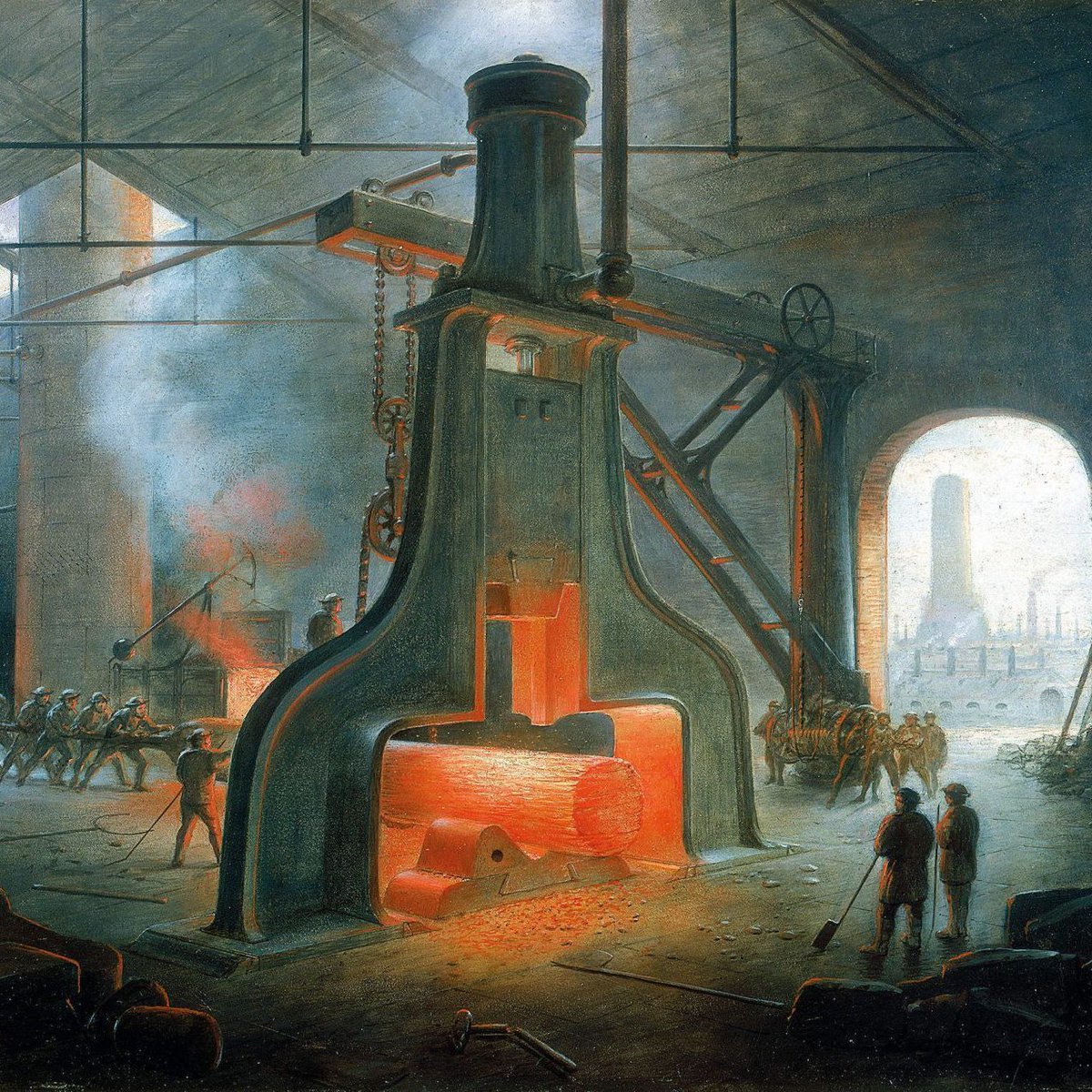
Was there really an “Industrial Revolution”?
In this article, Dr John Constable examines the origins of the term, how it entered academic and public discourse, and the political and intellectual traditions that helped popularise it. He also considers what this history may suggest about modern expectations of a “Green Industrial Revolution.”
Read the full article: https://t.co/W4TFwmyKz2
#HistoryReclaimed #IndustrialRevolution #JohnConstable #EconomicHistory #BritishHistory
Stepping stones in Pompeii still doing their job after 2,000 years. The Roman city’s paved roads doubled as open-air drainage channels during heavy rain, flushing away any refuse downhill. Raised stones kept pedestrian feet dry while carts rolled right through. Roman genius!
Today in 1340, Edward III leads an English fleet to victory over the French at Battle of Sluys. The king packs his ships with soldiers and longbowmen and uses superior tactics and favourable winds to capture or destroy 190 enemy vessels for the loss of only two of his own.
#OnThisDay in 1940, Hitler took a whirlwind tour of occupied Paris. After the French capital had fallen to the German army, Hitler toured the city, posing for pictures by the Eiffel Tower and discussing his plans for a victory parade.
📸 Getty
By 1600, Japan had more than 300,000 Christian converts. After the failed Shimabara Rebellion, led largely by Christian peasants and masterless samurai, the shogunate crushed the revolt and executed about 37,000 rebels and suspected supporters, many by beheading. https://t.co/5UZkJJBm6c
For anyone interested in the history of communist China, this interview with Frank Dikotter by Peter Robinson from @uncknowledge is essential viewing.
https://t.co/xxxyGStpe7
Carl Hendrick explains there IS a science of writing, but it's messier than reading science. Reading has one key: connecting letters to sounds. Writing is juggling many things at once—spelling, grammar, ideas, organization. Research shows the best way to teach writing is starting with sentences, not essays. Use simple exercises like extending thoughts with "because," "but," "so." Teach explicit strategies step-by-step. This helps all kids, especially those without language-rich homes.
https://t.co/TxiSrM0eaI