We are expanding our research portfolio and mandate!
Announcing our new name
ICMR-National AIDS Research Institute (NARI)
is now
ICMR-National Institute of Translational Virology and AIDS Research (ICMR-NITVAR)
@ICMRDELHI#NARI2NITVAR
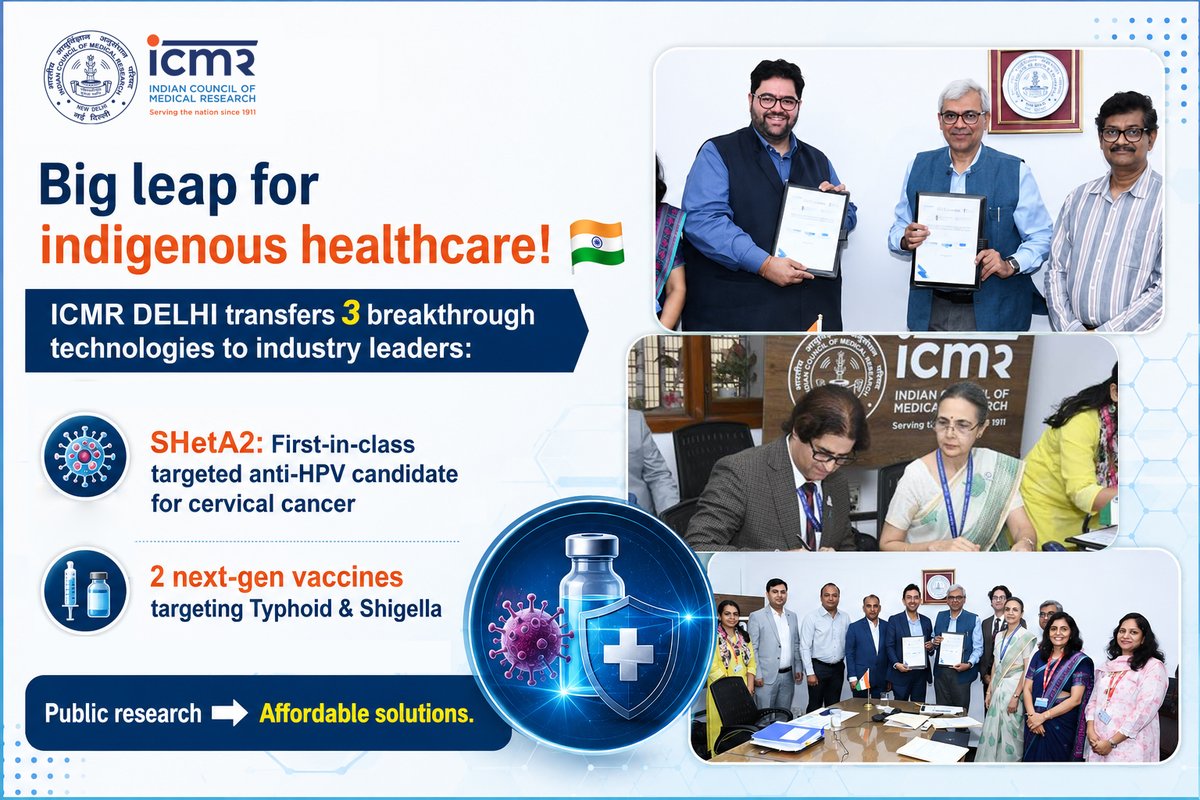
Big leap for indigenous healthcare! 🇮🇳
ICMRDELHI transfers 3 breakthrough technologies to industry leaders:
🔹 SHetA2: First-in-class targeted anti-HPV candidate for cervical cancer
🔹 2 next-gen vaccines targeting Typhoid & Shigella
Public research ➡️ Affordable solutions.
🚨 Kabeer Chillar, an IIT Bombay Computer Science student, who secured a perfect 300/300 in JEE Main 2026, earning AIR 1, followed by AIR 2 in JEE Advanced with an incredible 329/360.
He won a gold medal for India at the International Chemistry Olympiad (IChO) 2026. 🏅 👏
ICMR transfers three indigenous biomedical technologies to advance cancer and infectious disease solutions
☑️SHetA2 Anti-HPV candidate, two enteric vaccines among technologies transferred for further development
☑️Technology transfer brings government-funded research closer to affordable healthcare
☑️Medical Innovations Patent Mitra driving India's path to self-reliance in healthcare innovation: Secretary DHR and DG ICMR, Dr. Rajiv Bahl
Read here: https://t.co/B9cRsqmyru
Prof. (Dr.) Gobardhan Das, Member, NITI Aayog, visited ICMR HQ and engaged with senior officials on DHR and ICMR’s key achievements, focusing on strengthening health research, innovation, and evidence-based policymaking.
He told his students to go to the windows.
Get out. Jump if you have to.
Then Liviu Librescu walked to the classroom door and pressed his body against it.
He was 76 years old. He weighed 140 lbs
The gunman was in the hallway.
It was April 16, 2007. A Monday morning. Solid mechanics class at Virginia Tech, Room 204. Twenty-two students, most of them 19 or 20 years old.
At 9:45 AM, gunshots echoed through Norris Hall. Room by room, the shooter was working his way down the corridor.
Liviu heard it. He understood immediately.
He had survived the Holocaust. He had survived a labor camp. He had spent decades living under Communist oppression. He knew exactly what evil sounded like.
He told his students to escape through the windows. Second floor — it was a drop, but they'd survive. Then he walked to the door and held it shut with his body.
The shooter tried to force it open. It wouldn't move.
He fired through the door. Wood splintered. Bullets came through.
Liviu stayed.
Behind him, students were climbing out the windows. Dropping to the ground. Running. One by one, all twenty-two of them got out.
The shooter kept firing through the door.
Liviu held it shut until every student was safe.
Then the bullets killed him.
When police arrived, they found his body at the door.
All 22 of his students survived. Not one was injured.
Liviu Librescu was born on August 18, 1930, in Ploiești, Romania.
He was Jewish. In 1941, when he was eleven years old, Romanian authorities sent him and his family to a labor camp. His father died there. Liviu survived. When the war ended, he was fifteen.
He went back to school. Studied engineering. Earned a doctorate from the University of Bucharest.
But Communist Romania had no interest in allowing a Jewish intellectual to succeed. He was blocked from academic positions. Passed over for jobs he deserved. He applied to emigrate. The government kept refusing.
Finally, in 1978 when Liviu was 48 years old — Israeli Prime Minister Menachem Begin personally intervened. Romania let him go.
He had spent most of his adult life trapped in a country that didn't want him.
In Israel, he taught at Tel Aviv University. Published over 300 papers. Became an international expert in aeroelasticity — the science of how air flows over aircraft wings.
In 1985, Virginia Tech offered him a position. He moved to Blacksburg, Virginia. He taught there for 22 years. His students loved him — demanding but kind, high standards, genuine care.
He was still teaching full-time at 76. Still publishing research. Still showing up every Monday morning for solid mechanics.
April 16 was the first day of Passover — the Jewish holiday celebrating liberation from slavery and oppression.
Liviu Librescu died on the day his tradition sets aside to celebrate freedom.
He spent his entire life escaping death and oppression by luck, by persistence, by the intervention of others. And on his last morning, he chose to stand at a door so that twenty-two young people could have the future he had fought so hard to reach.
He could have run. He could have hidden. He could have climbed out a window with his students.
He chose to stay.
The Virginia Tech shooting killed 32 people that day — the deadliest school shooting in American history at the time.
Room 204 had zero casualties.
Because a 76-year-old Holocaust survivor held a door with his body until every student behind him was gone.
His funeral was held in Israel. Students from Virginia Tech flew across the ocean to honor him. The Israeli government awarded him the Star of David Medal posthumously. Virginia Tech named a scholarship in his memory.
His son said his father died the way he lived — protecting others.
A man who survived everything evil threw at him for 76 years.
On his last day, he made sure 22 kids survived too.
Professor Liviu Librescu. August 18, 1930 — April 16, 2007.
Holocaust survivor. Labor camp survivor.
302 published papers. 22 years at Virginia Tech.
22 students out the window.
He held the door.
#WATCH | Tokyo: On winning Japan Open, Badminton player PV Sindhu says, "I am happy but at the same time there are many more tournaments... It is a relief that I could get a win after almost two years... This will definitely give me a lot of confidence for the upcoming matches and tournaments to maintain the same level of play and stay consistent."
(Source: BAI)
Jo Nagai was raising swallowtail butterflies at his home in Kobe, Japan, when he noticed something odd. The ones he had looked after as caterpillars seemed to recognize him. Wild butterflies fled. His didn't.
He was in second grade. He wrote a four-page letter to Dr. Martha Weiss, an entomologist at Georgetown University who had studied whether moths could retain memories through metamorphosis. He asked if she could help him design a version of her experiment for butterflies.
She said yes.
Using a muscle therapy device, Jo trained caterpillars to associate the scent of lavender with a mild vibration. When the caterpillars became butterflies, 70 per cent of them still avoided the lavender. Their brains had been completely rebuilt during metamorphosis. The memory survived anyway.
Then he bred them.
The offspring, which had never been trained, also avoided lavender. So did their grandchildren. Without ever experiencing the vibration, two generations of butterflies inherited an aversion to a scent their grandmother had been taught to fear.
Jo documented it all in a 33-page research paper and presented his findings at the International Congress of Entomology in Kobe in 2024. He was 10.
A second grader wrote a letter to a Georgetown professor, and together they found evidence that butterflies can pass memories down through generations.
-Wilderness Whisper
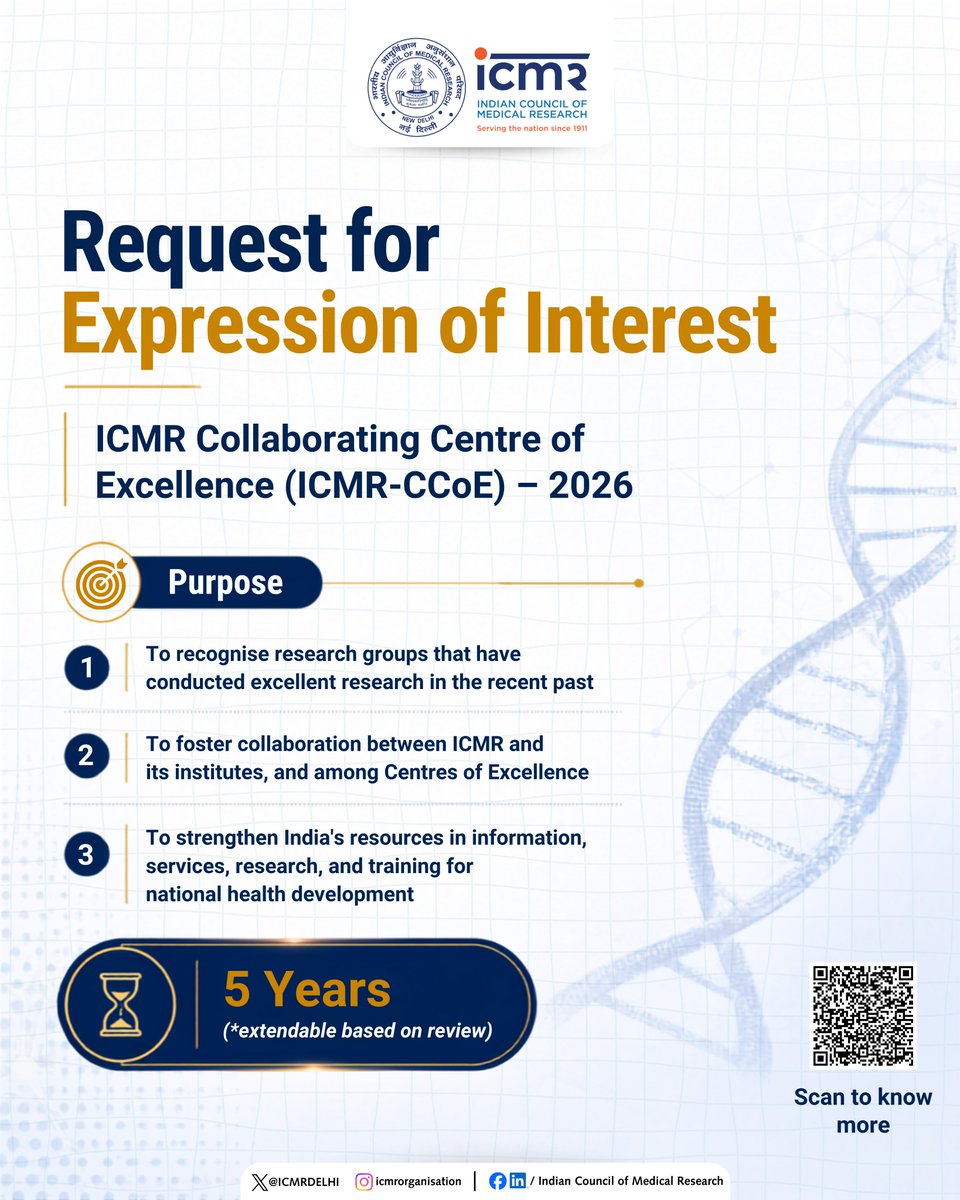
🚀ICMR invites EoI for recognition as ICMR -CCoE 2026!
🏛️ Eligible research institutions & organisations are encouraged to submit applications through the ICMR ePMS portal.
📅 Term: 5 Yrs
⏳ Deadline: 31 July 2026, 5 PM
📄 For Details:
🔗 https://t.co/goDNFk1Met
The two day 32nd Annual Scientific Advisory Committee (SAC) Meeting at ICMR-NITVAR, Pune commenced today with the felicitation of Prof. Dr. Sanjay Zodpey, SAC Chairperson, on being conferred the Honorary Fellowship of the UK Faculty of Public Health.
#ICMR#Research#PublicHealth
Absolutely remarkable
All five Indian students who participated in the 56th International Physics Olympiad (IPhO) 2026 in Colombia, won Gold!
Placing India joint #1 in the world alongside China, Kazakhstan, Russia, South Korea and Taiwan, among 381 students from 87 countries.
The champions:
Kanishk Jain — Pune
Riddhesh Anant Bendale — Indore
Rishit Garg — New Delhi
Shresth Suraiya — Mumbai
Svarit Joshi — Ahmedabad
And this comes without the kind of vast, state-organised apparatus that some countries deploy to nurture Olympiad talent.
We’re fortunate to have the dedication of the scientists, teachers and mentors at the Homi Bhabha Centre for Science Education, who have built a world-class Olympiad programme with only modest resources.
But, at the end of the day, the driving force is the raw talent, curiosity & hunger to succeed of these remarkable young minds.
I want to say thank you to these Olympians & to everyone who has helped shape their journey for making me so optimistic about India’s future.
They’re my #MondayMotivation
Her name is Chhaya Sharma.
In December 2012, a young woman was gang raped on a moving bus in Delhi and left to die. The whole country knew her story. Almost nobody knows the name of the woman who hunted down the men who did it.
She was a police officer, then Deputy Commissioner of Police in south Delhi.
When the case landed, the pressure was unlike anything the force had seen. Crowds filled the streets. Cameras waited outside her office. Every hour without an arrest was another headline calling the police useless.
She did not let any of it touch her team. She stood between them and the noise, and told them to do the work properly.
For six days her team chased the accused across five states. She kept her people focused on one thing, evidence.
Every detail documented, every forensic sample handled correctly, nothing rushed, nothing sloppy, because a case this big could collapse on a single mistake.
All of the accused were caught within days.
Then came the part that mattered even more. Her team filed the chargesheet in just eighteen days. It was built so carefully that it survived every level of the courts, all the way up to the Supreme Court, and ended in conviction with the maximum punishment.
The rest of her career has been quieter and just as hard. She has spent years going after human traffickers, and has led operations that pulled children out of the hands of people who were selling them.
In 2019, an international award for courage was given to her in America, an honour once given to Malala Yousafzai.
The nation cried for the victim, and rightly so. But justice did not arrive on its own. A woman in uniform went out and dragged it back, and then went quietly on to the next case.
Her name is Payal Jangid.
She was eleven years old when she was told it was her turn to be married off. A child, handed to a stranger, her school and her childhood ended in a single day.
She looked at that future and said no. Then she made sure no other girl in her village would have to fight it after her.
She was born in Hinsla, a small village in Rajasthan, where marrying off young girls was normal, even celebrated. Girls were seen as a burden to be passed on as quickly as possible.
Educating them was considered a waste.
When Payal was eleven, her own marriage was being arranged. She refused. In a place where a child arguing with elders was unthinkable, she stood her ground, and with the help of a local children's group she stopped it.
Then she did something even harder. She stopped her own sister's child marriage too.
She did not stop there. She became the leader of the village children's parliament, a group of children fighting for their own rights.
She went from house to house. She held rallies. She painted messages on walls. She sat in front of angry elders who told her not to fill their children's heads with such ideas, and she kept going anyway.
Slowly, the village changed. Girls began staying in school. The child marriages stopped. In time, Hinsla became a village with no child marriage and no child labour at all.
In 2019, a girl from a village most people had never heard of stood on a stage in New York and became the first Indian ever to win the Changemaker Award from the Gates Foundation. She was seventeen.
The girl they tried to marry off at eleven had refused to disappear, and in doing so, she set a whole village free.
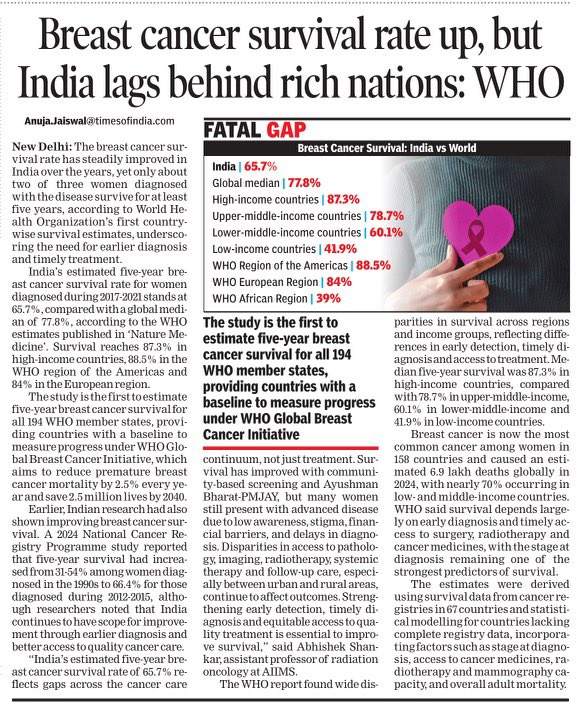
#Breastcancer#survival in #India has steadily improved over the years, yet only about two in three #women diagnosed with the disease survive for at least five years, according to the World Health Organization's first country-wise survival estimates, underscoring the need for earlier diagnosis and timely treatment.
India's estimated five-year breast cancer survival for women diagnosed during 2017-2021 stands at 65.7%, compared with a global median of 77.8%, according to the WHO estimates published in #NatureMedicine. Survival reaches 87.3% in high-income countries, 88.5% in the WHO Region of the Americas and 84% in the European Region, highlighting wide disparities in outcomes across regions and income groups. @timesofindia@WHO@ShankarAbhishek@aiims_newdelhi@MoHFW_INDIA
A FLIGHT THAT I WILL ALWAYS REMEMBER - a beautiful story (a slightly long read)!
Last week, on my flight from Delhi to Pune, I experienced a moment I’ll carry with me for the rest of my life.
I had just settled into my window seat when a little boy, no older than seven, stopped beside me, holding his father’s hand.
“Uncle… if it’s okay, can I please sit by the window?” Before I could answer, his father immediately said, “I’m so sorry, sir. Please don’t feel obliged. He’s been asking since we entered the airport. It’s completely alright if you’d like to keep your seat.”
I smiled. "It’s yours, champ.” His face lit up instantly. He rushed to the window, pressed his little hands against the glass for a few moments, smiled… and then, just a few minutes after take-off, rested his head on his father’s shoulder and quietly fell asleep.
He slept through almost the entire flight. About twenty minutes before landing, his father looked at me and smiled. "I guess he didn’t make much use of your window seat.”
“That’s alright,” I replied. “He must have been exhausted.”
There was a brief silence.
“He is,” his father said softly. “We’ve spent the last eight months in Delhi. He’s been undergoing treatment for severe aplastic anemia at Rajiv Gandhi Cancer Institute and Research Centre.
There were days we didn’t know if we’d ever make this journey home. Today is the first day the doctors felt he was well enough to travel.”
I looked at the little boy again. Only a few minutes earlier, I had seen a child asking for a window seat. Now I saw a little warrior who had spent months fighting for something infinitely more precious than a view above the clouds.
His father then asked me, “Do you know why he wanted the window seat so badly?” I shook my head. “He told me, ‘Papa, when we’re above the clouds, I’ll be a little closer to God… and I can say thank you for making me better.’”
I didn’t know what to say. I simply looked away and quietly wiped a tear from my eyes. As we walked towards the terminal, his father turned around, smiled and said, "Thank you. You made his day.”
The truth is he had made mine. That flight reminded me that we meet people for only a few moments, while they may have been carrying burdens for months or even years.
The impatient customer.
The distracted colleague.
The exhausted parent.
The quiet child asking for a window seat.
We see behaviour.
We rarely see the battle behind it.
Perhaps empathy doesn’t begin with grand gestures. Perhaps it begins with choosing compassion before judgment.
✅ Everyone you meet is carrying a story you cannot see.
✅ A small act of kindness can become someone else’s lifelong memory.
✅ Sometimes the most beautiful view isn’t from the window seat.
It’s the perspective that changes your heart.
Last week, I gave away my window seat. What I received in return was a lesson I’ll never forget. #lifelesson
Union Health Minister Sh. @JPNadda ji to lay the foundation stone of ICMR’s first dedicated Centre for High Altitude Medicine & Public Health Research at Keylong on 11 July—boosting climate-resilient healthcare across India’s Himalayan region🗻🗻🩺
https://t.co/rCcoaWwNyN