Emergency Medicine doc, forever POCUS fellow. Interested in Trauma & Resus. obsessed with Echocardiography. love Regional Anaesthesia. ex-Gamer.#FOAMed#POCUS
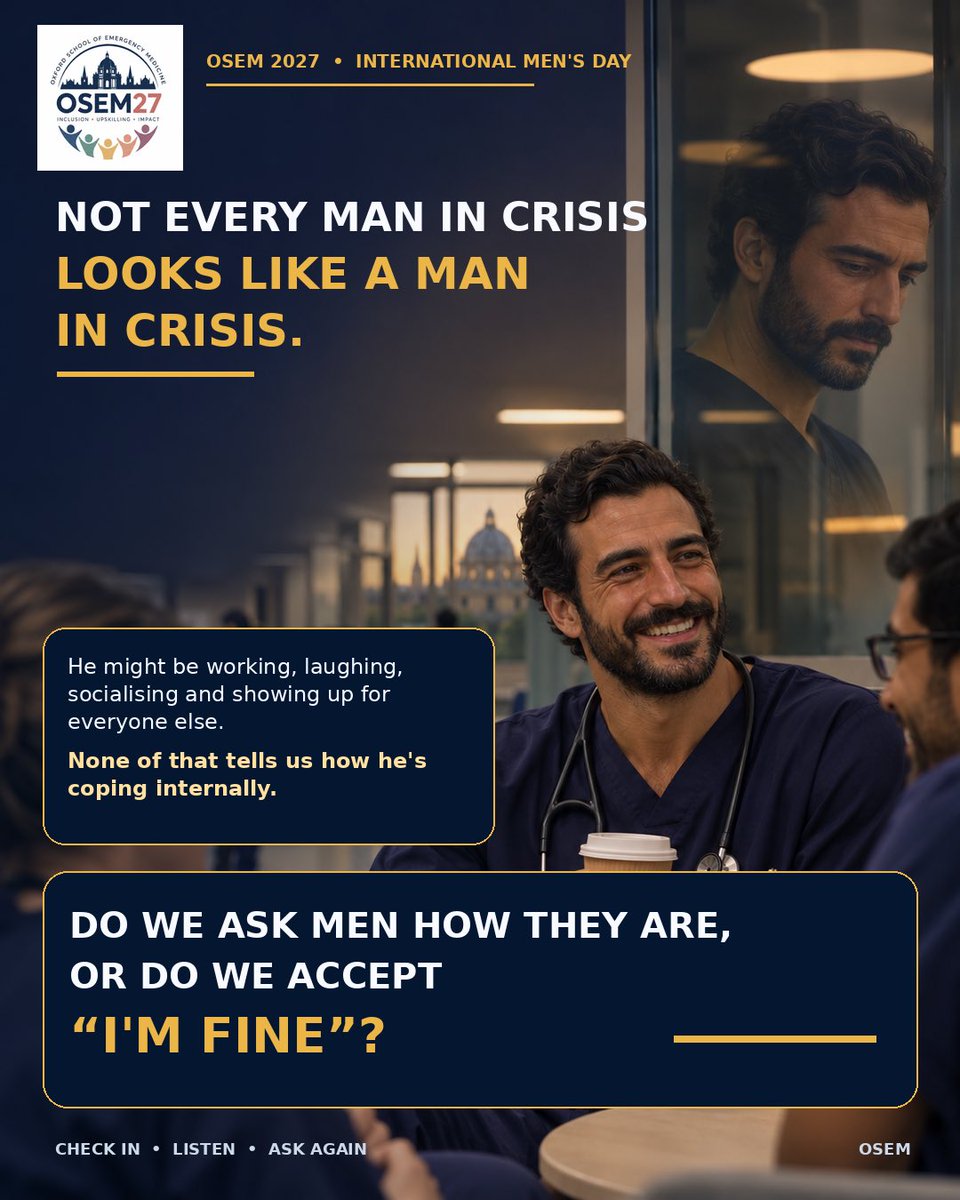
Not every man in crisis looks like a man in crisis.
This International Men’s Day, let’s look beyond “I’m fine” and check in on the colleague who always seems okay.
Ask. Listen. Ask again.
#InternationalMensDay#MensHealth#EmergencyMedicine#OSEM2027
🚨 Do you think PENG Block is truly MOTOR-SPARING? 🤔
Time to rethink!
Can PENG weaken the quadriceps despite being designed to spare motor function? 🦵
Pain relief ≠ preserved muscle strength!
Technique, volume & spread matter. 💉
#PENGBlock@DrRiteshRoy1@dragarwalgaurav
Infant intubation tips every resus team should know:
https://t.co/rOe9CcO3qV
Kids feature a lot at Resuscitation Wizardry:
Paediatric cases, and concepts that apply to every age
London, 7–8 December. Tickets still available:
https://t.co/ys0a9boFXh
Delighted to share the publication of our TETRiS study in Resuscitation, and proud to have contributed to this national collaboration.
Traumatic Emergency Thoracotomy for Resuscitation in Shock (TETRiS) prospectively examined resuscitative thoracotomy across 20 UK Helicopter Emergency Medical Services and 26 Major Trauma Centre Emergency Departments.
Among 116 patients, 71% underwent thoracotomy in the prehospital setting. Eight patients survived to hospital discharge.
For me, the most important message is that identifying the underlying cause and intervening within the window of reversibility are central to successful resuscitation.
Suspected cardiac tamponade prompted 62% of procedures, yet operative findings showed exsanguination alone in 71% of patients. Outcomes were more favourable in patients with isolated tamponade and those with residual physiological activity at intervention.
This distinction matters: tamponade and exsanguination demand different priorities. Our findings reinforce the importance of recognising the likely reversible cause and directing time-critical treatment accordingly.
The higher survival observed in the emergency department also needs careful interpretation. These patients had shorter arrest durations and more favourable physiology; the setting alone cannot explain the difference.
A particular strength of TETRiS is bringing prehospital and hospital data together, capturing patients whose outcomes may be missed by hospital-based registries.
Thank you to my fellow authors, Zane Perkins Lisa Ramage, Max Marsden Jared Wohlgemuth Mike Christian Harriet Tucker Ross Davenport TETRiS Collaborative, and the PHOTON, TERN and NaTRIC networks. A meaningful achievement made possible by collective effort across trauma care.
https://t.co/GtrOdCo1RH
#TETRiS #Resuscitation #Trauma #PrehospitalCare #EmergencyMedicine
@ZBPerkins@LisaRamage@MaxMarsden83@JWohlgemut@tucker_harriet
🚨 CALLING ALL EM INNOVATORS, RESEARCHERS & CHANGE-MAKERS! 🚨
💡 Got an idea worth sharing?
📊 Research you’re proud of?
🏥 A project that’s making a difference in EM?
OSEM27 wants to hear from YOU!
Abstract submissions are NOW OPEN!
Deadline: 26 February 2027
#MedEd#OSEM27
Hey y'all, it's the 10th day of #Blocktober26 -- hope you're enjoying your weekend! Today I want to talk about a common clinical scenario that can be tricky to manage...
When I started The Dependent Variable, one of my worries was that I might eventually run out of things I wanted to write about.
I now have the opposite problem.
Already outlined is an article exploring terms such as stressed volume, unstressed volume, compliance, capacitance, venous tone and mean systemic filling pressure.
They are closely related. They are often used almost interchangeably. But they are not the same thing.
Also mapped out is a six-part series on the way we often over-complicate haemodynamics by measuring or calculating ever more numbers:
ScvO₂. The CO₂ gap. P(v−a)CO₂ / C(a−v)O₂. Pulse pressure, diastolic shock index, PPV and SVV. Dynamic arterial elastance: Eadyn = PPV/SVV. Ees/Ea and ventriculo-arterial coupling.
For each of them, I want to start from zero (no prior knowledge assumed) work through what the number actually represents, where it comes from, what physiology sits underneath it, and whether it genuinely helps us make better clinical decisions.
The aim is to take you from novice to expert without making the subject unnecessarily complicated.
Lots more to come from https://t.co/zplblayyhn Stay tuned.
I built an interactive echocardiography tutorial with Claude Code.
Chapter 07: a 3D heart, the standard imaging views, the probe position, and simulated ultrasound video.
Dear cardiology fellows 🫀
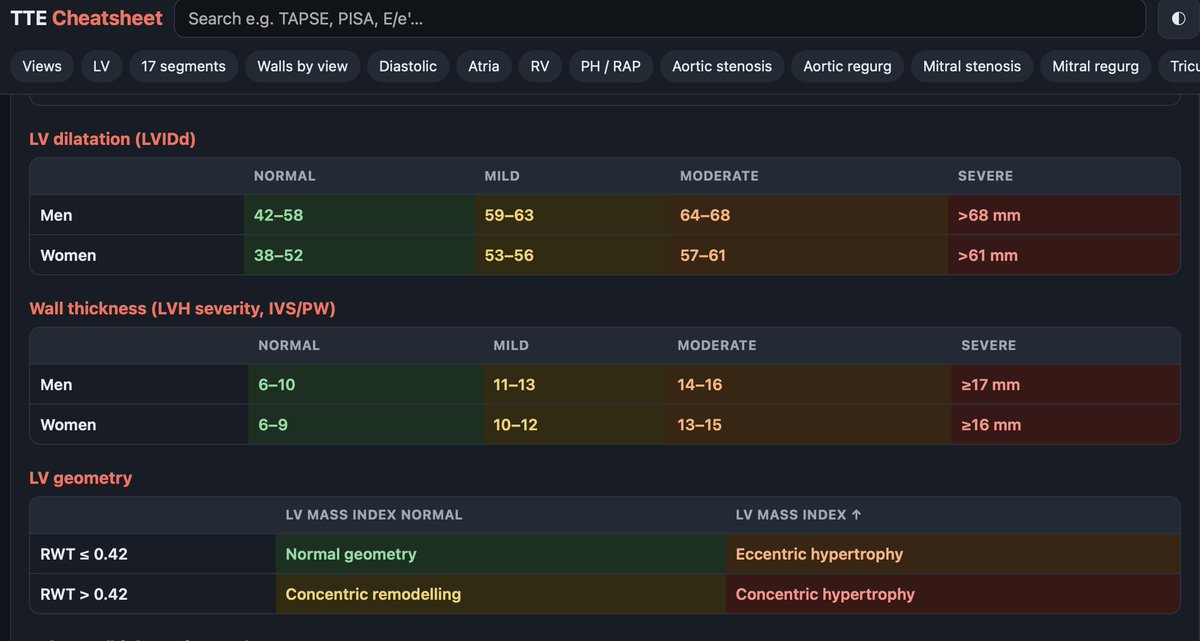
I built a free TTE cheatsheet with @claudeai I keep open while reading echos: guideline cutoffs, 17-segment walls by view, valve grading and 15 built-in calculators (AVA, SV/CO).
Check it out 👇
https://t.co/MZzWwYgeMe
#EchoFirst#CardioTwitter
I have decided to giveaway my USMLE Step 2/3 Anki for free for everyone
This helped me to score a 275 2 years ago
It’s a little bit big, but i’m sure it’s of very high quality
I wish you all success
https://t.co/BUseVUkiqh