Paper: https://t.co/KHAlJS5Yg3
Short answer, on real 2024 Irish market data: yes, but only with efficient hardware and a sensible dispatch strategy.
What we modelled: a 100 MW Irish wind farm, a miner from 0 to 90 MW, 2024 I-SEM hourly prices, two hardware generations (the old Antminer S9 and the more efficient S21 Hydro), six operating strategies, and a full six-year appraisal.
Irish births down 18% in a decade. Fertility at a record-low 1.5. Young people blame housing and the cost of living.
Everyone calls it a housing crisis. I think it's a money problem wearing a housing mask.
https://t.co/xM2662p5IO
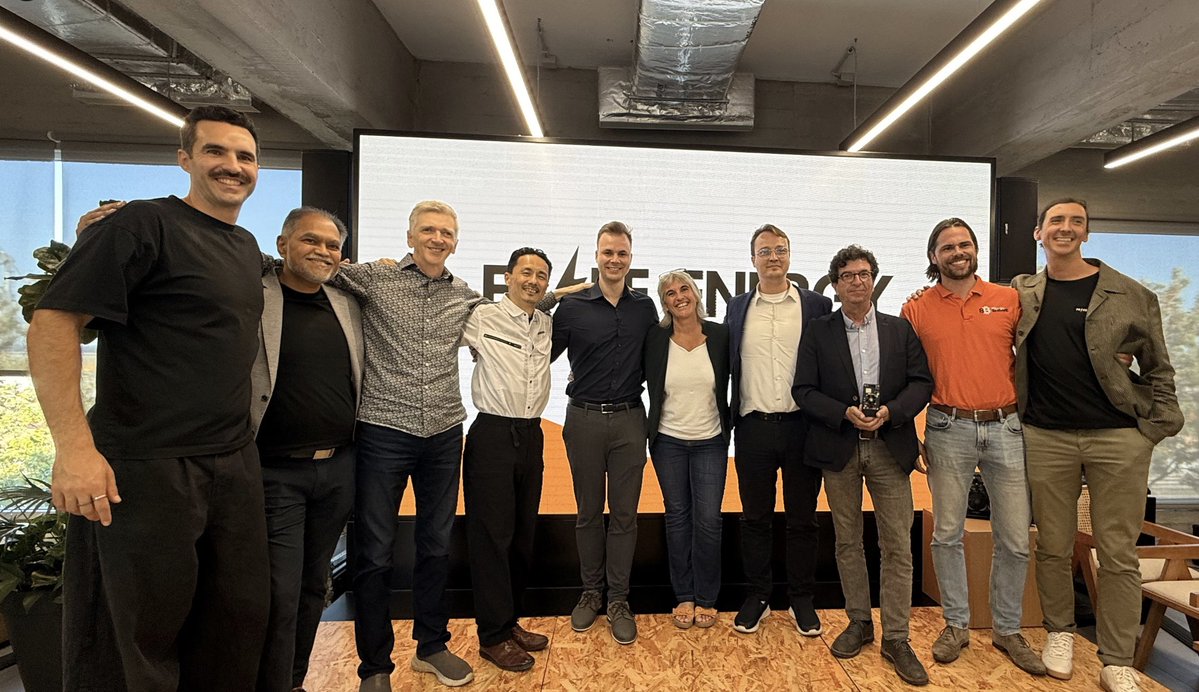
I just got back from the Bitcoin Energy Summit in Lisbon and I have a question that won't leave me alone.
First some context: Bitcoin mining is now stabilizing the grids of 7 nations, 4 agencies (including the Spanish Govt and the World's largest energy policy association) just called for more flexible demand being critical to the resilience of the grids of the future - and Bitcoin mining is the world's most flexible load resource by an order of magnitude.
So in light of this my question is this: why is 95% of the Bitcoin adoption conversation about Bitcoin-as-money when Bitcoin-as-energy is already deployed on grids across 3 continents?
Is it possible that energy is the Bitcoin usecase that paves the road for mainstream acceptance of Bitcoin in the West?
I've been in this space for four years now. When I started, the conversation was "bitcoin mining wastes energy." A group of Bitcoiners including @thetrocro, @jyn_urso and others changed that. Then it became "ok maybe it doesn't waste energy, but it's not useful." @gladstein, @jack and others changed that too.
But here's what I noticed in Lisbon. Three separate European organisations - the European Bitcoin Energy Association, Free Madeira, and the Institut National de Bitcoin in France - are all independently converging on the same conclusion.
@geyer_rachel, Chair of EBEA said energy is what will move the needle for Bitcoin in Europe. @andreloja at @FREEMadeiraOrg said energy is the most topical issue in Europe right now. Bastien Desteuque (@Proxy18387764), directeur général at @BitcoinPolicyFr said they're focusing on mining because France has spare nuclear capacity and that's where the biggest opportunity is.
Three organisations. Same conclusion.
And that's before you get to what's actually being built. In Sweden, a man I coach runs ASIC hardware that earns almost two-thirds of its revenue from frequency regulation - keeping the lights on, responding in seconds to the need of the grid operator, and helping to stabilize the grid an incredible 11,247 times last year alone. (Yes, you read that sentence right).
In Lisbon, I watched Kenji Tateiwa present a circular economy where bitcoin mining heat grows tropical fish and the CO2 gets converted to charcoal and micro diamonds. Bastian outlined how France's surplus nuclear energy could be absorbed by bitcoin mining by 2027.
And outside the West, from stabilizing the economy of Bhutan post-covid to helping save Virunga National Park in Africa - Bitcoin mining was behind both events and many more. This phenomenon is a global one.
The conversation has quietly moved from "does bitcoin mining help grids?" to "how many services can one machine provide?"
We've been thinking about this like monoculture - one machine, one function.
What I saw in Lisbon is permaculture. The same hardware doing frequency regulation, heat capture, Sats-minting ... and potentially in the near future - voltage regulation (something that would have prevented the 28 April 2025 Iberian Peninsular Blackout).
I talked to Bitcoin founders after the keynote who told me the energy thesis had opened their eyes. These are people who worked to advance Bitcoin payment infrastructure, and they hadn't fully grasped this.
Bitcoin solves a monetary problem the world is only beginning to understand. I'm more convinced of that than ever.
And ... as we wait for that revolution to be fully grasped, the energy revolution is already here - deployed, generating revenue, stabilizing grids. It might just be the thing that opens the door for everything else. What other Bitcoin use case is this far along ... at least in the West?
Our money is poisoning us
And nobody's talking about it
When your currency loses 7% a year, time horizons collapse
Farmers can't afford to build soil for 10 years
Food companies can't invest in quality ingredients
People can't cook from scratch working two jobs
So they optimize for survival:
Pesticides instead of crop rotation - 3x faster
Seed oils instead of tallow - 90% cheaper
Fast food instead of real food
Every shortcut makes economic sense when money dies slowly
The incentives flip
from
Nourish our bodies
to
Don't go bankrupt this quarter
Whether it’s a business or an individual
It's killing us
Society declines when we use money that declines
Fix the money, fix the food
Privacy, and our basic freedoms, are under attack from all sides.
Incredibly, the so-called 'liberal democracies' are now leading these attacks; arresting their own citizens for posting online, rolling out facial recognition cameras, and moving to ban VPNs.
"What can men do against such reckless hate?" And are we losing this battle?
Absolutely not. There's still time to fight back, and we have much in our arsenal. We at @bitcoinpolicyuk have put together a 'Privacy Toolkit', that should let anyone, whatever their skill level, take a few small steps towards improving their privacy and their freedom, and making themselves just a little bit harder for governments to track and to oppress.
This isn't comprehensive, and we'll continue to update it as time goes by. We hope it's useful to everyone and serves as a handy guide to help us all push back against government overreach, wherever we find it.
Link in the thread and comments welcome! 👇
BREAKING:
The Netherlands just told its citizens to go to hell.
61,000 signatures.
Parliament reviewed it.
And kept it anyway.
You don't have to sell anything.
You don't have to make a single euro.
You just have to own assets while they go up.
And the government will send you a bill.
Every. Single. Year.
No cash? Doesn't matter. Pay up.
Asset crashed after you paid? Too bad.
This is not a tax system.
This is state-sanctioned theft with a bureaucratic stamp on it.
Every other country is trying to attract crypto wealth.
- Luxembourg buying Bitcoin.
- The U.S. protecting crypto legislation.
- UAE building crypto banks.
And the Netherlands?
Taxing you for having the audacity to invest.
The most financially repressive tax in modern Dutch history. And they chose it deliberately.
Because your money is more useful to them than it is to you.
Jamie Dimon is on television praising "blockchain technology" and "permissioned ledgers."
The chyron underneath is announcing JPMorgan's new stablecoin.
Let me translate what's actually happening.
A "permissioned blockchain" is a mathematical oxymoron. Satoshi didn't build the timechain so Jamie Dimon could make legacy banking slightly more efficient. A blockchain without proof of work and decentralized consensus isn't a technological breakthrough. It's an overpriced Excel spreadsheet on a server in Manhattan.
When Dimon says "permissioned," he means JPMorgan holds the master key. They decide who runs a node. They decide whose transactions get processed. They decide whose wealth gets frozen.
Same legacy friction. New buzzwords.
The stablecoin is worse.
A JPMorgan stablecoin is programmable fiat. Still backed by parabolic government debt. Still losing purchasing power to inflation every year. The only difference: they don't need to call a branch manager to freeze your account anymore. They execute a smart contract and lock your savings at the speed of light.
They took the melting ice cube of fiat and added a digital surveillance layer. Then called it innovation.
Here's what they actually understand: they can't control Bitcoin. So they're trying to extract the database architecture, strip out the decentralization, and sell you the cage with better branding.
They don't get that the database is meaningless. The innovation is the proof of work. The innovation is a global ledger that requires no military, no central bank, and no CEO to enforce its rules.
Wall Street has entered the bargaining phase.
Don't bargain with them. Hold absolute scarcity.
If this gets 100 reposts, I’ll give someone this @TinyChipHub Bitcoin miner for free.
Also, the ‘karpuz’ code gets you ten percent off TCH devices this month.
https://t.co/oIJVMUnSkg Do with that information what you will. 🍉