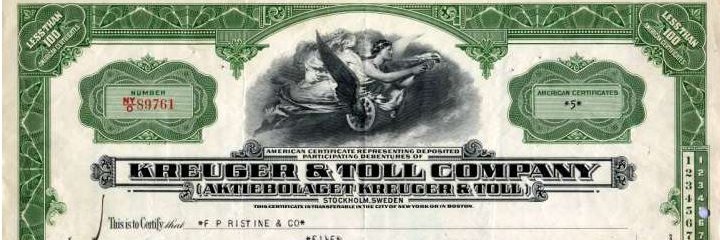
"Derivatives, are financial weapons of mass destruction, carrying dangers that, while now latent, are potentially lethal”-W Buffett; tweets are not fincl advice
Happy Saturday.
I am basically on Twitter to be an advocate for the Average Joe who doesn't have much to invest.
Though the fourth estate may disagree, I try not to be ad hominem (but it is hard at times!) and typically make my respectful case by linking to archived segments in which investment and trading boners are clear as day.
I recognize my own weakness and often cite that I am often wrong and always in doubt. But I take ownership for my mistakes in a real time blog on @thestreetpro where I have been writing a diary of over 7500 words a day for 29 years!
My advocacy roots started as a "Nader Raider" when I coauthored a book with Ralph Nader on the banking industry when I was 22 years old.
My strong relationship with Barrons' Alan Abelson, a true cynic, blossomed - he featured me in over 40 interviews in his Up and Down Wall Street column. I went on to write four editorials for the "Other Voices" column of Barrons (my fourth is out today!). That relationship, too, led me to be an advocate for the small investor.
It didn't hurt that Grandma Koufax (a successful business woman and investor), who didnt trust the business media, taught me how to invest when I was 16 years old.
I am here to protect you from the smug charlatans (I know that is extreme but it is true in too many cases) on Fin TV who have no investment process/rigor/risk management, do not take timestamp their recommendations, take no ownership for repeated investment boners and who polish their images on @cnbc and elsewhere at your expense.
There are some contributors, panelists (Karen, Rob S) , guests (Dan Niles) and FinTV hosts/reporters that I admire (like Dan, Santoli, Faber, Carl (Q) -- but their ranks are dwindling as producers grow lazy in their programming (preferring status quo to value added).
I am here to protect you from the Fin TV hosts and reporters who conduct non value-added and superficial interviews with company managements - throwing soft balls in order to protect their access at the expense of the small investor. (I always cite Kate Rooney's @cnbc interview with Sam Bankman Fraud (FTX) one month before the company and he were indicted for fraud. Or the constant interviews with @CathieDWood $ARKK who has lost more capital (over $12 billion in any actively managed ETF in history). Or $MSTR Saylor or $BMNR @fundstrat Tom Lee and the peacock known Dan Ives @DivesTech. Or even the unquestioning Jensen Huang interviews.
I am here to highlight ever bullish technical analysts whose methodology (cherry picking of stats, poor sampling, etc.) stretch technical reality.
I highlight lazy moderators who are entrenched on Fin TV and do no homework (or default to political dogma @joesquawk) as well as producers who, too , have become lazy in their formulaic programming.
I am a contrarian who doesn't believe in Perma anything - but the business media is dotted primarily with perma bulls who do no analysis or modelling, preferring to view the investment prism from the rear view mirror:
"Investment vision is always 20/20 when viewed thru the rear view mirror".
Most have never met a market they didn't like.
Most shows and panelists and guests fail to prepare the Average investor for the inevitable fall (as we are experiencing now) and are exposed for swimming naked when the tide goes out.
The ocean of naked swimmers was very crowded this week....
@SquawkCNBC@CNBCFastMoney@HalftimeReport@KeithMcCullough@Hedgeye_HGRO@RPKInvestor@HedgeyeDJ@andrewrsorkin@saraeisen@SullyCNBC@carlquintanilla@TheJudgeCNBC@guyadami@peterboockvar@convertbond@jimcramer@whitneytilson@tomkeene@annmarie@lisaabramowicz1@ferrotv@business@beckyquick
Banks earn (outsized) underwriting fees => banks carry ZERO downside if the IPO fails => sell-side research is paid to be (structurally) bullish on cash-incinerating issuers => US regulators are (functionally) captured => a company selling "unicorn tears" could list.
A quick thought on the markets.
A lot of people are asking why everything is falling at once: stocks, commodities, crypto, even gold. It seems like what's causing this is the dollar.
The dollar has gone up very quickly, and when that happens it pulls money out of everything else. A huge amount of the world's debt is owed in dollars. When the dollar rises, that debt gets harder to pay, so the people who owe it need cash. The fastest way to get cash is to sell something.
That would explain why the selling looks so indiscriminate. I doubt investors decided copper, tech stocks and gold were all bad ideas in the same week. More likely they're selling whatever they can get a price for. In that kind of market, what something is worth matters less than how fast you can sell it.
Leverage seems to be making it worse. U.S. margin debt is around $1.45 trillion, about 58% of all U.S. currency in circulation and 6.2% of M2. Leverage won't tell you when a selloff starts, but it tells you a lot about how bad it can get. Someone who bought stocks with borrowed money can't sit through a drop. Once prices fall far enough, the broker sells for them, which pushes prices lower and sets off the next round.
Gold is the part that confuses people, since it's supposed to be the safe place. My guess is it's being sold because it's liquid and had held up. If you get a margin call, you sell what has a bid, and that's often the thing you'd most like to keep.
If this read is right, the selling probably doesn't stop just because things get cheap. It stops when the dollar stops rising, or when something breaks badly enough that the Fed steps in. The government carries so much debt that it more or less needs rates below inflation, and a long dollar squeeze works against that. If the Fed cuts and adds liquidity, real rates go negative again, which has historically been very good for gold. It fell about 30% in 2008, then went from roughly $700 to $1,900 over the next three years.
So the squeeze hitting gold now could be what sets up its next run. I could be wrong on the timing, but this seems to make the most sense at present.
It's only Friday night and the weekend crypto crash is already underway. Bitcoin is trading below $56,000 and Ethereum is trading below $1,550. It's going to be a long weekend for HODLers, especially those holding ETFs who can't sell until Monday morning after the market opens.
JUST IN: Trump threatens a “tremendous tax” on companies building data centers abroad and admits he had not told his own team
“We’re not going to allow our companies to build data centers outside of our country. We’re not going to allow that to happen.
“You know, they allowed that to happen with chips and everything else, and it was very destructive to our country. That’s where we started going behind.
“I don’t know if that’s a breaking story, but I haven’t even said that to my people. But I’m telling them now. They’re here. Many of them are here.
“We’re not going to allow companies to build data centers in other countries. If they do that, they can. But we’re going to put a tremendous tax on them if they do it.”
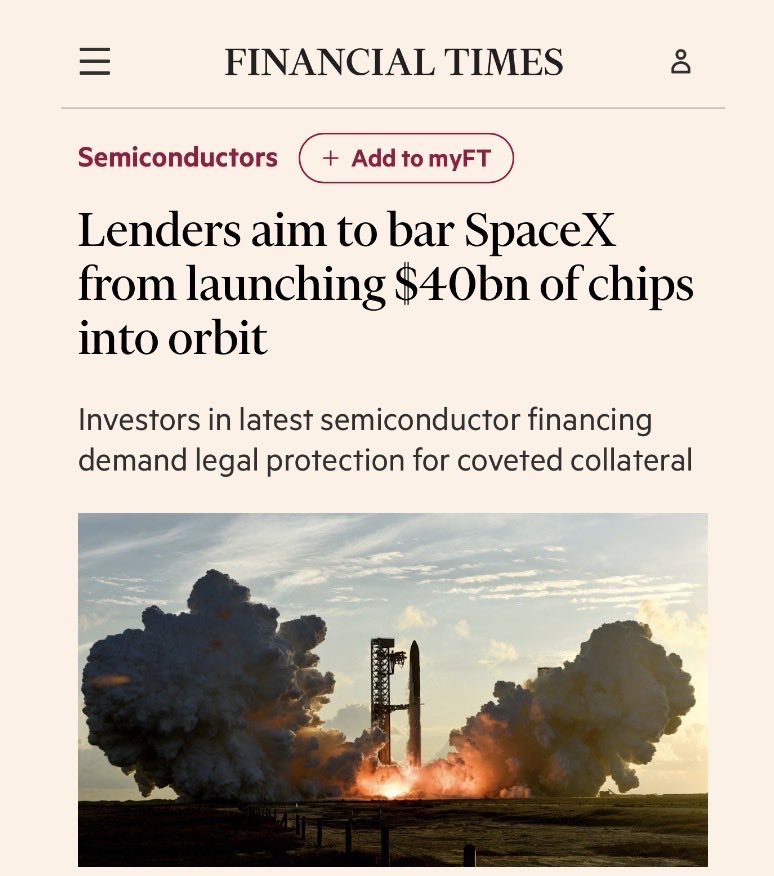
$SPCX’s own lenders just asked for a clause keeping their GPUs on Earth. Hilarious.
The bull thesis is data centers in space. The mass kills it: 1 GW is ~13,300 tonnes, or ~133 Starship flights at 7x+ the launch cost where the math works, on a rocket that has flown 15 times ever.
The lenders are happy to let that story pump the stock. But put THEIR collateral on the rocket? A step TOO FAR.
Sell the dream to shareholders. Just don’t launch my money. cc: @carlquintanilla
An AI fire suppression system at a China's Hebei ski resort doused a food booth sign covered in flame graphics.
The AI system reportedly mistook the artwork for real fire.
Officials blamed heat from a charcoal stove behind it.
And, again, respectfully, your own screenshot says “Total RADIATOR Mass.” That’s the cooling panels, not the satellite. SpaceX’s own Starmind page: 75 kW/ton = ~13,300 tonnes per GW = ~133 Starship flights. Starship has flown 15 times EVER. Your $20M/launch is a “target.” Hope = not a track.
Correct. Space isn't cold, it's a vacuum, & a vacuum is a thermos. Every watt a GPU burns can only leave as infrared glow, so 1 GW needs about a sq km of radiators. Add radiation-fried chips + zero repairs, & the cost = 3x earth’s. Physics allows it. The economics don't. $SPCX
@Jespabe That’s the radiators alone. Read your own screenshot: “Total Radiator Mass.” SpaceX’s Starmind page says 75 kW per ton for the whole satellite. That’s ~13,300 tonnes per GW on their numbers, before anyone else’s (and Musk has a history of getting a lot of numbers wrong).
"Bad takes"? Fine. Run the experiment. Give $TSLA a board that does its job, the kind $NVDA has, and tell me where the stock trades.
Funding secured. The SEC contempt motion. The 2018 pay package. A decade of self-driving promises. The Paint It Black video. SolarCity. Project 42. The drug use reports. Racism at Fremont. The inauguration nazi salute. Trump, DOGE, Europe. Nearly half a billion on the 2026 midterms. I'm leaving things out.
Any one of these gets a normal CEO a call from the lead director. @elonmusk has never gotten the call. Not from his board, not from Washington.
Bulls and bears ought to agree on this much: that immunity is a big reason people own $TSLA and $SPCX. He can say or do whatever moves the stock and nothing happens to him. That's the trade.
The trade now has an expiration date. The new Congress shows up January 3, and subpoenas cost a lot less than midterm donations.
Then there are the financials, which nobody seems to want to discuss (see attached), for company trading at 494x 2026E EPS vs. 27x for the "Mag 6".
Icarus had a good run too.
@Jespabe Respectfully, "on the right track" is carrying A LOT OF WEIGHT here. 1 GW in orbit = ~20,000 tonnes = ~200 Starship flights. The world attempted 324 launches in 2025. Parity needs ~$200/kg vs ~$1,500 today. Starship first reached orbit JUST in Sep. That's a hope, not a track.
@Jespabe Fair: 0.5 km² works if the radiators run ~90°C; near room temp it's ~1 km². Area isn't the problem, mass is. Launch cost is the big variable, agreed, but full reuse isn't proven at cadence yet. That's why I said physics allows it and the economics don't.
“.. lenders have expressed concerns that if the group later decided to shoot the valuable chips that underpin their loans into space, it would prevent them from reclaiming and selling the semiconductors in the event of a default ..”
@FT $SPCX
https://t.co/BDhUJbAYQo
$ANT - JAPAN’S NIKKEI PLUNGES NEARLY 5% AS ANTHROPIC IPO FAILS TO REVIVE AI CONFIDENCE
Japan’s Nikkei plunged as much as 4.85%, hitting a seven-month low, as technology stocks suffered heavy selling.
🔸 SoftBank Group: -14.4%
🔸 Kioxia: -11.62%
🔸 Advantest: -10.15%
🔸 Tokyo Electron: -6.07%
Anthropic opened 34% above its $83 IPO price but closed at $97.17, trimming gains to 17%.
The fading rally disappointed investors hoping the blockbuster listing would revive confidence in AI stocks.
Approximately 90% of Tokyo’s prime-market stocks declined, highlighting broad risk aversion.