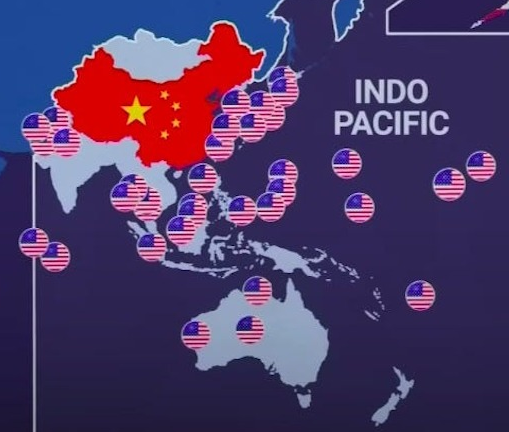
@OopsGuess "Australia says China is carrying out 'the biggest conventional military buildup since World War II.' "
Context: U.S. military bases around China.
@Natie2Natie That time the BBC specifically grayed the trees in a picture, which they sneakily replaced with the original after this was pointed out: https://t.co/V1ehaMjsPq
@max77sabers There are new APIs in MV3 which make some content blocking capabilities more reliable; the purpose of uBO Lite is to tap into these new APIs by adopting a fully declarative approach with reliability and efficiency being the main goal https://t.co/fGCkfHg8hG
With uBO Lite 2026.628.2035, new tabs to deepseek site would automatically close. Sorry about this, no harm intended. Fixed in 2026.711.25 (pending review in extensions stores) https://t.co/lSeTnvietN Meanwhile, workaround is to set filtering mode to "basic" for the site.
In retrospect, I should have published a new release with the fix sooner given it's a high traffic site. My bad, I didn't assess properly the severity.
A new version of uBOL (2026.422.1301) has been published to fix a regression from last version, which could cause pre-existing custom cosmetic filters to stop working. Sorry about this.
https://t.co/MsY8LS5r3y
https://t.co/wOm3HsYkoi
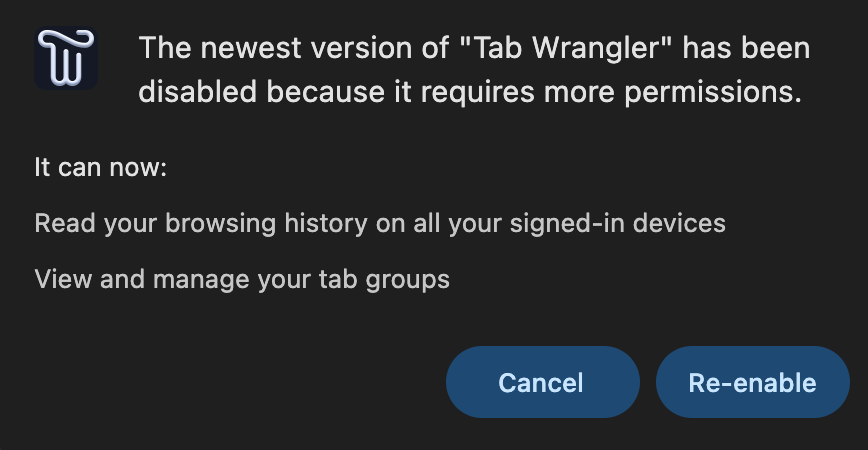
Minor correction: "Read your browsing history *on all your signed-in devices*" is the result of the asking permission for both the "tabs" and "sessions" APIs together. Usage of "sessions" API was added more than 8 years ago (so still not new): https://t.co/yUroBrG0ED
A silly overreaction. Granted, it doesn't help that the browser does not report which exact permission(s) was added. There is no evidence the extension was sold. The project is developed in the public eye and there are no such announcement: https://t.co/bHiaFh7uZi
Another Chrome extension allegedly sold to mine your personal information
This is an entire black market you'd have no idea existed but it does!
Your best bet is to use no Chrome extensions at all, except uBlock Origin for ad block
Or better: just vibe code your own so you know what is running in your browser
"Read your browsing history on all your signed-in devices" is not new, and a result of requiring the "tabs" permission. You were already warned about it when you installed the extension. It was always there: 17 years ago in the first commit of the project https://t.co/nfx8E5UVdz
@nxt888 > "The logic of Phoenix, identify, isolate, eliminate civilian support networks, was used in Iraq. In Afghanistan. In other places ..."
Latin America: https://t.co/pT1GRNc4wW
@RnaudBertrand John Pilger made an excellent documentary about the complicity of journalists in manufacturing consent for war—everybody should take the time to watch it: “The War You Don’t See”, https://t.co/wD32Z9vi3Y 2010 but still very relevant.
In 2026, the financial siege that strangled Cuba for more than six decades became a military one.
Five oil tankers seized in a single month. 7.3 million barrels confiscated. One of the tankers was not even under sanctions.
The largest naval deployment in the Caribbean since 1962. US drones surveilling Mexican tanker routes. An executive order threatening tariffs on any country on earth that sells Cuba a single barrel of oil.
Mexico, facing $400 billion in trade exposure to the US, stopped shipments. Venezuela's supply was destroyed by force. No alternative supplier was willing to risk retaliation or seizures.
20-hour daily blackouts. Hospitals on generators running out of diesel. Families cooking with wood.
The Secretary of State testified to Congress that regime change is the objective. The President said: "I think it's just going to fall."
But the siege did not begin in 2026. It began decades ago, and it was never unilateral.
187 nations vote to condemn the US embargo on Cuba every year. 33 consecutive years. The most lopsided vote in UN history.
And every year, every country that votes against it lets its banks enforce it anyway.
The reason is structural.
88% of all global foreign exchange transactions touch the US dollar. 95% of cross-border dollar payments clear through 42 American banks. One country controls the pipes through which the world's money moves.
That is all it takes.
Any foreign bank that processes a Cuba-related payment faces ruin.
BNP Paribas was fined $8.9 billion.
Société Générale, $1.34 billion.
HSBC, $1.9 billion.
Standard Chartered, $1.1 billion.
ING, $619 million.
$13.5 billion in penalties against foreign banks from countries that formally oppose the embargo.
The lesson was received. Most foreign banks now refuse all Cuba operations.
Several countries passed laws making it illegal for their own companies to comply with the US embargo.
Total enforcement of those laws over 30 years: one fine. $15,000. Against a hotel in Mexico City.
The votes against the blockade are symbolic. The fines are real.
And the machinery does not stop at banking.
A US private equity firm buys a Dutch software company. 23 years of Cuban contracts, severed in a week.
A US corporation acquires two Swiss ventilator manufacturers. Deliveries to Cuba stop overnight.
An American cargo company refuses to deliver Jack Ma's donated medical supplies to Cuba. It was the only country in Latin America that did not receive them.
PayPal blocks any transaction containing the word "Cuba." Including orders for a cocktail recipe book.
Cuba does not lose these suppliers to politics.
It loses them to mergers, algorithms, and compliance departments that would rather cut off an entire country than risk a phone call from OFAC.
The result:
35 children on a pediatric ward vomiting 28 to 30 times a day because the anti-nausea drug essential for chemotherapy cannot be sourced from anywhere on earth.
An 89-year-old woman implanted with a pacemaker recycled from a dead patient, two years of battery life, because no manufacturer will sell to Cuba.
69% of necessary medicines unavailable.
Infant mortality rising for the first time in decades.
When one nation controls the infrastructure through which the world trades, and weaponizes that control to deny an island of 11 million people fuel, medicine, food, pacemakers, ventilators, software, insurance, shipping, and banking for more than six decades, while every other nation on earth formally objects and none enforces its objection, the word for that is SIEGE.
The longest siege in modern history.
Condemned annually. Enforced permanently.
"malicious browser extension called NexShield that impersonates the legitimate uBlock Origin Lite ad blocker [...] Ironically, the victim was searching for an ad blocker when they encountered a malicious advertisement"
https://t.co/HJ1pmUD1Sl
All browsers can limit on which sites an extension can read/change data, they all offer "deny by default/allow on specific sites". r/n Safari does it best as it also offers "allow by default/deny on specific sites", a better approach for a content blocker.
https://t.co/eTvXJOqE8r
To be clear, "Read and change all your data on all websites" also exists with MV3. Installing one of top MV3-compliant content blockers currently in the Chrome Web Store still warn about this, as seen in pictures below.
Everyone keeps saying uBlock Origin ‘saved the internet’ but we casually gave it permission to read and change everything we do in the browser, logins, cookies, banking, crypto, all of it. If that code ever gets sold, hacked or pushed a bad update, your ‘ad blocker’ instantly becomes a perfect spyware plug‑in sitting on every site you open.
Chrome removing it isn’t just about ads, it’s also because these old‑style extensions had too much power under the old Manifest V2 system, so they’re being disabled as “not following best practices” on Chrome as well.
Use browsers with built‑in blockers like Brave/Vivaldi, or go one level up with Pi‑hole, AdGuard Home, or NextDNS so ads get blocked before they even reach your browser.
@AlexRoseGames @iseawhy @Yuya_2026@hetmehtaa The whole thread here is about Chrome Web Store extensions going rogue after changing hands. uBO in Chrome Web Store never changed hands. Stating that this happened to uBO is incorrect.