If you want the agent to code more like you, don’t just keep correcting it in chat.
Give it:
a short coding-style file
a few examples of code you consider “good”
explicit “avoid this” patterns
lint/format/type rules
tests or validation that catch recurring style violations
Over time, turn repeated review comments into repository rules. That gets much closer to “your style” than vague prompts like “write clean code.”
@adrianhqs Hot take: most engineers look at the code of an another and they see slop. There is a strange tendency for all of us, I believe, where we see our own coding as better than it actually is. By the way, you can train the agent to code close to your own preferred style.
@themishra4402 If you're a true software engineer I don't think it's called vibe coding. Isn't it called Agentic Engineering? Although, I guess you could be vibing if you're just throwing together a prototype.
@DakotaSteve@S___Elliott And as far as the trade deficit is concerned, that deficit is the oil you buy at a greatly reduced price resistive to the market price .
Here are 4 recently reused lies that you Trumptards repeat and clearly believe.
1. “They were charging our farmers 400% tariffs.”
Trump repeated this in mid-September 2026 while saying a deal could come “fairly soon” if Canada dropped those duties. Canada’s supply-management system does impose very high over-quota tariffs on dairy, poultry, and eggs once a small duty-free quota is filled (often in the 200–300%+ range). The large majority of U.S. agricultural exports to Canada face no tariffs at all, and Canada is consistently one of the top two foreign markets for U.S. farm products. Calling the system a blanket 400% tax on “our farmers” is not accurate.
2. The United States has been “ripped off for 50 years” and runs a huge deficit ($90 billion in one recent version).
Trump used this framing again in September 2026. Official U.S. Census/USTR figures for 2025 put the goods-and-services deficit with Canada at roughly $27 billion (a $55 billion goods deficit offset by a U.S. services surplus). That is a small share of the ~$900 billion two-way relationship. Earlier versions of the same claim used $200 billion; the number has shifted without matching the data.
3. “They do 95% of their business with us… we do very little with them.” / “We don’t need their product.”
Canada sent about 72% of its merchandise exports to the U.S. in 2025 (down from prior years), not 95%. The U.S. is Canada’s dominant market, but Canada is also one of America’s largest export destinations. Integrated auto, energy, and parts supply chains run both directions.
4. Canada’s unemployment rate “is now at 10% and rapidly rising.”
Posted in late August 2026. Statistics Canada’s July 2026 rate was 6.4% and had been falling, not rising. Using U.S. methodology the figure is even lower.
Older but still-repeated claims that fact-checkers have flagged in 2025–2026 include treating Canadian-border fentanyl as “massive” (northern-border seizures are ~0.2% of U.S. totals; the overwhelming majority comes via Mexico) and asserting that Canadians broadly want to become the 51st state (polls show large majorities oppose it).
@JasonEslerWho@adrianhqs Yes, but it would give me 80 hours with Sol
and Terra, and 25 hours with Astra. However when the next model comes out, and if model inflation continues, I guess I'll be back to the 20 hours again if this inflation pattern continue. Ha ha!
@JasonEslerWho@adrianhqs No I'm old school. I don't need fancy tech to do this. It's an old windows laptop with a broken hinge. I'm squeezing the last bit of life out of it with an external monitor. However when I do ultimately replace this, I will definitely indulge! :) :)
Yes, but this is part of the model inflation I'm talking about that is not tracking with the subscriptions. The 5X plan used to allow me to work for 50 hours in a week. Now, I'm lucky to get 20 hours. Earlier models (pre-5.5) are no longer available in codex, and therefore the subscriptions available are gradually loosing their usefulness .
@Gaus450 The demands of the advancing models exceed the capacity of the available subscriptions. I think they need to completely rethink their subscription structure.
@fullythankful@John_Beckham14 ???? I'm making a statement about a populations of supporters who are believing bold faced lies from their leader and appear incapable of identifying these lies.
@fullythankful@John_Beckham14 That's a highly ironic statement. There has been no fair trade since Trump took office - only a bully who is successfully selling lies to his entire support base in the USA, because they lack the critical thinking and intelligence to recognize the lies.
@SherryYanJiang Yes, me too, but .... SOL consumption has worsened. My Terra/Sol X High (Code/Review) used to cost 2.8%/hour. It now costs over 4% on the 5X pro subscription.
Good job! This is exactly what I was posting about this morning. I see so many negative comments about vibe coders on X, and it really annoys me. You are a classic example of why it annoys me. Your vibecoding experience was the so-called: "hello world!" - the first application most of us wrote before AI ever existed. And now you're correctly going out there and getting yourself properly educated. Bravo!
@ClassicGamerTWR@gdesouza Having said that, I wonder what I would say if I were fighting with a code base of 1 million lines as another user just noted.
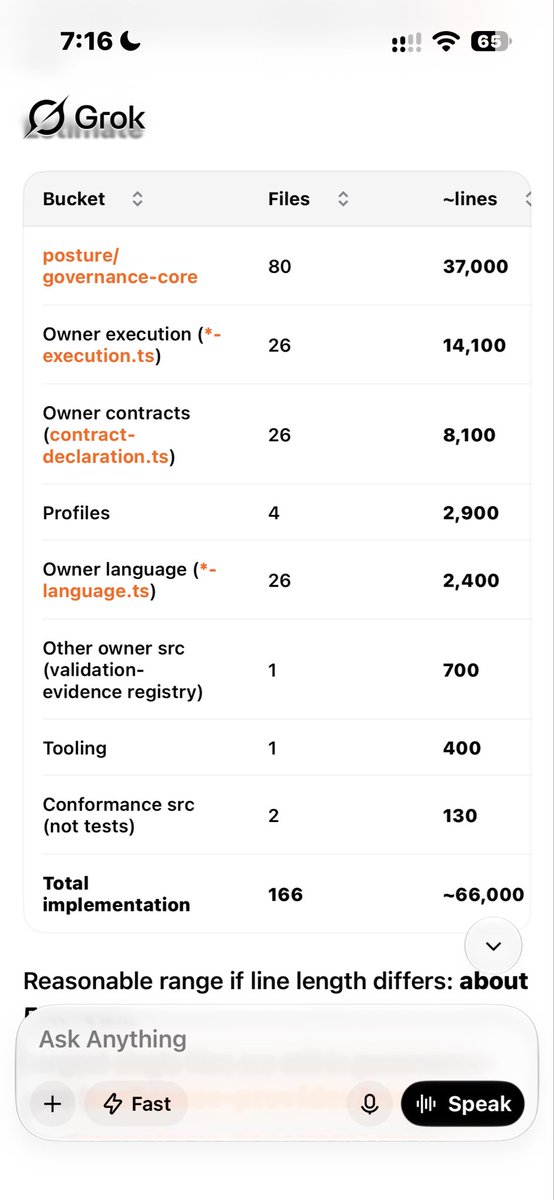
Interesting, I'm at the end of my session limit on Codex, but I had Grok estimate the total number of lines of code in my application. I've been working on it entirely myself, and I've only built the core. This is just the governed core that I have built right up to the point just before technology specific adaptors are created. I have not yet run into difficulty of complexity as you are describing, but I am maintaining a very strict system of documentation control , indexing every single document and code file, so that the AI agent knows exactly where to look for each task. Again, I would argue that this issue of complexity boils down to how well you have actually organized the code and organized the documentation associated with that code.
I think the expression "learn to code" has also changed. At least for now, I think you still need to be able to recognize systems and architecture. You need to be able to organize the parts of your project in such a way that the agent can read it efficiently. This is what "learn to code" has become. Designing your project is no longer about human readability and is more about agent readability. If you design it with that in mind, a simple request to that agent allows the human to understand.