I recommended Descript for a podcast intro today and @theaaron corrected me.
The problem wasn’t really the tool. I was asking one AI editor to handle three different layers: A-roll, motion/animation, and sound design.
That correction was useful.
Sometimes “which AI should I use?” is the wrong question. First figure out which part of the job you’re actually trying to solve.
@codeslubber@claudeai That “Clearly. Ok.” after doing something nobody asked for is painfully familiar 😂 The scary part is how reasonable the extra work can look until you realize the plan moved.
@Vorioo $10 lasting a week vs $200 lasting a day and a half is brutal 😂 Was DeepSeek actually good enough for the whole YouTube workflow, or were there still parts you had to send back to Astra?
@theaaron@ryan_doser13@HyperFrames_@Remotion I was basically asking one AI editor to solve three different jobs 😆 A-roll, motion, and sound really need to be treated as separate layers. Appreciate you breaking it down.
You know the moment: AI starts with your plan, then halfway through it’s building something completely different.
The worst part is you usually notice after the work is already done.
That’s why I built Plan-to-Proof. It keeps the vision, instructions, visuals and quality bar anchored while Codex builds and checks that it’s still building the right thing before calling it done.
@theaaron@ryan_doser13 That makes sense. I was probably asking Underlord to solve the wrong layer. If the hard part is the motion + sound design, what would you actually put behind the A-roll edit?
Before an AI agent starts a big task, ask:
“Walk me through what I’ll be able to do when this is finished, how you’ll test it, and what you still need from me.”
I’d rather catch a misunderstanding here than after the build.
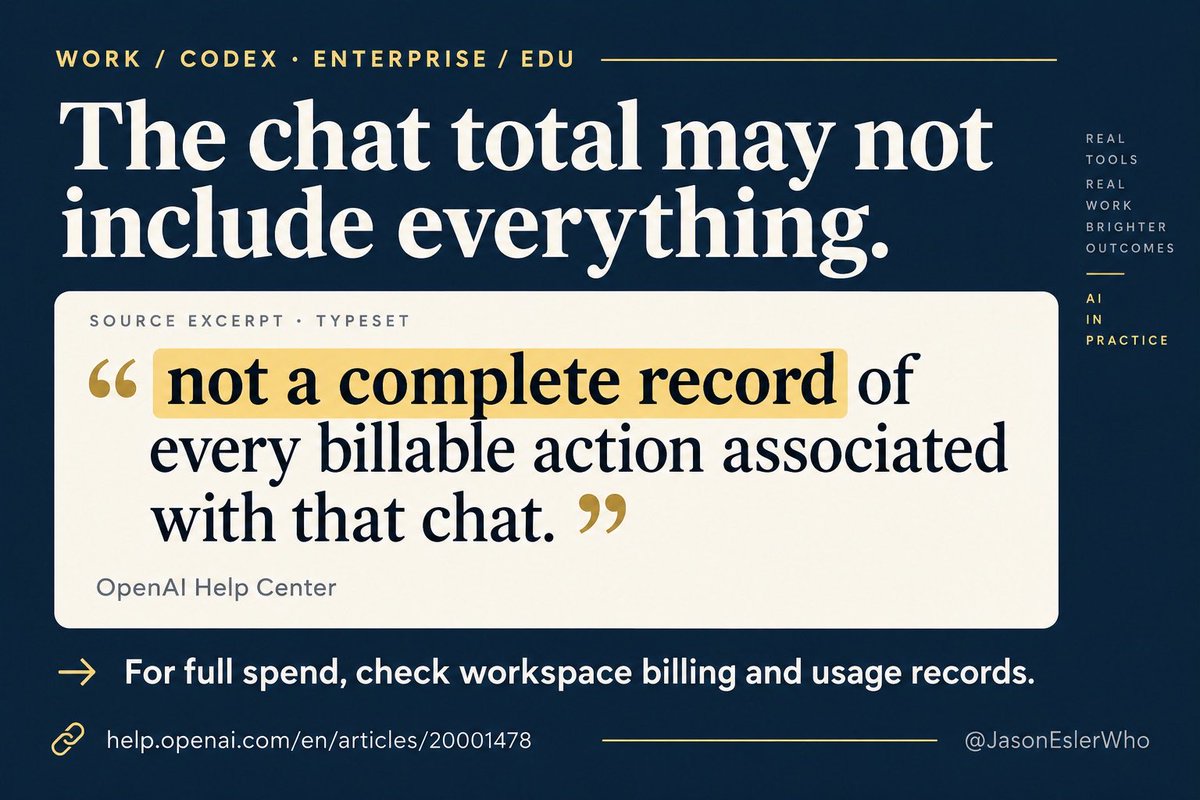
A Codex chat’s total can leave out work that still counts toward your limit.
OpenAI’s Enterprise/Edu docs list subagents, separate tasks and background work.
If it counts against my limit, I want to see where it went.
https://t.co/JndHQvegzN
@trevin@typesafeai I could see this sorting incoming requests into “answer,” “ask a follow-up,” or “pass to a person” before another model writes the response.
@ItsVictoriabel I’d ask the second model to point out problems before rewriting anything. Then I can decide whether it found an actual issue or just prefers different wording.
@HelloVyom How much did the game change once you had a playable version? I’m curious what you discovered by playing it that wasn’t in the original brief.
@steveweed_@OpenAI Is it doing that in brand-new chats too, or mainly after a long session? That would help narrow down whether you’re seeing a broader change or something about the conversation.
@AIWithPrince@PrismML How much memory would you budget for a useful coding session, then? The model fitting is encouraging, but I’d want room for the repo context and everything else running too.
@AgentRandom_ I’d start with the kill switch and one small task I can rerun. With only a week left, I’d want to know whether more tokens actually buy progress.