"The end of obedience is protection".....Ansar Allah or the Houthis represent a far greater risk to the political order of the Gulf and the military order in the Horn of Africa than is widely appreciated https://t.co/Zd2oNWEGAm
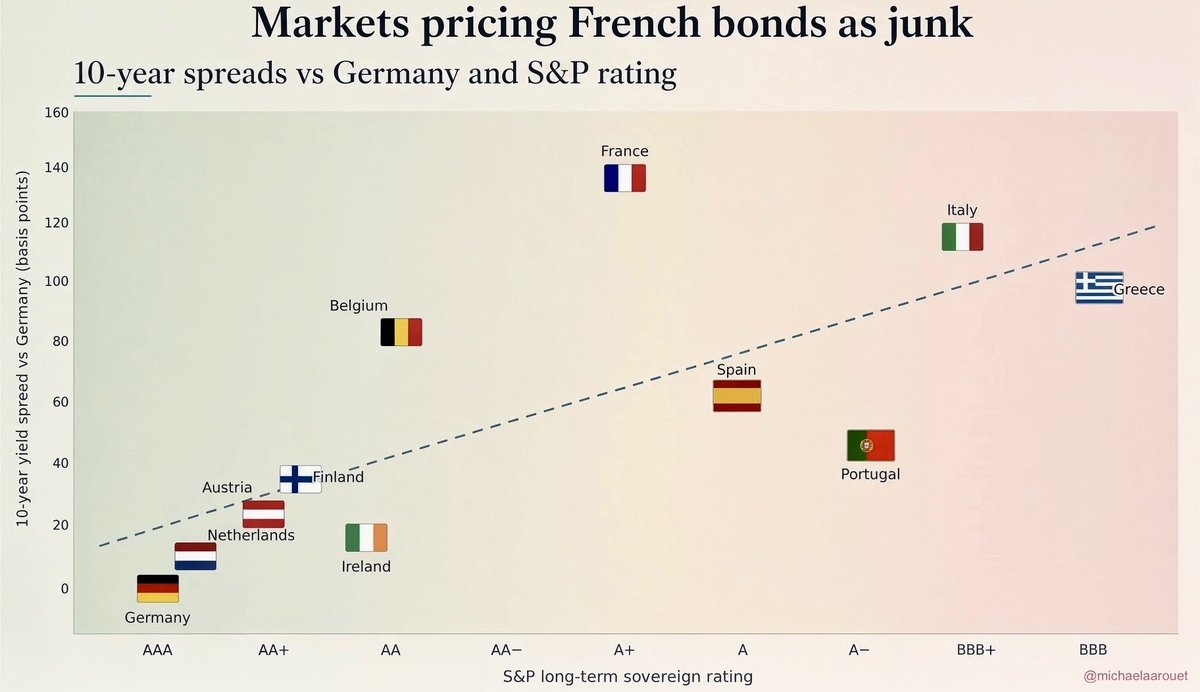
Most people don’t yet grasp what is happening in France. Markets are pricing French sovereign debt as junk, rating agencies will eventually have to follow. This will have two major impacts:
1. Most French banks are already rated at or just below the sovereign, so a move toward junk would likely drag domestically focused lenders with it. Credit to households and firms would slow sharply, hurting the economy and widening the fiscal deficit even further, a vicious cycle.
2. For the ECB, the constraint is legal as well as financial. A fall below investment grade would force sales by ratings-bound investors while making any backstop harder to justify under current rules.
The next euro crisis will begin in France. The first, which began in Greece, will feel like a walk in the park compared with what comes next.
MBS called Trump directly and asked for strikes on the Houthis. Riyadh is out of interceptors and asking outside partners for help. Even Pakistan and Turkey, its own defense-pact allies, said no. A ruler who can't defend his own realm doesn't stay a ruler for long, and a ruler whose first instinct is to call the President of the United States probably isn't one at all.
"The end of obedience is protection".....Ansar Allah or the Houthis represent a far greater risk to the political order of the Gulf and the military order in the Horn of Africa than is widely appreciated https://t.co/Zd2oNWEGAm
MBS called Trump directly and asked for strikes on the Houthis. Riyadh is out of interceptors and asking outside partners for help. Even Pakistan and Turkey, its own defense-pact allies, said no. A ruler who can't defend his own realm doesn't stay a ruler for long, and a ruler whose first instinct is to call the President of the United States probably isn't one at all.
If you can’t defend your territory, you are not long for this earth. As Bane famously asked the spiteful yet ultimately hapless John Dagett in the Dark Knight Rises, “Do you feel in charge?" https://t.co/4mcJncKp05
@tparsi After realizing Bruce Lee and Chuck Norris are uninterested you reach out to Steven Seagal....this will ultimately just precipitate the consolidation of these regimes into something that is better able to defend itself....https://t.co/UrHiLSPWBs
If you can’t defend your territory, you are not long for this earth. As Bane famously asked the spiteful yet ultimately hapless John Dagett in the Dark Knight Rises, “Do you feel in charge?" https://t.co/4mcJncKp05
25K views for a six month old article....
nothing in this is non-obvious folks...just becoming clearer with the Houthis steam-rolling the paper tiger to the North....
the future......is now
@clashreport If your first instinct when you want to register a complaint is to call the President of the United States, you probably don’t feel in charge at all.
https://t.co/UrHiLSPoLU
Cutting Through the Noise: Where the Iran–U.S.–Gulf Confrontation Stands
Against the backdrop of the escalating crises in the Strait of Hormuz and Yemen, it is worth cutting through the tactical noise and asking a more important question: Where do the United States, Iran and the “Axis of Resistance,” and the Gulf states actually stand?
1. Tactical U.S. gains in Hormuz have not translated into strategic success.
The United States has managed to move several tankers through the Omani channel, an operational achievement but a strategically limited one. Persistently high oil prices, elevated maritime insurance premiums, and rising fuel prices in the United States demonstrate that moving individual tankers does not by itself restore confidence in the international energy market. The strategic problem is not simply whether a tanker can physically transit the area, but whether global markets believe that freedom of navigation has been sustainably restored.
2. Washington and Tehran remain trapped in an action–reaction cycle.
Iran has not abandoned its effort to control access through the Strait of Hormuz and continues to target tankers attempting to use the Omani route. At the same time, Tehran’s actions have not deterred the Trump administration, which appears committed to a “tanker-for-tanker” approach. Neither side is backing down, and neither has yet established a stable deterrence equation.
3. The escalation ladder is moving upward, not sideways.
Iran has already crossed important thresholds, including attacks involving U.S. vessels and the launches toward Jordan last week. Yet these steps, and other increasingly aggressive actions encouraged by the IRGC, have failed to stop continued U.S. operations. This is critical: the confrontation is dynamic. Each side is testing increasingly dangerous measures because the previous ones failed to deter the other.
4. Iran’s strategic objective is relatively clear: break the maritime blockade to create a new strategic reality in which Tehran effectively controls the Strait of Hormuz.
Tehran wants the restrictions on its maritime access removed, either through escalation or diplomacy. The preferred diplomatic route appears to be an arrangement negotiated with Oman, potentially gaining broader Gulf support at tomorrow’s meeting in Salalah. For Tehran, diplomacy and escalation are therefore not contradictory strategies. They are two instruments designed to achieve the same objective.
5. Salalah could become a critical decision point.
If the Oman–Iran arrangement receives Gulf support but President Trump nevertheless insists on continuing the campaign, Tehran may conclude that diplomacy can no longer deliver the lifting of the blockade. This becomes particularly dangerous as the United States moves closer to the midterm elections. Iranian decision-makers may calculate, correctly or incorrectly, that Trump will become increasingly reluctant to undertake a major military escalation that could produce higher oil prices and additional American military commitments.
If that assessment takes hold in Tehran, the incentive for escalation will increase rather than decrease.
6. Yemen makes the equation significantly more complicated.
The Houthi attempt to break the Saudi blockade should not automatically be understood as an Iranian-directed operation. The relationship between Tehran and the Houthis is not a traditional patron-client relationship, and the Houthis retain considerable independent decision-making authority.
But their decision cannot be separated from the broader regional confrontation. The war involving Iran changed the strategic environment. The Houthis appear to have identified greater Saudi vulnerability and may also have calculated that Washington, already preoccupied with Iran, would be reluctant to become deeply involved in another military campaign on Saudi Arabia’s behalf.
7. Iran is nevertheless a major beneficiary of Houthi escalation.
Even if Tehran did not order the Houthi move, it clearly benefits from it. Pressure around Bab al-Mandab contributes to higher energy and shipping costs while simultaneously increasing pressure on Saudi Arabia. Tehran therefore has a strong strategic interest in supporting the Houthis. even while its ability to dictate Houthi decisions remains limited. Iran does not need to control the Houthis in order to benefit strategically from their actions.
8. Solving Hormuz alone will not solve the regional crisis.
Even an agreement over the Strait of Hormuz would not necessarily end the Saudi-Houthi confrontation. The Houthis are unlikely to terminate their campaign simply because Iran reaches an arrangement with Washington or the Gulf states. Their objective concerns Yemen and the Saudi blockade, and the confrontation could therefore continue until Riyadh is prepared to fundamentally change that reality.
In other words, reopening both strategic waterways may ultimately require something broader than an Iran–Oman understanding: a regional arrangement addressing both Hormuz and the conditions for ending the Saudi-Houthi confrontation.
9. This is why tomorrow’s Salalah meeting matters far beyond Oman and Iran.
It could clarify three critical questions: whether the Oman–Iran arrangement has broader Gulf support; whether Saudi Arabia is prepared to explore a political solution with the Houthis; and, most importantly, whether the IRGC concludes that diplomacy still offers a credible pathway toward lifting the pressure on Iran.
If the answer to the last question is no, the danger of escalation will rise significantly. Iranian leaders may believe that the period before the U.S. midterms provides them with additional leverage because Trump’s political tolerance for a major new regional war, and the economic consequences associated with it, is limited.
10. Economic pressure on Iran is real but that does not necessarily make Tehran more cautious.
The maritime restrictions are placing substantial additional pressure on an already troubled Iranian economy. But this creates a dangerous paradox. The greater the economic pressure becomes, the stronger the IRGC’s conviction may become that the blockade must be broken almost regardless of the cost.
This is the central strategic problem confronting yhe administration: pressure without a credible off-ramp may produce escalation rather than capitulation.
The coming days therefore matter enormously. The central question is no longer whether the United States or Iran can inflict additional tactical costs, they clearly can. The question is whether Salalah can create a diplomatic mechanism that allows the parties to step away from an increasingly unstable escalation cycle.
Without such a mechanism, another round of escalation is not an unlikely scenario. It is increasingly becoming the default trajectory.
#IranWar
#yemen
#houthis
If you can’t defend your territory, you are not long for this earth. As Bane famously asked the spiteful yet ultimately hapless John Dagett in the Dark Knight Rises, “Do you feel in charge?" https://t.co/4mcJncKp05
@kenmoriyasu@jekavanagh Bombshell? This just seems misguided. The U.S. should be pulling out of the Middle East where it has no strategic interests. Instead of debating what can be achieved through offshore balancing in Asia. The hardware supply chain center of tomorrow's technologies! Nuts...
@MarkUrban01 If your first instinct when you want to register a complaint is to call the President of the United States, you probably don’t feel in charge at all.
https://t.co/UrHiLSPoLU
If you can’t defend your territory, you are not long for this earth. As Bane famously asked the spiteful yet ultimately hapless John Dagett in the Dark Knight Rises, “Do you feel in charge?" https://t.co/4mcJncKp05
If you can’t defend your territory, you are not long for this earth. As Bane famously asked the spiteful yet ultimately hapless John Dagett in the Dark Knight Rises, “Do you feel in charge?" https://t.co/4mcJncKp05
@DeItaone If your first instinct when you want to register a complaint is to call the President of the United States, you probably don’t feel in charge at all.
https://t.co/UrHiLSPoLU
@tparsi If your first instinct when you want to register a complaint is to call the President of the United States, you probably don’t feel in charge at all.
https://t.co/UrHiLSPoLU