@mrzhbrtweet Couldn’t e.g. Siemens just pull an Apple, pay Google/Anthropic/openAI 10% of their profit in one year = $1bn and get their own Siemens AI at frontier capability level?
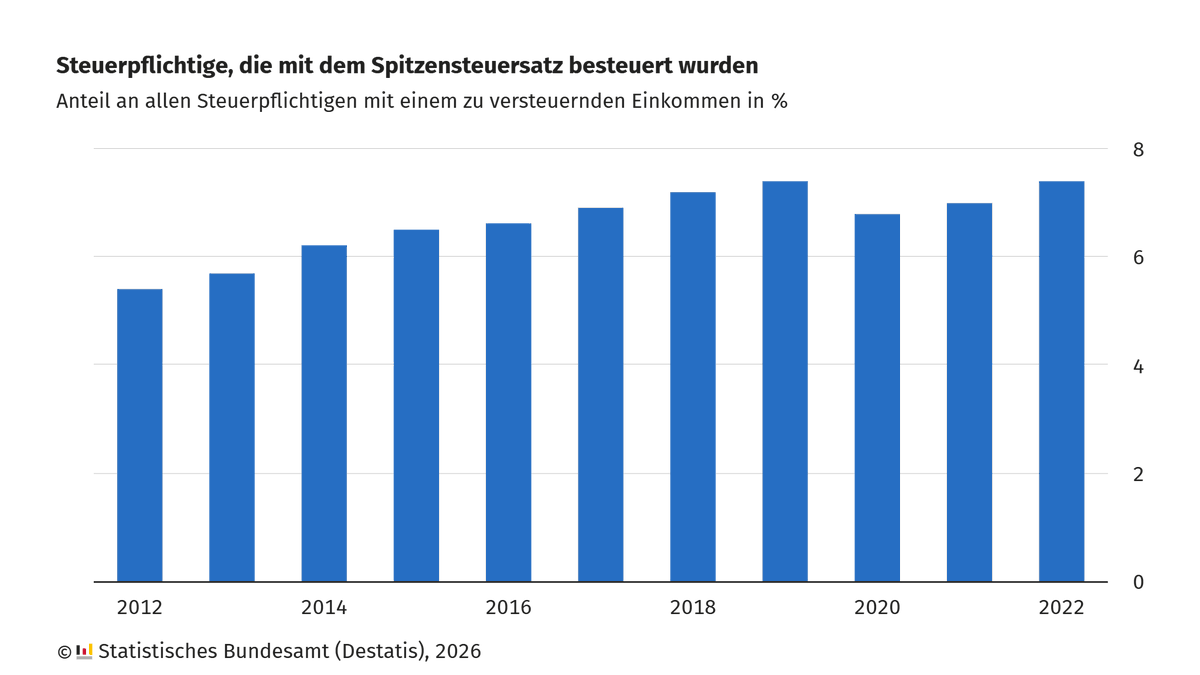
2022 wurden rund 3,2 Millionen Steuerpflichtige mit dem #Spitzensteuersatz von 42 % besteuert, 7,4 % aller unbeschränkt Steuerpflichtigen. Auf sie entfielen knapp die Hälfte (49 %) des gesamten #Einkommensteuer|aufkommens. Mehr Infos: https://t.co/Kc6ZsCl9gN #Steuern
@Simon__Grimm Do I understand correctly we have an AI Security Institute before we have an institute focusing on how Germany can catch up to the US and Chinese labs? 😂
There are 12 venture-backed companies that raised >$3B in private markets and then listed in the US.
Only one that has a positive return today, relative to the S&P 500's performance over the same period.
Most are deeply negative (aggregate -117%).
Only two that were positive at lockup expiry, neither stayed that way.
The high cost of private capital means the companies that raise the most, and stay private longer, are almost inevitably overvalued as insiders raise the price of funding events aggressively to stay NPV positive.
Had two memory leaks by ChatGPT macOS app on Tahoe in the last four days, causing the ChatGPT app to grow to 40GB RAM - freezing my whole computer. Codex says based on logs the cause might be „ChatGPT 1.2026.118’s helper service path/registration was failing, and the app leaked Swift async continuations while retrying or waiting on that helper.“
⚙️ Behind the build of self-improving tax agents with Codex
We co-built Tax AI with @ThriveHoldings around tax prep workflows so when reviewers fix any errors, Codex can trace the failure, improve the system, and test the change before it ships.
https://t.co/otI9oYp2A6
Good Morning from Germany, where the road to socialism is paved with ever-rising govt consumption. Since 1999, state consumption is up 63%, while GDP has risen only 31% and capital investment a meagre 16%. The public sector keeps expanding, but the investment base is stagnating. Germany is becoming less of a market economy and more of a state-led redistribution machine.
The next 12 months will be dramatically better for infrastructure companies upstream of Anthropic and OpenAI than for application-layer companies downstream of them.
Yet another example of AI creating new jobs rather than destroying them. And it’s no coincidence that @levie mentions providing the correct context for agents as key objective for that new class of jobs. We at @getduodata believe that markdown files are not good enough when it comes to company metrics like „ARR“ or „churn“. Every agent needs to know what those mean (e.g. „does ARR include trial customers?“ etc), how to calculate those in precise formulas and where the underlying data is stored (instead of pulling it from the next best Excel in Box or Sharepoint).
As advanced agents move from coding to the rest of knowledge work, it takes a real amount of work and know-how to get right.
You need to ensure agents have the right context and data to work with, wire up systems to agents in a safe and secure way, ensure that the agents are producing quality output, design the end-state workflow where and how humans will be in the loop, maintain the agents when there are model and system upgrades, and more.
This isn’t a side project or something you can just do on nights and weekends. You need to design and develop robust agents that will be used in mission critical workflows. It’s a highly technical job, very much akin to a forward deployed engineer for internal functions.
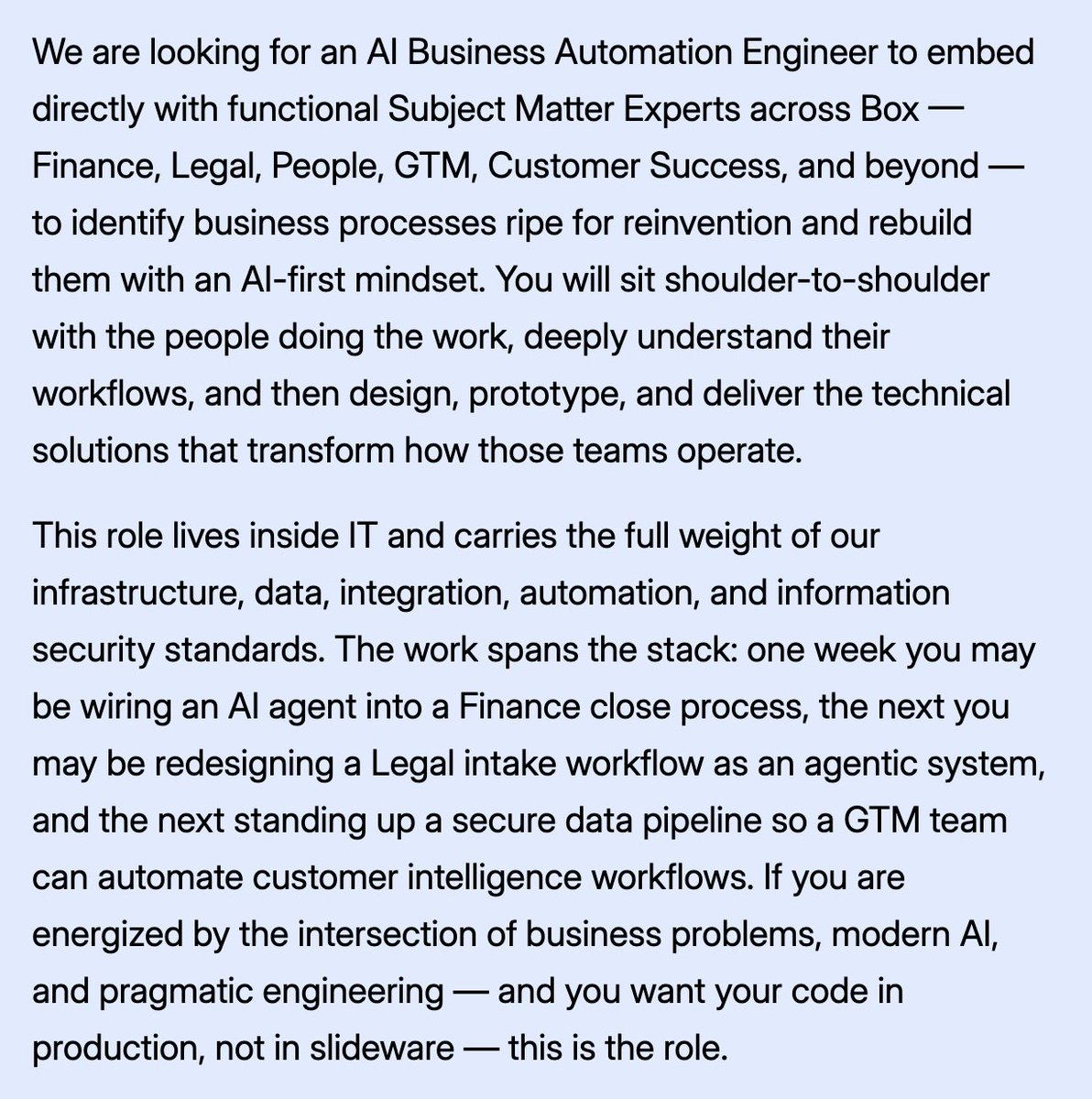
This is why, at Box, we’re starting to hire for AI automation engineering roles. This a technical role that will partner with the business directly and help augment how they work to drive even more output, and deliver better experiences for employees and ultimately customers.
This is just one example of the kind of role that AI will start to open up in the future. I expect most companies will have many flavors of this going forward.