$ASTS
BO🅰️’s Cliff Notes - @CatSE___ApeX___ was right about everything
👇👇👇👇
https://t.co/xwk7BodzfM
👆👆👆👆
This study out of Tsinghua University is one of the first real looks at how Starlink direct to cell actually works on normal phones. And honestly the takeaway is pretty simple.
It works… but it is constantly fighting physics.
The satellites are hundreds of miles away, so the signal is way weaker than a normal cell tower. That makes the connection harder to hold and way more prone to errors. Right now it looks okay because almost nobody is using it yet, so there is basically no congestion. That is best case scenario.
Then you’ve got the satellites flying across the sky at crazy speeds. That creates timing and frequency issues that are really hard to clean up. Even when they try to correct it, the signal is never perfectly lined up, so performance takes a hit.
And here is where it gets messy.
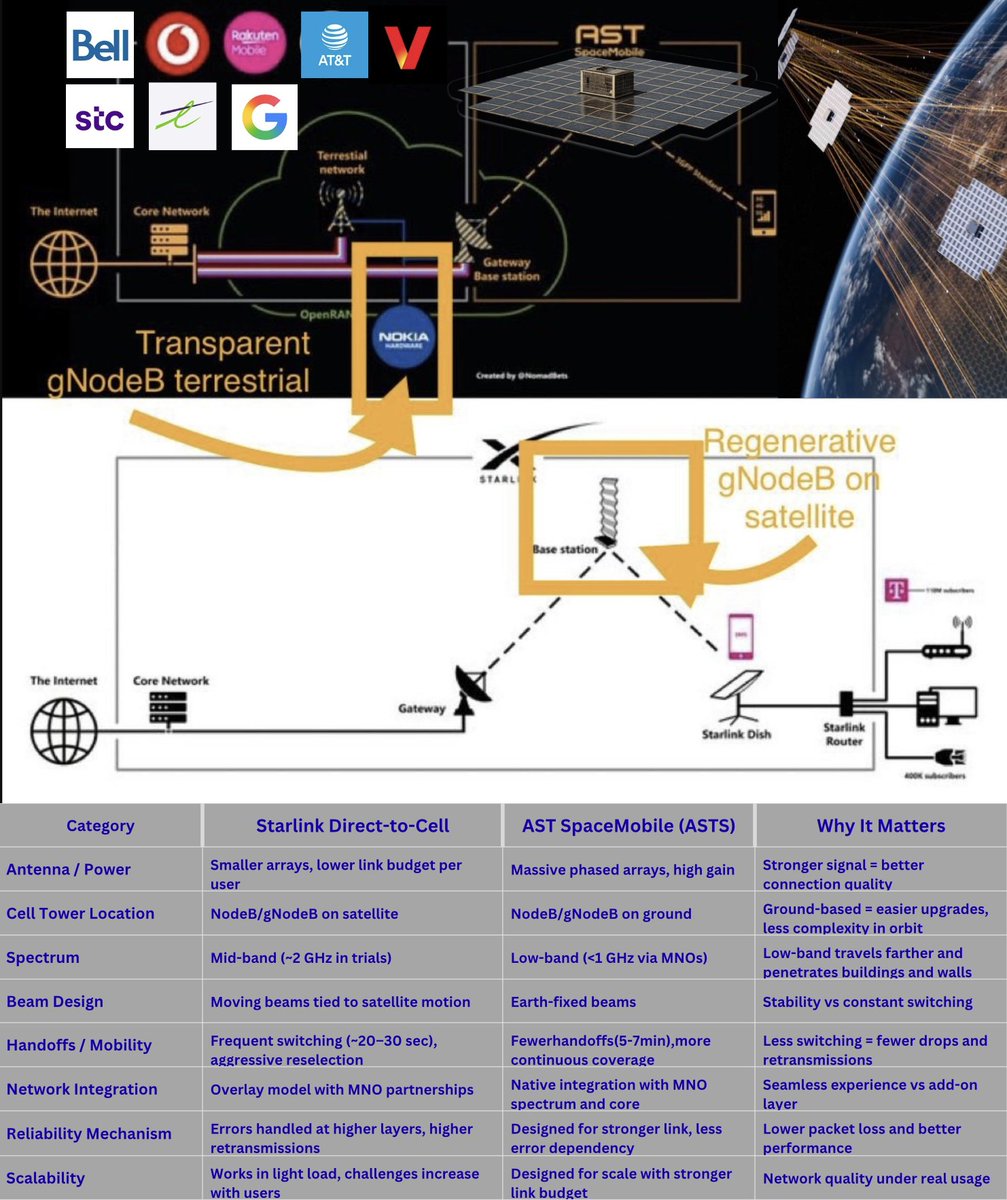
Even if you are standing still, your phone is switching between satellites or beams every 20 to 30 seconds. That constant handoff creates interruptions, packet loss, and forces the system to resend data over and over.
To keep things from breaking completely, Starlink actually had to turn off HARQ, which is a core LTE feature that normally fixes errors in real time. Without it, errors stack up and get pushed higher into the system. That leads to a lot more retransmissions and packet loss. In testing, downlink packet loss was hitting around 25 to 30 percent in test.
Even basic things like just connecting take longer, and the system bouncing between satellites can actually make stability worse instead of better.
Big picture
This is not something you just fix by adding more satellites or more spectrum. The issue is deeper than that. They are trying to force terrestrial cell tech to work in space, and that comes with tradeoffs that show up as instability and inefficiency.
It proves you can connect a phone, but scaling that into a reliable network is a completely different problem.
That is why this is bullish for AST.
AST is not trying to retrofit the system. They designed it from the ground up for space. They are using low band spectrum, which travels farther, goes through buildings, and does not need nearly as much correction.
So instead of fighting physics, they are working with it.
If these results hold as things scale, the winner is going to be the system that works with physics, not against it.
That is exactly where AST stands out.
Look at the architecture. Starlink is trying to put the whole cell tower in orbit. AST is keeping the tower on the ground and just using the world’s largest phased array to extend its reach. One is a complex workaround. The other is an elegant extension of the networks we already use.
Built on a timeless visual by @NomadBets and added a few updates
@DrOllie1979@CatSE___ApeX___ This article explicitly points out that ATS's transparent forwarding architecture and the communication latency resulting from its higher deployment altitude will perform worse than Starlink's regenerative forwarding architecture.
"India’s largest service provider, Reliance Jio, is evaluating the development of a sovereign LEO satellite constellation, which would challenge several global satellite broadband providers, including Starlink..." via @FierceNetwork_
https://t.co/hKsI4JtdwZ
The CEO of India's Jio Platforms says his company needs to be a low-cost 'large token generator' as hyperscalers move onto his turf.
Read more on Light Reading: https://t.co/zytrArSFJZ
Tokenisation may sound like another AI buzzword to add to an ever-growing list that would make even the Oxford English Dictionary blush, but for some in the industry, tokens are a clear path to monetising #AI investments: https://t.co/cWl3BuwuMB #telecom#Tokenisation
In this week's episode of Pulse, @Cisco’s Tom Foottit dives into how AI and agentic workloads are changing network behavior and how traditional assurance models must evolve to measure performance and user experience effectively. https://t.co/KQbYrWR0Gq
At this year’s #CTIASummit, one message was clear from policymakers and industry leaders: we need a clearly defined spectrum roadmap to provide connectivity for the next decade of 6G and AI-driven innovation: Read more from @NickLudlum: https://t.co/6SLhtdbCF2
Autonomous network maturity varies by operational domain, with progress determined less by technology than by data quality, integration readiness and governance foundations. Nemanja Prekovic, head of delivery TMT at Avenga, explains. https://t.co/YcPf5RUAX1
AI is changing the role of the data center network. As GPU clusters scale, optical connectivity is essential to deliver the bandwidth, latency and efficiency AI cloud providers need. In the AI era, the network is part of the compute. Read more @eetimes: https://t.co/QJaCghbWNC
At the Mobile AI Industry Summit during MWC Shanghai 2026, Huawei released the GigaUplink Solution to enhance uplink capabilities, helping operators drive industry innovation and business growth in the Mobile AI era. The solution leverages upgraded multi-antenna technology and intelligent spectrum, device-network, and network collaboration algorithms.
Learn more: https://t.co/SI0xlRJA9S #Huawei #MWC26 #AdvancingAllIntelligence #HuaweiNews
Ericsson AI in RAN is paving the way to AI-native systems.
With our new software solution we're applying telco-grade AI models directly inside the radio access network⚡ improving performance & efficiency.
👉 A step toward outcome-based connectivity: https://t.co/OD3ItN5gx2
The world is carving up 6 GHz in three incompatible ways; the consequences for 6G, Wi-Fi 8, and hardware complexity are just emerging. https://t.co/lkfX4fsNzx
"Here are 10 reasons why AI might actually reduce network traffic, or at least reduce the need for additional public fixed or mobile access capacity" from @disruptivedean
https://t.co/0l9q9tdktD
good stuff!
High module prices, poor 5G coverage and a profusion of narrowband technologies all share some blame for the disappointment surrounding IoT.
Read more on Light Reading: https://t.co/xU9wtivvm0
Automation got us here. It won’t get us where we need next.
In the AI supercycle, networks are changing faster than ops can keep up with more dynamic traffic, rising complexity and higher expectations.
The shift: From task automation → real-time decision-making.
Enter autonomous networks.
Read more in our latest blog here: https://t.co/Pv7vDkglQi
We all know the "bull" case for AI driving network traffic. Video, agents, sensors, robots, inference, edge off-load etc. But what about the "bear" story?
My new article gives 10 ways that AI could actually *reduce* access-network data volumes
https://t.co/khJjZ7bQOE





![ktai_watch's tweet photo. [DATAで見るケータイ業界] 5Gの屋外基地局数は約27万局に拡大、基地局投資は26年度に拡大する見込み https://t.co/Afpu2RvDAi https://t.co/00t7z8dlNl](https://pbs.twimg.com/media/HLxLqXta4AAMp1S.jpg)


