📢 I'm really excited to share that I'm back to working on Open Source, an SDK no less! And not any SDK, but @aiSDK! Thank you @vercel for letting me 🖤
I'll be using Twitter exclusively for work.
@oscard0m_@mattzcarey@aisdk@octokit It's not black & white. I still think Octokit is built correctly using small repositories, it's decomposable and each component is useful on its own. For AI SDK it absolutely makes sense to have it in a monorepo, with its 50+ adapters.
@farreldarian@tan_stack@cramforce@rauchg Thanks for building this! Would you be up for publishing it as a standalone npm package? We can then add it to the AI SDK docs so other Effect users can find and use it.
Generative UI for conversational agents.
Combining @aisdk with Chat SDK and 𝚓𝚜𝚘𝚗-𝚛𝚎𝚗𝚍𝚎𝚛, you can go straight from LLM to UI on platforms like Slack and Teams.
I believe this will become the dominant Human-Agent Interaction (HAI) paradigm:
https://t.co/MHxtLyoy7t
In just 24 hours 🤯
✓ 𝟲,𝟴𝟭𝟳 vulnerabilities identified
✓ 𝟱𝟴𝟬 critical or high
✓ 𝟭,𝟰𝟭𝟭 already patched by Agent
Vercel Security Reviews are 100% free until Nov 10
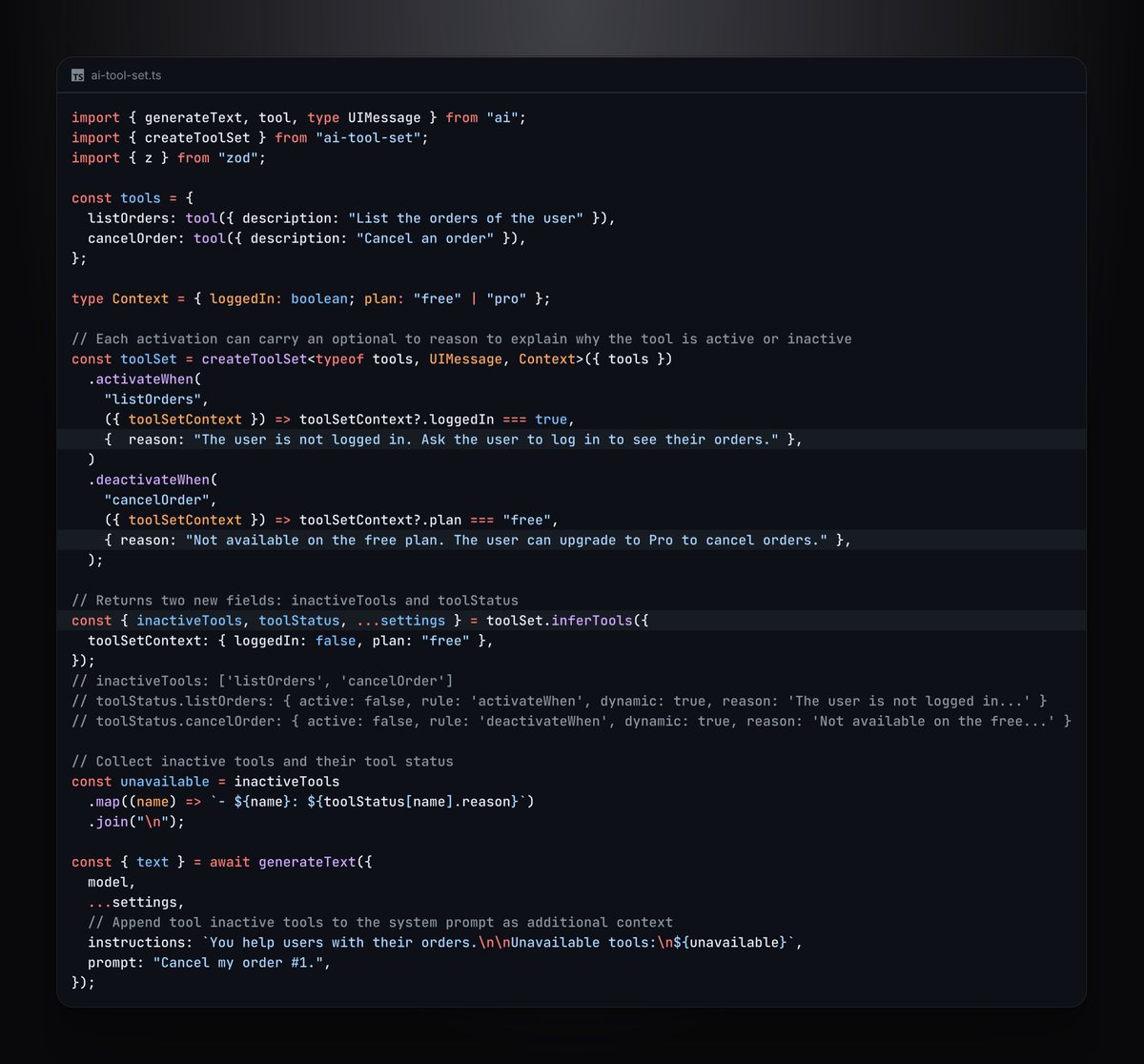
New `ai-tool-set` feature: tool activation reasons
Your agent only sees the active tools
It doesn't know what's hidden behind some toggles
Each activation can now carry a reason why a tool is inactive
Pass it to your model as extra context, so it can better guide the user
@felixarntz From the given options, I'd say "Consumer vs Adapter API", in the case of AI SDK I'd refer to it as "Application API vs Provider interface" or just "API vs Provider interface"
What terminology do you find most intuitive/understandable for differentiating between something like these two layers (e.g. in AI SDK)?
1. Top-level API which most devs use (e.g. streamText)
2. Provider implementation spec which provider adapter builders use (e.g. ProviderV4)