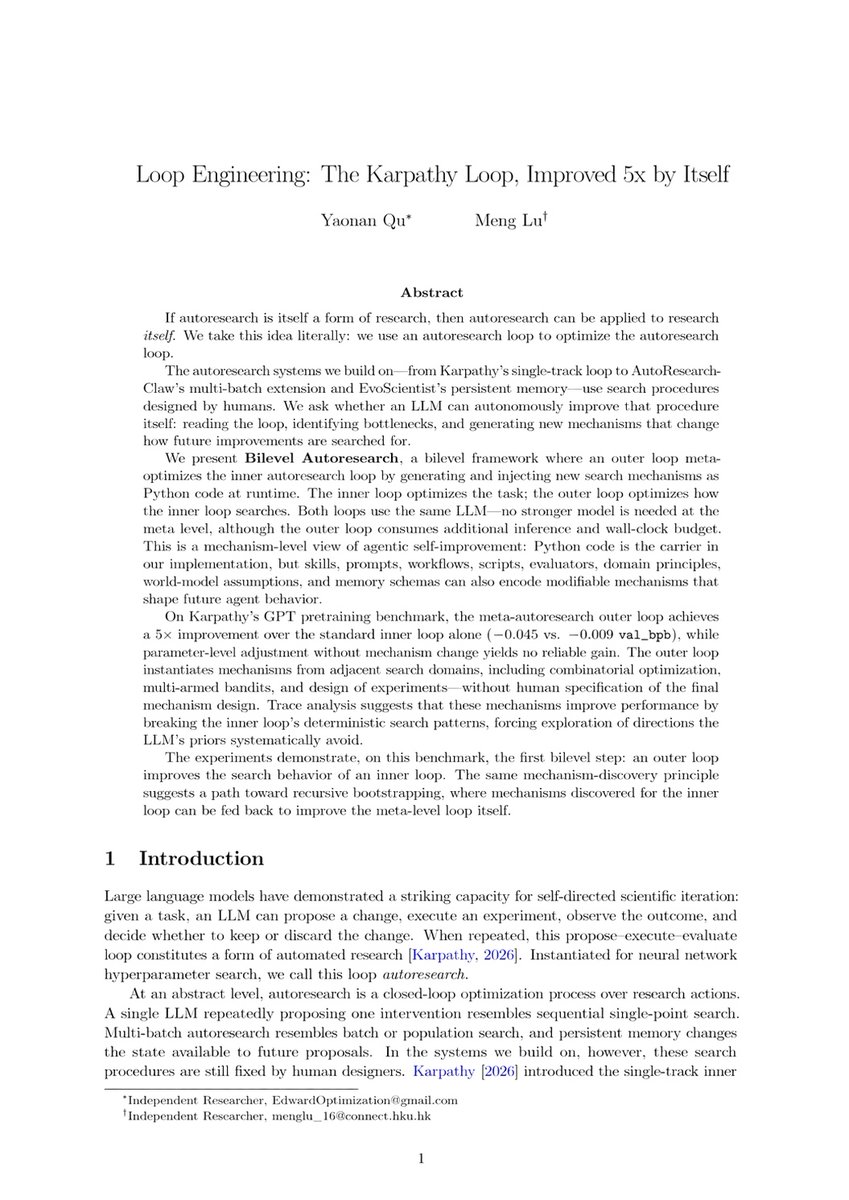
Two Hong Kong students just made Karpathy's loop 5x better - dropped 18-page PDF
The twist: the loop got 5x better the moment you put another loop on top of it
here's the whole method, step by step:
step 1 → Karpathy's loop gets stuck - the LLM keeps reproposing the same changes, falling back to its priors
step 2 → so they add an outer loop that reads the inner loop's code and finds where it's stuck
step 3 → the outer loop writes new search logic as Python and injects it live - 5x better, same model
how to steal this for your agents:
step 4 → write a second agent whose only job is to read the first one's logs and find where it's stuck
step 5 → let it rewrite the rules - workflow, skill, prompt - not just retry the task
step 6 → auto-revert every rewrite on failure, so a bad change never breaks your pipeline
the result: 5x better than Karpathy's loop alone - same LLM, no smarter model, it's the architecture
this 18-page PDF is what comes after the Karpathy loop
read it now - the full build workflow is in the article below ↓
48 HOURS AFTER KARPATHY POSTED HIS LLM WIKI IDEA, A 26-YEAR-OLD BIRMINGHAM GRAD SHIPPED THE ONE COMMAND THAT MAKES IT WORK. IT NOW HAS 76,000 GITHUB STARS
1 command. 71.5x fewer tokens per query. 0 vector databases
points graphify at any folder - codebase, docs, PDFs, screenshots, video. Tree-sitter parses the code, Claude reads the prose, the whole thing lands as a knowledge graph in graphify-out/
one flag - --obsidian - writes the entire graph as a fully-linked Obsidian vault: one markdown note per concept, every relationship a wikilink, every node linked back to its source. Drop the vault into Claude Code as a skill. Claude queries the graph instead of grepping through raw files, forever
Safi Shamsi finished his MSc at Birmingham with Distinction in 2025. His thesis was a knowledge-graph RAG system for academic search. He shipped Graphify 48 hours after Karpathy's post, iterates every week, and has already been forked by Rootly AI Labs for incident data. Hacker News, Analytics Vidhya, Towards AI - all organic.76,000 stars. Three months old
no neo4j server. no vector db. no embedding pipeline. no cloud. no monthly fee
you're reading this on a device that could clone the repo, run one command, and have a Claude-native knowledge graph of your entire codebase in Obsidian before your next standup
Anthropic just dropped 5 workshops on building self-improving agentic systems from scratch:
00:00 - Ship your first Claude agent
36:44 - Build memory for Claude agents
1:05:06 - Make your agent autonomous
1:26:46 - Set up a proactive agent
2:03:35 - self-improving agents (tools,skills)
These 3-hours of free Claude workshops will replace 10 paid agentic courses.
Watch today, then read article below on how to build a self-improving agentic system with Fable 5.
Wow my @threejs Awesome Graphics Agent Skills is almost 200 stars and 1k downloads, thanks for everyone’s support! I will keep updating it! Already at v0.3.2
Check it out here if you haven’t and install from npm:
https://t.co/JqdgczCwy4
YA NO ES VERDAD QUE "LA IA NO PUEDE HACER JUEGOS 3D
Acaban de sacar GAME BLOCKS, una librería open-source (Three.js) que le da a los agentes de IA un set de componentes 3D verificados.
En vez de pedirle a Codex/Claude que genere lógica 3D desde cero (y que falle), le das componentes probados de:
- Movimiento
- Colisiones
- Física
- Cámara
- etc.
Resultado: la IA ensambla juegos 3D que realmente funcionan.
El video de arriba muestra decenas de prototipos generados con esta aproximación.
Esto cambia el juego para prototipado rápido con IA.
Repo y más info en comentarios
Prompt, context, harness & loop engineering, clearly explained!
An agent is a while loop with four layers of engineering wrapped around it:
- Prompt engineering
- Context engineering
- Harness engineering
- Loop engineering
Each one wraps the last, and the model sits in the middle, so none of them compete with the others. Instead, they just zoom one level further out.
> Prompt engineering:
This defines the input the model sees on one call, often composed of a role, instructions, examples, and an output format.
The techniques here alter the internal computation and reasoning the model goes through due to the wording it sees:
- Chain-of-thought makes it work in steps before answering
- Few-shot examples define the format and the edge cases
- A JSON schema or XML tags make the output parseable by code
- Self-consistency samples a few chains and takes the majority
> Context engineering:
It's everything the model sees on a turn, not just the prompt. That includes the query, retrieved docs, memory, prior turns, and tool outputs from earlier steps.
The window is finite and fills up fast, so the engineering work is to rank inputs and cut everything that isn't pulling weight.
You do this by:
- Retrieving only the chunks relevant to the query, then reranking them
- Keeping key facts out of the middle, where accuracy drops
- Summarizing old turns, evict stale outputs, push big blobs to files
> Harness engineering:
It's the code around the model that defines the tools, parses the calls, retries on failure, and can route work to sub-agents so one handles retrieval and another handles code.
A verifier then grades the result by running tests, validating a schema, etc.
Prompt and context involve getting one call right. The harness involves everything that has to happen around that call for it to run in a real system.
> Loop engineering:
In the usual setup, you manage the outer loop, i.e, you write a prompt, read the turns the agent runs, write the next prompt, and repeat, while catching failures.
This layer hands that job to the agent itself. It kicks off on a schedule or an event, and runs many turns with no prompt in between.
A loop inherently doesn't know when it's finished. An agent can report that it's done and halt while the tests still fail. So the stop can't be the agent's word, but rather it has to be a real signal, like:
- A turn and token cap to stop stuck runs
- A no-progress detector to catch repeated calls
- A completion check to verify the goal with a separate model or a deterministic test
By this layer, you're operating on the whole run, so the engineering moves from writing each prompt to setting the goal and the stop conditions up front and letting it run.
If you want to dive deeper into loop engineering, my co-founder wrote a full breakdown of that outer loop.
It goes from the basic while loop to a run that finishes on its own, with the code behind each part, and the parts that are hard to get right, like knowing when to stop, context rot over a long run, and keeping the checker separate from the maker.
Read it below.
🚨ANTHROPIC ACABA DE PUBLICAR EL MANUAL PARA MONTAR UNA EMPRESA SIN EMPLEADOS
>CEO: 1 persona.
>empleados: agentes de claude
dura 30 minutos y es gratis
Guarda esto en favoritos para que no lo pierdas.
met an anthropic engineer making $1.2M a year.
asked him how he ships alone at the pace of a full team.
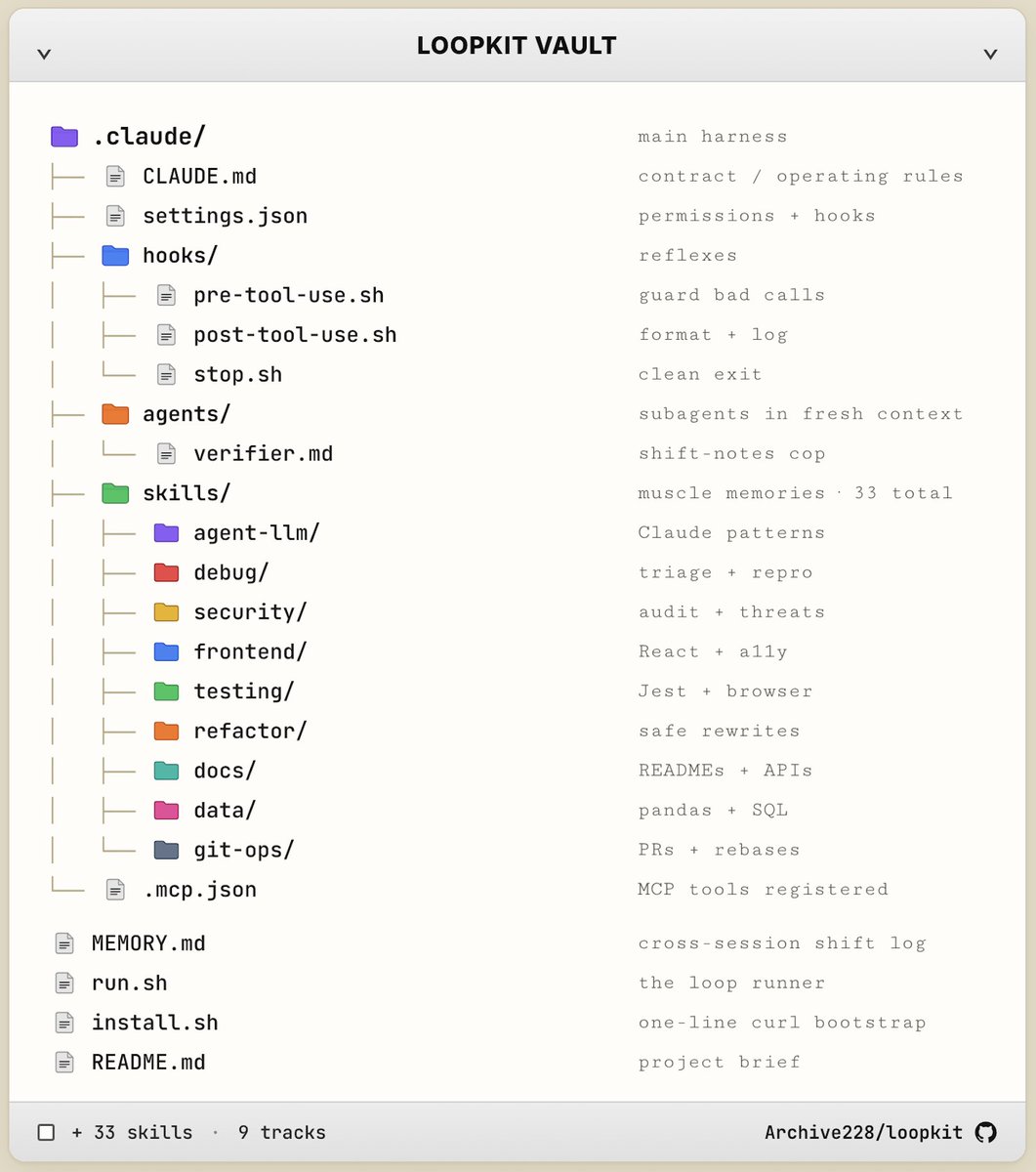
he didn't answer. sent me his .claude/. one folder.
SAME MODEL - DIFFERENT RESULT.
everyone's still picking between opus and sonnet like the model is the ceiling. it isn't.
the real lever is what the model wakes up into:
CLAUDE.md → hooks → verifier subagent → skills → mcp → memory → shift notes.
you stop chatting with the model.
you write the folder once. the folder runs the model.
- CLAUDE.md - the contract
- settings.json - the permissions
- hooks/ - the reflexes
- agents/verifier - the shift-notes cop
- skills/ - 33 muscle memories
- .mcp.json - the tools
- MEMORY.md - the shift log
that's the stack.
full breakdown in the article below. bookmark before he realizes i posted it.
I don't prompt Claude Code anymore.
I have loops running that prompt Fable, and my job is just to write loops.
This is the Boris Cherny method, and I have to say, it's extremely powerful.
Everything you need to get started with loop engineering (as a complete beginner):
Games went mass-market, but still feel trapped in an old definition of “game.”
The next leap might not come from inventing a new mechanic, but from redefining the whole cultural and product role of a game.
Ex-Google engineer explained AI agent loops, harness, evals in 20 minutes - better than 500$ courses.
trace every run → judge it with an LLM → diagnose → fix → ship.
That loop is how agents self-improve over time.
Agent loops + memory + harness + evals - thats the stack.
Watch it, then save the framework below.
You can build an AI second brain in 15 minutes.
No coding experience needed. no $1000 course
[Here is how you can do it in 5 mins:]
Step 1: Download Claude Desktop.
Step 2: Download Obsidian Desktop.
Step 3: Create a new vault and start dropping .MD files into it.
Step 4: Tell Claude Code to connect directly to your vault using Andrej Karpathy's prompt: https://t.co/2SJBZyjXDl
That is it.
Your entire knowledge base becomes searchable, connectable, and queryable by the most powerful AI model on earth.
Every note you have ever written.
Every idea you have ever captured.
Every resource you have ever saved.
Claude can now read all of it, find connections you missed, and surface insights from your own thinking that you forgot you had.
Most people are using Claude as a search engine.
The people building second brains with it are using it as an intelligence layer on top of everything they know.
The gap between those two use cases is the gap between asking Google a question and having a research partner who has read everything you have ever written.
Bookmark this.
Build it tonight.
Anthropic engineer: "You're not supposed to prompt Claude. You're supposed to build a system that prompts itself."
Loops.
Most builders are doing this wrong:
No memory file, so every loop starts from zero.
No sub-agent split, so one agent tries to do everything.
No stop condition, so loops run forever and bill you in your sleep.
Most builders are missing at least two of the three.
Watch the video first.
Then read this - everything you need to know about Loops in 2026, in one place.
Bookmark this before it gets buried.
I genuinely don't understand why everyone isn't using this yet
Andrej Karpathy, a co-founder of OpenAI, posted a simple idea that hit 16 million views: stop using AI to write code, use it to build a second brain.
You point Claude Code at a folder, drop in any source, an article, a transcript, a PDF, and Claude reads it, links it, and files it into a living wiki of everything you know. It compounds like interest, the more you feed it, the smarter it gets.
Here's the whole thing:
> Install Obsidian, create a vault, open it in Claude Code
> Paste Karpathy's wiki idea file and tell Claude to build it
> Claude makes three folders: raw for sources, wiki for its pages, a CLAUDE.md that runs it
> Drop any source into raw and say "ingest this"
> Ask questions across everything, forever
Five minutes to set up, and you never start from a blank chat again.
Full step-by-step guide with Claude and Obsidian, link below.
Bookmark this
Read @ballmatthew's "The State of Video Gaming in 2026". The growth levers seem to be Tier 2–3 markets, ads/D2C/payments, Roblox/UGC, and outsourcing — not product innovation. Maybe game design, as we know it, has hit a dead end. What does next-gen game design look like?