Two foreigners indicted for human trafficking and sex with minors in Romania have just been brought to Florida by private jet, after a public and political pressure campaign by billionaire members of the Trump administration against the Romanian justice system. Rapist immigrants will always be protected by fake conservatives, as long as those immigrants are white and rich.
@elonmusk , @JDVance and friends keep preaching freedom and traditional values while attacking the very fundamentals of our European democracies and siding with Russia’s rapist army. Romanians will not be manipulated by this.
@Cobratate@TateTheTalisman
There's a shocking fact about AI that nobody tells you: You can catch up to the public AI research frontier in just 2 weeks. Yes, really.
I've built a $150M annual revenue startup over the last 8 years and If I were to start a company today, I’d drop everything and go all-in on AI.
But like many busy software builders, I felt lost—overwhelmed by the noisy, crowded and fast-moving modern AI landscape. And I wasn’t alone.
So I spent my entire holiday diving deep into AI research—reading 30+ papers, watching hours of lectures, analyzing trends, and catching up to the research frontier.
✨ Here’s what I learned:
- You don’t need months (or years) to catch up.
- You don’t need a PhD or decades of ML experience.
- You need fewer than 20 papers and 2 weeks to understand the major breakthroughs shaping AI today.
It's because the technology is extremely nascent and most techniques that came before are no longer relevant:
- ChatGPT is barely 2 years old and Transformers are only 7 years old.
- Most game-changing discoveries happened within the last 4 years, driven by a few breakthrough ideas, scaling laws, and efficient matrix multiplication.
The biggest secret?
Many groundbreaking AI papers with thousands of citations are surprisingly simple and applied, like adding "let's think step by step" to the prompt, or simply asking the LLM over and over again to improve its answer (Self-Refine).
I realized there are tons of founders and builders in the same boat—wanting to dive deeper into AI but unsure where to start.
I've created an essential AI Guide that helped me catch up, in just 2 weeks, to the frontier of public AI research to figure out where the next opportunities and gaps were:
- Curated list of only the most important papers
- Simple explanations of key concepts
- Clear pathway to understanding the frontier of modern AI
It’s perfect for:
- Founders expanding into AI
- Builders wanting to innovate at the frontier of AI
- Investors looking to separate the signal from the noise
👇 Want the full guide?
- Like and Share this post
- Comment "AI Guide"
- I'll send you the complete guide
(ps, I’m also teaming up with @VishalVasishth, co-founder of @obviousvc with @ev (focused on large-scale societal impact companies like Twitter, Medium, Beyond Meat), to host a small meetup to discuss what's working and needs to be solved in the AI stack in SF. Message me if you're interested)
For one day only, General Catalyst invited 20 of San Francisco’s top AI entrepreneurs to showcase what’s possible with AI.
Live product and raw code only. No pitches. No bullshit.
Here’s what we saw at the @cerebral_valley co-working demo session at @generalcatalyst (🧵):
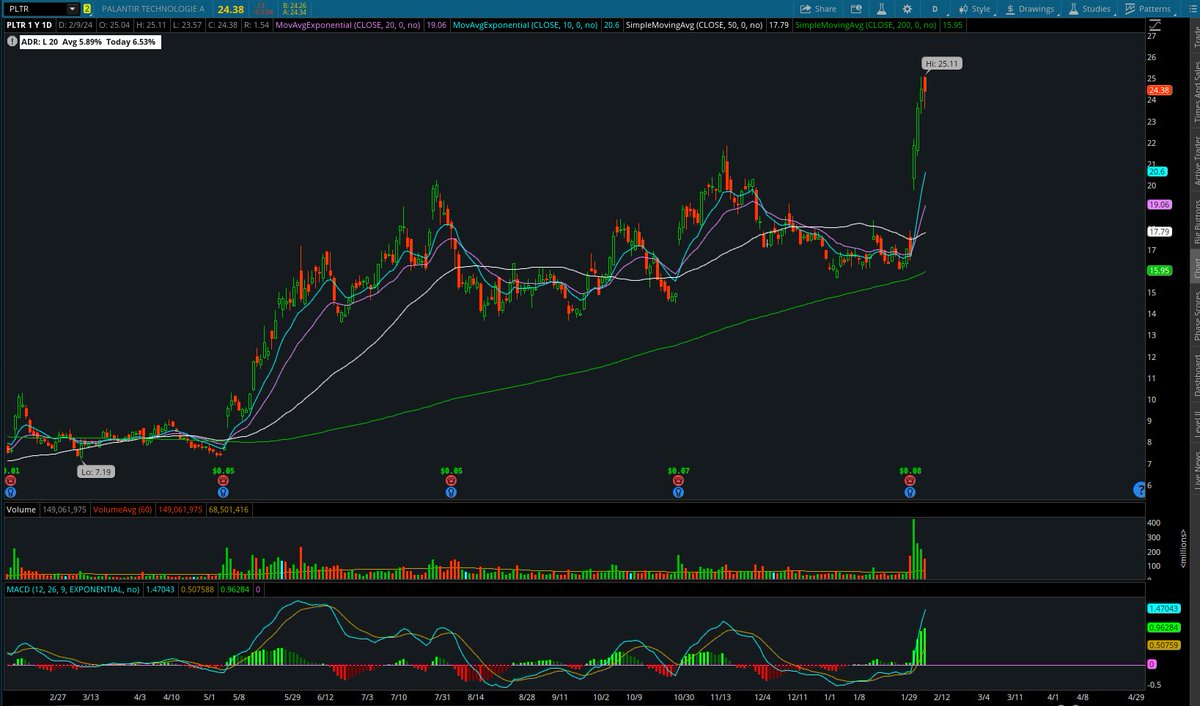
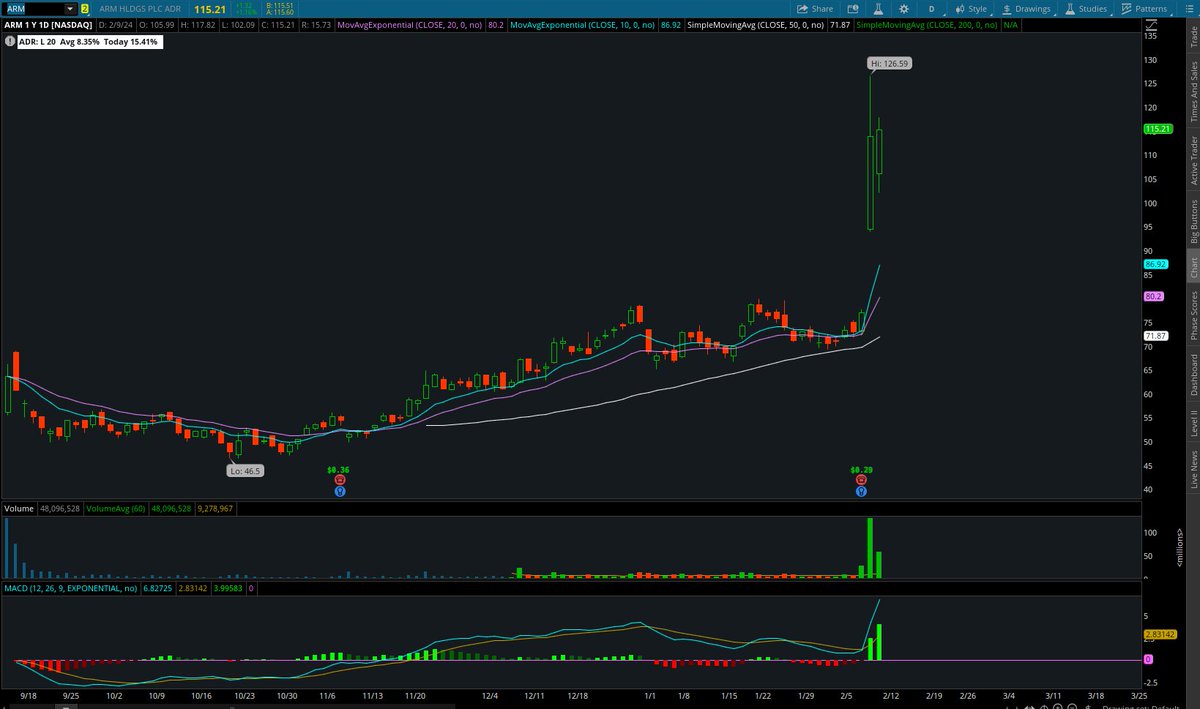
Earnings Season Has Been Fantastic So Far
Here are some of the best EP's that I have seen so far
$ARM $POWL $PLTR $SMCI $XPO $NET $TSM $AMZN $CLSK $NFLX $META $URI
Cybersecurity stocks big winners WTD:
$JNPR +26.21% & 52WH
$CRWD +14.98% & 52WH
$PANW +13.34% & 52WH
$ZS +8.92% & 52WH
$FTNT +6.70%
$NET +5.95%
Overall $CRWD $PANW are the two best cybersecurity stocks for 2024 IMO.
Current investment portfolio after the first week... holdings from largest to smallest:
$CELH $SMCI $TMDX $FOUR $UBER $LNTH $META $AMD $NU $MELI $TDW $ASPN $DKNG $ONON $U $SQ $NVDA $PLTR $ZG $SOFI $ELF $HIMS $EOLS $INDI $SDGR $PGY
Top 12 holdings: 69.2% of portfolio
YTD performance is -0.3%
I'd be down -2.1% if not for my hedges, I've been ~40% hedged with $ARKK $IWM $QQQE shorts because I was worried about some delayed profit taking in early 2024 with the new tax year. It might last another 1-2 weeks (or longer) so I'll keep my hedges for now while slowing averaging down in my highest conviction names (if they pullback further).
Stocks for 2024 (and thoughts on the market)
Here is a list of growth stocks on my radar for next year
$ADYEY $CELH $CRWD $DDOG $DLO $DUOL $FOUR $GLBE $MBLY $MELI $MNDY $NET $NU $NVDA $ONON $SNOW $TSLA $ZS
All of the above are growing rapidly, have long runways and seem to be promising businesses.
The stock market is currently overbought and IMHO we are due for a sell-off after year-end.
Still of the view that there will be an economic downturn next year but it'll be important to see how the stock market reacts to the deterioration.
If stocks ignore the weakening fundamentals, have shallow pullbacks in Q1 and trend higher, it'll imply that perhaps the stock market is front-running the Fed easing and looking past the downturn.
Recall that during COVID, when we had a global recession, due to Fed easing, the stock market took off and the top of the bull-market in late 2021, when the Fed conveyed it was getting ready to tackle inflation and become "tight", the stock market peaked and that was 5-6 months before the end of QE (when the economy was still strong). Therefore it is conceivable that in the event of a hard landing, the stock market may once again ignore the state of the economy.
Time will tell.
Depending on the data and the stock market's reaction, I will gradually scale into the above stocks next year (a few of the stocks above are currently very attractively valued).
If there is a recession coming, incoming labour market data will show it soon and in this scenario, I'll maintain my defensive portfolio positioning. On the other hand, if the data somehow defies all odds and confirms we have a soft landing, I will stop relying on the macro indicators (which thus far haven't produced a false signal), and manage risk by using a trend following approach.
So, there you have it. Q1 is when the rubber will meet the road and we'll find out whether (a) the trusty old macro indicators still work or not and (b) if the stock market is willing to look past any potential downturn.
*The above stocks are not buy recommendations, so do your own due diligence and homework and/or consult your registered financial adviser before investing - investments can hand out losses and it is your money.
Happy festive season and all the best for 2024!
In 2024, the #AI theme will move from "pilots" to "production.
I created a map for you to review.
$TSLA $UPST $SHOP $DUOL $ADBE $AI $HUBS $CRM $PATH $MSFT $DDOG $IOT $SYM $ORCL $AMZN $GOOGL $IBM $DOCN $OKTA $CRWD $S $ZS $NET $PANW $VRT $SMCI $ANET $NVDA $AMD $SNOW $ESTC $MDB $PLTR
In 2001, Warren Buffett gave a talk at the University of Georgia.
He asked them the most Warren Buffett question ever:
• If you could invest in a friend and get 10% of their income for life -- who would you pick?
Once the students answered the question, he then asked this:
• Why would you invest in that person?
• What character traits do they have?
Now they have a list of character traits to adopt.
Shortly after this, Buffett asked:
If you could short a friend's earnings, who would you pick and why?
Now you have a list of character traits to avoid.
----
1. Do not think this thought experiment is limited to money.
If you don't care about money -- you can use it for whatever currency you value instead.
E.g. Happiness coin
If you could get 10% of a friend's happiness, who would you invest in and why?
If you could short someone's happiness, who would you pick and why?
You can run the same thought experiment with Fitness coin, Friendship coin, Romance coin, etc`
2. This thought experiment is genius because it hacks a bug in life's video game:
Humans are terrible at self-awareness.
But we are great at spotting things in other people.
E.g. If your friend is in the wrong relationship, you can realize in 10 minutes what may take them 10 years.
Daniel Kahneman summarised his book on cognitive biases with the following:
“The premise of this book is that it is easier to recognize other people’s mistakes than our own.” - Daniel Kahneman
3. Nuance - It has to be purely from merit.
Buffett says it can't be because someone will inherit a large sum from their parents.
It has to be based on their behavior.
E.g. If you want 10% of someone's fitness coin, it's not because of incredible genetics -- is because of the actions they take.
Learn With Me
I’m often asked how I quickly synthesize information and form opinions. The value, to me, of doing this can be summarized as follows:
- Be more informed about technology, markets and the economy.
- Improve my situational awareness about trends and competitors.
- Have a clearer picture of how a company or sector is doing over another.
- Make better decisions.
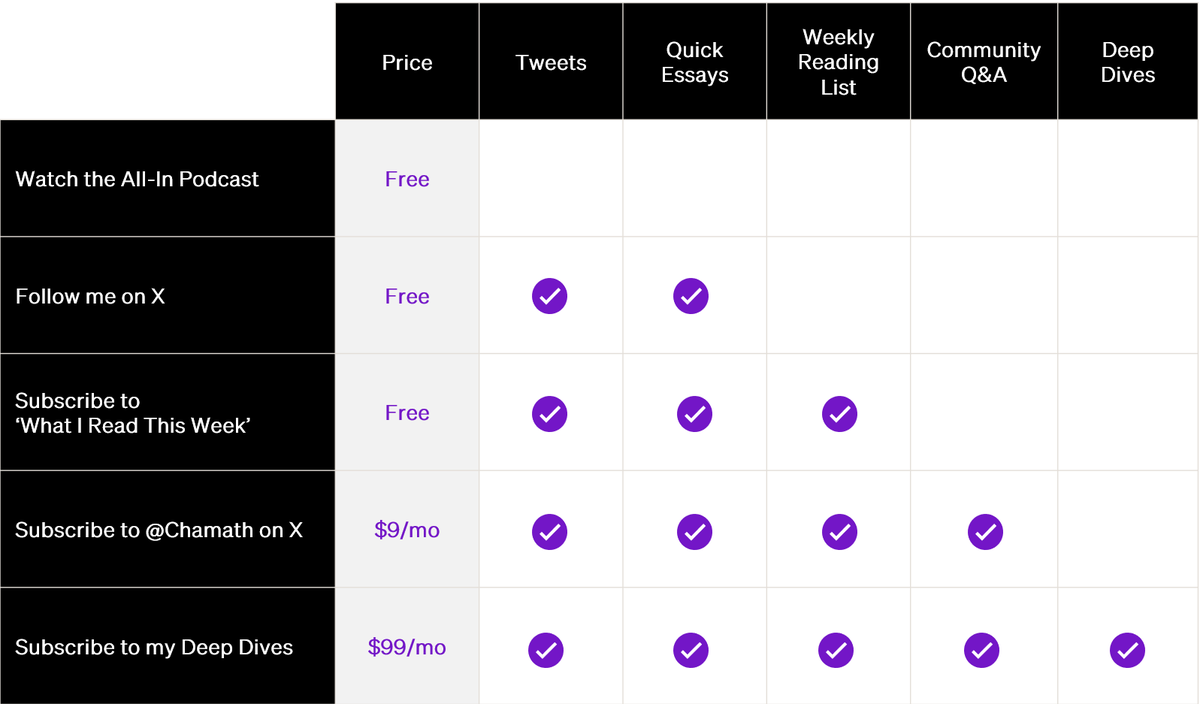
I’ve now systematized this into a product that I can share with you, to the extent you are interested.
Read below for more details…
The world is complex and moves at a rapid pace. One day, climate change is all the news; the next day, it's how AI is on the verge of upending everything we know about everything; then we need to become experts in superconductors because some meaningful breakthrough may be at hand.
Meanwhile, the geopolitical chaos in Europe, the Middle East, and Asia seems to be omnipresent and is constantly challenging the existing world order. Finally, we want to know what all of this means for the economy and the companies we work at or are invested in.
It’s hard to make sense of all of this, especially as the incentives of the mainstream media have become increasingly difficult to understand. So how do I form opinions? How do I learn complex topics quickly, usefully, and then fold that into a usable framework?
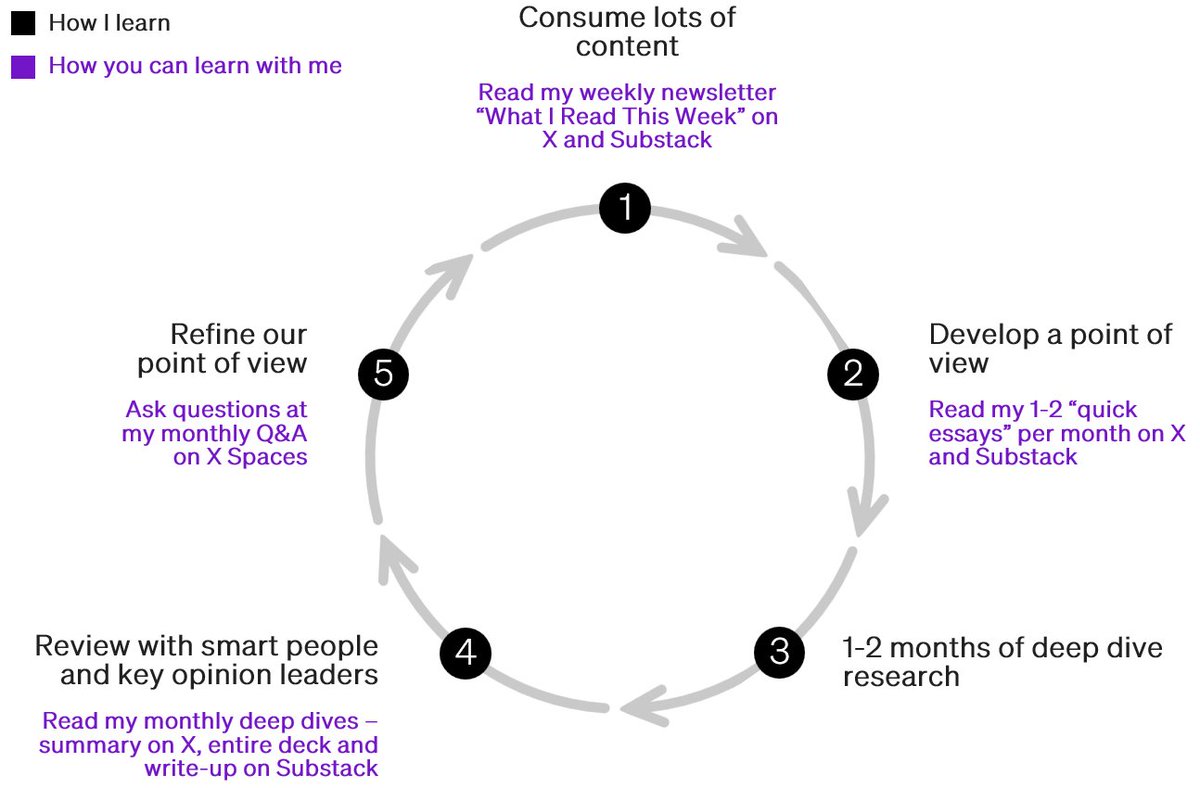
I start with consuming content. Everything from news articles to social media to scientific papers to institutional research to YouTube videos.
Most topics I skim and move onwards from, but for certain topics, where it makes sense, I write a quick 1-2 page essay because I feel it may be important. I do this so I can develop a quick point of view and understand the nuances a little bit better.
When something seems super interesting, I select it for a dive deep with my team, where we allocate at least a month or two to thoroughly understand the key drivers and opportunities, and produce a presentation that captures everything we’ve learned.
We then take our work and review it with a set of smart people and key opinion leaders to challenge and refine our views. Historically, these work products have been very educational to me. I suspect they could be educational to others as well.
So, to this point, I have decided to share more of the work that we do at Social Capital so that if you want to, you can learn along with us.
Here’s the plan:
1. I’ll keep posting my daily thoughts and observations on X.
2. I’ll continue to share a summary of the best content that I consumed in the previous week through my weekly newsletter ‘What I Read This Week’.
3. I’ll publish 1-2 quick essays per month on X and on my weekly newsletter ‘What I Read This Week’.
4. Once per month, I’ll host a Spaces to talk about the content we’ve produced, thoughts on the “current thing”, talk to guests and include time for Q&A. This will be the key feature of my Subscription on X. You can subscribe to me on X, and my first Spaces will be in November.
5. Once per month, I will publish a deep dive. This will be a comprehensive slide deck on a topic with an accompanying write-up.
My Deep Dives:
I've structured my deep dives around five primary themes I believe are useful for understanding the world today. These themes will change over time, but it’s important to have a starting point.
1. Deep Tech: I think about “deep tech” as applying science to take things that are scarce and make them abundant, overcoming major scientific and engineering challenges. Such progress often results in significant leaps forward in our capabilities and lays the groundwork for new businesses. It's vital to track these developments to see the potential world in the next decade.
2. Energy Transition: The global energy transition will reallocate trillions in capital expenditure, reorganize U.S. industry, replumb global supply chains, and more. To understand the trajectory of the world and make informed decisions about where to invest your time and efforts, a grasp on energy transition is critical.
3. Healthcare & Life Sciences: Healthcare spending constitutes ~20% of U.S. GDP and shapes the primary demographic shifts influencing economic progress. For example, global GDP diminishes by ~15% due to premature deaths in the working-age population. With new technologies like MRNA and CRISPR, new drugs like GLP1s, and the challenges posed by aging, overweight or sick populations, understanding healthcare and life sciences is as important as it’s ever been.
4. Economic Analysis: In 2021, we saw nearly every business model receive funding. In 2023, capital markets have been much more constrained, and many companies are struggling. Understanding how and why companies receive funding and why certain businesses are valued more than others is important for understanding how technology can be implemented in an economically productive way.
5. Socio-Political Trends: This is the overlay that ties everything together, from the demographic trends that drive consumption habits, to political trends that can act as a headwind or tailwind to economic growth.
I’ll be publishing our first deep dive on December 1st for free, starting with a teardown of the global energy transition. The full content calendar for the next year is outlined below, however, subscribers will be able to comment on what they want to be covered in future months. I’ll make sure to announce next month’s topic in advance so you know exactly what’s coming up.
You should expect beautifully formatted, easy to understand presentations that assume no prior knowledge, with accompanying write-ups that will get you up to speed quickly on each of these topics.
If you are interested, subscribe to my Substack (link in bio) where I will be enabling paid subscriptions in the coming month.
Disclaimer: The views and opinions expressed above are current as of the date of this document and are subject to change without notice. Materials referenced above will be provided for educational purposes only. None of the above will include investment advice, a recommendation or an offer to sell, or a solicitation of an offer to buy, any securities or investment products.