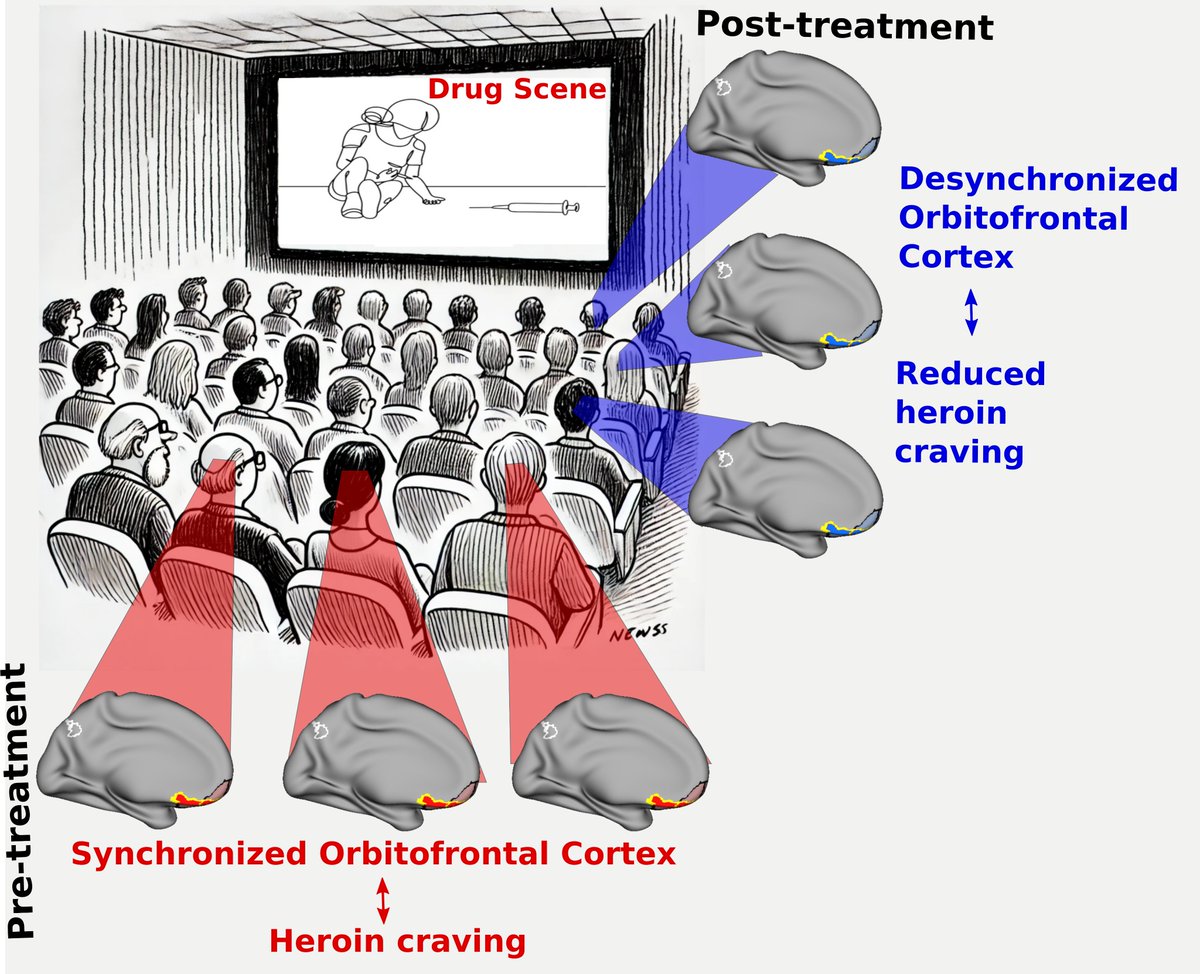
Film "Trainspotting" helps Mount Sinai researchers ID brain region biased towards drug cues & trtmnt effects in individuals w heroin use disorder; establishes new paradigm for studying drug addiction w naturalistic stimuli resembling real experiences. 👉https://t.co/y1gBwTL6FM
Kronberg et al. measured fMRI responses to a drug-themed movie in individuals with heroin use disorder. Responses in the OFC were biased towards drug scenes at baseline; reductions in this bias correlated with reductions in craving after treatment. https://t.co/5Zqi2Towsa
Naturalistic drug cue reactivity in heroin use disorder: orbitofrontal synchronization as a marker of craving and recovery https://t.co/6u5TNDlrhh #medRxiv
Ever wondered if there exist PFC gray matter differences between cocaine and heroin addiction? Look no further, our new paper in @Brain1878 will tell you all about it! With @bic_ismms@Yuefeng_Huang@greg_kronberg et al https://t.co/mjuPkKGUwU
Very excited to share our diffusion MRI study on the structural connectivity of the PFC and habenula in cocaine and heroin addiction translated to the human brain! @bic_ismms
https://t.co/PnMQGfpnlL
@BWJones Not sure which companies are doing/leading this rn, but neuromorphic computing seems very computational neurosciencey
@hisspikeness
https://t.co/sldGzQoiTv
@DavidBeniaguev Love this. I thought this line of work was amazing when i first saw it. Maybe taken for granted now 🤷♂️
https://t.co/beWpUXkKAz
https://t.co/nRK28JhYo7
Our new manuscript is out, by @Yuefeng_Huang and @aoceceli: Cortico-striatal engagement during cue-reactivity, reappraisal, and savoring of drug and non-drug stimuli predicts craving in heroin addiction https://t.co/2Qfmy8a33c… #medRxiv
@andpru agreed. although i'm really not sure what it means to play center vs forward anymore... other than being a slightly larger human😅 might be time to scrap these labels for awards teams