1. David Raya - Thank you
2. William Saliba - Thank you
3. Cristhian Mosquera - Thank you
4. Ben White - Thank you
5. Piero Hincapié - Thank you
6. Gabriel Magalhães - Thank you
7. Bukayo Saka - Thank you
8. Martin Ødegaard - Thank you
9. Gabriel Jesus - Thank you
10. Eberechi Eze - Thank you
11. Gabriel Martinelli - Thank you
12. Jurrien Timber - Thank you
13. Kepa Arrizabalaga - Thank you
14. Viktor Gyökeres - Thank you
16. Christian Nørgaard - Thank you
19. Leandro Trossard - Thank you
20. Noni Madueke - Thank you
23. Mikel Merino - Thank you
29. Kai Havertz - Thank you
33. Riccardo Calafiori - Thank you
35. Tommy Setford - Thank you
36. Martín Zubimendi - Thank you
41. Declan Rice - Thank you
49. Myles Lewis-Skelly - Thank you
51. Alexei Rojas - Thank you
78. Jack Porter - Thank you
THANK YOU MIKEL ARTETA
THANK ARSENAL
THANK YOU EVERYONE
What stood out to me was the method. Smart EHR friction, standard order sets guiding the physician is a much better way I feel. Wonder if such practices will be implemented more in INDIA
Vitamin D testing is frequently overused across U.S. health systems, with much of it occurring outside the bounds of evidence-based clinical indications.
Despite clear guidance from the Endocrine Society and the U.S. Centers for Medicare and Medicaid Services, routine screening in low-risk populations remains common and costly. Within Oregon, vitamin D testing has been identified as one of the top 15 low-value services, representing a substantial opportunity for cost savings and practice alignment.
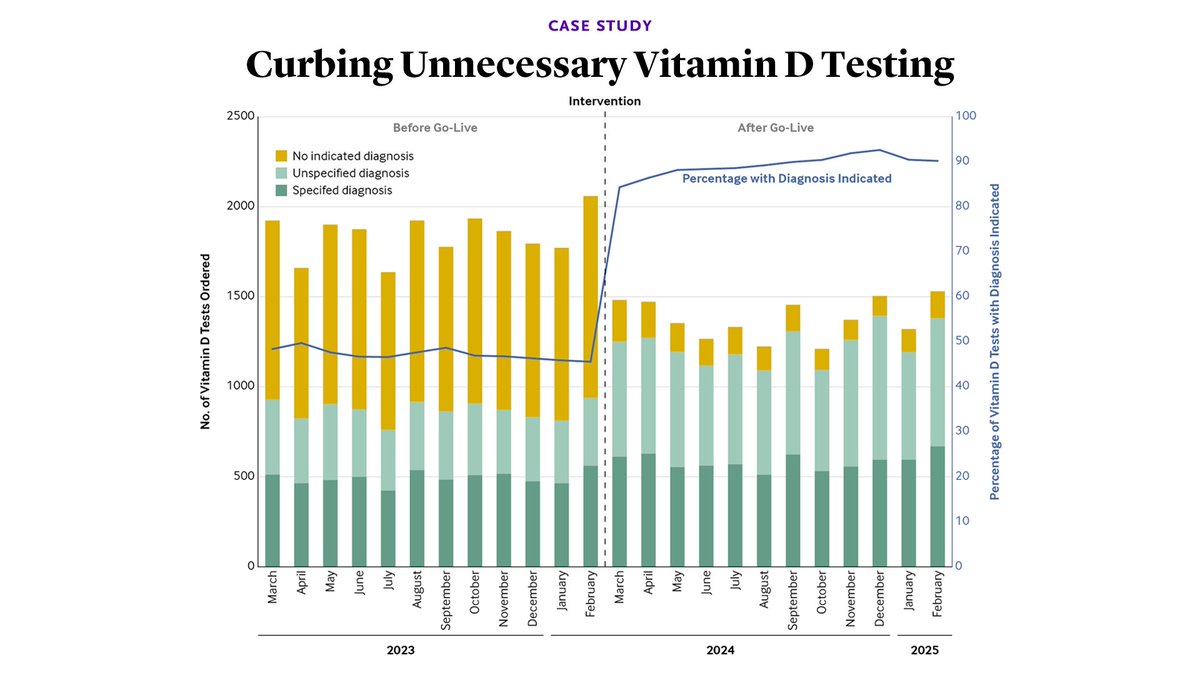
In an effort to reduce the volume of low-value vitamin D testing across a three-hospital academic health system, a multidisciplinary working group designed and implemented an electronic health record best practice advisory to fire at the point of order entry when a vitamin D test was attempted without an approved indication.
The initiative involved implementing a targeted clinical decision support intervention, aligned with evidence-based diagnostic coding curated using the U.S. Centers for Medicare and Medicaid Services coverage criteria and reinforced by coordinated communication and measurement infrastructure.
The proportion of indicated vitamin D tests increased from 45% in the final month pre intervention to more than 88% at 90 days post intervention, and remained above 90% at 1 year post go-live. Improvements were consistent across payer types, age groups, and locations of care, with the largest gains seen in outpatient and Medicaid populations.
In absolute terms, the number of vitamin D tests decreased by 25.3% when comparing the 12 months pre intervention with the 12 months post intervention. Along with this decrease was an estimated cost savings of nearly US$112,000.
Read the Case Study “Curbing Unnecessary Vitamin D Testing” by R. Hasan et al. in the February 2026 issue of @nejmcatalyst Innovations in Care Delivery: https://t.co/mhs06VkJaM
Explore the full issue: https://t.co/BMMejTBkuQ
@NEJM TL;DR
Vitamin D is massively overtested and overtreated.
Low vitamin D is usually a marker of poor health, not the cause.
Vitamin D supplementation should be targeted, not routine:
Children (rickets prevention), Pregnant women ,Selected high-risk prediabetes, Older adults (65+)
@theliverdoc TL;DR
Vitamin D is massively overtested and overtreated.
Low vitamin D is usually a marker of poor health, not the cause.
Vitamin D supplementation should be targeted, not routine:
Children (rickets prevention), Pregnant women ,Selected high-risk prediabetes, Older adults (65+)
@karthik2k2 stuff like end of life care and a proper will. So the bystanders are having to make a lot of decisions in a short span of time and there is a burden of emotions on them.
@karthik2k2 People have to be made aware about death and how to deal with death. How old age will be and how all of that is a natural process. Part of the problem also lies with the system where proper info is not shared with bystanders. Another thing is unlike west we don't prepare for ....
I'd thought of sharing my NEET PG Preparation strategy today. But at this point, You could just sleep the whole duration of the exam and still qualify 🙂
It looks like Medical education has turned into a business for some people....where they have to make sure maximum seats are being taken up. What is the standard these regulatory bodies are setting? Makes our System look like a joke in the eyes of others !!
NEETPG-25 cutoff scores have been lowered to the 7th percentile, 5th percentile, and 0 percentile.
I find this grossly unethical.
On one hand, tens of thousands of students sacrifice everything and work extremely hard to compete.
On the other hand, such low percentiles mean that the well-off can get into any branch they want.
Degrees as coveted as an MD or an MS should have minimum requirements.