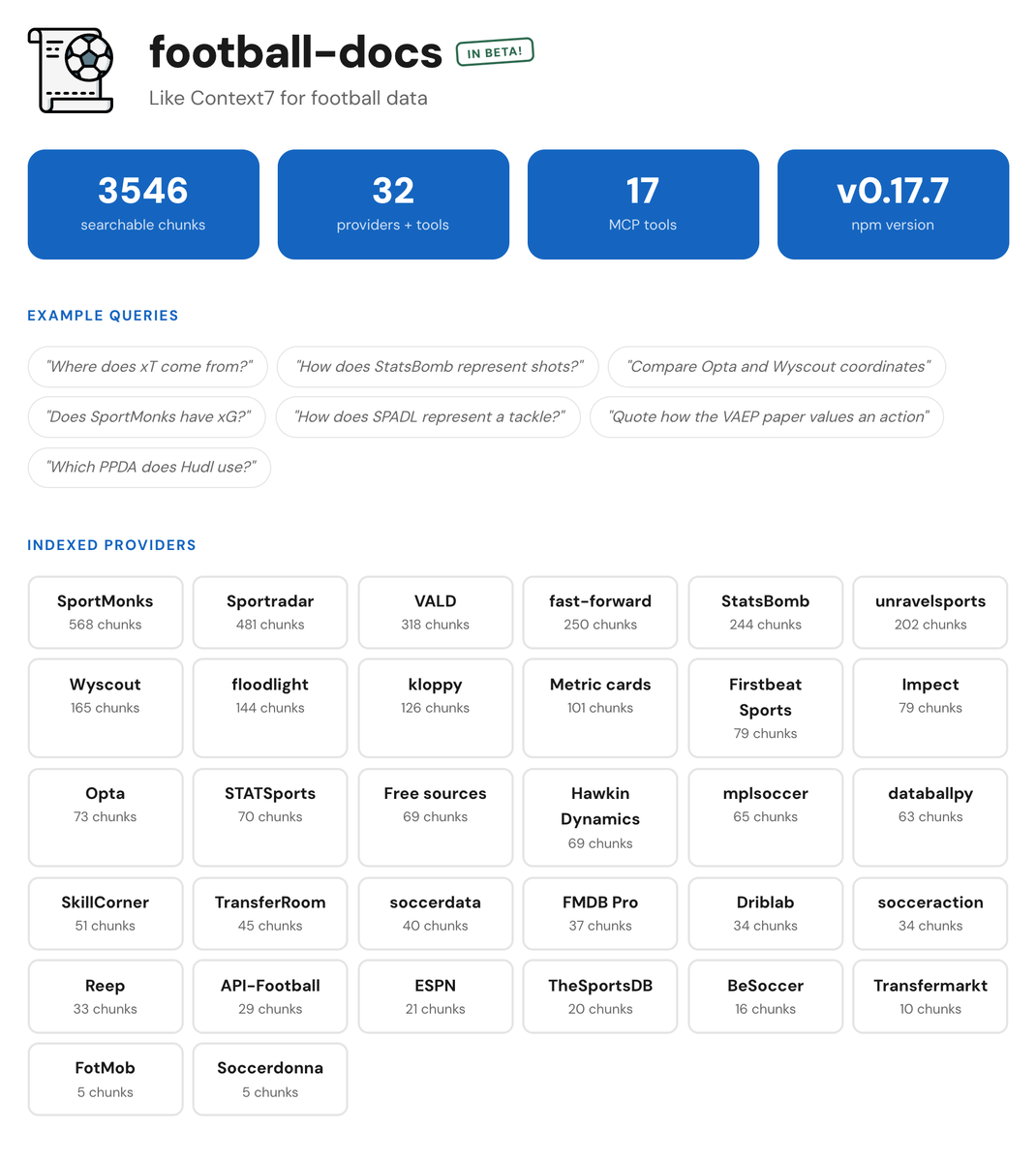
football docs 0.17.7 is out ⚽
if you've not heard of football docs: it lets your AI coding tools search real football data provider docs instead of guessing from training data
- new provider: @ApiFootball access, data model and identity docs, checked against the API (thanks Ivan Muñoz!)
- resolve_entity reads reep's new release layout, and venues are now an entity type (thanks Felipe Allegretti for the fix!)
- upstream refresh: skillcorner dropped its game intelligence v1 endpoints, driblab added percentiles, and statsports, sportradar, hawkin dynamics (api 1.17) and soccerdata (2026.43.0) are all updated
now at 32 providers, 3,546 searchable chunks. updates reach your MCP install automatically, no download needed
https://t.co/lpbLS1BRET
Everyone should check out this new game: Crude Desk
The game is modeled after fast-paced trading floor tests used by commodities firms during job interviews. You play as a junior trader supporting a head trader on a desk, making rapid-fire decisions as complexity ramps up each level
Crude Desk was created by Deacon Larson, a University of Southern California student and former commodities trading intern
Try to beat me on the leaderboard! #oott
trading through extreme chaos.
much of my insufferable schtick on here is...
“you can get away with doing very simple things if you pick the right place to do them”
you can also get away with doing very simple things if you pick the right time to do them.
So you want to build a strategy, but are not sure where to source inspiration or ideas from? Here are some top sources I have found overtime. Many of these will provide full strategy parameters, some will spark ideas, some will simply teach you things you didn't know.
SSRN (https://t.co/pkUCNBglGm)
A main home for academic finance papers, free to read. Search specific keywords for things of interest.
arXiv (https://t.co/BoQd4Jb2Nr)
A main home for academic finance papers, free to read. Search specific keywords for things of interest.
Concretum Group (https://t.co/rnoiuw8pqR)
The authors have published several intraday papers on various things including opening range breakout and intraday momentum.
Ernie Chan's blog (https://t.co/nvf7AOUZFX)
Free posts on mean reversion and momentum from a well known quant.
Quantocracy (https://t.co/5GY7DzWTjN)
A daily aggregator of quant blog posts. Good way to discover new authors.
QuantConnect (https://t.co/iOQOVTlyvf)
Research articles written by various traders sharing ideas, strategies, and concepts.
Unger Academy (https://t.co/HAdRfHD3FQ)
Free articles from a well known futures systematic traders covering strategy breakdowns and concepts.
Robot Wealth (https://t.co/GyMqUdcQpD)
Free practical, code driven articles.
Alvarez Quant Trading (https://t.co/grinXHvhbV)
Free blog with tested equity and futures ideas.
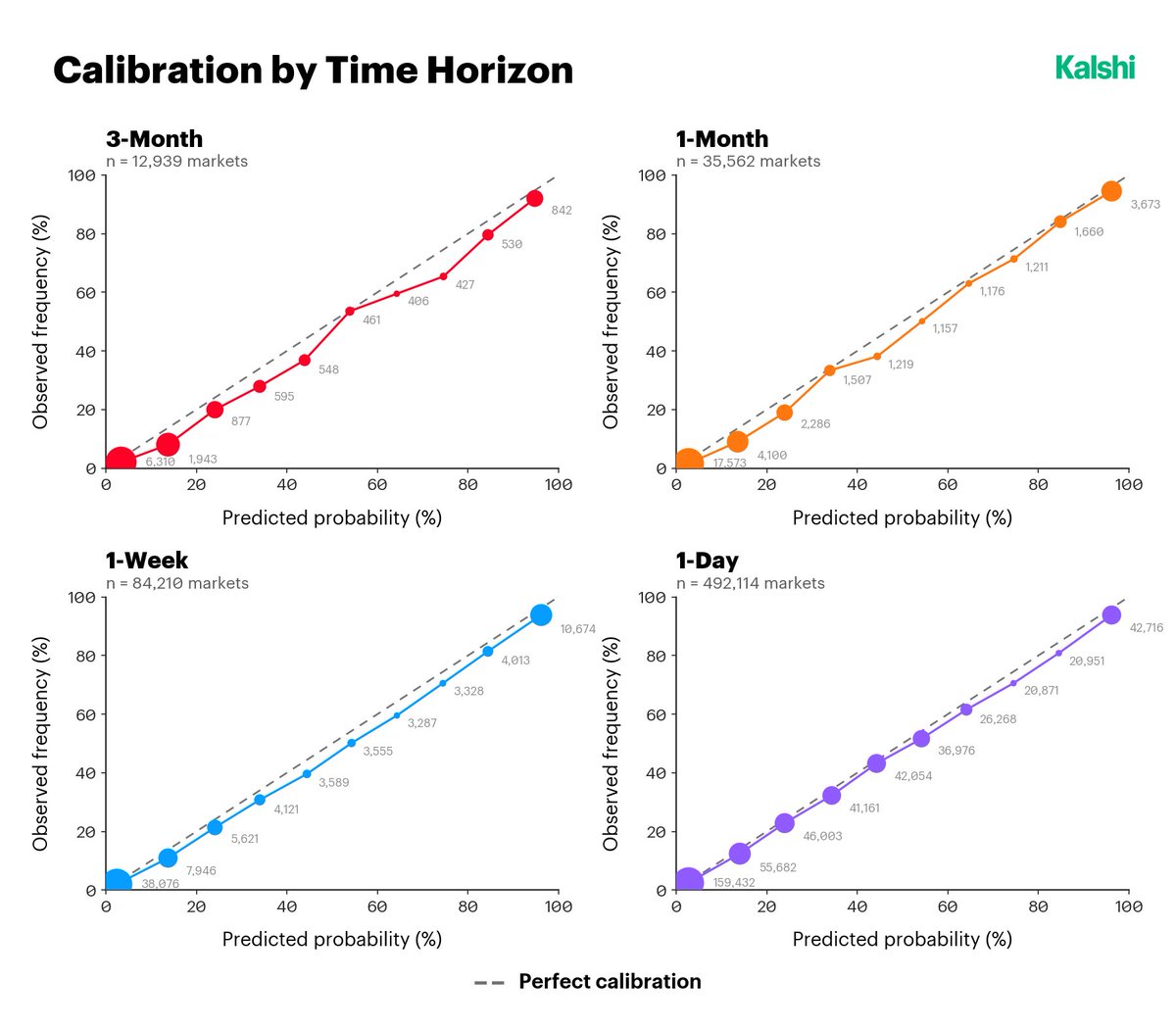
We ran a study on over 2 million markets to evaluate their calibration. To our knowledge, this is the largest replicable study on this topic.
Here are the results: 🧵
1/ Synth's HFT team has found that @Kalshi’s 15-min BTC market is beginning to predict subsequent BTC moves on @binance and all other CEXs.
And strength of this predictive relationship has grown materially throughout 2026 (see image).
@Kalshi is becoming the venue for BTC price discovery on short time horizons.
🧵
Sure. A selection of books I've read in the last few years. You don't have time to make every mistake yourself - reading keeps the idea engine running 🫡
Options Trading
Options Trading // Sinclair
Volatility Trading // Sinclair
Positional Options Trading // Sinclair
Trading Volatility // Bennett
Day Trading Options // Augen
Black Scholes & Beyond // Chriss
Markets & Trading General
The Laws of Trading // Lebron
Practical Speculation // Niederhoffer
Trader Construction Kit // Rubano
Chronicles of a Million Dollar Trader // Miller
Stocks on the Move // Clenow
Rediscovering the Wheel // Thurlow
Reminiscences of a Stock Operator// Lefevre
How to Trade Stocks // Livermore
Best Loser Wins // Hougaard
Buy the Fear Sell the Greed // Connors
Secrets of the COT report // Williams
The Misbehavior of Markets // Mandelbrot
Principles of Professional Speculation // Sperandeo
Think & Trade like a Champion // Minervini
The Speculator's Edge // Pacelli
The Complete Turtle Trader // Covel
Profiting in Bull & Bear Markets // Weinstein
The Perfect Speculator // Koteshwar
How to Make Money in Stocks // O'Neill
Trend Following // Covel
Mastering the Trade // Carter
A Complete Guide to the Futures Market // Schwager
Unknown Stock Market Wizards // Schwager
Statistics
Doing Bayesian Data Analysis // Kruschke
Statistical Rethinking // McElreath
Bayesian Data Analysis // Gelman
Regression & Other Stories // Gelman
Sports Betting
Sharper // TruePokerJoe
Winning Sports Betting // Kanemoto
Monte Carlo or Bust // Buchdahl
Without a Tout // Miller
Betting Baseball 2007 // Murray
The Logic of Sports Betting // Miller
Trading Bases // Peta
Investing in College Basketball // Seidel
Precision // Wong
Trading Psychology
Trading in the Zone // Mark Douglas
Psycho-Cybernetics // Maltz
Thinking Fast & Slow // Kahneman
Enhancing Trader Performance // Steenbarger
The Daily Trading Coach // Steenbarger
The Book on Mental Toughness // Frisella
Alpha Trader // Donnelly
Mastering the Mental Game of Trading // Goldstein
General
The Only Skill that Matters // Levi
The Man Who Solved the Market // Zuckerman
The Mathematics of Poker // Chen
I think a useful mental model for trading is to focus first on moving away from the things that reliably produce failure, rather than trying to move toward the things that appear to produce success.
Both approaches may seem equivalent, but they lead to very different decisions. Trading is taking risk and risk is exposure to luck. Therefore, outcomes are not directly controllable. The only thing you fully control is your error rate. So that's where most of the work should go, right?
Tennis is a great analogy here. In professional tennis, players mostly win by producing exceptional shots. In amateur tennis, matches are usually decided by who commits fewer unforced errors. The winning strategy is simply to keep the ball in play and stop taking dumb shots.
In that sense, good trading is often less about discovering the perfect action and more about systematically eliminating the actions that are known to be destructive. You approach success indirectly by systematically removing the behaviors that make success harder.
So much chatter about index rebalance this week. In the words of an old colleague, “many [candidate] portfolio managers can talk a great game about index rebal, but very few can do it well” (I know you are reading this). A short 🧵
1/
It's been a long time since I wrote anything remotely informative on X. I have something minor that sits somewhere in between [finance] signal analysis and statistics, which is also very practical, simple, and with a familiar ending. A loong 🧵 👇.
1/18
You start out with the 101 stuff: line grinding. Sharp books have more information because they let informed participants stay and get paid. So you can shop relative value until you wear out your welcome at soft books. Or try your hand at bonus sniping (used to be common in online poker back in the day too fwiw). Kiosk raiding.
Then you look deeper. Inefficiencies. Underpriced correlations. Rule changes. Flawed statistical distribution assumptions. Latency arbs (steam chasing). Stat arbs (ml vs spread).
Then there are models. Models against relatively soft markets are great. They start to get eaten up as liquidity increases, as one would expect. Underappreciated inputs can move the needle here, but it’s a game of outrun.
Finally, you come to the realization that the most robust errors your counterparties are making are behavioural psych related. These errors persist, are subtle, and are exceedingly hard to iron out of sports markets.
Then you start noticing them in other markets too 🤫