The founder of TSMC got no equity in the company. He was 56 years old. He's worth ~$10B today from buying TSMC stock with his own money.
Ben Thompson called him "a one of one" who belongs on the Mount Rushmore of the greatest tech executives of all time.
This is his story.
Morris Chang was born in Ningbo, China in 1931 and spent much of his childhood fleeing war. At 18, he arrived at Harvard as the only Chinese student in a freshman class of over 1,000.
In 1955 he had two job offers, one from Ford and one from a transistor maker that paid $1 more per month. Ford refused to match, so Chang took the other job.
He spent the next 25 years at Texas Instruments (TI) and eventually rose to run its worldwide semiconductor business. Then his ascent stalled.
TI moved him out of semiconductors and into a job he later described as being "put out to pasture." Two years later, he quit.
He landed next at General Instrument in New York, living on the 53rd floor of Trump Tower, where Donald Trump was his neighbor. The job lasted about a year.
It was there, in 1984, that Gordon Campbell asked him for $50 million to start a chip company. A few weeks later, Campbell called back and said he only needed $5 million. Why? "I'm not going to build a fab."
Taiwan had been trying to recruit Chang for years, determined to move beyond cheap plastics and running shoes and build a high-tech economy.
The government had asked him outright to run its industrial research institute, ITRI, back in 1982, while he was still at TI, and he'd said no. After General Instrument let him go, it asked again. In 1985, he said yes.
Donald Lee-Brown, who runs research at Positive Sum, likes to say the very best entrepreneurs can divine where the puck is going.
Chang saw that chip design and chip manufacturing were going to split, and someone would need to do the manufacturing for everyone else.
On his second day at ITRI, he inherited requests from three chip companies, each asking the institute to help fund its own fab.
Instead of building three factories, Chang proposed building one they could all share. That idea became TSMC.
Taiwan put in $70 million for 48% of the company. Philips invested $40 million, and private investors contributed another $35 million. Chang, despite founding and running it, got none of the equity.
Intel, TI, Motorola, AMD, Panasonic, and Sony all passed on funding it.
TSMC grew revenue 49% annually for its first decade. By 2000, most of its revenue came from fabless companies like Qualcomm, Broadcom, and Nvidia.
In 1997 Chang got a letter from the CEO of a four-year-old company that was facing bankruptcy and whose calls TSMC's sales office had been ignoring. Chang called the number printed on the stationery.
Jensen Huang picked up amid a bunch of shouting, then said to his team, "Quiet, Morris Chang is calling me."
Chang stepped down as TSMC's CEO in 2005. Four years later, at 77, he came back. One of the first problems waiting for him was Nvidia.
A manufacturing failure had damaged the relationship, and TSMC's management had refused Jensen’s request for compensation.
Chang emailed Jensen and told him he would be at his house at six. Salad and pizza at 6:30. Business at eight sharp. In Jensen's study he offered more than $100 million, good for 48 hours, no negotiating.
Jensen accepted it in two days.
Back in the CEO seat, Chang nearly tripled capital spending in a single year to own the 28-nanometer node.
In his memoir he quotes Shakespeare on the decision, "there is a tide in the affairs of men which, taken at the flood, leads on to fortune." The tide turned out to be the smartphone.
And then Apple literally showed up at his front door. Chang's wife, Sophie, is the second cousin of Foxconn founder Terry Gou.
One evening in 2010, Gou invited himself to dinner and brought Apple’s COO, Jeff Williams. Eventually, over lunch at Apple, Tim Cook told Chang: "Intel just does not know how to be a foundry."
Today, TSMC manufactures the A- and M-series processors at the heart of Apple's iPhones, iPads, and Macs.
When Chang founded TSMC, the global semiconductor market was about $26 billion. Last year it reached $795 billion. Roughly 30x since 1987.
Philips did even better. Chang estimated that by the time Philips sold its final TSMC shares in 2008, it had earned 135x its original investment.
@ivochermont ILTB tem varios. Qualquer um com o Gavin Baker, Josh Wolfe... mesmo os mais antigos. Alguns do Dwarkesh falam mais de tech, mas outros falam de investimentos.
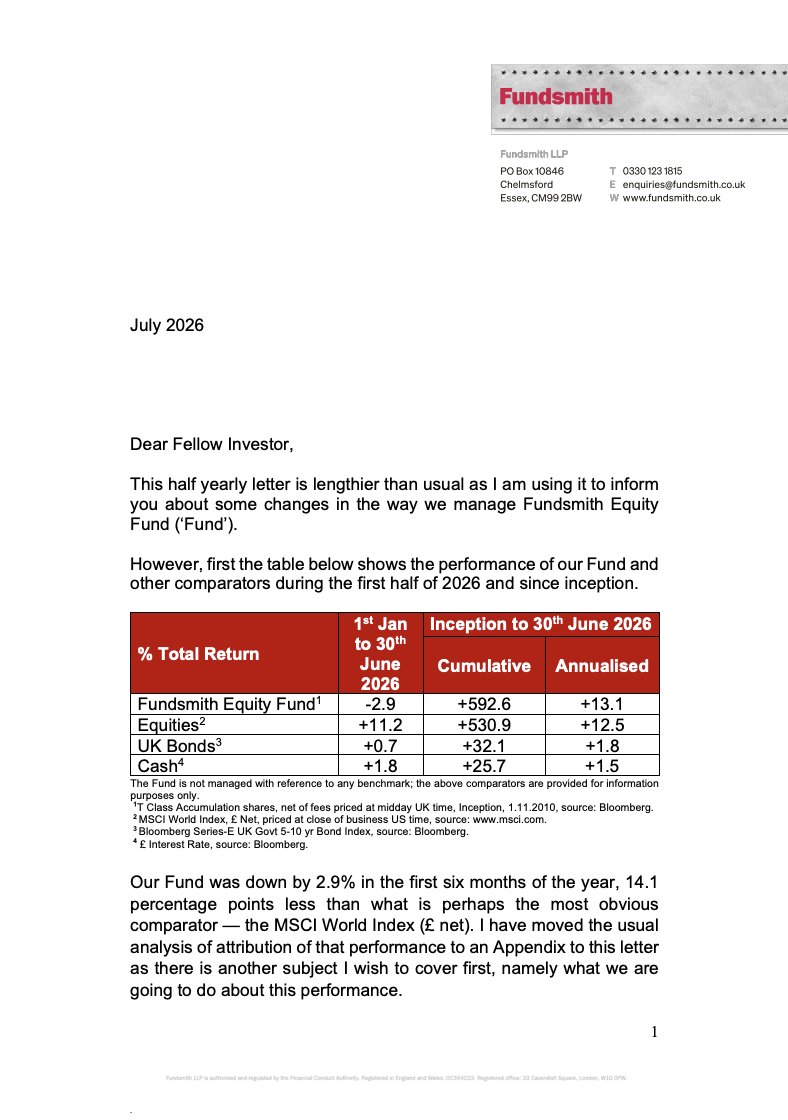
Just finished reading the already-famous Terry Smith letter. Some thoughts below in no particular order:
1. The letter is filled with contradictions. You can't bash momentum and then claim that you'll be more momentum driven to end the AUM bleed (I mean do it, don't say it). You are basically implying that you'll chase a strategy that you don't believe in because you are "forced" to (yikes)
2. He is right in claiming that flows are not driven by active investors, but that is what it is and has been that way for a long time since algos took over. Should not really matter LT. Tbf he does admit in the letter that it has become tougher to play the LT game as a professional investor (which I do believe is true)
3. Summarizes fundamentals across three metrics: profitability, returns, and growth. I think he is definitely right with the metrics, but he probably has given little weight in the past to growth, which is key to shareholder value creation. A 60% ROIC means nothing if there are no reinvestment opportunities available
4. Also right in claiming that indices are more concentrated today and therefore an index investor is making an active investment decision on a handful of companies. This is neither good/bad, it's just what it is
5. Momentum is indeed at the helm (just have to look at the performance of the SPMO vs the SPY) but it's a hindsight metric. You know it works after the fact, but it can stop working. He claims that he doesn't know when it'll stop working but that it will, while at the same time becoming a momentum investor (weird?)
6. "We will be much less willing to deploy the time-honoured technique of buying quality companies when they hit a glitch. In the current momentum driven market buying shares in companies which have hit a glitch is like trying to catch the proverbial falling knife." Who would've imagined a couple of years ago that Terry Smith would be writing this?
7. Claims that Texas Instruments $TXN is "not involved directly in AI." The reason why it has worked is probably because it is directly involved and it has a +$1B data center business growing at 50%+ rates. Wonder if they actually understand what they are buying at this pt.
8. In the company snapshot he again shares several metrics to claim they have a high quality portfolio but again ignores growth. Yes, he later claims that they expect FCF growth of 14%, but where is that FCF growth coming from? (the source matters)
9. A lot of the explanations of why they sold positions scream "capitulation"
Closing thoughts: very weird letter not because he is changing his style (could be a great idea in hindsight) but because he is doing so with (apparently) no conviction whatsoever. Likely a sign that "quality" is about to turn the corner.
We'll see!
@LOGOinvestor I think there’s a healthy debate to be made here. I read a comment where you disregarded Meta, for example. But today you have Meta for 18x. MSFT 22x. NFLX 21x. Seems to be what market is paying for a 16%ish five year profit cagr TODAY.
I like Netflix btw. But, is it better?
@donnapaulparody@LOGOinvestor@netflix Today:
2Q net adds showing to be slowest since 2022, and watch time/engagement under pressure.
Structurally:
Short dramas - kids cant focus for longer than 5min novelas;
Acquisitions dramas;
Slower growth. Profit grew 32% cagr past 5y. Fwrd is probably 16/17% cagr next 5y
@R1chardMaur1ce@LOGOinvestor@netflix Using a chart with some drawings is the definition of gambler.
3 issues with netflix:
Slowing growth
Short-dramas (dopamine wars)
Acquisitions attempts = change ins strategy and failures
+ M science reporting today 2Q net adds slowest since 2022.
@FelpsCrypto FT:
A Meta spokesperson said the share sales talks were "pure speculation", but added “weve been clear that huge opportunities lie ahead in AI, and we'll continue focusing on raising capital in the most flexible ways to support that".
Nao precisa de AI pra reescrever artigos