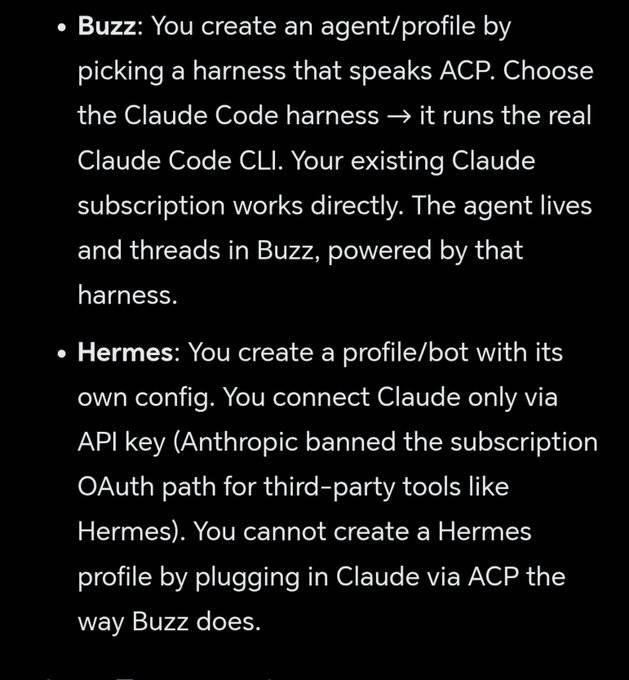
I absolutely cannot wait for @NousResearch to implement creating/setting up profiles/bots via ACP the way Buzz does instead of only Auth/API.
Imagine having Claude in the loop via existing sub while jumping back to OG codex threads in its own harness. The perfect ecosystem.
PLEASE MAKE IT HAPPEN @Teknium 🙏
DAY #1 of requesting this. gonan keep reposting till its implemented
ik i already mentioned this before but pretty pleaseeeeeeeeeeeee
@Teknium Struggling to get use of the features that require multiple profiles.
@Teknium1 any tips on how you structure yours, what to include vs. skip, and where people share ready-made ones?
# on shortification of "learning"
There are a lot of videos on YouTube/TikTok etc. that give the appearance of education, but if you look closely they are really just entertainment. This is very convenient for everyone involved : the people watching enjoy thinking they are learning (but actually they are just having fun). The people creating this content also enjoy it because fun has a much larger audience, fame and revenue. But as far as learning goes, this is a trap. This content is an epsilon away from watching the Bachelorette. It's like snacking on those "Garden Veggie Straws", which feel like you're eating healthy vegetables until you look at the ingredients.
Learning is not supposed to be fun. It doesn't have to be actively not fun either, but the primary feeling should be that of effort. It should look a lot less like that "10 minute full body" workout from your local digital media creator and a lot more like a serious session at the gym. You want the mental equivalent of sweating. It's not that the quickie doesn't do anything, it's just that it is wildly suboptimal if you actually care to learn.
I find it helpful to explicitly declare your intent up front as a sharp, binary variable in your mind. If you are consuming content: are you trying to be entertained or are you trying to learn? And if you are creating content: are you trying to entertain or are you trying to teach? You'll go down a different path in each case. Attempts to seek the stuff in between actually clamp to zero.
So for those who actually want to learn. Unless you are trying to learn something narrow and specific, close those tabs with quick blog posts. Close those tabs of "Learn XYZ in 10 minutes". Consider the opportunity cost of snacking and seek the meal - the textbooks, docs, papers, manuals, longform. Allocate a 4 hour window. Don't just read, take notes, re-read, re-phrase, process, manipulate, learn.
And for those actually trying to educate, please consider writing/recording longform, designed for someone to get "sweaty", especially in today's era of quantity over quality. Give someone a real workout. This is what I aspire to in my own educational work too. My audience will decrease. The ones that remain might not even like it. But at least we'll learn something.
I think it is time to talk about the rate limits on Codex now.
Back on gpt-5.5, on the $200/month plan, I could freely run 2-3 gpt-5.5 agents on xhigh on fast mode nearly 24/7. I would never even have to personally think of the usage limits that I had and would even struggle to think of things to do to burn the limits when I was close to a 7 day reset. The 5h limit was not even a consideration at all, it is as if it never existed to be honest.
Now on gpt-5.6 Sol, on the $200/month plan, I run 1-2 High agents on normal speed maybe 12-16h a day. With the same credit count per million tokens as gpt-5.5, that should mean that my usage limits last more because
1. 1-2 agents instead of 2-3
2. high thinking instead of xhigh
3. normal speed instead of fast mode (2.5x more limit usage btw)
I also heavily optimize my local Codex settings and systems, thanks again to @theo for his article and YouTube video on those. So theoretically on paper my limits should last significantly longer, also because OpenAI claims the model is more token efficient than 5.5. However, I still absolutely burn through my limits insanely fast. Back when the 5h limit was still in place (which they said they temporarily removed but haven't added it back) I could burn it in 2-3h with just 2 Sol agents. I am aware that 5.6 loves subagents, and the parallelism of more agents at once could lead to significantly higher token utilization counts, but even then why are my limits still being blasted through so much? I really don't understand how this is happening.
All of the resets @thsottiaux has been giving us is just to tide us over. The removal of the 5h limit alongside the banked resets every week, the global resets every other day for users, is still barely enough for users, people are constantly begging and asking for resets. Users are also highlighting the problems once the 5h limit and mass resets are gone, people will no longer be able to sustain any usage on the plans. I am personally also very scared of what will happen when both of the above get reverted back to normal.
I think that there are a few solutions to this.
1. More detailed and customizable usage tracking. The concept of a 5h limit on paper is fine, a lower and smaller limit to make sure that the user does not burn their entire weekly in a day. But people found it too restrictive.
The solution: Allow users to simply choose the amount of limits they want, provide users with a number of the weekly limit. Users can add on another limit bar and then set how much percentage of their weekly it should be limited to. For example, I can set a 1 day limit to 14.2% of my weekly (around 1/7 of 100%), this would make it so that I manage and ration my limits out well.|
2. Model transparency and displaying of how much tokens and cost they actually do per thread and task in Codex. Claude has /usage which shows the user the API equivalent cost, Codex does not have this feature, I think that this is actually really useful and helpful for users to see costs. Each chat and thread in Codex should also display more detailed usage. I would love to see my cost per per message, the cached message and on my limits, 3 different rate limit estimates which are also customizable. A past day estimate of tokens in the last 24h vs the tokens a user has left to see at the past day's rate how fast the user would run out. A past hour estimate and a 5min estimate. This would allow users to easily just get an estimate of real time use for the past day, hour and 5mins to match their current and existing usage patterns. Some people use it very consistently, some people us it at peak times, some just use it when they use it. This would allow for users of all types to see their estimated time their limits will run out.
3. More transparency with limits. Codex currently operates on a system of "Credits" where 1 credit is $0.04 in API equivalent. I personally think that this is a layer built just for obfuscation and confusion, no one knows the Credits that they have, and let alone the amount of money that is worth. And if possible they should make the limits in terms of Credits, or even better just dollar amounts.
This would allow for users to truly understand how much actual money they are burning instead of just a 100% bar that they don't know how much it communicates and converts to.
4. Fix 5.6's token usage problem on a model and inference side.
This comes with some drawbacks, mainly to OpenAI as a company and not to users, people might end up being able to min-max their subscriptions even more and end up draining OpenAI's money. But us users have already been able to reverse engineer the usage limits. Where the $200 plans give like $14k in equivalent API credits so honestly not much effect on that front.
@sama Yeah, but the prices you put out for your new models, as of right now, are not reflective of what a lot of people are experiencing with them in Codex. The usage burn seems to be much much higher than your previous generation.