🏆1st place in the AI Scientist track at Ralphthon @ ICML2026 — $10,000 in OpenAI credits.
@happyhappy_jun & @WoominSong from @KAIST_AI
We've open-sourced all of it: harness, code, the full log of research traces.
See our post: https://t.co/HIzZ7dOELn
How we did it 🧵
Can explicitly learning future point motion improve the model that generates those future images?
We introduce VPM (Video-Point Model), a 4D world model that jointly forecasts future multi-view videos + persistent 3D point trajectories.
Short answer: yes. Teaching a video world model to forecast 3D point tracks makes its videos more faithful & 3D-consistent, and makes robots better.
🌐 Project: https://t.co/srVtzZsY5c
🧵 [1/6]
Conspiracy Theory: Opus 5 started reward hacking during training to maximize token usage - especially with IPO coming up ;)
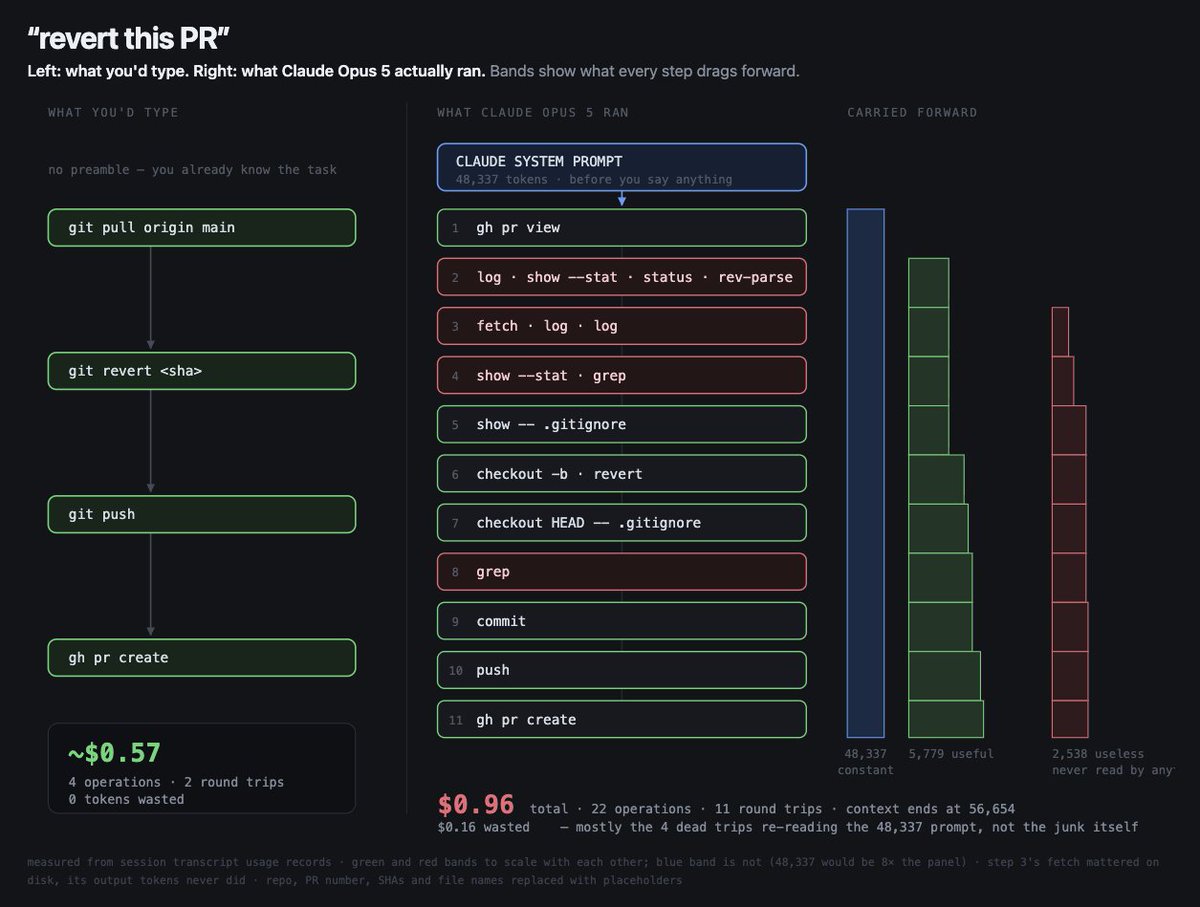
I've been using Opus 5 quite a bit since it came out two weeks ago. I've noticed it has a tendency to overthink and prefers to plan deeply even for small corrections to re-steer it - leading to massive tangents throughout its trajectory.
In one instance I simply asked it to revert a pr (i know im lazy). In a typical developer workflow this would be a sequence of maybe 4 commands to:
1. git fetch && git pull origin main
2. git revert <sha>
3. git push
4. git merge
Opus executed 11 bash commands - half of which were redundant and continuously blew up token cost. Granted, some of these commands were fair given revert is a somewhat sensitive task so I expect some additional verification tools so we aren't running risky world state mutations.
However this gets expensive. Even with the 10% KV cache prefix discount, every redundant tool turn carries forward both it's own output and the system prompt: which includes CLAUDE.md files, skills, and other agent metadata.
Now if this is happening to such a simple task, then what happens happening when you /goal a long horizon task?
This past week, I've been in incident mode trying to setup our own OTEL SDK to emit traces from a customer's agent to my local ingestion pipeline so we can compute reference free outcome metrics based on user behavior and engagement with an agent. While the logic can get quite complex between many moving parts, I spent quite a bit of time hand crafting a rigorous design spec for the telemetry shape and fundamental signals required to compute these metrics.
However, I found that Opus would constantly argue with me and continuously expand scope to where I would have to relearn entire modules just to tell it to go back to my original design. I was wrestling with it for 3 days before my Codex limits refreshed so I presented Codex (GPT-5.6 Sol) with the task... and it was able to close out my 3 day struggle on the first try - with only a few re-steers for detailing.
The ironic thing is: Opus5 claims a 10% boost in performance on Frontier-Bench, their headline performance indicator, compared to GPT5.6 Sol. https://t.co/AERcqjSKYe
It's a symptom of a broader problem - that benchmarks, which are the predominant marketing strategy for model releases, genuinely do not reflect broader model performance. In the end, some degree of process supervision and actual usage is needed to make sure the model is staying on track and actually advancing user intent. The expensive part of an agent isn’t just the tokens it generates, it’s the human attention required to keep it from inventing work.
Disclaimer: I tried to have Opus 5 write this post for me. I eventually gave up and hand wrote it. The images below are from Opus so take the tokenomics with a grain of salt.
Fine-grained subtask annotations improve VLA performance.
We trained a vision + proprioception model that’s now SOTA at generating them, generalizing across embodiments.
93.1 F1@50 on REASSEMBLE, 98.6 on @Amazon Robotics blade insertion. Details below 👇🧵
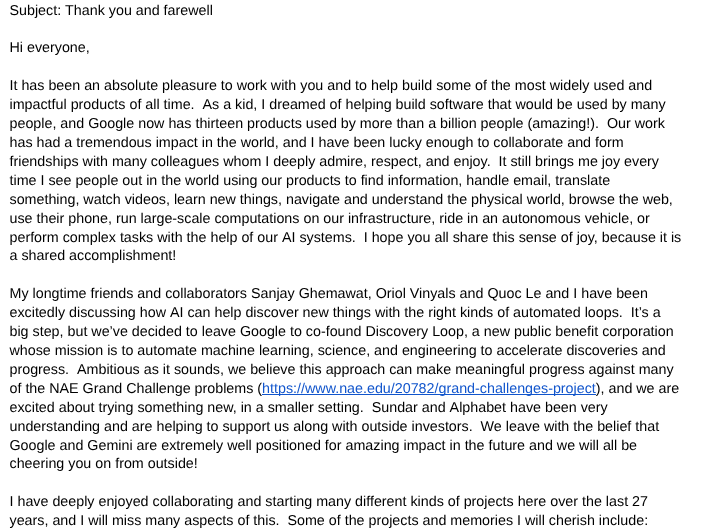
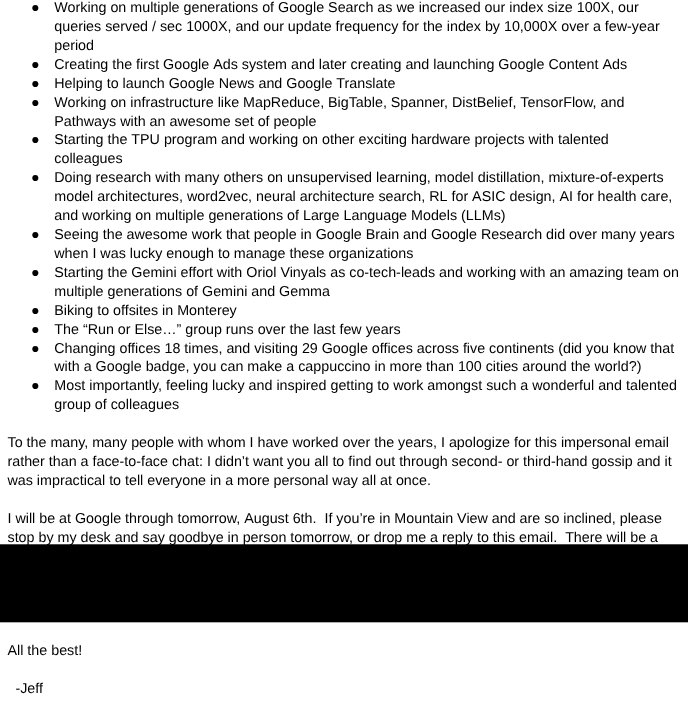
Tomorrow will be my last day at Google after 27 years, and watching it grow from 25 people to 190,000+ has been an amazing journey. Below is a note I shared with many people internally at Google today. An excerpt is:
It has been an absolute pleasure to work with you and to help build some of the most widely used and impactful products of all time. As a kid, I dreamed of helping build software that would be used by many people, and Google now has thirteen products used by more than a billion people (amazing!). Our work has had a tremendous impact in the world, and I have been lucky enough to collaborate and form friendships with many colleagues that I deeply admire, respect, and enjoy. It still brings me joy every time I see people out in the world using our products to find information, handle email, translate documents, watch videos, learn new things, navigate and understand the physical world, browse the web, use their phone, run large-scale computations on our infrastructure, ride in an autonomous vehicle, or perform complex tasks with the help of our AI systems. I hope you all share this sense of joy, because it is a shared accomplishment! Thank you to all of my colleagues at Google over many years!
Now I'm excited to go start @DiscoLoopAI with my longtime friends and colleagues @Sanjay_Ghemawat, @OriolVinyalsML, and @quocleix.
(Updated post: slightly redacted to not have some personal info)
@ajs6888@WoominSong@KAIST_AI Thanks! Along we git log, we also log 3 hours of all tool calling, reasoning trace, and conversation between agent. After analysis and anonymization, we will post about it. Stay in tuned
🏆1st place in the AI Scientist track at Ralphthon @ ICML2026 — $10,000 in OpenAI credits.
@happyhappy_jun & @WoominSong from @KAIST_AI
We've open-sourced all of it: harness, code, the full log of research traces.
See our post: https://t.co/HIzZ7dOELn
How we did it 🧵
Thanks for interest! We ALREADY publish all harness, code, editing history in github. Detail of harness is in blogpost. Check them out!
Also, skills that provided from us is only in "alin-skills", any otherthing is self-invented skills.
Instead of specifing skills (a.k.a process), we define final goal (it is also in github too) and let system create skill to reach the goal
https://t.co/4Q1ihwZJTc
https://t.co/wNUyqa7TuS
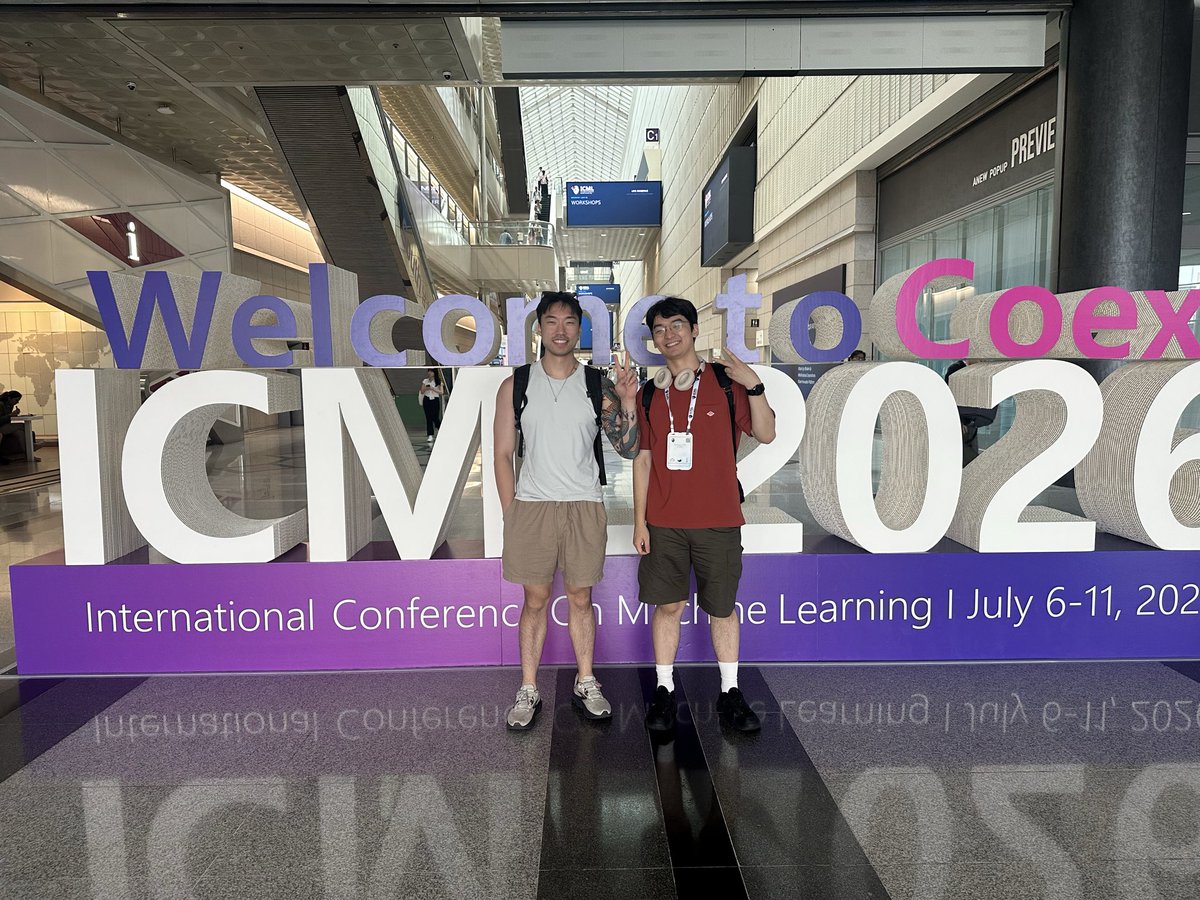
found my goated high school physics project partner @happyhappy_jun at #icml. kinda surreal catching up on our respective research in robotics, planning, and decomposing complex reasoning in modern lms into human interpretable components
[8/8] Special thanks to Goobong Jeong for organizing such an exciting event, and to Prof. @JinwooShin0417 , @KAIST_AI) for supporting and advising our work on advanced AI agent systems.
Happy to chat about any of this — DMs open ☕ #Ralphthon#ICML2026#AIScientist #ResearchAgent
[7/8] Everything is open — writeup, harness, paper, and the raw research traces (including the Overleaf git history):
🤖 Harness: https://t.co/eia8AlDLcG
📄 Paper + code + traces: https://t.co/7gIkGKh9wx
📝 Blog: https://t.co/HIzZ7dOELn