A recent line of WAMs generates actions from VDM hidden states of a single denoising step, yet their quality gets little attention.
👉 We introduce FRED to improve them via self-distillation, with large gains on real robot experiments.
🌐 https://t.co/tE4SdJgMEX
🧵 [1/7]
@XinchenYinYXC Yes, we also trained in the monocular camera setting. In practice, most robotics and autonomous driving systems rely on multiple cameras. We believe extending to multi-view is an essential step toward the next paradigm of world models.
Can explicitly learning future point motion improve the model that generates those future images?
We introduce VPM (Video-Point Model), a 4D world model that jointly forecasts future multi-view videos + persistent 3D point trajectories.
Short answer: yes. Teaching a video world model to forecast 3D point tracks makes its videos more faithful & 3D-consistent, and makes robots better.
🌐 Project: https://t.co/srVtzZsY5c
🧵 [1/6]
Thanks! Indeed, 3D geometry cannot be fully recovered from monocular input alone. Even with depth, only a single 2.5D view is available, and occluded regions remain unknown. Multi-view input gives the model access to richer and more diverse observations than a single egocentric view. We discuss this empirically in Table 22.
📄 arXiv: https://t.co/FgWuwGJiUH
💻 Code: https://t.co/IKbFnUY7Vc
🤗 HF: https://t.co/0oNVAcIvP6
Co-led w/ Sunghwan Hong. Big-shout out to my advisor, Jinwoo Shin @JinwooShin0417. This project would not have been possible without my amazing collaborators Dohyeon Kim, Jonghoon Lee, Jungwoo Park, Inhee Lee, Doosan Baek, Jinil Kim, Taehyun Lim, Hanbyul Joo @jhugestar, Marc Pollefeys @mapo1, and Saining Xie @sainingxie.
KAIST · ETH Zürich · SNU · NYU · RLWRLD · Physics Sim Lab
🧵 [6/6]
Robots too. Add actions as a token modality and the point-supervised backbone gives the best success rates on LIBERO, RoboCasa and a real Franka arm: the tracks describe the robot's own future motion, densely and in 3D. Point track is highly correlated with robot actions.
🧵 [5/6]
🏆1st place in the AI Scientist track at Ralphthon @ ICML2026 — $10,000 in OpenAI credits.
@happyhappy_jun & @WoominSong from @KAIST_AI
We've open-sourced all of it: harness, code, the full log of research traces.
See our post: https://t.co/HIzZ7dOELn
How we did it 🧵
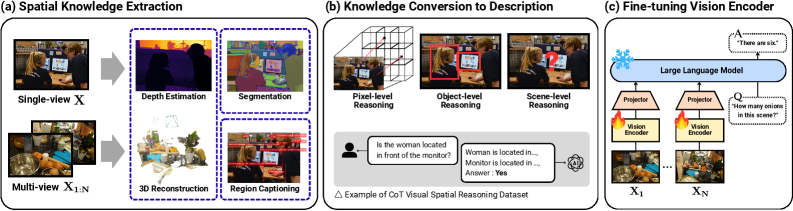
SpatialBoost enhances vision encoders with 3D spatial awareness
A framework that injects 3D spatial knowledge into pre-trained vision encoders via language-guided reasoning, boosting DINOv3 performance by 3.8% on ADE20K and advancing 3D perception tasks.