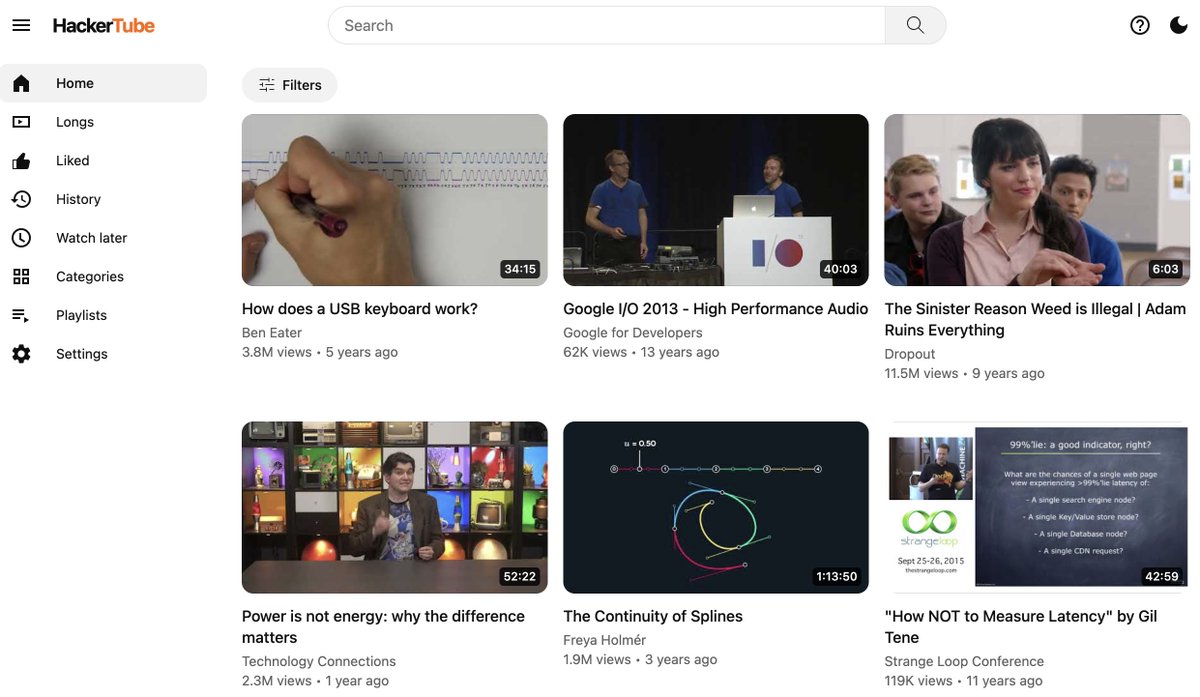
Weekend hack: HackerTube. I was annoyed with YouTube's recommendations so I had Claude filter down 43M comments over 20 years of HN to 6,454 videos that keep being recommended. *Significantly* better viewing experience, ~2 hours with Opus 5.5:
https://t.co/JIhXN7OSh1
- Excellent recs without any logins (state is kept in local browser session)
- Thumbnail is a representative frame from middle of the video instead of the super duper A/B test hyper-optimized user uploads
- Underlying data from the comment analysis as one zip file, point your Claude at it and ask for your own version
- HackerTube Longs ✊
A bit more on the process:
I use Claude Code (desktop app for Mac), Opus 5.5 on Medium effort as my default. I only talk to Claude and have it do everything, the only "manual work" I helped with in tandem was in the browser (reminiscent of MenuGen): 1) I had to create some kind of API key from Google Cloud UI to query YouTube for video metadata, 2) I booted up a VPS box for serving and 3) I bought the domain name. Once the box was up I gave Claude the IP and told it update, secure, harden, deploy and optimize the code, and it did the whole thing.
Many awesome projects that would have normally taken weeks/months even can now be few-shotted for breakfast. What else are we not thinking of.
I spent 48 hours in SF hanging out with billionaires, data labs and AI founders and execs running $1B to $100B companies.
My observations:
1. Sooo MANY stories of data brokers making like $2M a WEEK selling company data to labs. I can't tell if it's the beginning or a bubble, and I kept wondering which niches are left. Digging into it actively.
2. At dinner, someone asked the table, "If a new model drops next month, does your company get better or worse?" HALF the table went quiet! I think that's the best question to ask about any AI startup right now.
3. The bar people talk about now is hitting $1B in revenue in 12 months (I guess that's the new unicorn?). What I didn't hear much about is retention. AI revenue can come in fast and leave fast, and I think we're going to see a lot of stories of AI companies with huge revenue and terrible retention.
4. It's pretty clear we're living through the reinvention of the computer. The model is the CPU, the harness is the operating system, and skills and plugins are the apps. Thinking about it that way makes it easier to see where the whitespace is.
5. We're maybe 12 months from an agent that can watch you work for a week and then do your job without any instructions. The screen recording plus agent memory plus local model combination makes this possible right now.
6. Agent harnesses feel like the new GPT wrappers, in a good way, especially vertical ones. The best teams I talked to treat the model as swappable. One founder walked me through routing different models to different jobs: one for taste and visuals, a cheaper one for the everyday stuff, another for text.
They use prompts they can move across models over fine-tuning, and A/B test the output on what users actually do with it: do they edit it, export it, share it? A vertical harness is basically four things: the connectors for that industry's data, evals written by people who know the work, rules for what the agent can and can't touch, and a clean screen for a human to review. The model is maybe 20% of it.
7. There's a lot of reverse engineering going on/cloning going on more than I've ever seen. People are decompiling software and rebuilding it with agents, and someone showed a suite of like 10 apps that are worth $5B+ each all that he cloned open source. Me and everyone are still thinking through what it means when software gets this easy to copy.
8. My guess is the value moves to data. If the software can be rebuilt quickly, what's worth paying for in a legacy SaaS company is the years of customer data and workflows inside it. Some SaaS companies are secretly data companies.
Gets me thinking about how do you truly value data for this saas companies? Like if we were buying these dying saas companies at 2x ARR before (as example), maybe there is a better metric. Idk, just thinking out loud here.
9. It feels like a good chunk of legacy software won't make it to the agentic era, especially anything built around people clicking through a lot of screens.
10. Every company I talked to wants to pipe its internal data into one place and expose it to agents through MCP. Then they look at the data and realize it's a mess: five versions of the same customer, old Slack channels, PDFs nobody can search. Cleaning that up feels like a big consulting opportunity!
11. A lot of founders are building the basic building blocks for agents: APIs, data layers and tools. Some of the companies I saw barely have a UI because the main user is an agent. I really believe the startups that build primitives to this agentic era will do extremely well. Building blocks is the best way to think about it.
12. Labs can get plenty of training data, but it's harder to get real examples of agents failing inside companies. Whoever has those logs has something valuable.
13. Someone running a big consumer company told me the next fight is over memory. The model that remembers the most about you wins, and the smartest model matters less than people think.
14. Physical AI came up a lot. Astra I think was the first model that got people into AI can actually do CAD, and I think a lot of people are thinking what does vibe manufacturing really look like. The line I keep thinking about came from a robotics founder: the hardest problems in AI are deployment problems now, not research problems. Their robots work on their own, call a human when they get stuck, and every one of those calls becomes training data.
15. Cybersecurity companies are having a moment and are actually cool companies to build now, especially the ones that clean up after a breach. Every agent with access to your systems is a new door into your company, and a lot of those doors were left open.
16. Some startups are worth more dead than alive now. A shutdown company with 5 years of Slack, email and code can get paid for licensing all of it. I wouldn't be surprised if founders start factoring that into when they shut down.
17. People are starting to talk about monetizing the agent web. It feels really early, but when the most popular user of the internet is an agent, what startups should you be building?
18. I think agent insurance is coming. Once an agent makes an expensive mistake, insurers will want audits before they cover anyone.
19. Several people said the hire they want most is someone with taste who can write evals. The models are getting good at generating ideas, so the hard part is judging which ones are good.
20. New trend I observed: startup raises VC, uses venture dollars to become a creator, startup fails, founder falls back on being a full-time creator and incubates other products bootstrapped.
21. Getting SIGNIFICANT distribution is HARD right now. Founders are sponsoring buses, buying billboards like crazy and throwing parties with famous DJs to get noticed. Kinda feels dotcom era in that sense.
Attention is what's scarce! The growth guy going viral sharing his UGC strategy from Wispr Flow is a good example. It's the sauce everyone wants, and I truly believe there are probably only 50 people on the planet who know how to scale these types of businesses efficiently in this era.
Always good to get that dose of SF. I felt sooo lucky to have such an incredible trip during such an incredible time in building businesses. Surreal in so many ways.
Happy to be home and locked in.
Until next time!
Best accounts to follow from each frontier lab to stay constantly up to date
Anthropic
@karpathy
- must-follow account for AI; recently joined Anthropic
@bcherny
- Claude Code creator, always shares great tips
@trq212
- also a Claude Code developer; writes amazing articles on CC
OpenAI
@polynoamial
- works on reasoning research, shares a lot of technical details
@gabriel1
- Sora developer, great career path
@jxnlco
- works on dev experience, shares a lot about Codex
Google AI
@OfficialLoganK
- all the major Google Gemini and AI Studio updates
@ammaar
- product and design; shares great things about vibe-coding in Google AI Studio
@fofrAI
- cool use cases for generative models
Cursor
@leerob
- the loudest voice behind Cursor updates
@ericzakariasson
- shares great insights on using Cursor
@mntruell
- Cursor’s CEO; major releases and usage updates
xAI
@ai_explorer25
- ex-MSFT, covers all ai content and free resources
@milichab
- recently joined xAI, shares updates on Grok
@skcd42
- also covers major Grok releases
The most OP workflow in my opinion.
- ChatGPT: prompting
- Midjourney: image generation
- Topaz Labs: upscaling
- Runway: image-to-video generation
If you aren't convinced, look in the comments.
Tech is overestimated in the short term,
(because infra is so damn harder than people realize)
And underestimated in the long run.
(becuase new tech becomes
infra for new applications)
Applies for computer, chip, internet, llm, rl, etc.
"Chatting" with LLM feels like using an 80s computer terminal. The GUI hasn't been invented, yet but imo some properties of it can start to be predicted.
1 it will be visual (like GUIs of the past) because vision (pictures, charts, animations, not so much reading) is the 10-lane highway into brain. It's the highest input information bandwidth and ~1/3 of brain compute is dedicated to it.
2 it will be generative an input-conditional, i.e. the GUI is generated on-demand, specifically for your prompt, and everything is present and reconfigured with the immediate purpose in mind.
3 a little bit more of an open question - the degree of procedural. On one end of the axis you can imagine one big diffusion model dreaming up the entire output canvas. On the other, a page filled with (procedural) React components or so (think: images, charts, animations, diagrams, ...). I'd guess a mix, with the latter as the primary skeleton.
But I'm placing my bets now that some fluid, magical, ephemeral, interactive 2D canvas (GUI) written from scratch and just for you is the limit as capability goes to \infty. And I think it has already slowly started (e.g. think: code blocks / highlighting, latex blocks, markdown e.g. bold, italic, lists, tables, even emoji, and maybe more ambitiously the Artifacts tab, with Mermaid charts or fuller apps), though it's all kind of very early and primitive.
Shoutout to Iron Man in particular (and to some extent Start Trek / Minority Report) as popular science AI/UI portrayals barking up this tree.
A checklist for secure vibe coded apps.
Putting things on the internet is kind of like parking your car in San Francisco—there's inherent risk. 😅
Luckily, there are some straightforward things you can do to minimize those risks. Here are 16 simple things to make secure vibe coded apps. 👇
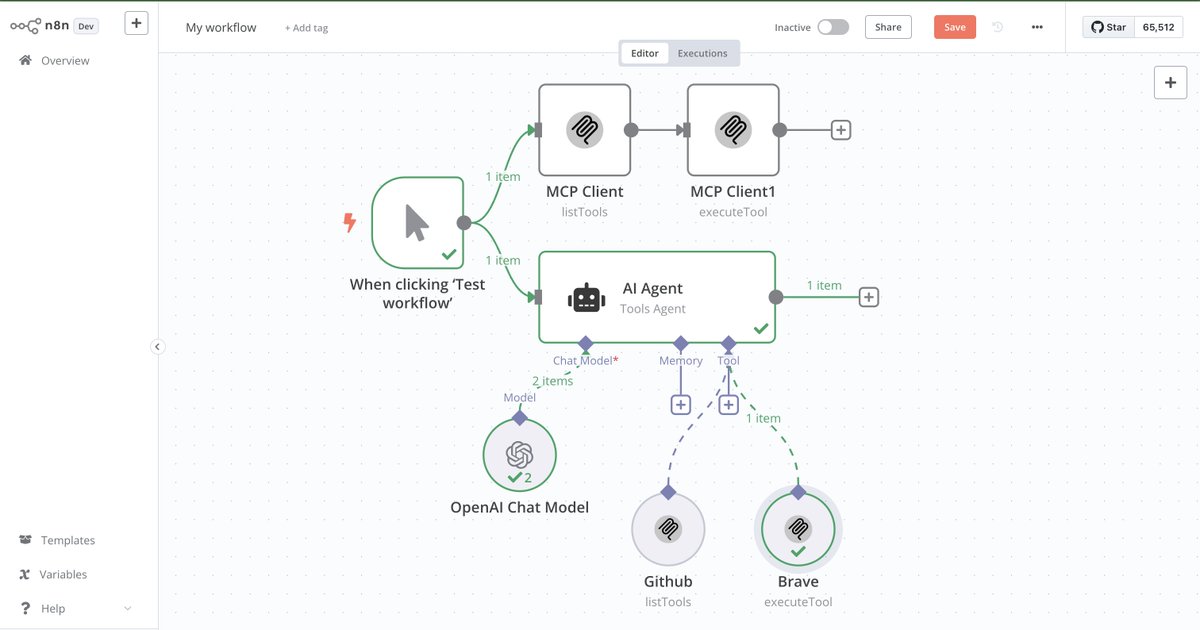
Build AI agents with MCP without writing a single line of code.
Connect AI agents to 100s of external tools via MCP and execute them directly from n8n.
100% free and opensource.
Today I’m excited to announce the start of a project I’ve dreamed about for years:
ui/pub — a registry of the highest-quality @shadcn components, blocks, and templates.
Designed beautifully. Carefully coded. Built to ship fast.
#buildinpublic
Claude can now access WhatsApp via MCP.
Search chats, find contacts, and send texts while keeping all data stored locally in SQLite - only shared with LLMs when you use specific tools.
100% opensource and self-hosted.
Learn how LLMs work under the hood!
This is the best place to visually understand the internal workings of a transformer-based LLM.
Explore tokenization, self-attention, and more in an interactive way:
I'm so pleased to present a new book with @stripepress: "The Scaling Era: An Oral History of AI, 2019-2025."
Over the last few years, I interviewed the key people thinking about AI: scientists, CEOs, economists, philosophers. This book curates and organizes the highlights across all these conversations.
You get to see thinkers across many, many fields address the same gnarly questions: “What is the true nature of intelligence? What will change from the millions of machine intelligences running around? What exactly will it take to get there?”
Settled answers are unavailable; we’re all running unsupervised. But between these discussions lie, I hope, some insights on the most interesting and important questions of our era.
Link below. Enjoy!
Unbelievably impressive. I think programmers are right to have some worry that the world of tomorrow won't need all of them. Illustrators, animators, and cartoonists surely already do. What a time to be alive.