Maths teacher, mentor teacher, ed consultant fascinated with discovery learning and inquiry, problem solving, assessment, visualization & making a difference.
@howie_hua Correction to this excellent post: Every positive odd number can be written as the sum of two consecutive natural numbers, not the sum of the squares.
@pwharris 51 x 16 is one more 16 than 50 x 16. I'd quickly do 50x16 by taking half of 100 x 16 --> 800 + 16 = 816. I could also have used doubling and halving 50 x 16 as 100 x 8.
@YohakuPuzzle 1 - 3 - 6
2 - 10 - 12
4 - 60 - 8 --> puzzle broke by noticing column 1 and 2 needed an odd number {1, 3, 5, 15} and the pair had to be in the same row as all the right hand numbers are even. I haven't checked that this solution is unique.
@pwharris Doubling/halving. If I double one dimension, the other needs to be half to keep the same area. Good visual of this. Another approach is 25x18 = 25x2x9 = 50 x 9
@dmarain A lovely inquiry that seems to generate its own furthering questions in response to the "Wait! What? Really?" Extensions: can it work with three different factors? (1/n = 1/a + 1/b + 1/c ) Does the n have to be a good composite number?
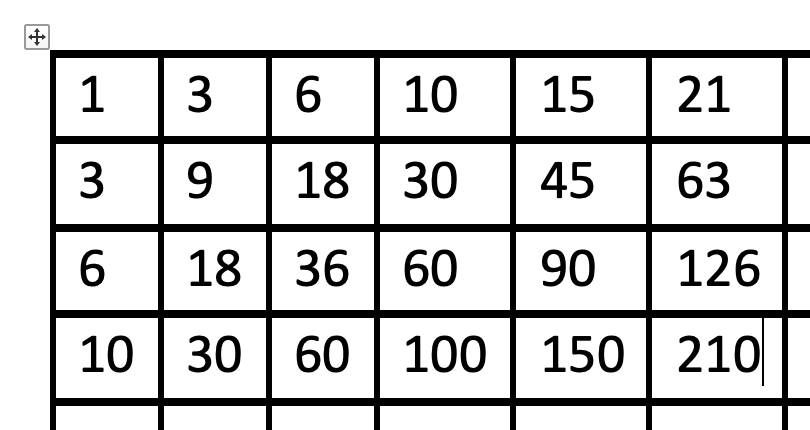
@mrdardy@dmarain Pt. 2 Now I'm curious what either of your approaches might change by recording the data in this way for a specific rectangle. Would the emerging patterns lead to a generalization?
@mrdardy@dmarain When I had extended the squares question on a checkerboard, I asked, "How many rectangles of any size is on an m x n grid?" The students started with simple cases, organized counting and then one had a breakthrough by organizing the data on a grid. A 6x4 has 210 rectangles Pt.1
@MickeyCootes@MathGuyTFL This is the correct approach. Those stating PEMDAS need to see that - 4^2 has the 4^2 taking priority and then being multiplied by the -1.
(-4)^2 =16 but -4^2 = -16
Even the platforms AI knows this.