So-called “Learning Styles” were someone’s idea that got into the education water before the due diligence of scientific validation occurred - like so many others, such as notions of left-brain, right brain learners, multiple intelligences, growth mindset, “we only use 10% of our brains” and so on. Education won’t be a true profession until it hooks its wagon to scientific rigour and the accountability social contract attached to that.
An amazing opportunity for Irish teachers (and those in compatible time zones!) to hear Anna Stokke speak about evidence-based Maths instruction!
@rastokke
https://t.co/AlgN0fawRj
"An associate professor at the University of Otago's College of Education, Naomi Ingram, said....direct instruction typically involved working from a script."
That's false. Someone working in a faculty of ed doesn't know what direct instruction is?
https://t.co/tj47h19Fww
The old dividing line in education used to be progressive v traditional (discovery v explicit) but the new divide is rapidly becoming those who see AI as a potential tool for learning and those who see it as the end of days.
One of the few people who are thinking clearly about AI in education today is @Kris_Boulton and this is a conversation with @mrbartonmaths worth listening to for anyone wanting to learn more. https://t.co/WMvwjzBa7Q
This is a good article and this point is more critical than ever: "But if teachers are not taught explicitly about the connection between knowledge & critical thinking, some may leave with the impression that factual content matters less than it used to."
https://t.co/Dt93QsY7O3
This is highly relevant to Ireland’s growing fixation on “wellbeing” and “anti-bullying” in education. As concepts such as abuse, trauma, bullying, mental disorder, and prejudice have expanded in scope, schools are experiencing a corresponding mission creep. They are increasingly expected to operate as quasi-clinical settings. Teachers are expected to be “trauma-informed” and asked to do work that is outside their competence. Ordinary and developmentally appropriate experiences are being pathologised. The result is that our kids are more fragile then they ever were.
https://t.co/jzcuaE5RHP
Hirsch’s index of edu-lingo written in 1996 continues to be timeless.
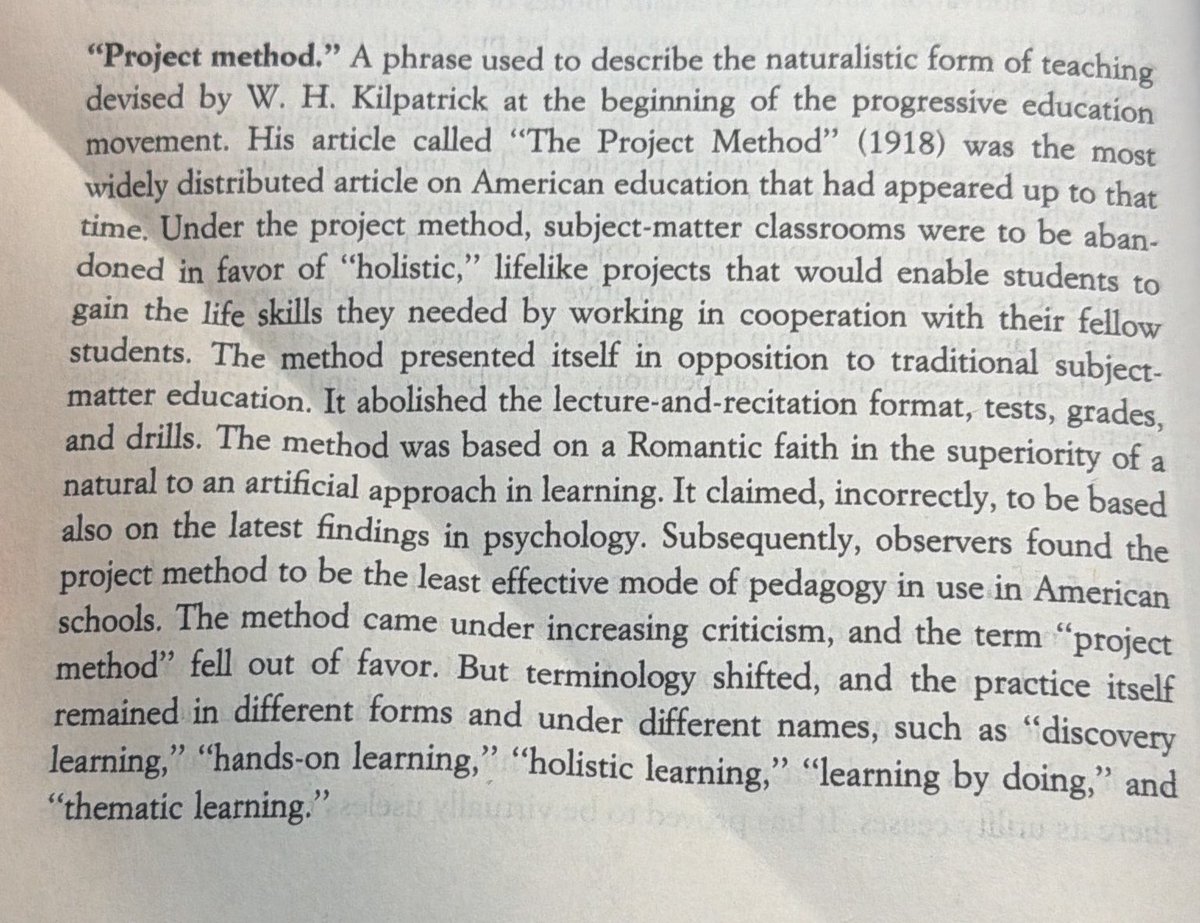
Here is an example of the rhetoric traced to 1918. It parallels the misguided fads of 2026 as yet again popular discourse tries to reinvent education in the age of AI, oblivious about the mistakes of the past.
Last week I spent an inspiring few days in Belfast listening to some incredible school leaders, local teachers, world leading experts and working with @Education_NI to support the excellent work that @paulgivan and his team are doing on curriculum reform and then I come back to London and see this disaster.
The contrast could not be more stark.
This is a hugely important piece by @PamelaSnow2. A very insightful application of cognitive load theory to neurodivergence and trauma-informed classroom practice. To the best of my knowledge there is no research on this topic and this has really illuminated my understanding on the topic both as a researcher but more importantly as a SEN parent. I do hope Pam explores this area further. https://t.co/O7YD4EDFbA
Dr. Anna Stokke discussed the Instructional Hierarchy in her presentation. I believe this is something every educator should know so they can use appropriate instruction for each stage of learning.
This should be taught by schools of education.
A strange thing is going on right now: Both cognitive science traditionalists and constructivist progressives now seem to be both arguing for learning as primarily a social enterprise.
For example, I don't know who Dan Meyer is but I gather he has largely progressive views and this conversation he had with @mrbartonmaths is symptomatic of this thing I mean where the emergence of AI in education is creating a weird kind of alliance where both camps now seem to be saying: learning has to happen between humans in real time. I disagree and this is why I think the Alpha model is potentially so powerful. 🧵https://t.co/q8AwHezbra
In 10 years, we'll realize young adults can't read, write, or think as well as they should. We'll wonder how we allowed students to offload huge chunks of their learning to AI. Today we're just watching it happen. This is the most obvious unforced error of our time.
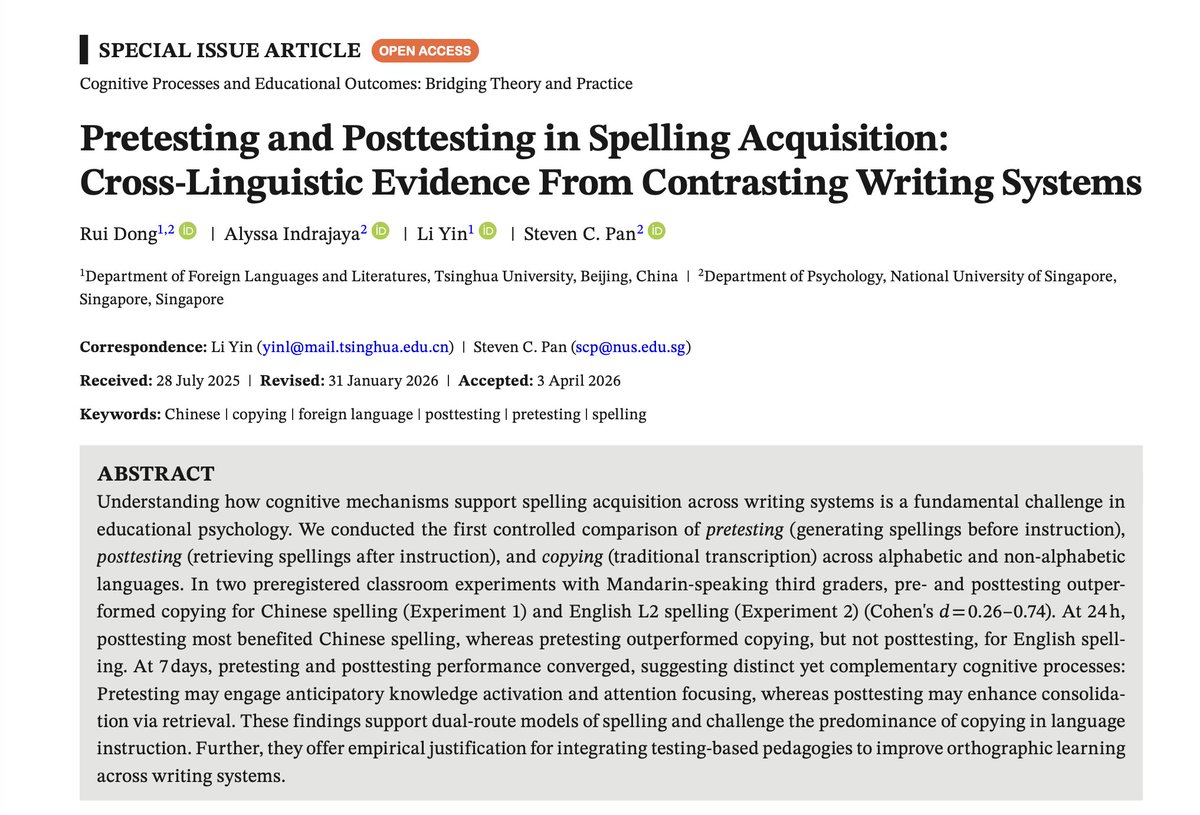
What works in spelling instruction? New study on how to teach it effectively and the pre-testing effect:
- Copying spelling words might be one of the least effective things we ask pupils to do.
- Generating answers before learning can improve spelling, even when pupils are wrong.
- The benefits of testing grow over time, not immediately.
- What matters is not how many times pupils see a word, but how often they retrieve it.
@AnnaStokke’s (23 min) podcast, Chalk & Talk, is a short, concrete “must listen to” for anyone interested in research-based education practice. Although Anna’s prime interest area is math instruction, the principles she describes for cutting through the “the research says” smokescreen have general applicability to other education areas. The number of times I’ve heard a EdD-degreed (in Education Leadership) educator invoke the phrase “the research says” is enough to make one gag. Anna cuts through that smokescreen with explicit recommendations for dealing with it. She alludes to her previous podcast with @BG_Solomon1 as a conceptual resource.