BTW this is the reason why i find it interesting when I hear claims "we did not distill". Everyone indirectly distills whether one likes it or not, unless you train on the common crawl of 2022 and use data vendors that don't use any AI tech.
Got fable to hand-write weights of a 100k param model to recognize real versus fake legal citations.
Basically one-shotted a full NN that’s better than training it
That’s my feeling. Skills to do signal processing or machine learning won’t buy much, as AI often do them better. But the understanding of the signal or model do. It’s just that with AI we can now do the signal processing without deep understanding, unlike in the old time.
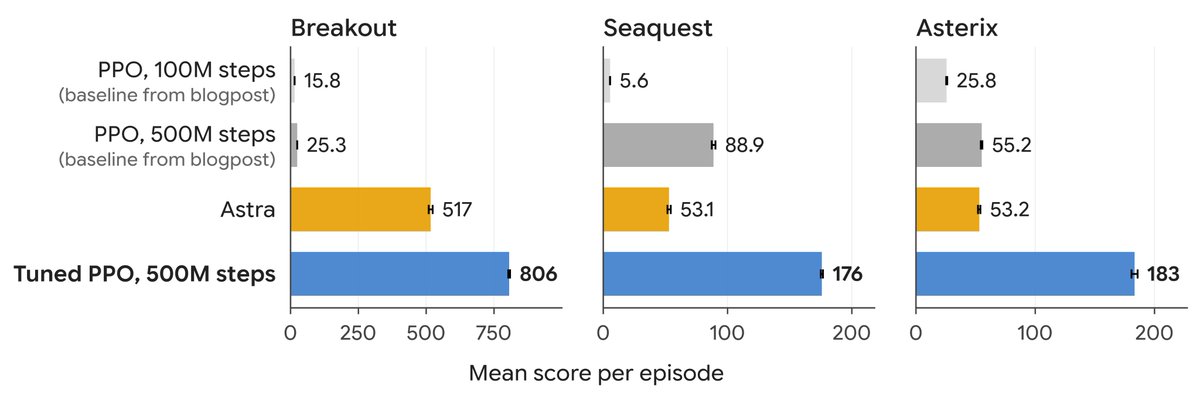
I am not gonna comment on the results per se, but if you believe your work is valuable and insightful, why not tune the baselines?
This took in total about 45 min of training on an A6000.
@korymath I have a feeling that multiagent will end up in a boot similar to sensor fusion. Yes it’s very powerful when agents/sensors have complementary information and we can easily identify which to trust. But once the signal and noise are not that clear, they often ended up worse.
"ETH is false" situation be like 😛
Mathematicians: 3-SAT is slow because you’ll always have to brute-force at least a fixed fraction of the switches, forever
OpenAI, with assistance of ChatGPT: ackshually, you’re wrong because the fraction shrinks!!
Mathematicians: :O :O wdym
@quxiaoyin Not really. AI is quite good at coding and doing experiments, but they are terrible at telling us what is good for a somewhat ambiguous requirements. Senior MLE will hardly go away
Hot take: the community keeps asking whether diffusion LLMs can beat AR. That's the wrong question. Diffusion is a sampling method, and it can sit on top of an AR model to make it faster instead of replacing it.
Speculative decoding already speeds up AR, but it has two long-standing problems. Training a drafter takes a long time, and you have to build a complete pretraining corpus for it. Even then, token acceptance drops sharply on out-of-domain data.
Uno @ssahoo_ offers an elegant way out: it decouples sampling training from capability training. There's no separate drafter. The model itself, plus one LoRA, drafts several tokens in a single forward pass, and the LoRA learns to match the model's own next-token distribution, so there's no drafter corpus to build and no labels to collect.
We applied this to the Looped Transformer Nanbeige4.2-3B: 1 hour of LoRA training gives a lossless 2× speedup on agentic task. We haven't optimized anything yet, and we believe the acceleration can go much further.
The takeaway: diffusion doesn't need to beat AR. Any model that can score its next token can get a fast diffusion mode in an hour.
Page: https://t.co/SCkbkrtf2z
Lora Adapters: https://t.co/Awks2jdkx0
@alexolegimas Jumping straight to drug discovery, one of the least verifiable fields in existence, makes no sense to me. Like, the models can barely serve as a competent accountant/lawyer, isn't drug discovery 1,000,000x harder?
It's weird how right now RSI has a sci-fi meaning (somehow magically getting better at everything always in a way that leads to "intelligence explosion") and also a concrete research meaning (self-modifying harnesses or successor-training models tested on held-out benchmarks)
Won’t this go down a very bad path that destroys the double blind systems? The reason that we went double blind is to protect people from the correlation that senior researchers are more likely to get their papers through?