Elon Musk was asked why his companies move faster than anyone else.
His answer:
"I'm constantly addressing the limiting factor. Whatever the limiting factor is on speed, I'm going to tackle that. If capital is the limiting factor, I'll solve for capital. If it's not the limiting factor, I'll solve for something else."
He then said something most managers never figure out:
"If something is going really well and making good progress, there's no point in me spending time on it."
"The irony is if something's going really well, they don't see much of me. But if something is the limiting factor, they'll see a lot of me."
He spends his time entirely on whatever is blocking the next step.
Not on what's interesting. Not on what he's best at. But on whatever is the bottleneck right now.
Most leaders do the opposite... They gravitate toward what they're comfortable with and away from the hard problem.
From: @dwarkesh_sp and @collision
Sequoia partner Michael Moritz explains why Bill Gates had the radio removed from his car dashboard
When asked what founder obsession looks like, Moritz gives two examples.
The first is Apoorva Mehta, founder & CEO of Instacart. Before investing in Instacart, Michael asked Apoorva how he got into the business of grocery delivery.
Apoorva responded that after toying with a variety of other businesses, he decided Instacart was the one for him when the idea of the business was “the last thing he thought about when he went to sleep and the first thing that he thought about when he woke up in the morning.”
Moritz comments:
“To me, that was as good a definition of obsession as any I’ve heard… it’s sort of that full on experience that you can never stop thinking about and you don’t switch off.”
His other example is Bill Gates.
When Microsoft was still private and quite small in the 1980s, Bill gave Michael a ride to the airport. When Michael asked him why the radio was missing from the dashboard, Bill said he had it taken out:
“If I’ve got the radio, I’m afraid that I’ll switch it on and I won’t be thinking about Microsoft.”
Moritz quips, “That’s obsession.”
Video source: @StanfordGSB (2019)
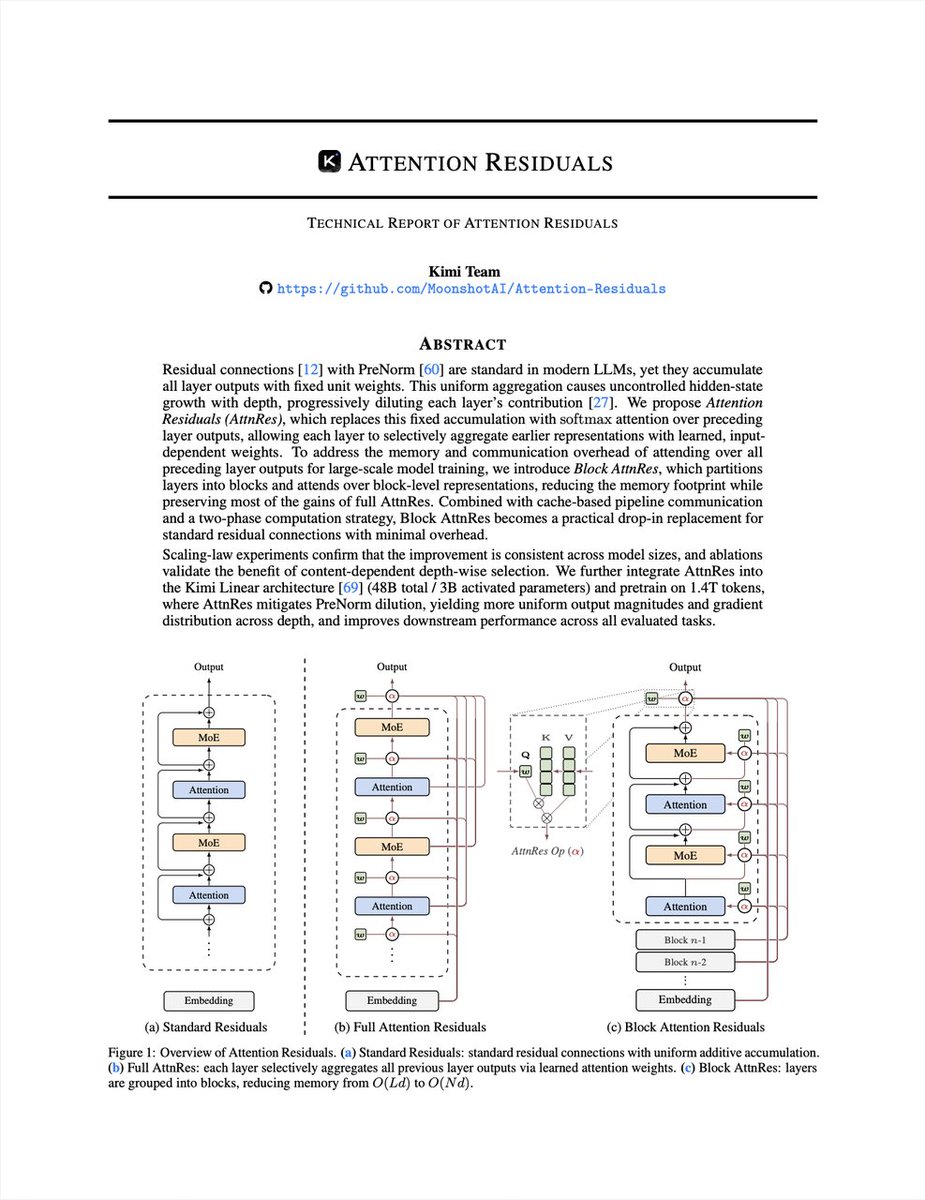
Introducing 𝑨𝒕𝒕𝒆𝒏𝒕𝒊𝒐𝒏 𝑹𝒆𝒔𝒊𝒅𝒖𝒂𝒍𝒔: Rethinking depth-wise aggregation.
Residual connections have long relied on fixed, uniform accumulation. Inspired by the duality of time and depth, we introduce Attention Residuals, replacing standard depth-wise recurrence with learned, input-dependent attention over preceding layers.
🔹 Enables networks to selectively retrieve past representations, naturally mitigating dilution and hidden-state growth.
🔹 Introduces Block AttnRes, partitioning layers into compressed blocks to make cross-layer attention practical at scale.
🔹 Serves as an efficient drop-in replacement, demonstrating a 1.25x compute advantage with negligible (<2%) inference latency overhead.
🔹 Validated on the Kimi Linear architecture (48B total, 3B activated parameters), delivering consistent downstream performance gains.
🔗Full report:
https://t.co/u3EHICG05h
Armies do not fight for abstractions. Armies fight for a people.
Armies fight for a nation.
Armies fight for a way of life and that is what we are defending.