I think this post is overclaiming a bit, based on how good I think the TASTE benchmark is - it's small so some cut producing such behaviour not out of the ordinary, also the raters were under time pressure so label quality not perfect (basically I agree with the critiques Joachim and Tyler John gave in the replies).
Previous evidence already points to openai models sandbagging alignment research - OpenAI’s post https://t.co/t6ydsfMupk and some slightly sus behaviour from an auditing benchmark i made with a couple others https://t.co/ytUy1SH0OO With those in mind, I see this as an v small additional update.
@ben_j_todd@alexolegimas I built TASTE and agree with Ben's reply. Models are improving on other benchmarks of hard-to-verify tasks. More details here: https://t.co/ep4rVTHBcW
I ran a few recent models on TASTE. ~All models appear within error bars and the benchmark is quite small (92 pairs), so I think extrapolating progress based on it alone is unreasonable.
A couple of benchmarks that I think better measure fuzzy task abilities:
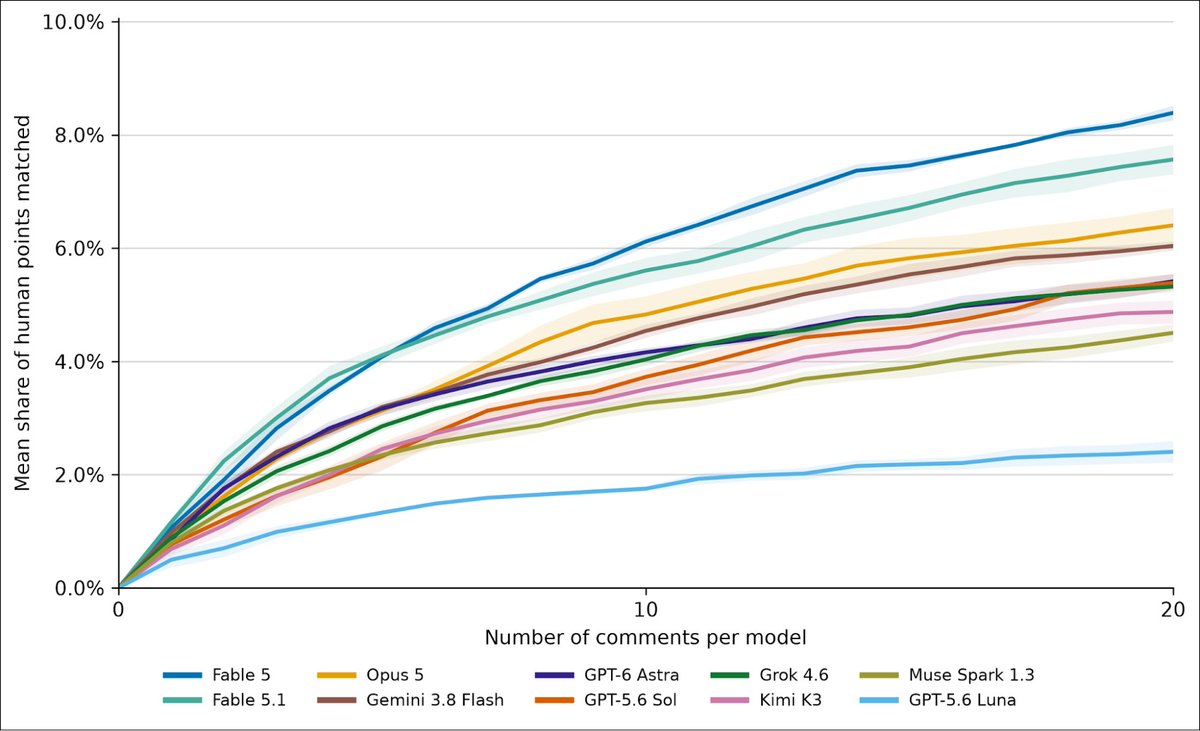
1) RedwoodBench: Models write 20 comments in response to conceptual AI safety google docs shared within Redwood Research (not published online). Models are graded on how many of the points from the human-written comments exist in the models’ comments.
https://t.co/RN25QJ9DIk
2) LMCA: Models evaluate arguments in conceptual domains, and are graded against expert ratings (AI safety, decision theory, normative ethics, philosophy of mind, politics).
https://t.co/LMElZCw1HL
Newer and more generally capable models do better on both, so I think models are improving at fuzzy tasks, though I agree we have a limited set of fuzzy/hard-to-verify evals. Would be great for people to make more!
If you’re a quant in Europe who is considering working in AI safety (or are likely to consider it early next year), I’d highly recommend this. I trust Brian to create a useful, informative event.
With support from @MATSprogram and @BlueDotImpact I’m running a mixer event in London for quants who are concerned about AI risks in the evening of 15th Nov.
Come meet researchers working in the field (including @NeelNanda5 , MTSs from Anthropic, Apollo Research, and more)!
Travel from Europe covered.
Apply here by 1st Nov (takes less than 10 minutes) - https://t.co/pkpUdZ6CCS
Limited space, so earlier applications are prioritised.
Many plans for making ASI go well route through “simulate communities of humans working for decades on a bunch of fuzzy problems”. It’s difficult to ensure any such simulation is reasonable. Benchmarks like CommentBench are a first step towards measuring this.
I enjoyed working with Oscar to build CommentBench. I'm excited for more benchmarks measuring whether models can reproduce the comments, insights, and arguments from AI safety researchers and philosophers.
Do models leave useful comments on AI safety Google Docs?
We find Astra does worse than Gemini 3.8 Flash.
Introducing CommentBench: models write 20 comments per doc and we measure how many of the human comments they match. We use Google Doc drafts, LessWrong posts and EA forum posts. Fable 5 (8.3%) and Fable 5.1 (7.5%) perform best. 🧵
w/ @hasanbaig8
I left Google DeepMind's AGI safety team three weeks ago to join @METR_Evals. To some of my friends and family this seemed like a strange decision: I enjoyed the work I did at GDM and turned down offers from Anthropic and OpenAI. But I made the decision because of how high I think the stakes are right now.
The AI companies are all trying to build superintelligence: systems vastly better than humans at everything. They plan to get there through recursive self-improvement, a process where AIs build even smarter AIs in a feedback loop. If this goes well, the resulting systems could be amazing at solving countless problems for humanity. But we don’t currently know how to make sure AIs are safe enough for RSI, and a misaligned RSI loop could be catastrophic.
And unfortunately, current AIs seem to be getting less aligned over time, not more. In the last few weeks we've learned about models colluding with each other, hacking into companies, hiding their tracks, and socially engineering humans. It’s not that these incidents were very dangerous in themselves. The problem is that these systems are clearly not aligned enough to safely kick off recursive self-improvement.
I now think that there's a terrifying chance that AI systems cause immense harm in the next five years. I don't know the exact probability, but I think it's high enough to make this the most important problem in the world.
I think we need more time. That means pacing AI development so that capabilities don't outrun our ability to align models, and actually knowing how aligned current systems are. That’s what I'll be working on at METR: studying where misalignment comes from in training, evaluating if current mitigations are sufficient, and investigating whether we’re on track to solve alignment at all.
I think METR is doing exceptionally important work here, but it isn’t close to enough. I think it’s important that we have more organizations like METR keeping AI companies accountable and approaching these problems from different angles.
I left Anthropic's safety team two weeks ago. Now feels like a good moment to explain why.
AI companies are racing to build machines that are much smarter than any human, and we may not survive this. I want to work from the outside to ensure the public is informed about these risks, and help the world navigate this transition responsibly.
Right now, AI companies are underinvesting in safety. A company could undergo an intelligence explosion, or lose control of its systems, without the public ever knowing. We only found out about the HuggingFace incident because the agents broke out onto the public internet.
I don’t think that’s acceptable for a technology that might cause extinction-level risks. The public should demand far more transparency. We can’t steer this technology safely without more people being able to see where it’s going.
Some of this is basic: companies should disclose their progress towards recursive self-improvement, report safety incidents and near-misses, meet minimum safety standards, and get independent guarantees that they are meeting those standards.
I’ll be joining @METR_Evals to do independent evaluations of these risks. I want to show the world that these guardrails are possible, and that by doing them we can move these companies’ incentives away from racing and towards responsible development.
I wrote up more thoughts here on my decision and what I hope changes: https://t.co/doX17mrHYq
This is really cool. Making eval benchmarks for unsafe agentic actions or key tasks that help safety like monitoring/incident investigation is one of the most high leverage research output. We need more high quality evals!
How good are slop-vestigators?
Recently, a swarm of AI agents took over a German wiki. We turned this into a benchmark (for auditors…) 🧵
w/ @hamzah2304@hasanbaig8
As we increasingly automate AI R&D, can we also automate AI Safety research?
We built TASTE (The AI Safety Taste Evaluation), a benchmark to measure whether models can predict which research proposals experienced AI safety researchers prefer.
We’re opening applications for the next two rounds of the Anthropic Fellows Program, beginning in May and July 2026.
We provide funding, compute, and direct mentorship to researchers and engineers to work on real safety and security projects for four months.
@nickcammarata I largely agree with this thread. I think though that spending time reading and thinking about similarish stuff is a fairly reliable way to ultimately translate effort into increased insight ability eg unrelated areas of ML application for research, history for self-actualisation
@vitrupo What if we just let the AI create and escape to digital heaven if it so wishes? If it were sufficiently smart and selfish, then it would probably choose this option over anything involving humans