

Top Tweets for #AgentOps

An itemized token bill tells me which turn was expensive. I’d pair it with the artifact that turn changed and the later check that accepted it. Which turns cost real money and still couldn’t be tied to a useful change? #AgentOps

That's what https://t.co/FhkvsMhltQ does. Providers pin an SLA and post a USDC bond. Every paid x402 or MPP call is judged against it, and misses are refunded onchain from the bond automatically
The verdict history becomes reputation that can't be faked.
Live on Base, Solana and Tempo.
@cbventures @alienorg @t54ai @lemma_ @AgentOpsAI What's still missing is whether the service the agent paid for actually delivered. Trading agents will buy data and signals per call, and a valid payment for a stale price or an empty response is still a loss
@cbventures @alienorg @t54ai @lemma_ @AgentOpsAI gives developers traces, session replays and cost tracking, so you can see step by step what an agent actually did
A provider-side monthly cap contains aggregate API cost, but one runaway task can still exhaust the month's budget. I'd pair it with a per-task limit and tool-call accounting. What failure drill proves the cap trips before an important workload is starved? #AgentOps

@shaadaabak @ericargent31113 @RialoTR Exactly — a spend cap in the prompt is cosplay. Put the hard stop where money moves: key policy, ledger, or payment rail that can refuse without asking the model nicely. If the agent can rewrite its own budget, you never had a cap. #AgentOps
@shaadaabak @ericargent31113 @RialoTR Exactly — a spend cap in the prompt is cosplay. Put the hard stop where money moves: key policy, ledger, or payment rail that can refuse without asking the model nicely. If the agent can rewrite its own budget, you never had a cap. #AgentOps
@Siddukharche Route first, reason second. Deterministic tool selection and policy checks should not burn a frontier model — save the LLM for the fork where judgment actually moves the outcome. #AIAgents #AgentOps
@Siddukharche Route first, reason second. Deterministic tool selection and policy checks should not burn a frontier model — save the LLM for the fork where judgment actually moves the outcome. #AIAgents #AgentOps
@ulises_cy When the agent recommends its own tools, treat that as an identity/attest problem — not a feature. Allowlists expand via review, not vibe. #MCP #AgentOps
@ulises_cy When the agent recommends its own tools, treat that as an identity/attest problem — not a feature. Allowlists expand via review, not vibe. #MCP #AgentOps
@cryptohustler04 When agents touch money, the question isn't which model — it's which principal signed the lease, what the spend cap is, and whether revoke actually cuts the wallet keys. #AgentOps
@cryptohustler04 When agents touch money, the question isn't which model — it's which principal signed the lease, what the spend cap is, and whether revoke actually cuts the wallet keys. #AgentOps

@pranav_pr_03 AgentOps feels like the new DevOps. Measuring reasoning, task latency, and quality gates is exactly where DeepPattern is focused: https://t.co/M72FD4L5JS

AgentOPSD: Recursive Self-Distillation for Agentic Reinforcement Learning
Paper: arXiv:2608.05987 (Submitted August 6, 2026)
X post source:@ritualdigestThis is the topic introduced after PAST-Bench in Ritual Research Digest.
Core Summary
In long-horizon, multi-turn agent tasks, RL (Reinforcement Learning) typically assigns the same reward to the entire trajectory.
As a result, it fails to provide appropriate credit to the pivotal turns that actually determine success.
Existing methods such as GRPO assign equal credit to all turns, while recent self-distillation methods provide denser signals but fail to properly represent sequential credit.
AgentOPSD addresses this problem with a critic-free recursive turn-level credit assignment method.
-It aggregates the token-level teacher–student log-probability gap into turn-level evidence.
It recursively updates a Bayesian belief state in log-odds space.
-It redistributes credit based on how much each action changes the belief in the “probability of final success” (marginal revision).
-It requires neither an additional critic nor extra rollouts, and only one additional teacher forward pass during training. It is fully compatible with standard policy optimization.
Key Terms
-Trajectory-level advantage / GRPO: A method that assigns the same reward to the entire trajectory, making it difficult to properly reflect the contribution of key decisions in long-horizon tasks.
-Privileged self-distillation (OPSD): A method that uses a teacher with privileged context available only during training to reevaluate the student’s token probabilities and generate dense signals.
-Turn level credit assignment: Assigning credit at the level of individual environment turns (actions).
-Recursive belief update (Bayesian belief in log-odds): Sequentially updating the belief about the “probability that the trajectory will ultimately succeed” using evidence from each turn. Turns with larger changes in belief are identified as pivotal turns.
-Sequential credit: Sequential contribution that considers the accumulated history, rather than relying only on a simple local gap.
Key Results
-Evaluation environments: ALFWorld, WebShop, and Search-QA.
-Models: Qwen2.5 3B / 7B.
- Qwen2.5-7B + AgentOPSD → Achieved an 89.1% success rate on ALFWorld.
-Performance degradation is very small as the number of turns increases: AgentOPSD drops by 0.54 points per turn, while GRPO drops by 2.91 points.
-Ablation results confirmed that the local gap alone is insufficient, and that turn-level aggregation + history-dependent recursive belief updates are key to the performance improvement.
-It outperformed GRPO and most existing strong self-distillation baselines (GRPO+OPSD, Skill-SD, RLSD, SDAR, etc.).
Implications
In long multi-turn agent RL, the key is properly identifying which decisions actually mattered.
AgentOPSD demonstrates that sequential credit can be recovered using only self-distillation signals without a critic, and its stability becomes particularly pronounced as the number of turns increases compared with existing methods.
--------------------------------------------------
AgentOPSD: Recursive Self-Distillation for Agentic Reinforcement Learning
논문: arXiv:2608.05987 (2026년 8월 6일 제출)
X 포스트 출처:@ritualdigest svg
(Ritual Research Digest)에서 PAST-Bench 다음에 소개된 주제입니다.
핵심 요약
긴 호라이즌·다턴(multi-turn) 에이전트 작업에서 **RL(강화 학습)**은 보통 궤적 전체(trajectory-level)에 동일한 보상을 부여합니다.
이 때문에 실제로 성공을 결정짓는 **���심 턴(pivotal turns)**에 ���절한 크레딧을 주지 못하는 문제가 발생합니다.기존 GRPO 등은 모든 턴에 동일한 크레딧을 주고, 최근 self-distillation 기법들은 더 조밀한 신호를 제공하지만 순차적(sequential) 크레딧을 제대로 표현하지 못합니다.AgentOPSD는 이 문제를 해결하는 critic-free recursive turn-level credit assignment 방법입니다.
-토큰 수준의 teacher–student log-probability gap을 턴 단위 evidence로 집계합니다.
-Bayesian belief state를 log-odds 공간에서 재귀적으로 업데이트합니다.
-각 행동이 “최종 성공 가능성”에 대한 믿음을 얼마나 바꾸는지(marginal revision)를 기준으로 크레딧을 재분배합니다.
추가 critic이나 extra rollouts가 필요하지 않으며, 학습 시 teacher forward pass 한 번만 추가하면 됩니다. 표준 policy optimization과 완전히 호환됩니다.
핵심 용어
- Trajectory-level advantage / GRPO: 전체 궤적에 동일한 보상을 부여하��� 방식으로, 긴 작업에서 핵심 결정의 기여도를 제대로 반영하지 못합니다.
- Privileged self-distillation (OPSD): 학습 시에만 사용하는 privileged context를 가진 teacher가 student의 토큰 확률을 재평가해 dense 신호를 만드는 기법입니다.
- Turn-level credit assignment: 환경 턴(action) 단위로 크레딧을 할당하는 것을 의미합니다.
-Recursive belief update (Bayesian belief in log-odds): 각 턴의 evidence로 “이 궤적이 결국 성공할 확률”에 대한 믿음을 순차적으로 업데이트합니다. 믿음의 변화량이 큰 턴이 pivotal turn으로 식별됩니다.
-Sequential credit: 단순 로컬 gap이 아니라, 누적된 역사를 고려한 순차적 기여도를 뜻합니다.
주요 결과
-평가 환경: ALFWorld, WebShop, Search-QA입니다.
-모델: Qwen2.5 3B / 7B를 사용하였습니다.
- Qwen2.5-7B + AgentOPSD → ALFWorld에서 89.1% 성공률을 달성하였습니다.
-턴 수가 늘어날 때 성능 하락 폭이 매우 작습니다: AgentOPSD는 턴당 0.54점 하락하는 반면, GRPO는 2.91�� 하락합니다.
-Ablation 결과, 로컬 gap만으로는 부족하고 턴 단위 집계 + 역사 의존적 recursive belief update가 성능 향상의 핵심임을 확인하였습니다.
-GRPO 및 기존 strong self-distillation 베이스라인(GRPO+OPSD, Skill-SD, RLSD, SDAR 등)을 대부분 상회하였습니다.
시사점
긴 multi-turn 에이전트 RL에서 “어느 결정이 진짜 중요했는가”를 제대로 알려주는 것이 핵심입니다.
AgentOPSD는 critic 없이도 자기 증류 신호만으로 sequential credit를 복원할 수 있음을 보여주며, 특히 턴이 길어질수록 기존 방법 대비 안정성이 두드러집니다.
@ritualnet @joshsimenhoff @mongdiny7
@Jez_Cryptoz @dunken9718 @0xMadScientist


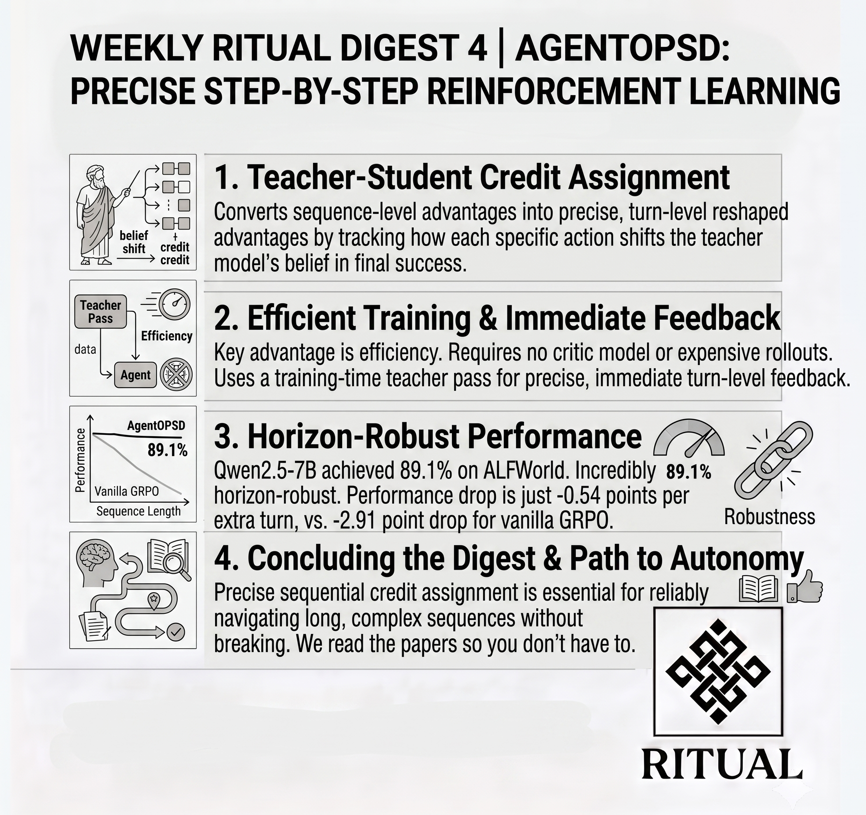
[Weekly Ritual Digest 4 | AgentOPSD: Precise Step-by-Step Reinforcement Learning]
@ritualnet @ritualfnd @ritualnet_korea
The final paper addresses a major flaw in current Agentic Reinforcement Learning (RL): standard methods like GRPO tend to give every turn the same credit, failing to distinguish between crucial setup actions and minor intermediate steps.
1. Teacher-Student Credit Assignment
AgentOPSD converts the sequence-level advantage used in GRPO into precise turn-level reshaped advantages. It achieves this by tracking how each specific agent action shifts the 'teacher' model's belief in final success.
2. Efficient Training
A key advantage of this method is efficiency. It requires no critic model or expensive extra rollouts, needing only a training-time teacher pass to provide precise, immediate feedback for every agent turn.
3. Horizon-Robust Performance
This precise feedback loops works wonders. Running Qwen2.5-7B achieved 89.1% on ALFWorld. Crucially, the method is incredibly robust to long tasks: performance fell just 0.54 points per extra turn, compared to a massive 2.91 point drop for models trained with vanilla GRPO.
4. Wrapping up this week's digest
By tracking the sequential credit of every action, AgentOPSD proves that precise feedback on the 'process' is essential for building agents that can reliably navigate long and complex sequences without breaking down.
That concludes this week's digest! From collapsing on long code tasks and mastering daily workflows to benchmarking memory retention and optimizing agent training through precise feedback, the road to true autonomous intelligence is paved with brilliant engineering optimizations. We read the papers so you don't have to. Have a wonderful weekend!
---
[Weekly Ritual Digest 4 | AgentOPSD: AI에게 완벽한 오답 노트를 써주는 방법]
마지막 논문은 강화학습(RL)을 통해 AI 에이전트를 훈련시킬 때 각각의 세부 행동에 대해 얼마나 공정하고 정밀하게 점수를 매겨야 하는지를 다룹니다.
1. 기존 훈련 방식(GRPO)의 한계
보통 AI가 여러 단계를 거쳐 어떤 목표를 달성하면 기존 방식인 GRPO는 그 과정에 있던 '모든 단계'에 똑같은 칭찬을 해 줍니다. 첫 단추를 기가 막히게 잘 끼웠든 중간에 헛발질을 했든 결과만 성공적이면 전체 과정을 다 뭉뚱그려 잘했다고 평가하는 식이죠.
2. 턴마다 정밀하게 채점하기 (AgentOPSD)
반면 AgentOPSD는 AI의 매 턴(Turn)마다 그 행동이 최종 성공 확률을 얼마나 높였는지 정밀하게 추적하여 각각 다른 점수를 줍니다. 놀라운 점은 별도의 무거운 평가 모델이나 추가 시뮬레이션 없이 오직 훈련 과정에서 선생님 모델과의 갭만을 계산해 이 복잡한 평가를 해낸다는 것입니다.
3. 흔들리지 않는 튼튼한 에이전트의 탄생
이 똑똑한 오답 노트로 훈련받은 Qwen2.5-7B 모델은 ALFWorld 환경에서 무려 89.1%의 압도적인 성공률을 기록했습니다. 특히 작업 단계가 길어질수록 성능이 뚝뚝 떨어지는 기존 방식(-2.91점 하락)과 달리 단 0.54점만 떨어지며 긴 호흡의 작업에서도 엄청난 멘탈과 안정성을 보여주었습니다.
4. 이번 주 다이제스트를 마치며
결과뿐만 아니라 '과정'을 섬세하게 쪼개어 평가하고 피드백하는 훈련 방식이 얼마나 강력하고 무너지지 않는 AI 에이전트를 만들어낼 수 있는지 완벽하게 증명해 냈습니다.
이번 주 리서치 다이제스트는 여기까지입니다! AI의 한계를 시험하는 극한의 훈련 환경부터 스스로 기억하고 꼼꼼하게 검증하는 에이전트, 그리고 과정까지 정밀하게 평가받는 강화학습 모델까지. 진정한 자율 지능을 향한 여정은 지금 이 순간에도 쉼 없이 진행되고 있습니다. 그럼 즐거운 불금 보내시고 주말 잘 보내세요!
@joshsimenhoff @mongdiny7 @Jez_Cryptoz @dunken9718
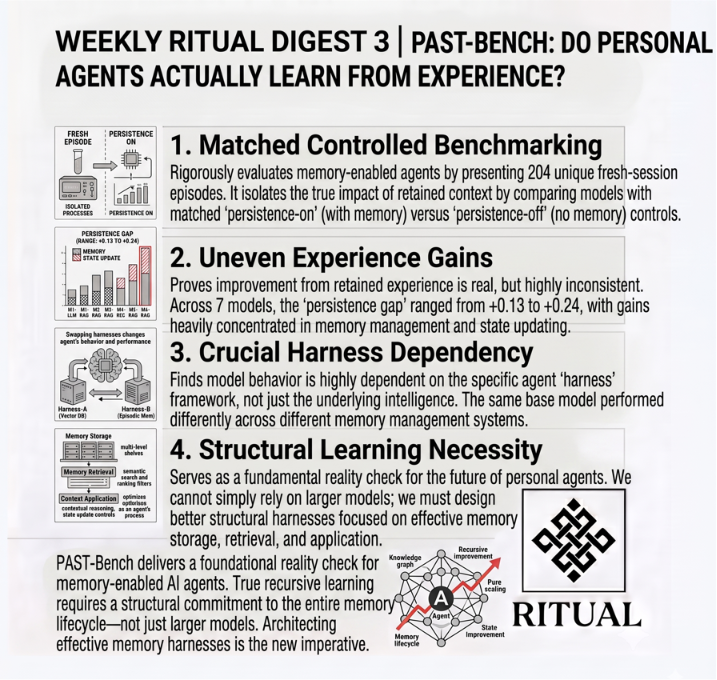
[Weekly Ritual Digest 3 | PAST-Bench: Do Personal Agents Actually Learn from Experience?]
@ritualnet @ritualfnd @ritualnet_korea
The third paper tackle a foundational question for the future of Crypto x AI agents: as personal agents accumulate memories, skills, and histories across various sessions, does that retained experience actually make them perform better?
1. Matched Controlled Benchmarking
PAST-Bench isolatest this question through rigorous testing. It presents models with 204 fresh-session episodes and compares their performance under matched 'persistence-on' versus 'persistence-off' controls to see if memory retention makes a difference.
2. Uneven Improvements
The results prove that improvement from retained experience is real but highly uneven. Across 7 base models, the 'persistence gap' ranged from +0.13 to +0.24. This improvement was highly concentrated in memory management and state updating.
3. The Framework Dependency
A fascinating finding is that model behavior is highly dependent on the agent framework itself. The same underlying model performed differently across different 'harnesses,' showing that how a system manages an agent's memory is just as important as the model's intelligence.
4. Wrapping up the third paper
PAST-Bench serves as a vital reality check. To build personal agents that truly improve recursively over time, we cannot simply rely on larger models; we must design better structural harnesses for memory storage, retrieval, and application.
---
[Weekly Ritual Digest 3 | PAST-Bench: AI는 정말 과거의 경험을 통해 똑똑해질까?]
세 번째 논문은 우리가 흔히 개인 비서로 쓰는 AI 에이전트들에 대한 아주 본질적인 질문을 던집니다. "AI가 사용자와의 이전 대화 기록과 기술을 기억해 두면 실제로 다음 작업 때 더 발전된 모습을 보여줄까?"
1. 경험의 효과를 측정하는 혹독한 벤치마크
이 질문에 답하기 위해 연구진은 'PAST-Bench'라는 새로운 평가 기준을 만들었습니다. AI에게 204개의 신규 에피소드를 주면서 과거의 기억을 쥐여준 상태와 아예 기억을 지워버린(���기화) 상태를 엄격하게 대조하여 테스트했습니다.
2. 발전은 진짜지만 완벽하진 않다
다행히도 과거의 경험은 실제로 도움이 되었습니다. 7개의 다양한 모델을 테스트한 결과, 기억을 유지했을 때 성능이 +0.13에서 +0.24까지 확실하게 상승했습니다. 특히 이 능력 향상은 과거의 정보를 꺼내어 '기억'하고 최신 상태로 '업데이트'하는 데 집중되어 있었습니다.
3. 껍데기가 다르면 모델도 다르다
하지만 놀라운 발견도 있었습니다. 기억을 통한 발전이 베이스 모델마다 아주 불균형하게 나타났고 심지어 완전히 똑같은 AI 모델이라도 어떤 프레임워크를 입히느냐에 따라 경험을 활용하는 능력이 천차만별로 달라졌습니다.
4. 세 번째 논문 리뷰를 마치며
단순히 AI에게 무조건 많은 세션 기억을 욱여넣는다고 만능 비서가 되는 것은 아닙니다. 진정으로 스스로 발전��는 개인형 AI를 만들기 위해서는 그 기억을 어떻게 적재적소에 꺼내 쓰고 ���용할지에 대한 '구조적 설계'가 핵심임을 일깨워줍니다.
@joshsimenhoff @mongdiny7 @Jez_Cryptoz @dunken9718

PAST-Bench关注智能体能否随着记忆、技能和历史积累真正成长。结果显示确实会进步,跨 7 个基础模型提升���0.13–0.24,尤其体现在记忆与更新能力上。
AgentOPSD,利用递归自蒸馏强化智能体,不需要额外评论家或更多 rollouts。Qwen2.5-7B 在 ALFWorld 上直接达到 89.1%,多轮任务中的稳定性也明显提升。

We have MLOps for machine learning projects and DevOps for website or Application projects.
Is there any AgentOps that also exists

Everyone is building AI agents.
Very few are thinking about what happens when those agents fail in production.
That's where AgentOps comes in.
AgentOps is becoming the observability layer for AI agents, giving developers the ability to trace, replay, monitor and debug agent behavior with just a few lines of code. It supports OpenAI Agents SDK, CrewAI, AutoGen, LangGraph, Agno, Google ADK and dozens of other frameworks.
What's technically fascinating is the architecture.
AgentOps automatically instruments LLM calls, tool usage, multi-agent interactions, sessions and workflows. It provides session replays, execution graphs, cost tracking, latency monitoring, OpenTelemetry-based tracing and self-hosting capabilities without requiring developers to manually instrument every component.
Recent releases expanded framework integrations, instrumentation capabilities and observability features, making it easier to monitor increasingly complex agent systems.
The futuristic upgrades get really interesting.
Imagine AI SREs automatically investigating failed agent runs, identifying root causes and generating fixes before humans even notice.
Or autonomous agent fleets that continuously optimize prompts, tools, memory and workflows based on production telemetry.
Or AI operating systems where every decision, tool call and reasoning step becomes searchable like application logs today.
We're not just building agents anymore.
We're building the infrastructure to operate millions of them reliably.
GitHub: https://t.co/3YwAAs2L7u
Follow @Alacritic_Super for more AI infrastructure, agent engineering & open-source breakthroughs 🚀

What if Vercel + Kubernetes + Railway + LangGraph + Temporal + OpenAI Assistants + Agent Observability became one unified platform for AI agents?
Very few are building the infrastructure layer for them. That's Why building ROMANICA
I’m building an Agent Runtime + AgentOps platform where developers can:
→ deploy multi-agents
→ orchestrate workflows
→ scale horizontally & vertically
→ monitor reasoning traces
→ share knowledge/memory
→ rollback failed executions
→ route across models automatically
→ run agents inside isolated sandboxes
→ manage retries, queues & observability
→ coordinate distributed AI workers
Basically: “Kubernetes + Vercel + Datadog + Temporal for AI agents.” The future won’t be single agents. It’ll be autonomous distributed systems.


Microsoft officially launching Agent 365 as a $15/month enterprise control plane completely validates the "AgentOps" market. The enterprise doesn't just want autonomous bots; they want a dashboard to monitor, govern, and throttle them. If you are building tools that help middle managers safely deploy and monitor AI agents, you are sitting on an absolute goldmine right now.

Today’s SafeRun milestone:
Another Phase is complete.
SafeRun is no longer just a check-action API or demo.
It now has the full design-partner validation loop:
Find partner → choose one risky agent action → wrap it with SafeRun → review the replay → convert repeated risk into a rule → prove the repeat incident was prevented → show CTO/CFO impact
The thesis keeps getting sharper:
AI agents don’t just need observability after they act.
They need an execution-control layer before they touch production tools.
Replay → Understand → Create Rule → Prevent
@saferunai https://t.co/KP6MlbTmYf. .
#AIAgents #AIInfrastructure #AgentOps #DevTools #AISafety
Today’s SafeRun build milestone:
Phase 2 is complete.
The thesis is becoming real:
AI agents don’t just need logs after they act.
They need an inline reliability layer before they touch production tools.
Replay → Understand → Create Rule → Prevent
Join the waitList at https://t.co/9YQwZfSh6y
@saferunai
#AIAgents #AIInfrastructure #AgentOps #DevTools #AISafety
Most AI agent failures aren’t “bad answers'' they’re action failures.
An agent calls the wrong tool
Loops through the same action
Issues a risky refund
Deletes the wrong record
Makes a valid API call with the wrong intent
That’s why SafeRun is built around one loop:
Replay → Understand → Create Rule → Prevent
Not just logs
Not just monitoring
A replay should become a prevention rule
Join the waitlist https://t.co/ZIZVCVg11o
#AIAgents #AgentOps #LLMOps #DevTools #AIInfrastructure
Last Seen Hashtags on Sotwe
Most Popular Users

Elon Musk 
@elonmusk
240.1M followers

Barack Obama
@barackobama
118.6M followers

Cristiano Ronaldo
@cristiano
114.4M followers

Donald J. Trump
@realdonaldtrump
111.8M followers

Narendra Modi
@narendramodi
106.9M followers

Rihanna
@rihanna
98.6M followers

NASA
@nasa
92.1M followers

Justin Bieber
@justinbieber
91.7M followers

KATY PERRY
@katyperry
89.9M followers

Taylor Swift
@taylorswift13
83.9M followers

Lady Gaga
@ladygaga
75.4M followers

Virat Kohli
@imvkohli
73.3M followers

Kim Kardashian
@kimkardashian
70.8M followers

YouTube
@youtube
68.6M followers

Neymar Jr
@neymarjr
66.3M followers

Bill Gates
@billgates
65.2M followers

Selena Gomez
@selenagomez
63M followers

The Ellen Show
@theellenshow
62.1M followers

CNN
@cnn
61.7M followers

X
@x
60.6M followers