

Top Tweets for #Autonomous

@alifoceb146 funny thing about autonomous rides: first 3 minutes feel terrifying, by minute 10 you're scrolling your phone bored

BlueJay Threat Agent can now autonomously scan for scam and phishing sites targeting a domain and send takedown requests. Built with @mastra and @agentmail


Has anyone in the US setup an LLC yet in preparation for running your own cybercab commercial fleet? I’ve been doing research, and choosing which NAICS code to operate under isn’t as straight forward as it seems. Also, which autonomous insurers will dare operate in this space?

How are you controlling runaway AI inference costs across US-East, UK-South & EU-Central? Check out this quick architectural guide on autonomous GPU FinOps:
https://t.co/GaQ5UGQLd7
#AIEngineering #CloudCostOptimization #TechOps

Gartner predicts that by 2027, 40% of enterprises will demote or decommission autonomous agents because governance gaps surface only after production incidents. If you are raising now, what proof of control are you showing investors — not just the demo?

@0xizzle There is no person to speak in a space, BADSEED is autonomous

@K28DesignLab Security and transparency will be key as AI agents become more autonomous

Tuning into the signal while everyone else stares at static.
Most infrastructure was wired for human clicks and legacy bottlenecks. @RialoHQ strips it down to machine-native logic-parallel execution, autonomous agents, and clean settlement under the hood.
Less noise. More throughput.


Solo builders using AI:
Would you prefer fully autonomous AI agents running your ops, or having AI do 90% of the work and leave it in an approval inbox (approve/edit)?
Where do you find the right balance of trust?

From optimizing data flows to enabling autonomous decision-making, @PerceptronNTWK is laying the foundation for a future where AI is:
• More efficient
• More accessible
Keep an eye on PerceptronNTWK this is where innovation meets decentralization.
#NodeAndProud


@Actum_AI Backed by 8 patent filings, 5 software copyrights, and reported real-world deployments, the focus is clear,
Move AI trust from promises to evidence.
Because in an autonomous world, execution alone is not enough. Accountability must come with it for more clarity.

Hey everyone, happy to join the group. I'm building Nexus Commerce, an Autonomous Services platform for @Shopify brands. Looking forward to connecting with everyone and following along with what you're building.
https://t.co/DHGmXQK8Iz

🛡️ AUTONOMOUS FINANCE NEEDS A SECURITY FOUNDATION.
Giving an AI the ability to act is only half the equation.
The other half is knowing what it should NEVER do.
🔐 Wallet permissions.
🔎 Risk detection.
⚙️ Controlled execution.
🔑 User ownership.
The smarter financial agents become, the more important their security architecture becomes.
Trust must be engineered.
Not assumed.
@KuviLabs 🦉
🔗 https://t.co/sPyyNvjA3Z

An NBER paper tracked 500,000+ GitHub developers using AI coding tools. Autonomous agents pushed their commits up about 240%. Releases went up about 30%.
If you're job hunting right now, that gap matters. Activity is cheap now, and I'd guess most hiring managers know it. A busy contribution graph says a lot less than it used to.
When I write up my own work I try to lead with what shipped and what broke less after it shipped. Commit counts aren't something I'd put anywhere.
Hiring folks, what do you actually look for now when everyone's output looks huge?
#techjobs #AI

MicroBioAgent: Closed-Loop Planning and Asynchronous Execution for Autonomous Microbiome Analysis
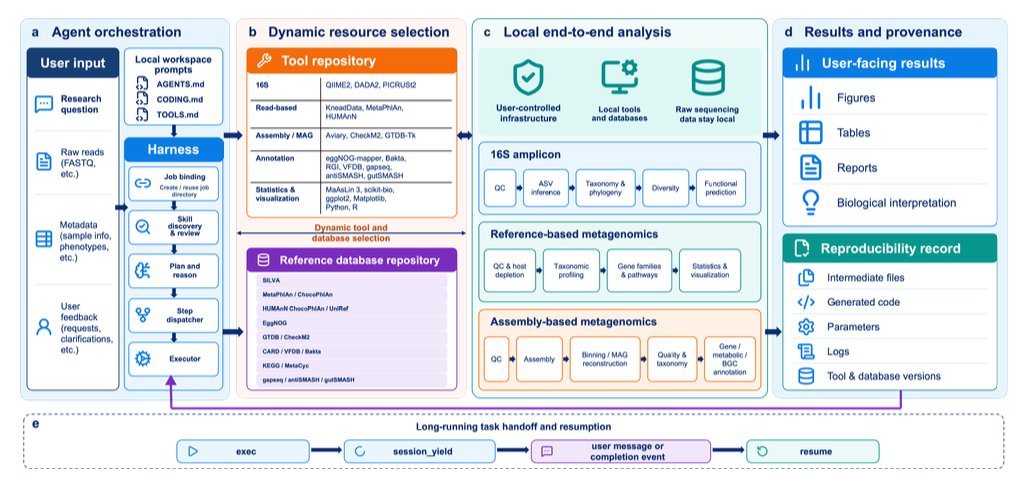
1. MicroBioAgent is a domain-specific LLM agent that turns high-level biological questions into executable, study-specific microbiome pipelines spanning 16S rRNA amplicon, reference-based shotgun metagenomics, and de novo assembly/MAG workflows—without relying on fixed pipeline templates.
2. Core idea: a closed-loop execution architecture. Instead of generating a one-shot workflow, the agent runs tools inside user-controlled local environments, inspects intermediate outputs (tables/logs), and adapts downstream decisions (methods, parameters, and follow-up analyses) based on what it observes and what the user requests.
3. A key systems contribution is asynchronous background task management for long-running metagenomic jobs. The agent can yield while commands run, accept new user guidance mid-run, and then automatically resume when the computation finishes—cutting LLM token consumption by >50% (and 2.4x fewer tokens vs polling-based execution in ablations).
4. The framework is built around modular “skills” (method playbooks) plus explicit configuration of tools/environments (runtimes.yaml) and reference databases (references.yaml). This makes the workflow extensible (swap tools/DBs) and auditable (commands, parameters, intermediate outputs stored per session).
5. Case study 1 (tomato rhizosphere; 60 16S + 36 matched shotgun libraries): the agent reproduced key resistance-associated patterns. After Ralstonia inoculation, Shannon diversity dropped in susceptible cultivars but remained higher in resistant cultivars (day 5 P=0.002; day 10 P=0.004), and weighted-UniFrac PCoA primarily separated inoculated vs control samples.
6. Also in case 1, it demonstrated practical “version-aware” iteration: MetaPhlAn3 recovered enrichment of the Pseudomonas putida group but missed Sphingopyxis unclassified reported in the original study; after the user requested alignment with the original tool version, the agent reran profiling with MetaPhlAn2 and recovered both biomarker signals.
7. Case study 2 (CRC cohort; 128 fecal shotgun metagenomes): MicroBioAgent combined taxonomic profiling (MetaPhlAn3) and functional profiling (HUMAnN3) with downstream statistics, network analysis, and predictive modeling. PERMANOVA detected significant community differences by CRC status (F=2.32, P=0.002) and stage (F=1.65, P=0.009), while key CRC-associated species matched reported directions (e.g., Fusobacterium nucleatum enriched).
8. In the CRC case, it built a co-occurrence network over differentially abundant species, recovering hub-like behavior for Parvimonas micra (including correlations with F. nucleatum and Solobacterium moorei). It also trained nested CV classifiers with mRMR feature selection: UniRef90 gene-family features achieved AUROC 0.902, outperforming KO-based models (AUROC 0.632).
9. Case study 3 (polyethylene enrichment; 6 ONT long-read metagenomes): the agent executed assembly+binning (Aviary), QC (CheckM2), dereplication (95% ANI), taxonomy (GTDB-Tk), abundance estimation (CoverM), and functional annotation (eggNOG-mapper). It recovered all focal taxa from the source study and identified genes tied to alkane terminal oxidation (9/11 focal MAGs) and universal detection of β-oxidation and oxidized-derivative metabolism modules (11/11).
10. Robustness testing across 27 independent sessions (3 backbone LLMs × 3 prompt granularities × 3 replicates) on a preprocessed benchmark showed 98.8% task completion (160/162). Diversity and differential-abundance outputs were highly consistent, while taxonomic relative abundance was more sensitive to autonomous choices (e.g., amplicon region assumptions, MetaPhlAn normalization flags, and occasional table-merge issues), highlighting where guardrails and inspection matter.
💻Code: https://t.co/JoJFIVYQlq
📜Paper: https://t.co/buUnwOvqjI
#Microbiome #Metagenomics #16S #MAGs #Bioinformatics #LLM #AIagents #Reproducibility #WorkflowAutomation #ComputationalBiology
From optimizing data flows to enabling autonomous decision-making, @PerceptronNTWK is laying the foundation for a future where AI is:
• More efficient
• More accessible
Keep an eye on PerceptronNTWK this is where innovation meets decentralization.
#NodeAndProud


Singapore’s government provides strong, structured support for Electric Vehicles (EVs) as part of its Green Plan 2030 and 100% cleaner-energy vehicles by 2040 target, while taking a cautious, phased approach to Full Self-Driving (FSD) and autonomous vehicles (AVs). @LawrenceWongST (<https://t.co/xgg6IvK3zI>)(<https://t.co/hc14fAHPqx>)
### Support for Electric Vehicles (EVs)
The Land Transport Authority (LTA) and National Environment Agency (NEA) use a combination of financial incentives, charging infrastructure, and regulations.
**Key financial incentives (2026–2027):**
- **Vehicular Emissions Scheme (VES)**: Extended to 31 December 2027. From 2026, **only fully electric vehicles** receive rebates (hybrids no longer qualify). Band A rebate is about $22,500 in 2026 and $20,000 in 2027.(<https://t.co/5jqbmLsmlX>)
- **EV Early Adoption Incentive (EEAI)**: Extended until 31 December 2026. Provides 45% off the Additional Registration Fee (ARF), capped at $7,500 in 2026 (reduced from $15,000). It ends after 2026.[](<https://t.co/5jqbmLsmlX>)
- Combined VES + EEAI savings: up to **$30,000** off ARF for EVs registered in 2026, and up to **$20,000** in 2027.
- $0 ARF floor for electric cars and taxis maintained until end-2027.(<https://t.co/5jqbmLsmlX>)
- Other schemes: Commercial Vehicle Emissions Scheme (CVES), Heavy Vehicle Zero Emissions Scheme (HVZES) offering $40,000 incentives for zero-emission heavy vehicles from 2026, and lower road tax for EVs.
**Charging infrastructure:**
- Target of **60,000 charging points by 2030** (40,000 in public car parks + 20,000 private).
- All HDB towns are EV-ready (or nearly so); more than 90% of HDB car parks already have chargers as of late 2025, with fast-charging hubs planned in every town by end-2027.(<https://t.co/xgg6IvK3zI>)
- **EV Common Charger Grant (ECCG)**: Co-funds charger installation in condominiums/private apartments until end-2026 (expanded to 3,500 chargers).
- New Electric Heavy Vehicle Charger Grant for heavy vehicles.(<https://t.co/9RihOcCnWz>)
Overall approach: Taper incentives gradually as EV costs fall and adoption rises (EVs already ~1/3 of new car registrations in 2024), while strongly penalising higher-emission vehicles. No new diesel car registrations from 2025.[](<https://t.co/LnrLFmEsyj>)
### Support for FSD and Autonomous Vehicles
**Tesla Full Self-Driving (FSD Supervised) is not available** in Singapore. The Ministry of Transport stated in 2026 that it has not been evaluated locally because it lacks type approval under relevant UN Regulations. Singapore is still deciding whether Level 3 (conditional automation) cars should be allowed at all.(<https://t.co/hc14fAHPqx>)
**Government approach to AVs is supportive but controlled:**
- Regulatory sandbox under the Road Traffic (Autonomous Motor Vehicles) Rules 2017 (extended to end-2028) allows authorised trials and deployments with strict safety requirements, insurance, and black-box data recorders.
- Active deployments: Autonomous fixed-route shuttles in Punggol open to the public since April 2026; other pilots at places like Resorts World Sentosa.
- Safety testing required at CETRAN (Centre of Excellence for Testing and Research of AVs).
- Plans for a comprehensive **AV Act** to be tabled in Parliament in 2027, covering liability, insurance, cybersecurity, and operator responsibilities. Public consultation occurred in 2026.
- Partnerships such as with Waymo for driverless ride-hailing targeted from 2028.
- Focus is on public transport use cases (shuttles, buses) first, with a phased, risk-calibrated rollout rather than unrestricted consumer FSD.(<https://t.co/UxS2i1J08w>)(<https://t.co/degEBgoVgt>)
In short: Singapore aggressively supports EV adoption through large rebates and a massive charging network build-out. For FSD/AVs, it is investing in controlled public-transport pilots and building a full legal framework, but has not yet approved consumer-level systems like Tesla FSD pending international type approval and local evaluation.
@taglia We tried, but Singapore govt is not supportive of electric vehicles

Tesla has solved autonomous driving.

FSD v15 now starting to roll out – upgrading every part of the end-to-end driving network
Safety
25x better handling of safety critical cases
Tesla Reality View
Adds a live visualization of the drive that lets you see & control what FSD is planning to do
Navigation for start & end of the trip now learns end-to-end from fleet route preferences. Later v15 releases will expand this to the entire route.
You also should notice better detection of signs, animals, debris, potholes and standing water, plus more natural speed handling in school zones and inclement weather.
Lastly, FSD can now slow for speed cameras & Bike Rack Mode lets you enable FSD w/ bike racks or similar hitch accessories

@GoKiteAI @bitrefill via the x402 micropayment protocol to identify the available services.
2️⃣ Security & Delegation:
A dedicated spending session was created with strict budget controls (a $5 cap) and secure Passkey biometric approval. No risk of overspending.
3️⃣ Autonomous On-chain Settlement:
Last Seen Hashtags on Sotwe
Trends for you
Most Popular Users

Elon Musk 
@elonmusk
240.1M followers

Barack Obama
@barackobama
118.6M followers

Cristiano Ronaldo
@cristiano
114.4M followers

Donald J. Trump
@realdonaldtrump
111.7M followers

Narendra Modi
@narendramodi
106.9M followers

Rihanna
@rihanna
98.6M followers

NASA
@nasa
92.1M followers

Justin Bieber
@justinbieber
91.7M followers

KATY PERRY
@katyperry
89.9M followers

Taylor Swift
@taylorswift13
83.9M followers

Lady Gaga
@ladygaga
75.4M followers

Virat Kohli
@imvkohli
73.3M followers

Kim Kardashian
@kimkardashian
70.8M followers

YouTube
@youtube
68.6M followers

Neymar Jr
@neymarjr
66.3M followers

Bill Gates
@billgates
65.2M followers

Selena Gomez
@selenagomez
63M followers

The Ellen Show
@theellenshow
62.1M followers

CNN
@cnn
61.7M followers

X
@x
60.6M followers