

Top Tweets for #ExportControls

#Biosecurity #BigPharma #ExportControls #Compliance
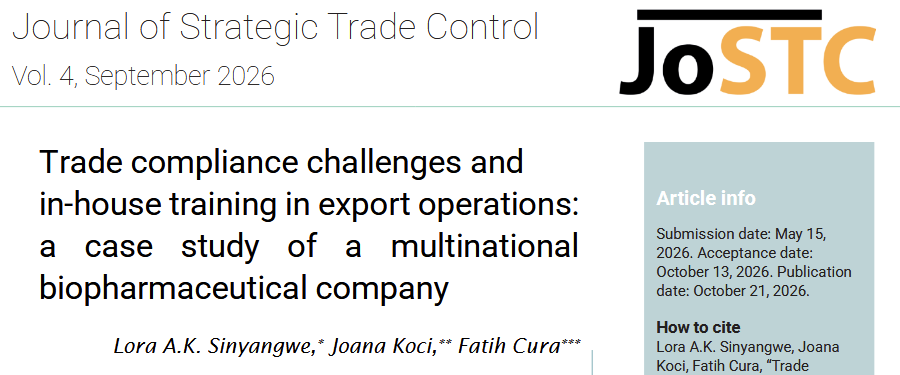
Trade compliance challenges and in-house training in export operations: a case study of a multinational biopharmaceutical company
https://t.co/gN5cyftZSM
[PDF file]
Trade compliance has become increasingly complex for multinational firms as export controls, sanctions, customs requirements, and other regulations change across jurisdictions. While existing research has examined regulatory frameworks and compliance systems, less attention has been paid to how trade compliance challenges, knowledge gaps, and training needs vary across organizational functions. This study examines how trade compliance challenges and knowledge gaps vary across organizational functions and how in-house training and knowledge-sharing practices are organized within a global biopharmaceutical company. Using a qualitative single-case study design, 21 semi-structured interviews were conducted across trade compliance, logistics, customer service, classification, research and development, and related functions, supported by internal training and audit materials. The findings show that regulatory complexity is closely connected with internal challenges involving product information, classification, documentation, responsibilities, and information flows.
#BiologicalWeapons #ExportControls #USA #Investigation
Public Health Preparedness: Action Needed to Address National and Biosecurity Risks Associated with Disposal of Federal Laboratory Equipment
https://t.co/W5TVuWiGxd
[PDF report available]
[...]
The GAO found that from fiscal 2022 through 2025, the Department of Health and Human Services and the Department of Agriculture sold nine unneeded scientific instruments that were on the U.S. Interactive Commerce Control List to individuals and companies in the United States and Canada, some of which appeared to be resellers.
[...]
#DualUse #Technology #ExportControls #EuropeanUnion
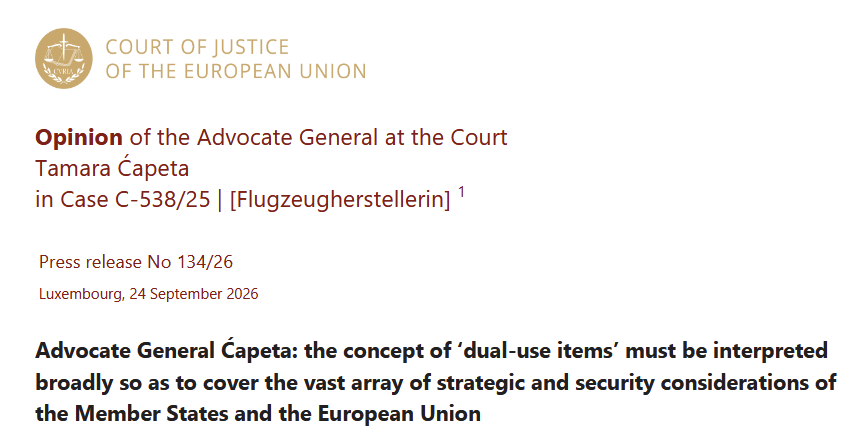
Opinion of the Advocate General at the Court Tamara Capeta in Case C-538/25 | [Flugzeugherstellerin]
https://t.co/orzHAwXUMc
[PDF document - link to full opinion included]
[...]
To determine whether an item is of ‘dual-use’, the Advocate General proposes that the competent national authorities rely on the item’s physical and technical characteristics at the time of exportation to decide on its potential usage capabilities. However, whether an item is of ‘dual-use’ does not require an assessment of the military capabilities of the end-user in the third country to which the item is to be exported, of the situation in that country, of the possibility for the end-user to repurpose said item or of the risk of that item being diverted for other purposes. Those concerns are not relevant for the assessment of whether the item is of ‘dual-use’, but may be taken into account when deciding on whether an authorization may be required for the exportation of said item.
[...]

#ArtificialIntelligence #ExportControls #Theft #China #ChemicalWeapons #BiologicalWeapons #Threat
US AI giant accuses Chinese rivals of mass data theft
https://t.co/i90CQJ09nT
US artificial intelligence company Anthropic said on Monday it had uncovered campaigns by three Chinese AI firms to illicitly extract capabilities from its Claude chatbot, in what it described as industrial-scale intellectual property theft. OpenAI leveled similar charges last month.
[...]
Anthropic said the companies achieved their ends through approximately 16m exchanges with its Claude model and 24,000 fake accounts.
These allowed the three labs to siphon off capabilities they had not independently developed at a fraction of the cost – and in so doing circumvented export controls on powerful US technology intended to preserve American dominance in AI.
The company argued the practice posed national security risks, saying models built through illicit distillation are unlikely to retain safety guardrails designed to prevent misuse – such as restrictions on helping develop bioweapons or enabling cyberattacks.
[...]
#ChemicalWeapons #Armament #DPRK #TechnologyTransfers #ExportControls
North Korea’s Chemical Imports: Technical Assessment 2
https://t.co/T2gGD5KVUN
[#OpenSource - PDF available]
[...]
This report assesses shipment-level trade data for imports of chemicals and equipment into North Korea that could be used to produce chemical warfare agents (CWAs). It is impossible to ascertain the uses of the imports this report analyses. However, two chemical imports from China do have particular relevance to the development of CWAs: sodium fluoride and disodium sulfate. The former appears on the Australia Group (AG) Export Control List of Chemical Weapons Precursors, while the latter can be readily converted into sodium sulfide – yet another AG-listed precursor. Similarly, one chemical exported from India to North Korea in 2017, phosphorus trichloride, is scheduled by the Chemical Weapons Convention and was banned in 2006 by the UN Security Council Resolution 1718 Committee for export into North Korea.
[...]
#ChemicalWeapons #BiologicalWeapons #SouthAfrica #Disarmament #ExportControls
No chemical or biological warfare stockpile in South Africa – Motshekga
https://t.co/BtZrx0kzko
[...]
[Defence minister] Motshekga “categorically confirmed that South Africa has no undeclared stockpiles of hazardous or warfare chemicals, nor any intent or practice that would place it in non-compliance with relevant legislation”.
She noted there is a local council to oversee issues relating to non-proliferation of weapons of mass destruction. The council was established in terms of the Non-Proliferation of Weapons of Mass Destruction Act and the responsible government entity is Department of Trade, Industry and Competition (DTIC) where Minister Parks Tau holds sway.
[...]
#ChemicalWeapons #AustraliaGroup #ExportControls
The Australia Group at 40
https://t.co/3TyF7S2vTb
[...]
One of the most significant Australians to advance the cause of chemical and biological disarmament was Bob Mathews, who had begun a career in the Australian Defence Science and Technology Organisation in 1968, the year in which the Nuclear Non-Proliferation Treaty was opened for signature. Between 1968 and 1978, one of Mathews’ duties was to analyse the role of a range of CW agents and their precursors.
In 1985, Matthews developed the original Australia Group export control list for CW precursor chemicals and, a few years later, another list for chemical manufacturing equipment. These documents in time became internationally accepted norms for responsible export control policy around chemical non-proliferation. All members of the Australia Group were expected to deny export licence requests for items on the control lists when there was concern that the items might be used in a chemical or biological warfare program.
[...]
#ChemicalWeapons #BiologicalWeapons #ExportControls #AustraliaGroup @SIPRIorg @EU_NonProlif
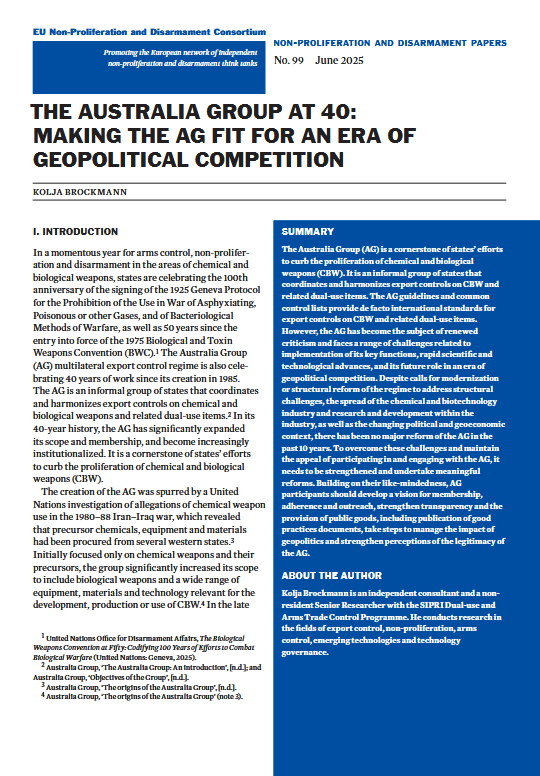
The Australia Group at 40: Making the AG Fit for an Era of Geopolitical Competition
https://t.co/tgBzKFJonR
[ #OpenSource - PDF available]
The Australia Group (AG) is a cornerstone of states’ efforts to curb the proliferation of chemical and biological weapons (CBW). It is an informal group of states that coordinates and harmonizes export controls on CBW and related dual-use items. The AG guidelines and common control lists provide de facto international standards for export controls on CBW and related dual-use items. However, the AG has become the subject of renewed criticism and faces a range of challenges related to implementation of its key functions, rapid scientific and technological advances, and its future role in an era of geopolitical competition. Despite calls for modernization or structural reform of the regime to address structural challenges, the spread of the chemical and biotechnology industry and research and development within the industry, as well as the changing political and geoeconomic context, there has been no major reform of the AG in the past 10 years. To overcome these challenges and maintain the appeal of participating in and engaging with the AG, it needs to be strengthened and undertake meaningful reforms. Building on their like-mindedness, AG participants should develop a vision for membership, adherence and outreach, strengthen transparency and the provision of public goods, including publication of good practices documents, take steps to manage the impact of geopolitics and strengthen perceptions of the legitimacy of the AG.
#BiologicalWeapons #DualUse #EU #Germany #ExportControls #Regulation
Dual Use Technologies in Biotech and their Regulation in the EU and Germany
https://t.co/dc4XYEBpmN
Dual use biotechnology illustrates the complex interplay between innovation, trade, and security. The EU and Germany have established comprehensive controls through Regulation (EU) 2021/821 and national laws, yet the pace of scientific and technological change requires constant vigilance and adaptation. Future success will depend on flexible, risk-based regulation, continuous dialogue with stakeholders, and effective international cooperation to ensure biotechnology’s benefits are realized without compromising security.

#BiologicalWeapons #Terrorism #Prevention #ExportControls #Education
How to stop bioterrorists from buying dangerous DNA
https://t.co/7xmtF4oJY3
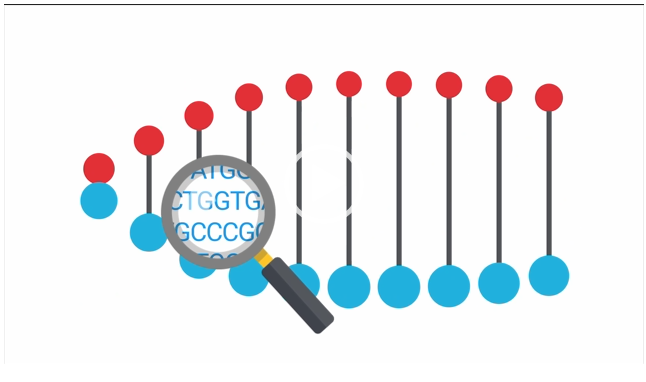
The current crossroads provides an opportunity to strengthen the next iteration of screening requirements. One major shortcoming of policymaking so far is the lack of clear guidance and decision-making criteria to conduct customer screening. Providers should make efforts to look closely at orders containing potentially concerning sequences to see who ordered them and why. Potentially risky DNA sequences, such as pathogen genes that contribute to virulence, might be necessary for studying disease and designing vaccines, for example. Customer screening, not just sequence screening, therefore, is necessary. But classifying customers as “legitimate” or “illegitimate” is subjective and often ambiguous. Screening is a trickier problem than it might first appear.
[...]
#BiologicalWeapons #CloudLabs #ExportControls #RiskManagement
Cloud Labs and Other New Actors in the Biotechnology Ecosystem: Export Control Challenges and Good Practices in Outreach
https://t.co/fQ9B0MubbV
The biotechnology ecosystem encompasses an expanding set of companies, start-ups, universities and other research organizations and a vibrant do-it-yourself biology community. Advances in biotechnology and the increasingly diverse profiles of new entrants to the ecosystem pose a range of chemical and biological weapon (CBW) proliferation risks and export control challenges. Among them, cloud laboratories (cloud labs) are an example of a new actor entering the biotechnology ecosystem that is pioneering a new business model. Cloud labs exemplify how developments in emerging technologies converge in a way that poses challenges for the application of export controls. Cloud lab providers offer fully automated, modular laboratories to customers for remote use to perform experiments and increasingly artificial intelligence-enabled research and analyses. Managing the CBW risks posed by cloud labs and other new actors in the biotechnology ecosystem requires awareness by relevant stakeholders and effective export control compliance measures. European Union member states and Australia Group participating states should therefore continue to assess and discuss the development of cloud labs, work to provide relevant guidance materials and develop good practices for conducting outreach activities targeting cloud lab providers and other relevant actors to reduce CBW proliferation risks.
#ChemicalWeapons #BiologicalWeapons #CWC #1972BWC #Africa #Kenya #ExportControls
Kenya moves to tighten national security with Strategic Goods Control Bill
https://t.co/h6Crm4dVee
[...]
In his keynote address, Dr. Omollo described the Bill as the result of more than a decade of collaborative national and international efforts to mitigate threats posed by chemical, biological, radiological, and nuclear (CBRN) materials.
He emphasized that the legislation is a critical step toward fulfilling Kenya’s international obligations under key treaties, including the Chemical Weapons Convention, the Biological Weapons Convention, and UN Security Council Resolution 1540.
[...]

🌏 China, Japan, and South Korea Agree on Joint Response to Trump's Reciprocal Tariffs
https://t.co/2kn1gsaae2
Officials in the 13th China-Japan-ROK Trilateral Economic and Trade Ministers' Meeting have a consensus that they hope to keep the semiconductor supply chain unimpeded.
#China #Japan #SouthKorea #TradeAlliance #TrumpTariffs #GlobalTrade #EconomicCooperation #SupplyChain #ExportControls #FreeTradeAgreement
#ChemicalWeapons #BiologicalWeapons #UNGA #FirstCommittee #Statement #ExportControls #UkraineRussiaWar
#Denmark #Finland #Iceland #Norway #Sweden
Joint Nordic Statement: First Committee on Disarmament - General Debate
https://t.co/3zfdXFNo5v
[...]
Madame Chair.
The re-emergence of chemical weapons is an urgent threat to international peace and security. This menace must be tackled firmly and collectively. The erosion of norms against the use of weapons of mass destruction has affected the Chemical Weapons Convention. In recent years, we have witnessed the use of chemical weapons on the soils of Malaysia, Ukraine and the UK as well as in Syria, Iraq, and Russia.
We remain deeply concerned by Russian use of chemical weapons in Ukraine. The increasing number of reports, including by Russian information sources, that Russia is using Riot Control Agents and chloropicrin as a method of warfare in Ukraine is alarming. We recall that such use is prohibited under the Convention, and urge Russia to ensure full compliance with its obligations
Any use of chemical weapons is a breach of international law and the Chemical Weapons convention and such use may amount to war crimes and crimes against humanity. Impunity for breaches of the global norms against chemical weapons must not be tolerated.
We underline our full and unequivocal confidence in the professionalism, objectivity, impartiality, independence and technical expertise of the OPCW’s Technical Secretariat. We express our unwavering commitment to protect the integrity of the Chemical Weapons Convention and the Organization for the Prohibition Chemical Weapons.
The Biological and Toxin Weapons Convention is a vital pillar of the disarmament regime. The Nordic countries are encouraged by the deliberations of the Working Group on the Strengthening of the Convention. We remain committed to contribute constructively to all items on its agenda and to reach consensus on recommendations and concrete actions to strengthen the convention and its implementation.
The multilateral export control regimes are integral to the international non-proliferation architecture. The Nordic countries are concerned with increased efforts to politicise export controls, framing them as imposing “undue restrictions” on developing countries and violating international law. On the contrary, export controls foster trust, which is conducive to trade and enhances cooperation on the peaceful uses of technology. Export controls help states fulfil their obligations under UN Security Council Resolution 1540 and the NPT to prevent proliferation of weapons of mass destruction. We support the strengthening of export controls globally, where the existing export control regimes are essential, to improve and facilitate international cooperation on peaceful uses of technology.
[...]

#BiologicalWeapons #ExportControls
Reforming the Australia Group to Better Combat Biological Threats
https://t.co/jsowLugJC5
Over the past year, the US government has moved to significantly bolster biotechnology innovation and trade. Last December, the Department of Commerce’s Bureau of Industry and Security decided to remove export controls on biological materials and technologies intended for participants in the Australia Group (an “informal arrangement” of like-minded countries who have agreed to harmonize export controls on sensitive biological and chemical materials)s. In other words, companies or individuals residing in Australia Group nations no longer need US export control licenses for these items.
This is a significant step in strengthening biotechnology and broader technological innovation. Through this update, the United States has incentivized free, unburdened trade in biological materials and technologies among its members and showcased the potential impact of the Australia Group. This regulatory alteration is part of a broader strategy by the United States and its partners to improve scientific cooperation and expand joint research endeavors.
Further, under the banner of the AUKUS trilateral security partnership, each nation has agreed to reciprocally eliminate export controls on emerging technologies and scientific applications intended for each country. As Defense One reported:
“The Australians said the changes will allow license-free trade of large new swaths of U.S. exports to their country: 70 percent of those subject to International Traffic in Arms Regulations, or ITAR, and 80 percent of the trade subject to Export Administration Regulations.
The changes will also eliminate the need for some 900 export-control permits affecting trade from Australia to the United States and 200 defense-specific export permits from the U.K. to Australia, covering $129 million a year.”
Both moves should bolster biotechnology innovation, as well as the development of a broad range of emerging systems and technologies.
The importance of these changes cannot be overstated. There are urgent issues at hand, such as allied and partner nations’ ability to work together in deterring and defending against what are widely feared to be continuing biological weapons threats from nations such as Russia. More broadly, collaboration on strategic technologies is essential to long-term security and economic competitiveness. Biotech must be a critical component of this, given its potential for transformational changes to countless areas of economies, defenses, health, and more, and this area is now closely watched by those seeking to understand China’s changing role in the world.
Given the stifling export control regime that had been in place until now, this update is a clearly positive step for the Australia Group. Going forward, the group should build on this progress by reformulating and expanding to better mitigate the ever-evolving spectrum of biological threats.
[...]
#ChemicalWeapons #ChemicalWeaponsConvention #OPCW #Chile #ExportControls #Education
OPCW and Chile Co-Host Training of Trainers Course on Chemical Weapons Convention Transfers Regime
https://t.co/BSPH7iX10w
[...]
The three-day course was designed to strengthen the enforcement of the Convention’s Transfers Regime, contributing to both national security and global non-proliferation efforts. Participants were provided with the tools necessary to effectively incorporate the Transfers Regime into their national customs training programs. This included the development of essential methodologies and resources for creating Convention-specific training modules for frontline customs officers.
[...]
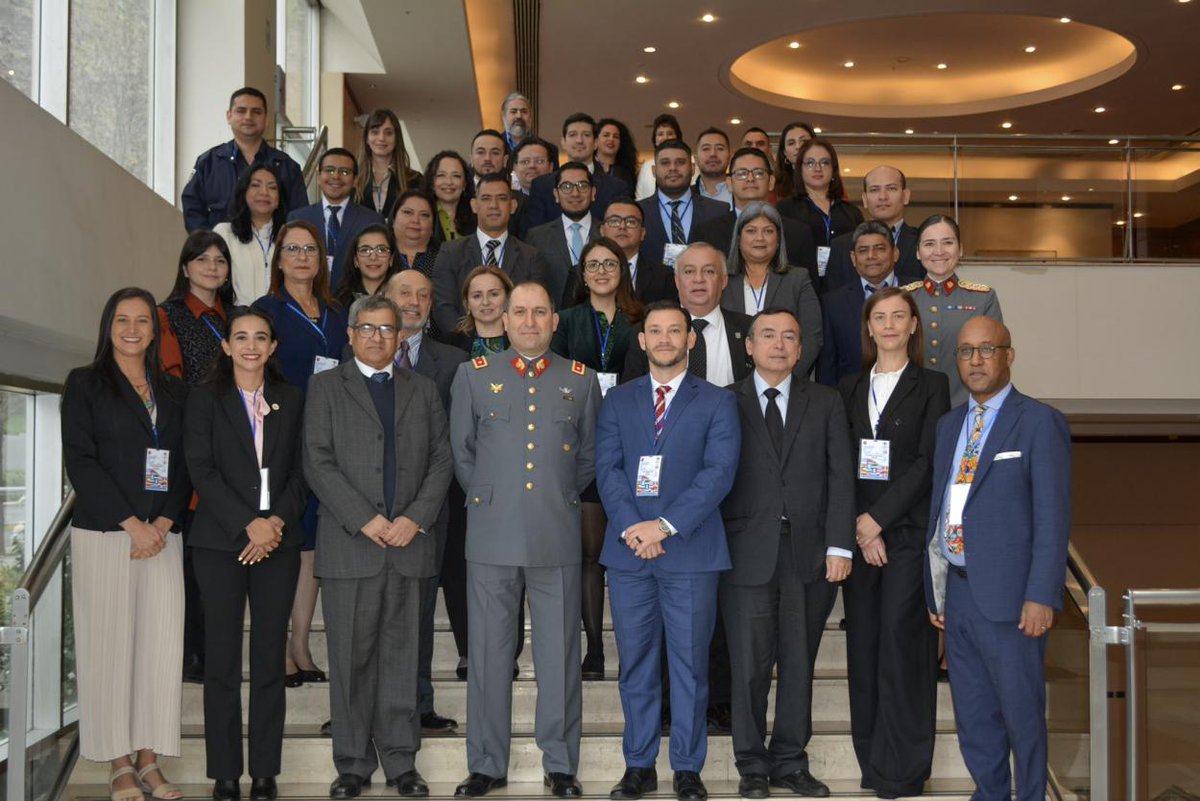
#ChemicalWeapons #BiologicalWeapons #ExportControls #Education
Building a culture of responsibility: education for disarmament and non-proliferation
https://t.co/p3oDrt81nT
I am honoured to have been invited to contribute to the Special Issue of the Journal of Strategic Trade Control (https://t.co/AwCO8GndcX) focussed on Training programs to counter current and emerging biological and chemical proliferation risks: themes, practices, and lessons learnt. Between January 2018 and December 2023, I was involved in the design, development and implementation of a master’s course on dual-use technology transfer control, which was implemented in Central Asia through the International Science and Technology Centre (ISTC) and Ukraine, Moldova, and Georgia via the Science and Technology Centre in Ukraine (STCU).
Challenging as the project was, the COVID-19 pandemic starting in early 2020 and the Russian invasion of Ukraine in February 2022 demanded flexibility, adaptability and, most importantly, improvisation. Notwithstanding, good results were achieved thanks to the involvement of a great team. Indeed, the outcomes would not have been possible without the brainstorming sessions, comments, and suggestions of a great team of partners. They include Dr Maria Espona (Argentina), the overall project coordinator, as well as contributions from the work package leaders, Ms Anne Harrington (USA), Dr Richard Guthrie (UK), Dr Kai Ilchmann (Germany), and Prof Dr Quentin Michel (Belgium). The exchanges with academic colleagues in Ukraine and Kazakhstan in setting up the courses were also of great value. Other meaningful experiences and insights came from interacting with interested parties in the Kyrgyz Republic, Tajikistan, Georgia, and Moldova. The same goes for the staff at the ISTC and STCU. I refrain from citing their names or identifying their roles because of the war in Ukraine (and ensure equal recognition of all colleagues).
Most Popular Users

Elon Musk 
@elonmusk
240.1M followers

Barack Obama
@barackobama
118.6M followers

Cristiano Ronaldo
@cristiano
114.4M followers

Donald J. Trump
@realdonaldtrump
111.7M followers

Narendra Modi
@narendramodi
106.9M followers

Rihanna
@rihanna
98.6M followers

NASA
@nasa
92.1M followers

Justin Bieber
@justinbieber
91.7M followers

KATY PERRY
@katyperry
89.9M followers

Taylor Swift
@taylorswift13
83.9M followers

Lady Gaga
@ladygaga
75.4M followers

Virat Kohli
@imvkohli
73.3M followers

Kim Kardashian
@kimkardashian
70.8M followers

YouTube
@youtube
68.6M followers

Neymar Jr
@neymarjr
66.3M followers

Bill Gates
@billgates
65.2M followers

Selena Gomez
@selenagomez
63M followers

The Ellen Show
@theellenshow
62.1M followers

CNN
@cnn
61.7M followers

X
@x
60.6M followers