

Top Tweets for #Freedomtool

The next democracy won't wait for permission to hold a referendum. It'll run from people's phones, private and impossible to censor. That's what gets built with #freedomtool
🇫🇷 La prochaine démocratie n'attendra pas la permission d'organiser un référendum. Elle se fera depuis les téléphones, privée et impossible à censurer. C'est ce qui se construit avec #freedomtool

La colère ne suffit pas. Il faut pouvoir décider.
Référendum Citoyen est né d'une ambition : donner aux Français un moyen de faire entendre leur voix et de peser sur les décisions qui engagent leur avenir.
🎬 Le Combat des invisibles, dimanche 18 à 14 h sur @CNEWS .
#Freedomtool 2.0 should explore how communities allocate AI resources and evolve ownership as their shared projects develop.

#Freedomtool is the most horizontal open-source thing we’ve ever been part of. Spanish 🇪🇸 builders taking the French 🇫🇷 community’s app and adding:
📥 an open registry for submitting ideas (polls) and a council interface for approving them for a vote.
🪪 Spanish ID integration.
The code is open for other communities to reuse and adapt. Someone builds what they need locally, and the next group doesn’t have to start from scratch or come back to us. Thanks to the contributors who are taking #Freedomtool in directions we wouldn’t have thought of ourselves.
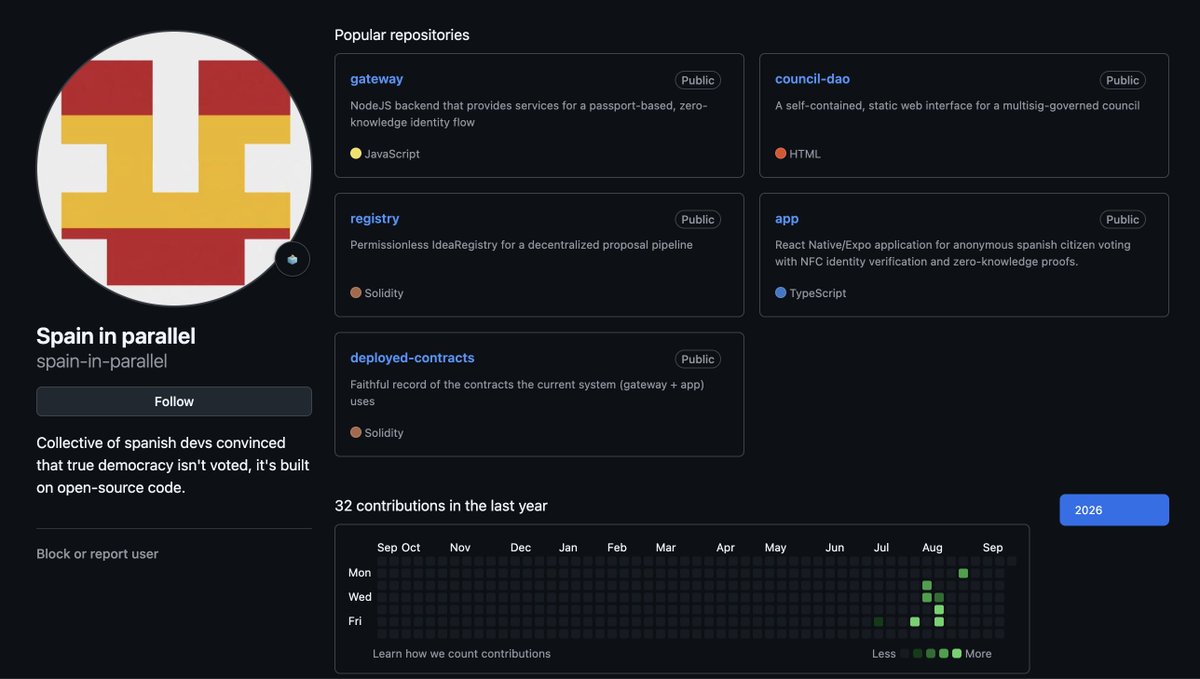
I hate when propaganda does not get its purpose nor the name of the product. It's called #freedomtool not tools of freedom.

What we want, and how badly. Plain voting like #Freedomtool today gets you the first one, but for the second we could use quadratic voting to solve the intensity signal without money.
Innovation of @Rarimo_protocol #freedomtool was not blockchain voting. That was solved years ago. The ballot box was never the problem. The door was. The real breakthrough is the Tap: hijacking the biometric chip 1.5 billion people already carry.
Your passport has an NFC chip, signed by your government. That signature already says "real, unique person." Every earlier system missed this. You either trusted a committee to pick who's eligible or some random marker.
So you tap your passport to your phone. The data never leaves the device. The phone builds a zero-knowledge proof locally: "I hold a passport with a valid government signature, I'm making exactly one voting credential from it, but I won't tell you a single field on it."
It reveals nothing about you and can't be reversed. Vote in a different election, you get a different nullifier. Nobody links your votes. Blockchain voting was a demo for years. The Tap made it real, and that's what makes difference.
I’m a supporter of active democracy, but not in the naive “one app and everyone should vote on everything” way. That’s not how it grows. What matters with #FreedomTool is the pattern.
We saw this mechanism in hostile environments, where people needed a way to coordinate without trusting the state. Now we see it in 🇫🇷 France with @RefCitoyen, a democratic Western society. The question is: did we plant the seed of a mechanism that can work, scale, and remove friction from direct democracy? YES
Tomorrow it can become a tool used by governing bodies in many different forms. It can be a referendum mechanism that costs a fraction of the current system and can be mobilized by citizens directly.
Or it can become the protest tool of the 21st century. A verifiable veto signal.
If enough people say no, the system has to pause. Democracy was built around choosing who governs. The next version will also need a native mechanism for people to say: stop, this does not have consent anymore. That’s what I call Vetocracy.
These early experiments are important because this is how the pattern forms. Not fully. Not perfectly. Not overnight. But it builds up.

Robinson et Alexandre Jardin présentent le projet «référendum citoyen» : «Depuis ce matin, les Français peuvent décider des grandes trajectoires du pays», dans #HDPros
Toute l'info est à retrouver sur https://t.co/wCnzQBE1GX
When I’m explaining #Freedomtool, that it’s the real-world ballot system outside of state apparatus, a public good and you hit me with a certification argument to move it up for a government process.
it’s a bumper.

Two years 🎂 of #freedomtool. It’s open-source, it’s a public good, and its footprint is slowly growing, yet we're still searching for the "flip conditions" that will actually scale digital democracy.
I don't believe in the procedural route of ISO23* certificates to win over governments. The facts don't lie: Estonia has had eVoting since 2007, and in nearly 20 years, zero states have even mimicked them.
We're not selling software it’s a deep, perhaps historical, resistance. So we’re going to keep betting on the rebels, the outliers, and the catalysts of change and I’m certain that, sooner or later, the dominoes will fall.
Thanks @Protocollabs for this 🎬 with @Kitty__Jenny
Let me explain it in simple terms. Since 2024, when we first launched #freedomtool with the Russian opposition, we have been boiling in hot water on the ground to solve each issue and ensure every vote of dissent was secure (there were 40,000 participants). That might look small, but it was the largest protest gathering in Russia since 2021.
There are two major caveats when working with passports. First, you need to ensure uniqueness so that 1 vote = 1 passport. For this you have three options:
1. Passport support (active authentication), where you can sign and get a nullifier directly from the document. But since the 2010s, major countries have abandoned support for that standard and it won’t work at scale.
2. An external signer: you can use a TEE, OPRF, secure server, whatever everyone is discussing. It adds an additional secret, and voila, it works. This is the architecture we used for the Russian use case.
3. A third way, which in my opinion is the purest but requires network effect: so-called “shielded privacy of passport hashes,” where you junk up all the passport hashes in an on-chain registry and reuse them for different use cases, granting everyone plausible deniability.
I call this pure because there is zero dependency on any vendor. You get a system like blockchain was for money. one that works outside anyone’s control and no one can switch off.
When you touch reality, we forget that MPC networks halt operations for certain jurisdictions on governmental notice, that states control bandwidth and can block your traffic, and that wherever you don’t face hostility, participation isn’t a crime and you don’t need these hard setups.
That’s the reality check most builders lack with voting tools. It’s not just an engineering question, it’s a political one. When you hit the ground, you learn it on your skin and the skin of others.
The second problem; governments issuing fake passports can be solved in two ways:
First, a similarity proof of the passport photo and the person holding a phone (we’ve built that with ZKML Bionetta).
Or, the second and more elegant one: a ZK graph, where you build participation commitments over time. That can become a much more valuable foundation to reimagine digital democracy. (We’ve built that too with ERC7812)
So thank you all for your contributions, but it’s still odd that after all these years we’re discussing the same topics, yet no one asks the real question: what are the true barriers to bringing these tools to the masses, and under what circumstances they actually work?

gm eth nerds who care about ZK voting


Vitalik highlighting our ZK voting #freedomtool. Democratic infrastructure deserves the same cryptographic guarantees as money.

One thing that it is worth re-thinking is our perspective on when, and how, it makes sense to build "democratic things". This includes:
* DAOs and voting mechanisms in DAOs
* Quadratic and other funding gadgets
* ZKpassport voting use cases, incl freedomtool type stuff, incl attempts to deploy it for local governance, etc
* Voting systems inside social media
* Attempts at "let's build and push for a brighter and freer political system for my country"
Lately I am getting the feeling that there is less enthusiasm about these things than before. The "authoritarian wave" (a phenomenon that is often viewed as being about nation-state politics, but actually it stretches far beyond that, eg. see the phenomenon of companies lately becoming less "multi-stakeholder" and more founder-centric, and recent disillusionment with social media) is not just a matter of some malevolent strongmen smelling an opportunity to exert their will unopposed and seizing it. It's also a matter of genuine disillusionment with democratic things (of various types, not just nation-state, also corporate, nonprofit, social media).
Defense of democratic things lately has the vibe of actually being conservatism: it's about fighting to preserve an existing order, and ward off hostile attempts to push the order toward a different order (or chaos) that favors a few people's interests at the expense of others, and not about appreciating positive benefits of the existing order. But conservatism is progressivism driving at the speed limit, and so if that's all that there is, it will inevitably lose, it will just take longer.
There is an unfortunate irony to this, because it comes at the same time as we have much more powerful tools to build more effective democratic things: ZK, AI, much stronger cybersecurity, decades of research and experience. But to do so effectively we need to diagnose the present situation. I will break this down into a few parts.
## Stable era and chaotic era
In the 00s and 10s, it was common to dream about things like: creating a global UBI, moving a country wholesale to a better political system like ranked-choice voting or quadratic voting, building a large-scale DAO that could eventually provide billions of dollars to global public goods that current systems miss (eg. open source software).
Today, all of these dreams seem more unrealistic than ever. I see the main difference why as being that the 00s and 10s were a stable era, and the 20s are a chaotic era. In a stable era, more coordination is possible and imaginable, and so people naturally ask questions like "what would be a more perfect order?", and work towards it. In a chaotic era, the average intervention into the order is not a principled act of mechanism design, it's raw selfish power-grabbing, and so there is much less room to think about such questions. It's difficult to imagine eg. moving the United States to quadratic voting or ranked choice voting, when the country cannot even successfully ban gerrymandering.
What do chaotic era democratic things look like? At a large scale, they do not look like hard binding mechanisms for making decisions. Rather, they look like tools for consensus-finding. They look like tools for identifying possible shifts to the order that would satisfy large cross-cutting groups of people, and presenting those possible shifts to change-making actors (yes, including centralized actors, even selfish actors), to make it clear to them that those particular shifts would be easier for them to accomplish, because they would have a lot of support and legitimacy. https://t.co/EJ0MH39onA style ideas are good here, anonymous voting is good, also perhaps assurance contract-style ideas: votes or statements that are anonymous at first, but that flip into being public (and hence publicly commit everyone at the same time) once they reach a certain threshold of support.
This does not create a perfect order, but it gives highly distributed groups *a voice*. It gives actors with hard power something to listen to, and a credible claim that if they adjust their plans based on it, those plans are more likely to get widespread support and succeed.
The Iran war is a good example here. My biggest fear in the ongoing situation has been that while the IRGC is unambiguously awful and murderous, there is an obvious divergence between US/Israel interests, and interests of Iranian common people: while both would be satisfied by a beautiful peaceful democratic Iran, the former would also be satisfied by the perhaps easier target of Iran becoming a low-threat low-capability wasteland, whereas for the latter that would be ruinous. How can Iranian people have a collective voice that carries hard power - not just in some future order that they create, but now, literally this week, while the situation is chaos?
Some "sanctuary technology" is sanctuary money. Other times, it's sanctuary communication. But we need sanctuary tools for collective voice too.
I love this and reflects the true nature why we built the #freedomtool. As @AlexandreJardin says “Ils ont voulu moins de démocratie… on va faire plus de démocratie!” | They wanted less democracy… we’re going to deliver more democracy!”
@alexis_roussel 🤝✊

AVANT L’ÉTÉ LES FRANÇAIS POURRONT S’EXPRIMER DIRECTEMENT - ce matin dans le @FigaroMagazine_
Peu à peu nous vous tiendrons au courant, en confiance.
Des travaux dirigés par Alexis Roussel, des réactions du monde des hackers face à ses choix technologiques qui font de l’appli un exploit tech.
Et de comment vos votes pèseront… très lourd.
Ils ont voulu moins de démocratie… on va faire plus de démocratie !
Alexis parlera.
Comme Robinson a commencé à parler.
Réparer la démocratie est notre joie.
#gueux

Technically, online voting is basically solved. (see #freedomtool .org) The real problem now isn’t tech, it’s participation = representation. We keep patching system, but the harder question is how democracy should actually work in a digital society.
Feels like electoral practice itself needs a redesign, cause politicians have learned that mobilizing voters through fear or hate is the easiest path and we will keep getting increasingly radicalized politics.
We should question every aspect of established election cycles, ballot formats, representative democracy, the foundation of 3-branched power. We can't have hyper-dynamic information flow globally and slow governance of a refurbished noble format.

Believe it or not, this was my first time on stage talking about #Freedomtool and when the conversation touches privacy, voting ends up in the top-3 use cases.
With Freedomtool we’re just at version one and there will be many iterations of this 🗳️

Private voting in DAOs
@LashaAntadze x @Rarimo_protocol
Anthony x @AragonProject
@TBSocialist x @breadcoop
@jbaylina x @vocdoni
@john_guilding x @zkMACI
"I think that one of the biggest and most important things about private voting is user protection uh from the voter and from the organizer. I think it's super important because it protects the voter and organizer against retaliation. It encourages honest expression"

Experiments I want to run with #Freedomtool 🧪
1. Anonymous delegation
You can delegate your vote, but anonymously.
No one knows who delegated to whom, not even the delegator’s total weight. Everyone votes as usual.
This means no one can calculate who can swing the results, and no coercion or pressure is possible.
2. Mutable voting
You can change your vote until the very last minute.
No one, including you, can extract proof of how you voted previously. If you forget or make a mistake, you just vote again.
3. Incentives
There should be a small economic mechanism tied to delegation and action.
There’s nothing more important than redesigning the electoral rails


My Bank won't like this, but I have a heavy Hive Crush!
You always complain about never finding any new music! Here it is 👇
🎧🎵🎶♦️
https://t.co/RjpAmIBhuj
Plus, any Hive account in debt,?
#Theunbanked #freedomtool
The red diamond pill is a heart's..
Unlocking parallel economy Hive freedom tools while walking next to the trees on the forest floor! ♦️🍁
This technology is amazing!
#freedomtool $hbd #bitcoin #banking
#hivepowers #diamondpowers #hive
Skateboard tricks are better with the #hivepower! It's like the community is trying to create fat tricks!
#freedomtool #hiveskate #hivepowers
#crypto #liveandlearn

Ever tried creating a #Hive account for your skate homies through https://t.co/JMh9dJbJh6?
Here’s how 🔽
- Go to https://t.co/3r1tbhvhgR
- Pick a username
- Enter their email
- Burn 3 $HIVE
- Click "Looks Good, go for it"
They’ll get their login info by email. Easy, right?

Is the #hive blockchain shadow banded on X?
Only one way to find out?
Do you see this post hit the up-vote button on #peakd #splinterlands $hbd #bitcoin #freedomtool #shadowbanded #x
Last Seen Hashtags on Sotwe
OldSchoolPorn
Seen from United States
Unexpected
Seen from Turkey
candids
Seen from Germany
광주게이
Seen from Korea
snapchat()*** + filter:native_video
Seen from Germany
anxiouspandaa(((((((((*****************))))))))) filter:videos
Seen from Singapore
snapchat() filter:videos since:2026-10-19
Seen from Turkey
CaughtOnCamera (*) filter:videos
kizlikbozma
Seen from Turkey
คาชุดนักศึกษา
Seen from Thailand
Trends for you
Most Popular Users

Elon Musk 
@elonmusk
241.5M followers

Barack Obama
@barackobama
118.8M followers

Cristiano Ronaldo
@cristiano
114.5M followers

Donald J. Trump
@realdonaldtrump
111.8M followers

Narendra Modi
@narendramodi
107.1M followers

Rihanna
@rihanna
98.7M followers

NASA
@nasa
92.3M followers

Justin Bieber
@justinbieber
91.8M followers

KATY PERRY
@katyperry
90M followers

Taylor Swift
@taylorswift13
84M followers

Lady Gaga
@ladygaga
75.5M followers

Virat Kohli
@imvkohli
73.5M followers

Kim Kardashian
@kimkardashian
70.9M followers

YouTube
@youtube
68.8M followers

Neymar Jr
@neymarjr
66.5M followers

Bill Gates
@billgates
65.3M followers

Selena Gomez
@selenagomez
63.1M followers

The Ellen Show
@theellenshow
62.2M followers

CNN
@cnn
61.7M followers

X
@x
60.7M followers