

Top Tweets for #ScienceGeek

Super cool! 🤩 #sciencegeek

約1分おきにすべての球が1列に揃う「ペンデュラムウェーブ」気付いたらずっと見てしまってた

#sciencegeek History is fascinating

That water clarity is an engineering decision, and the math behind it is wilder than the video.
Roman aqueducts ran on gravity alone. No pumps, no pressure systems. Engineers carved channels with a gradient so shallow it borders on absurd. The Pont du Gard in southern France drops 2.5 centimeters over 275 meters. That's roughly the thickness of a coin over the length of three football fields. They surveyed that accuracy with plumb lines and wooden leveling instruments.
The clarity you're seeing is a direct product of flow velocity. Too steep and the water erodes the channel walls, picks up sediment, turns brown. Too flat and it stagnates. Roman engineers targeted a slope of about 20 centimeters per kilometer, which kept the water moving fast enough to stay fresh but slow enough to stay clear. Before the water reached the city, it passed through multi-chamber settling tanks where velocity dropped near zero. Suspended particles sank. Clean water flowed out the top into the next chamber. Repeat three or four times.
Pliny specified the minimum slope in writing. Vitruvius published the exact mortar ratio for hydraulic cement: one part lime to two parts volcanic ash for underwater work. The pozzolana from Pozzuoli reacted with water to form a calcium-aluminum-silicate compound that actually gets stronger the longer it sits submerged. Modern concrete degrades in water. Roman concrete bonds with it.
Scale the whole system and it gets harder to process. Eleven aqueducts fed Rome at its peak. Combined output: roughly 1 million cubic meters of water per day. That works out to about 250 gallons per person for a city of one million. Modern New York delivers about 125 gallons per person per day. Ancient Rome had access to double the per capita water supply of the largest city in the United States, running entirely on slope and stone.
The Trevi Fountain in Rome is still fed by one of them. Two thousand years, same source, same gravity, same water.
#sciencegeek like the explanation. Birds are powerful indicators of danger and peace in their space. See it outside my windows often.
Your brain has a circuit that doesn't know you live in a city. Its only job is to monitor whether birds are still singing. When they stop, something dangerous is nearby. When they continue, the coast is clear. This wiring predates primates. These kids are being sedated by the oldest safety signal in the mammalian nervous system.
The Max Planck Institute tested this in 2022 with 295 participants. Six minutes of birdsong reduced anxiety and paranoia with medium effect sizes. Six minutes of traffic noise increased depression by the same margin. The effect worked on people who had never left dense urban environments. Their bodies responded to a signal their conscious minds had never learned.
King's College London ran a larger study. 1,292 participants, real-time mood tracking through a phone app, 26,856 assessments over three years. Hearing or seeing birds improved mental wellbeing for up to eight hours afterward. The effect held for people diagnosed with depression. Trees, plants, and waterways didn't explain it. The birds themselves were the variable.
Now here's where Italy connects to Finland. 95% of parents in the Finnish city of Oulu let their babies nap outside starting at two weeks old. A 2008 study confirmed the children took longer, deeper naps outdoors. Parents reported letting them sleep in temperatures as low as -15°C. 66% said their babies were more active afterward compared to indoor naps. The practice started as a public health initiative from Nordic maternity clinics in the early 1900s and became cultural infrastructure.
The Italian kindergarten in this video is running the same program the Nordic countries have been running for a century. Outdoor naps, natural soundscapes, no white noise machines, no blackout curtains. Meanwhile, American kindergartens have been eliminating nap time entirely to squeeze in more instruction. A UMass study showed that children who skipped naps forgot 12% of what they learned that morning. The nap itself was the learning.
The irony is that the countries spending the least on sleep technology for children are producing the best sleep outcomes. No sound machines. No apps. Just birds.

Testing out some new elements today. Can anyone spot Maninsocks? 👨🔬🧪🧦 #SockOfTheDay #Socks #PeriodicTable #ChemistryNerd #NoveltySocks #SockGame #ScienceGeek #SockPics #Feet #Foot #Toes #Fetish #FootFetish
#SockFetish

#sciencegeek A fun way to explain science to a larger audience.

Richard Feynman explaining atoms and stars in this ‘Fun to Imagine’ BBC series, recorded at Feynman's home in Altadena, California, ca. 1983 🧠
- 📹 BBC Archive

You’re the histone keeping my messy DNA organized.🧬🫶
#Histone #DNA #Genetics #MolecularBiology #LifeScience #BiologyHumor #NerdyCaption #ScienceMeme #Biotech #Microbiology #Biochemistry #CellBiology #DNALove #ScienceWithAttitude #LabLife #ScienceGeek

Discover the magic behind the #Physics question AQA can't get enough of! 💡🔬 Dive into the world of forces, energy, and motion with this iconic 6-mark wonder. Can you solve it? Test your skills and see if you’ve got what it takes! 🌟 #PhysicsChallenge #ScienceGeek #ExamPrep

This is one of the most beautiful images in the history of space exploration.
This iconic photo shows the space shuttle Endeavour in black silhouette over the Earth's colorful atmosphere.
It was taken on February 9, 2010, from the International Space Station during mission STS-130 as the shuttle approached for docking.
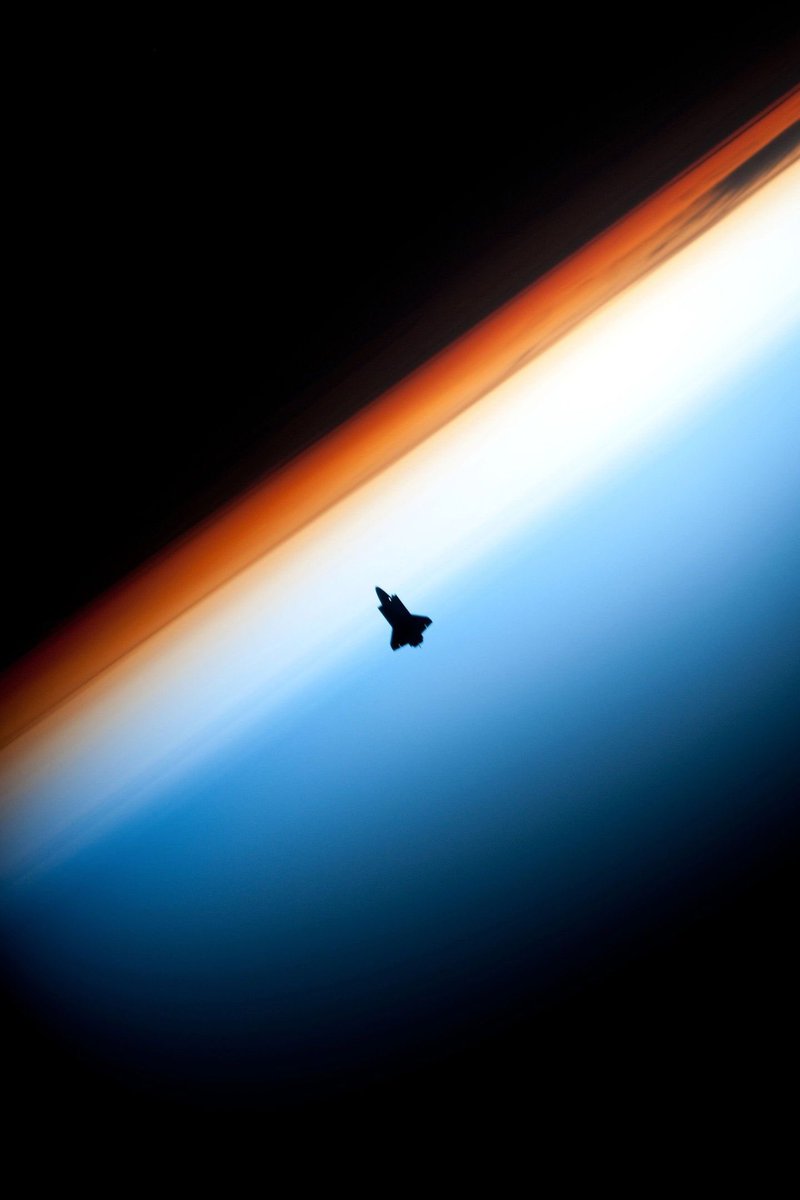
#sciencegeek intelligent architecture

One of the greatest and oldest special effects in history can be witnessed in Rome today
And it has been playing out, on cue, for nearly 2000 years...
Each year on April 21, the traditional birthday of Rome — the legendary date Romulus founded the city in 753 BC — the midday sun pierces the oculus at the crown of the Pantheon's dome and casts a perfect disk of light that settles squarely on the temple's entrance.
For roughly two minutes and fifty seconds, the bronze doors blaze gold...
At that exact moment, the Emperor would step across the threshold, his body swallowed in sunlight, as though the heavens themselves were handing him the city.
Hadrian's engineers designed the entire building as a cosmos in miniature: the interior is exactly 43.3 metres wide and 43.3 metres tall, meaning a perfect sphere fits inside it.
The Roman senator Cassius Dio wrote that the vaulted roof was meant to resemble the heavens themselves...

Only one chance in this lifetime…
Like watching sunset at the beach from the most foreign seat in the cosmos, I couldn’t resist a cell phone video of Earthset. You can hear the shutter on the Nikon as @Astro_Christina is hammering away on 3-shot brackets and capturing those exceptional Earthset photos through the 400mm lens. @AstroVicGlover was in window 3 watching with @Astro_Jeremy next to him.
I could barely see the Moon through the docking hatch window but the iPhone was the perfect size to catch the view…this is uncropped, uncut with 8x zoom which is quite comparable to the view of the human eye. Enjoy.

Unboxing days turn me into a science geek! Exploring new wellness tech is thrilling. Curious about innovative ways to keep balanced? Let's dive into this patch's magic! #WellnessTech #ScienceGeek


A moment so quiet… you could almost miss it —
but it’s history written in light. 🌍✨
From the International Space Station, a faint streak suddenly appeared —
cutting across Earth’s atmosphere like a whisper from space.
At first, just a glow…
then a long, ghostly trail stretching across the sky.
Not the spacecraft itself —
but the mark it left behind as it tore through the atmosphere at unimaginable speed.
That streak was Artemis II coming home. 🚀
After hundreds of thousands of kilometers…
after circling the Moon and pushing the edge of human exploration —
this was the moment it all ended… and began again.
No sound.
No countdown.
Just a silent line of fire across the sky.
And somewhere inside it —
humans, returning to Earth.
Sometimes, the biggest moments in history don’t explode…
they simply burn — softly, beautifully — across the atmosphere. ✨
#ArtemisII #NASA #ISS #Space #Reentry #EarthFromSpace #SpaceExploration
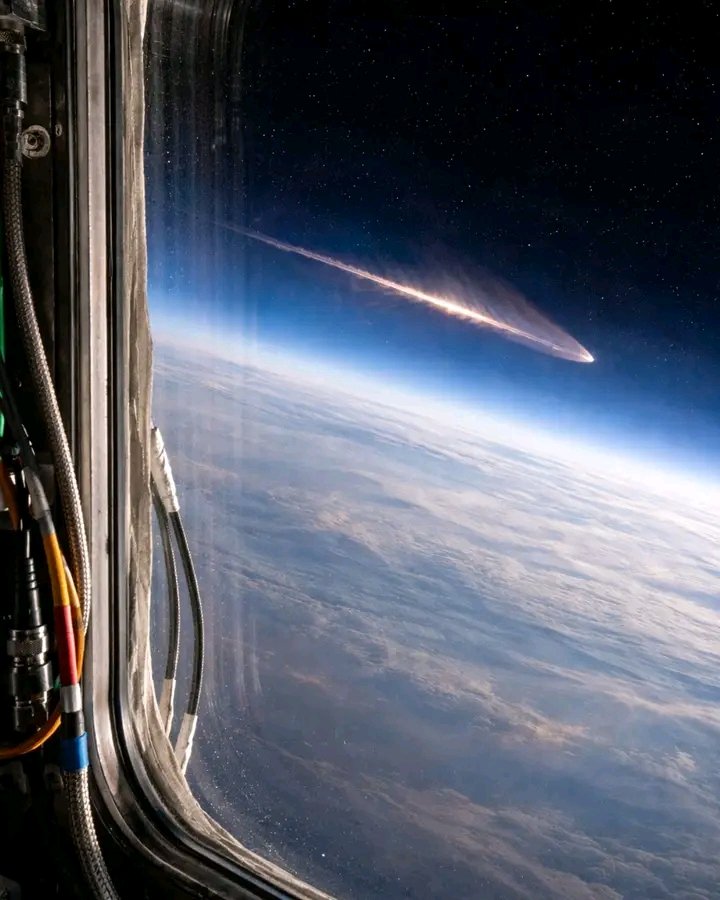
Look at this astronaut's face during reentry, knowing the capsule exterior is at 5,000°F.
The physics of why he's alive are wild.
The air in front of the capsule compresses so violently at Mach 25 that it turns into plasma. 5,000°F on the surface. Half the temperature of the sun. The heat shield absorbs that energy by literally burning itself away, layer by layer, carrying the heat with it as gas.
One inch of material is the entire margin. On the outside of that inch: 5,000°F. On the inside: 75°F. Room temperature. The thermal gradient across that single inch is the steepest temperature drop humans have ever engineered.
The orange glow in the window is ionized nitrogen and oxygen. That plasma is why comms go black for six minutes during reentry. Ground control can't reach the crew. The astronauts are alone inside a fireball, falling at 25,000 mph, watching the laws of thermodynamics keep them alive through a 1-inch wall.
Artemis II did exactly this last night. Four astronauts hit Earth's atmosphere at 24,664 mph, rode a 4,900°F plasma sheath for six minutes of radio silence, and splashed down a mile from target.
The heat shield is now being inspected for cracks. They found over 100 on the last unmanned test.

While #The305 only has 2 (#HurricaneSeason & #TouristSeason) today is the #VernalEquinox / #FirstDayOfSpring & as such #HaberPA offers you a #PSAOfTheDay explaining how & why the #Earth experiences #FourSeasons, full of #ScienceGeek facts. Please read it @ https://t.co/hxs5cu3ROp


NEVER-BEFORE-SEEN images from Cambodia’s monkey-breeding industry expose:
💔 Monkeys forced into crates for U.S. labs
💔 Terrified monkeys grabbed by the neck
💔 Pattern of violence
& MORE!
These images aren't a one-time leak.

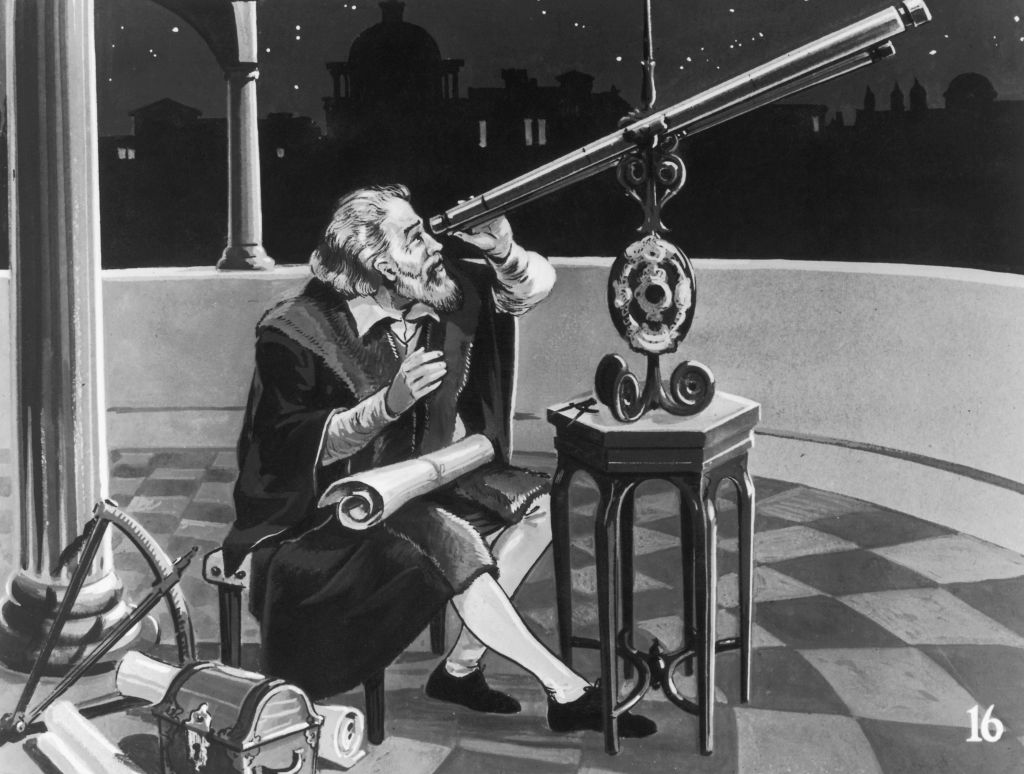
Happy Birthday to Galileo Galilei.✍️
Born on February 15, 1564, Galileo was a pioneering scientist whose observations transformed humanity’s understanding of the universe. Through his telescopic discoveries - including the moons of Jupiter and the phases of Venus - he provided powerful evidence that challenged long-held beliefs and supported the motion of the Earth.
Widely regarded as the Father of modern astronomy, his dedication to observation, evidence, and scientific inquiry laid the foundation for modern science.

Είμαι κυρίως βακτήρια, όχι κύτταρα! Είναι τρελό πώς οι μικροσκοπικές μορφές ζωής μας ξεπερνούν αριθμητικά μέσα στο σώμα μας. 🦠 #Microbiome #ScienceGeek #BacteriaLife

It took 9 years and 3 billion miles to get this shot.
Pluto’s icy Mountains rising as high as 11,000 feet (3,500 meters).

The incredible view during a spacewalk.
This is absolutely mind-bending. By locking the camera to a fixed point in the sky rather than the ground, this stunning timelapse perfectly visualizes Earth's rotation.🌍🌌
It really puts our movement through space into perspective.
Last Seen Hashtags on Sotwe
Trends for you
Most Popular Users

Elon Musk 
@elonmusk
240.1M followers

Barack Obama
@barackobama
119.3M followers

Donald J. Trump
@realdonaldtrump
111.6M followers

Cristiano Ronaldo
@cristiano
108.7M followers

Narendra Modi
@narendramodi
106.9M followers

Rihanna
@rihanna
97.2M followers

NASA
@nasa
92.1M followers

Justin Bieber
@justinbieber
90.5M followers

KATY PERRY
@katyperry
86.7M followers

Taylor Swift
@taylorswift13
80.5M followers

Lady Gaga
@ladygaga
72.1M followers

Kim Kardashian
@kimkardashian
69.3M followers

YouTube
@youtube
68.6M followers

Virat Kohli
@imvkohli
68.4M followers

Bill Gates
@billgates
63.4M followers

The Ellen Show
@theellenshow
62.5M followers

CNN
@cnn
61.9M followers

Neymar Jr
@neymarjr
60.9M followers

X
@x
60.9M followers

CNN Breaking News
@cnnbrk
59.9M followers