

Top Tweets for #TensorNetwork

PRB Editors' Suggestion: #TensorNetwork methods for bound #ElectronHole complexes beyond strong and weak confinement in #nanoplatelets
Bruno Hausmann and Marten Richter
Phys. Rev. B 114, 125310
➡️ https://t.co/Zm6ep4MCsO
#OpenAccess #EdSugg @APSPhysics #physics #condmat


Scalably learning one-dimensional quantum many-body Hamiltonians from dynamical data
By combining #tensornetwork techniques with those of automated differentiation and #machinelearning, we find a new way of pursuing scalable #Hamiltonian learning from data. I am happy to see our work out in @QuantSciTech.
https://t.co/71xv9xvo7x
The physics of a closed quantum mechanical system is governed by its Hamiltonian. However, in most practical situations, this Hamiltonian is not precisely known, and ultimately all there is are data obtained from measurements on the system. In this work, we introduce a highly scalable, data-driven approach to learning families of interacting many-body Hamiltonians from dynamical data, by bringing together techniques from gradient-based optimization from machine learning with efficient quantum state representations in terms of tensor networks.
Our approach is highly practical, experimentally friendly, and intrinsically scalable to allow for system sizes of above 100 spins. In particular, we demonstrate on synthetic data that the algorithm works even if one is restricted to one simple initial state, a small number of single-qubit observables, and time evolution up to relatively short times. For the concrete example of the one-dimensional Heisenberg model our algorithm exhibits an error constant in the system size and scaling as the inverse square root of the size of the data set.
Warm thanks to the team of @aukshetrimayum, Ingo Roth, Dominik Hangleiter and above all @FrederikWilde for this wonderful collaboration.

Variational #quantumalgorithms and classical variational methods, such as #tensornetwork techniques, provide upper bounds on ground-state energies. However, to meaningfully assess their performance and reliability, these results should be complemented by efficiently computable lower bounds.
https://t.co/Fxs5ORiqcW
This work demonstrates that three distinct types of lower bounds—the (i) Anderson bound, an (ii) algebraic bound, and an (iii) improved Anderson bound based on semidefinite programming—approximate the ground-state energy up to at most a small constant error per site.
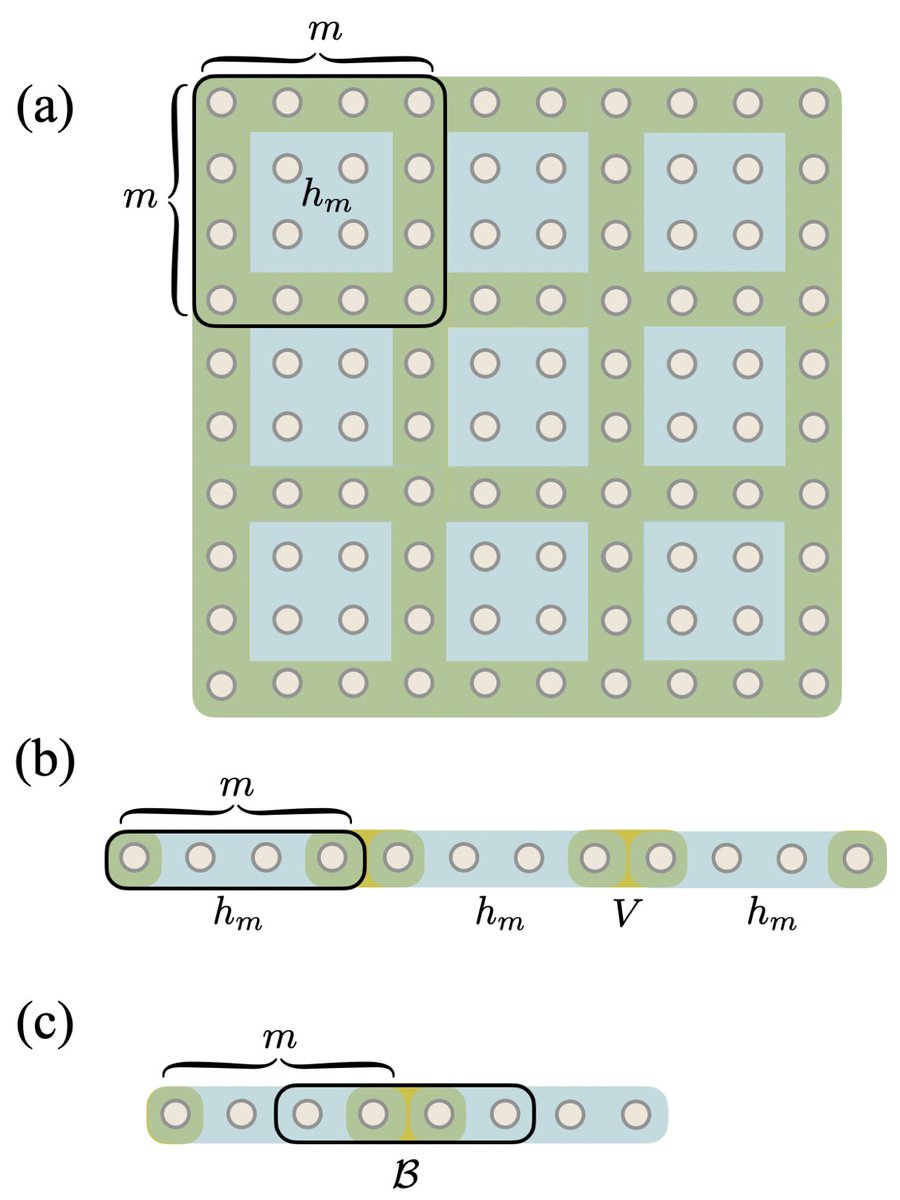
Variational optimization of projected entangled-pair states on the triangular lattice
A new physics-informed #tensornetwork ansatz performs well on quantum models on triangular lattices.
https://t.co/Diac5sFNex
In detail, we introduce a general corner transfer matrix renormalization group algorithm tailored to projected entangled-pair states on the triangular lattice. By integrating automatic differentiation, our approach enables direct #variational energy minimization on this lattice geometry. In contrast to conventional approaches that map the triangular lattice onto a square lattice with diagonal next-nearest-neighbour interactions, our native formulation yields improved variational results at the same bond dimension.
This improvement stems from a more faithful and physically informed representation of the entanglement structure in the tensor network and an increased number of variational parameters. We apply our method to the antiferromagnetic nearest-neighbour Heisenberg model on the triangular and kagome lattice, and benchmark our results against previous numerical studies.

#PRBTopDownload: Optimal symbolic construction of matrix product operators and tree #TensorNetwork operators
H. Çakır, R. M. Milbradt, and C. B. Mendl
Phys. Rev. B 112, 035101 – Published 1 July, 2025
➡️ https://t.co/eNC7mGfu6m
#OpenAccess #condmat #physics @APSPhysics

PRB Editors' Suggestion: #Quantum #TensorNetwork #algorithms for evaluation of spectral functions on #QuantumComputers
M. L. Wall, A. Reilly, J. S. Van Dyke, C. Broholm, and P. Titum
Phys. Rev. B 110, 214402
➡️ https://t.co/uOXsTelIqs
#EdSugg @APSPhysics #condmat #physics

Aimed at a more realistic classical description of natural quantum systems, we present a two-dimensional #tensornetwork algorithm to study #finitetemperature properties of frustrated model quantum systems and real quantum materials.
For this purpose, we introduce the infinite projected entangled simplex operator ansatz to study thermodynamic properties. To obtain state-of-the-art benchmarking results, we explore the highly challenging spin-1/2 #Heisenberg antiferromagnet on the #Kagome lattice, a system for which we investigate the melting of the magnetization plateaus at finite magnetic field and temperature.
Making a close connection to actual experimental data of real #quantummaterials, we go on to studying the finite temperature properties of Ca10Cr7O28. We compare the magnetization curve of this material in the presence of an external magnetic field at finite temperature with classically simulated data.
As the first theoretical tool that incorporates both thermal fluctuations as well as quantum correlations in the study of this material, our work contributes to settling the existing controversy between the experimental data and previous theoretical works on the magnetization process.
Finite temperature tensor network algorithm for frustrated two-dimensional quantum materials
https://t.co/GcqpHVKgwk
We present a practical #tensornetwork based algorithm to approximate expectation values of Gibbs states of two-dimensional quantum systems and #quantummaterials.
A #quantuminspired approach to learning dynamical laws from data - block-sparsity and gauge-mediated weight sharing
https://t.co/HP6ezMaDqs
This work develops state-of-the-art #tensornetwork algorithms to learn dynamical laws from #data, with legs not corresponding to complex vector spaces, but to function dictionaries.


New work by @erik_der_elch @junyuliu4 @risi_kondor et al @FacultyMaths @FlatironCCM @UChiChemistry @UChicagoCS @UChicagoPME @TheSeQure-'Unifying O(3) equivariant #neuralnetworks design with #tensornetwork formalism'-https://t.co/MQ4btRQYUi #machinelearning #quantum #compchem #AI
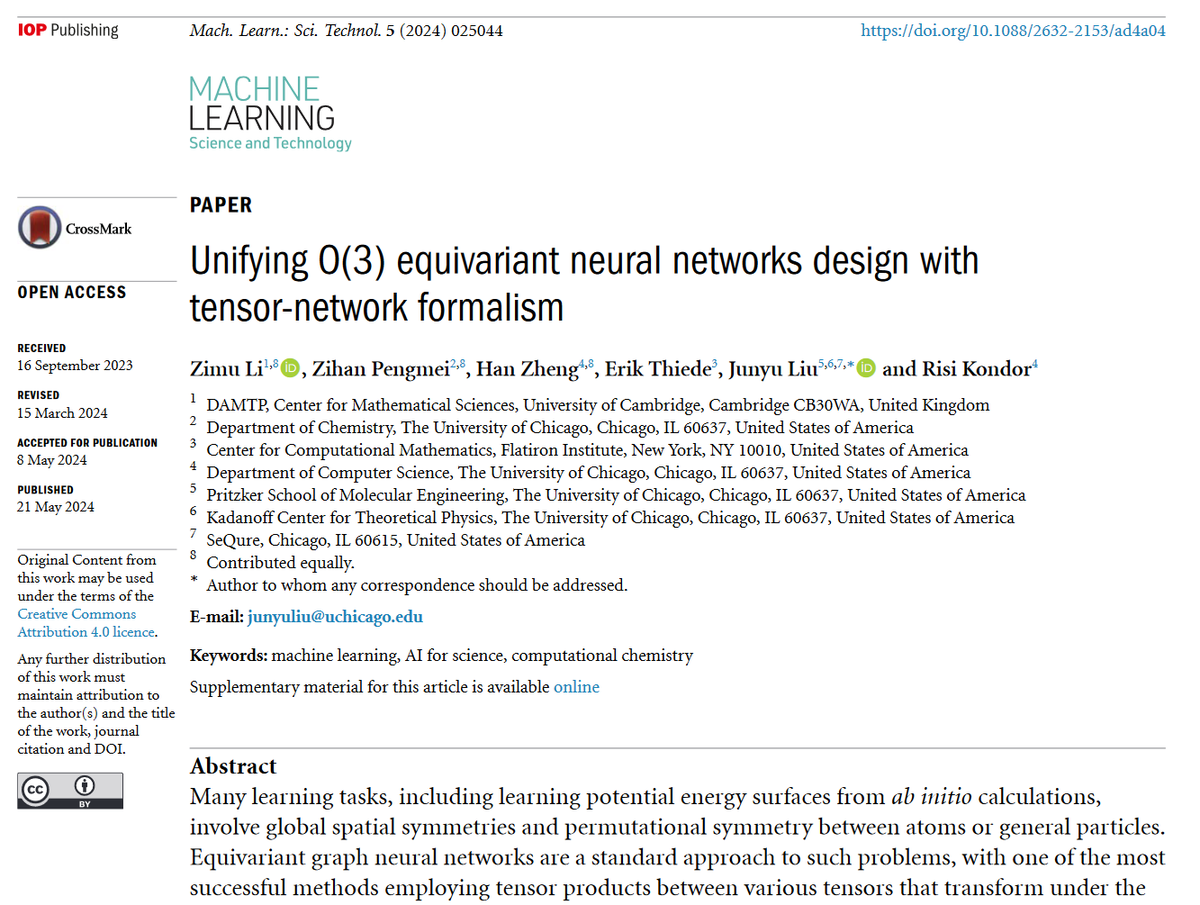

#tensornetwork
めもめも
https://t.co/cphIZAvoHu


Applications are open for the 3rd meeting of the International Quantum Tensor Network!
🗓️ 26 - 28 July 2023
🇩🇪 Burghausen, Germany
🛏️ Accommodation & travel support available
Apply by 29 March here: https://t.co/0HUCLqaE6O
#quantum #tensornetwork #research #conference

Great new work by Ian Convy and K Birgitta Whaley @UCB_Chemistry @BerkeleyPhysics - 'Interaction decompositions for #tensornetwork regression' - https://t.co/Igbrg0eEEo #machinelearning #tensornetworks #quantum #neuralnetworks #algorithms #AI #TensorFlow


Check out our new paper on the application of #tensornetwork in #deeplearning. We proposed a new variational algorithm for training the quantum-inspired tensor neural networks with an entanglement-aware DMRG algorithm.
A nice collaboration with @OrusRoman
https://t.co/Ud0DrWRNLq

Don't miss this Editor's Pick article from Todd Gingrich @NUChemistry - his group showcases an application of tree #tensornetwork states to classical, many-body time-dependent steady states.
https://t.co/yV2ZOmDdNO

Gauged gaussian fermionic PEPS form a class of #Quantum states suitable for studying lattice gauge theories. In our latest #HEPTN seminar, Erez Zohar discussed them in detail and showed their numerical power. Check out the recording here: [https://t.co/HEiMZzO6d4] #TensorNetwork
![HellerInTheory's tweet photo. Gauged gaussian fermionic PEPS form a class of #Quantum states suitable for studying lattice gauge theories. In our latest #HEPTN seminar, Erez Zohar discussed them in detail and showed their numerical power. Check out the recording here: [https://t.co/HEiMZzO6d4] #TensorNetwork https://t.co/rdgyeKeah9](https://pbs.twimg.com/media/FGbSTN-XwAMYxCz.png)

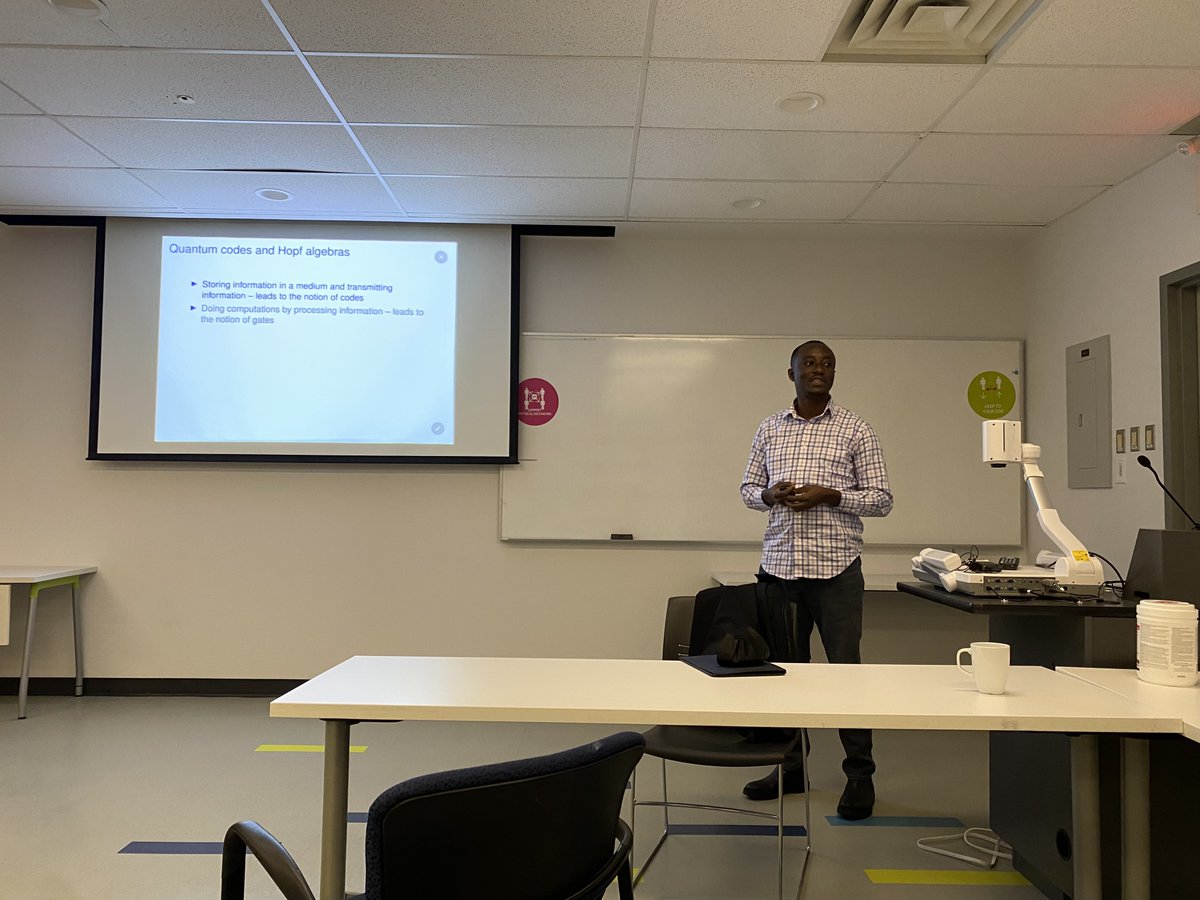
First in-person #quantum seminar in @iqstucalgary & @quantumalberta: Prince Osei of @AIMS_Next on "Semidual Kitaev lattice model & #tensornetwork representation". Thrilling to be back in the saddle once again.



🥳 Check out the new #Paper “Generating function for #TensorNetwork diagrammatic summation” in the @apsphysics Journal @PhysRevB, published by our research group leader Norbert Schuch together with W.-L. Tu, H.-K. Wu, N. Kawashima, and J.-Y. Chen: https://t.co/f5FgcntQQL


Hey, this sums up the #TensorNetwork vs #QuantumSupremacy debate even better than my earlier tweet
#QuantumComputing


Last Seen Hashtags on Sotwe
Trends for you
Most Popular Users

Elon Musk 
@elonmusk
241.5M followers

Barack Obama
@barackobama
119M followers

Cristiano Ronaldo
@cristiano
113.9M followers

Donald J. Trump
@realdonaldtrump
111.8M followers

Narendra Modi
@narendramodi
107.2M followers

Rihanna
@rihanna
98.6M followers

NASA
@nasa
92.4M followers

Justin Bieber
@justinbieber
91.7M followers

KATY PERRY
@katyperry
89.7M followers

Taylor Swift
@taylorswift13
83.6M followers

Lady Gaga
@ladygaga
75.1M followers

Virat Kohli
@imvkohli
72.9M followers

Kim Kardashian
@kimkardashian
70.7M followers

YouTube
@youtube
68.8M followers

Neymar Jr
@neymarjr
65.9M followers

Bill Gates
@billgates
64.9M followers

Selena Gomez
@selenagomez
62.8M followers

The Ellen Show
@theellenshow
62.3M followers

CNN
@cnn
61.8M followers

X
@x
60.7M followers