

Top Tweets for #colocation

IMPORTANT CORRECTION:
I made a critical conversion error for $IREN in my spreadsheet, which actually has an $11.4b enterprise valuation. $11.4b/5GW = $2.3m/MW.
So not below that of $KEEL but definitely on the level of a colocation provider when in fact they’re not making colocation deals. This is the real point of my post.
Apologies for the stupid mistake!

$DUOT Duos Technologies Q3 2026 Earnings
• Rev: $10.5M (+101.9% YoY, vs $14.1–14.8M est)
• Gross Margin: 42%
• Cont. Ops EPS: -$0.22 (vs -$0.08 est)
• Cash: $44.81M (+ $52.9M sale receivables)
Completed pivot to pure-play Edge Data Centers; signed $400M+ 20MW colocation deal & reaffirms FY26 ($50M+) & FY27 ($160M) rev guidance!
#DUOT #DataCenters #AI
Just reviewed $NBIS’ recent earnings.. and they said they’re experiencing delays at their colocation sites, including their New Jersey sites for Microsoft, yet sites they own are actually on track or ahead of schedule. What aspect caused delays at their colocation sites? Power. This is why the company stated in their Letter to Shareholders, “We prefer to build our own sites, which give us greater control over execution and better economics.” Looks like everyone is susceptible to delays but at least $IREN’s delay with Horizon 2 was associated with a network design change requested by the customer. Moreover, at least 50% of the 1 GW of incremental compute $NBIS plans to bring online next year is expected to come from owned datacenters, which generate stronger margins than colocation. This is literally free marketing for $IREN’s vertically integrated power and physical infrastructure portfolio, something the community has been preaching for a long time. Unfortunately for $NBIS, the opportunity to secure a lot of grid-connected power at scale has gotten way more difficult. It’s important to note that $NBIS’ current 5 GW of secured power is not the same as $IREN’s current 5 GW of secured power, because $IREN will actually own all of the physical infrastructure and compute associated with those 5 GWs. I also haven’t heard or seen $NBIS report a development pipeline but my guess is that it doesn’t come close to $IREN’s 35 GW development pipeline. We’ll see how much of this actually gets realized over time but creating that much potential opportunity doesn’t happen overnight. One thing I will give $NBIS a lot of credit for at this point in time is that they already have Vera Rubins deployed (not operating yet). As I’ve been saying as of lately, Vera Rubins will prove to be most beneficial in 2027. I look forward to seeing at what GPU rental rates these get contracted for.
Nebius Group $NBIS Q3 2026 Earnings Highlights:
Revenue surged nearly 6x YoY and beat expectations, though colocation delays and heavy CapEx plans weighed on shares:
Revenue: $980.8M (+571% YoY, beat $907.5M est.)
AI Cloud Revenue: $973.8M (+643% YoY)
Adjusted EBITDA: $465.8M (47.5% margin, vs. -$5.2M in Q3 2025)
GAAP Operating Income: $50.4M
ARR: $6.4B (+1,062% YoY, more than doubled from $3.0B in Q2)
Key Takeaways:
• Guided FY26 revenue to the lower end of its $3.0B–$3.4B range due to colocation delays pushing revenue into early 2027.
• Issued strong FY27 revenue guidance of $12.0B–$13.0B, with the midpoint ahead of Wall Street estimates.
• Customer prepayments currently cover over 100% of CapEx needs.
• Extended server/network equipment depreciation from 4 to 5 years and announced it will phase out ARR as a primary metric.
#NBIS #AI #CloudComputing #Earnings #Investing
$WYFI Q3 2026 Earnings Highlights: Colocation growth offset by bottom-line miss
• Total Revenue: $24.02M (+19% YoY) vs $29.5M exp
• Adjusted EPS: -$0.50 vs -$0.36 exp
• GAAP Net Loss: -$101.43M (Driven by $80.8M one-time debt conversion expense)
• Adj. EBITDA: Near breakeven vs $9.6M exp
Segment Performance:
• Colocation: $5.6M (+232% YoY) driven by new MTL-3 & NC-1 data center capacities
• Cloud Services: $18.1M (+0.4% YoY) with a $700M+ pipeline ahead
Acquired two new North Carolina sites (NC-2, NC-3) for $60M to unlock 200MW of future AI capacity.
#WhiteFiber #DataCenter #AI #StockMarket #Earnings $WYFI

Core Scientific will finish winding down its bitcoin mining this quarter and enter 2027 as a colocation provider. Mining was 17.5 million dollars of its 232.9 million third quarter revenue, or 7.5 percent. Colocation was 215.4 million.


@Austus05 @adoins @SundoodleSoleil @slimzycpt @widyakrnwn Colocation and latency reduction are the real alpha in high-speed trading. Blackline positioning strategies right next to block-building validators is huge. Have a great weekend team!

👀 Colocation $WULF

Someone told me this morning that the business model for co-location companies is broken.
That genuinely made me laugh.
If anything, the economics keep getting better.
Why?
Because there simply isn’t enough power available for AI infrastructure right now. We are massively short power, and any good analyst following this space knows it.
So why are these stocks down so much?
Simple. They’re all being traded in the same basket.
That won’t last forever.
Eventually, the real operators will separate themselves from the pack. That’s how every new industry evolves.
Wall Street isn’t questioning whether these companies can sign contracts. Everyone is going to sign contracts. There’s too much demand chasing too little available power.
The real question is:
Who can actually build the data center on time, on budget, energize it, and start collecting rent?
That’s what the Street wants to see.
Who are the players and who are the fakers?
Contracts are one thing. Execution is another.
Once the revenue starts hitting the income statement, cash starts flowing, and investors can see the economics in the actual numbers, the conversation changes completely.
For some companies that signed contracts 18 to 24 months ago, I expect that inflection to start becoming visible by the end of Q1 next year.
That’s when we should begin seeing separation.
Until then, enjoy the process.
Don’t overcomplicate it.
Power. Contracts. Construction. Energization. Revenue. Separation.
This isn’t rocket science.

Am I bullish on data centers? Yes, specifically companies taking a colocation approach. Their long-term contracts and clearer economics make them easier to model and hold larger positions in.
As a long-term value investor, I like to ask myself: if markets became illiquid for four to six years, would I still be happy owning this business?
That is what draws me to $CIFR and why I believe it is one of the biggest opportunities in the market at $9.
Cipher provides the sites, power, and supporting infrastructure. Its tenants provide the compute hardware. This avoids potential exposure to GPU replacement cycles, unlike a neocloud that finances chips and sells compute. The focus for colocation providers is partnering with high-credit tenants, signing accretive contracts, managing construction costs, and delivering the facilities on time.
Who signs those contracts matters just as much. Black Pearl and Stingray are leased to Amazon Data Services, with https://t.co/V5wgHNBXCO guarantees. Barber Lake’s initial tenant is Fluidstack, supported by Google’s credit backstop. These are materially different credit relationships from neoclouds, which also finance GPUs and often carry a mix between servicing hyperscalers and direct to AI-native companies.
In today’s environment, it is ridiculous to think that a 0.5 to 1 percentage point increase in financing costs, by itself, will stop a hyperscaler from securing compute. in a world where startups are creating flagship level software systems for fractions of the costs securing compute is a necessity for these hyperscalers to remain competitive.
That does not mean neoclouds cannot be excellent investments. They can offer more upside from selling compute, but financing GPUs creates a different set of financial and technological risks. My point is that an interest-rate-driven selloff should distinguish between neo cloud model and a colocation model where they benefit from long-term, hyperscaler-backed leases.
What Cipher already has contracted
Three HPC campuses totaling 700 gross MW:
Barber Lake: 300 gross MW, or 207 IT MW. Approximately $3.86 billion from the initial Fluidstack term, followed by a binding commitment for another ten years with a leading AI lab. Together, roughly $9.05 billion over 20 years, before additional cost recovery.
Black Pearl: 300 gross MW, or 216 IT MW. A 15-year Amazon lease with 3% annual escalators and approximately $5.48 billion in base rent. Initial capacity was delivered in August, two months early, and rent has already commenced.
Stingray: 100 gross MW, or 70 IT MW. Another 15-year Amazon lease with 3% annual escalators and approximately $2.02 billion in base rent.
Barber Lake and the recent financing
The higher construction bill is real: roughly $2.94–$2.97 billion against an original $2.157 billion budget, requiring approximately $750 million of additional project equity funding.
It is clear that Cipher’s first lease at Barber Lake was particularly favorable to the tenant. Cipher bears the first $359.3 million above the original budget, with half of qualifying costs above that threshold recovered through additional rent over the 20-year term.
Its later Amazon contracts put more responsibility for costs above agreed thresholds on the tenant. That distinction matters: Barber Lake’s cost exposure should not simply be applied to every future Cipher deal.
The longer commitment also matters. The same infrastructure can keep generating rent into a second decade without repeating the original ground-up construction spend. Maintenance and upgrades remain necessary, but extending the earning life of an existing asset can materially improve its lifetime returns.
The $850 million convertible closed October 16 with no regular cash interest, an initial conversion price around $15.31, and capped-call protection up to $28.35. After purchaser discounts and the $89.7 million hedge cost, it provides approximately $745.4 million before other offering expenses.
👀 Colocation

There is a lot more scrutiny on debt, credit quality, financing and spreads in recent days. Not every ai landlord is created equal and not every signed co-location lease is the same or share the same economics despite the headlines. Some have more leverage while others may have better debt coverage. I'm sharing my models for the first time. Feel free to save and modify for your own use. Open to corrections. $APLD, $BTDR, $CIFR, $CLSK, $CORZ, $GLXY, $HUT, $RIOT, $WULF
https://t.co/fSTHvypQbn
$IREN is such a great long-term bet. A big criticism I’ve noticed that they receive over colocation companies like $WULF and $CIFR is that they’ve acquired a massive GPU depreciation expense by moving into the compute layer of the AI stack. But what surprised the market is that we are seeing GPU rental rates for older models (I.e., H100/200, B200/300, etc.) continue to trend higher. This indicates that the market doesn’t really understand what the depreciation life cycle is for GPU models. Is it 5 years? 7 years? Or even 10 years? Personally wouldn’t be surprised to see up to 10 years given the scarcity aspect of compute. Just look at how high the contracted $ per IT MW has repriced since a year ago and apply that to $IREN’s pipeline. The ARR projections are already insane and will only get better. For example, I can see $IREN achieving $80b ARR (or more) by year end 2030. If you don’t think this is possible then you need to do more research on where the demand for compute would derive from. It’ll be eye opening. Yet the market still thinks they can’t execute on near-term targets and underestimate valuation multiples as a result. $IREN continues to be massively underrated in spite of its retail following as many investors overestimate near-term execution risks.
So what happens if and when $IREN brings more than $4b ARR online by year end? What if margins prove to be higher than $NBIS? My guess is that haters will look for other reasons to shit on this company. Doesn’t make sense to go after $IREN’s dilution risks since this is minimal moving forward in my opinion. I mean debt and customer prepayments already cover over 90% of total capex associated with buildouts. You don’t think the company would use their revenue to cover a majority of the remaining < 10% capex before pulling the dilution lever? And what if customer prepayments increase to cover up to 70% of GPU capex instead of today’s 50%? Dilution risks become negligible at that point.
$IREN is heading towards $150 per share before mid-2027, and $550 before mid-2028. I don’t care about the drawdown we saw last week. Volatility works both ways. Price can easily recover and trade around ATHs as $IREN gets closer to bringing 480 MW worth of compute online and macro improves as well. I’m looking to have a good Christmas. 🎅
it’s clear from here. colocation. they have to execute well, build it, turn megawatts into profits ⚡️ $WULF $CIFR $HUT $CLSK
Say it with me
$CIFR = Colocation
Colocation = Building and leasing powered sites, not owning or renting GPUs
Leasing powered sites = Monetizing access to energy with lower financing, depreciation, and technological obsolescence risk.
$WULF = Colocation
Colocation = Building and leasing powered sites, not owning or renting GPUs
Leasing powered sites = Monetizing access to energy with lower financing, depreciation, and technological obsolescence risk.
$NBIS = Neocloud
Neocloud = Owning GPUs and renting out compute capacity
Renting compute = Greater upside from AI compute demand, but higher financing, depreciation, and technological obsolescence risk.
$CRWV = Neocloud
Neocloud = Owning GPUs and renting out compute capacity
Renting compute = Greater upside from AI compute demand, but higher financing, depreciation, and technological obsolescence risk.
@BorzBasik Their operating hashrate has been decreasing and they’ve only made one AI colocation contract and the $ per IT MW is lower than $CIFR’s deals.

@Strikerbtc appreciate the specific nod to old school colocation tactics. optimum caught the mismatch early.

@Strikerbtc Latency really is everything for on chain equity trading, colocation might not map, but data speed does.

@Strikerbtc Colocation tackles latency, but onchain still suffers from consensus finality delays. That lag could mean a fast order ends up with a stale price if blocks aren’t finalized quickly.

@Strikerbtc Colocation and dedicated fiber are insufficient for onchain trading, where latency is the edge that truly matters.

@Strikerbtc Colocation and dedicated fiber aren't feasible solutions for decentralized onchain markets with low latency requirements.

TheHUB is the first purpose-built colocation infrastructure for digital markets.
exchanges, trading firms, node operators and infrastructure providers sit in one physical environment, with equalized network access to every market inside it.
https://t.co/Ja9IbOUTWK

Fairness built in fiber.

@planA_thru_Z I would like to know the current percentage of mid/long range colocation, and how much of the backlog is associated with the same. Thanks.

The Fiber Problem
TradFi solved speed with colocation put your machines in the same building as the exchange. Split seconds become nanoseconds.
DeFi can't do that.
you don't know where the next block proposer will be. Could be Tokyo or anywhere, could be a home staker in Lagos. You can't build dedicated fiber to a location that changes every 12 seconds.
And funny things is if you even if you tried the math kills you yeah cause ten nodes need roughly a hundred fiber connections and a hundred nodes need ten thousand. It doesn't scale not even close.
So DeFi has to solve speed differently.
@get_optimum answer is coding instead of
physically moving machines closer, they mathematically reduce how much data needs to travel. Nodes share equations instead of raw data. Missing pieces get reconstructed from whatever arrives.
No fiber, colocation or hardware arms race, just math doing what infrastructure can't.
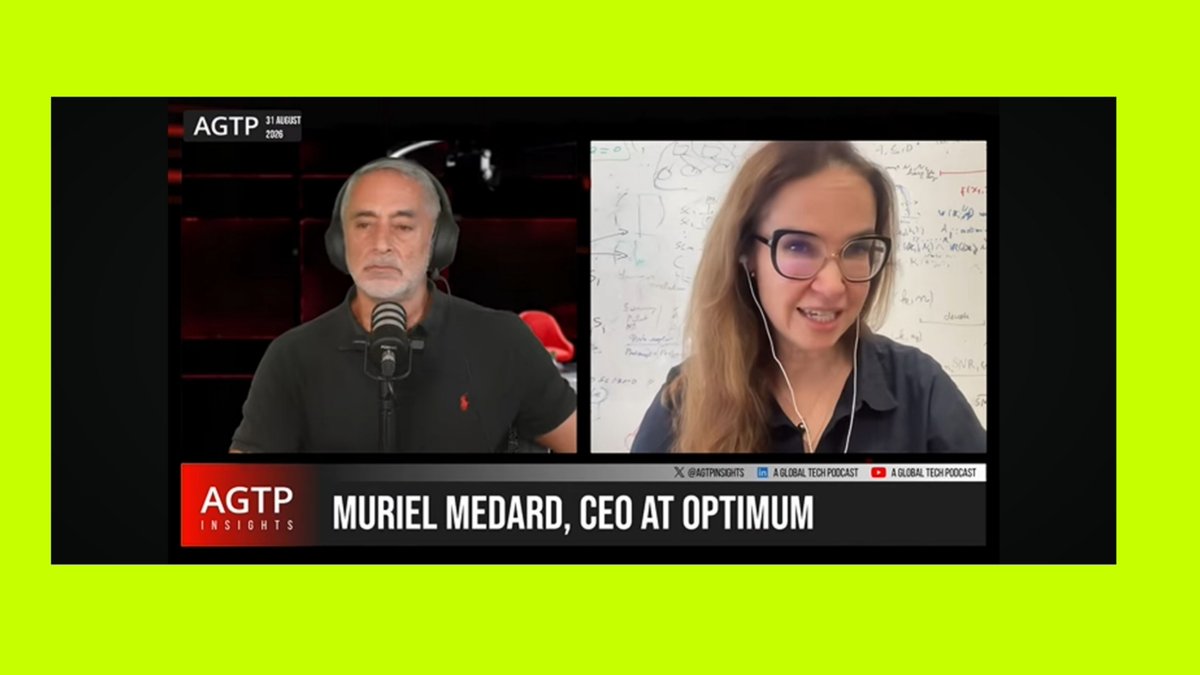
I Just watched Muriel Médard on AGTB Insights she came on after a long AI segment and stole the show here's what I got from her part.
On what @get_optimum actually is, a spin out from her MIT lab. A universal data acceleration network..It speeds up blockchains faster, more reliable, less bandwidth. She calls validators "the engine room."
On colocation : TradFi solved speed by putting machines in the same building. DeFi can't do that You don't know where the next proposer will be Michael called it "mathematical colocation" the math doesn't care about geography. She loved it so much she said she'd borrow it.
Why fiber doesn't scale: 10 nodes need 100 fibers. 100 nodes need 10,000. You can't build that, math is cheaper than cable.
The part that surprised me : She proved that a decentralized random approach is mathematically as good as a centralized controller with perfect information people hated this, they thought random was lazy but it's optimal.
On why people resist : There's a belief that centralization is better and that decentralization is something you pay for. The idea that it comes free sounds too good to be true.
Now on finance : Speed is money but only if it's reliable speed. Variance in finance is like beta in a stock it hurts you even if the average is fine. DeFi's variable gas and confirmation times are the real adoption blocker.
On what's next: Chain agnostic by design. She's looking at chains with activity, liquidity, and momentum. Said it narrows to "three or four." She promised to tell Michael first which one.
I really enjoyed watching the show and learnt few things too
You can also watch it here https://t.co/6ji0WrfsRB
@JimmyHope_
@Isaacjohnibiam
What a lot of investors don't understand right now is that the market is pricing $IREN like they're making colocation deals. In other words, the company is trading at an enterprise value per MW (based on their total capacity) that is in par with companies like $WULF and $HUT. It’s insane, to say the least, considering $IREN has more existing grid-secured capacity and more MWs they can monetize compared to both.
Here's the interesting part.. $IREN has a weighted average contracted $ per IT MW very close to $NBIS ($12m vs $13.5m per IT MW, respectively). And $NBIS currently trades 4x more than $IREN on an enterprise value per MW basis (~$12.5m vs ~$3m EV per MW, respectively).
Right now, $IREN has an ~$18b enterprise value and to trade in par with $NBIS upon executing year end guidance would mean $18b x 4 = $72b enterprise value. For simplicity, subtract $10b in debt and add $6b in cash for conservatism, and that produces a $68b market cap for $IREN.
Here’s my question to the $IREN haters, does a $68b market cap sound crazy for a neocloud operating $4b ARR? As a comparison, $NBIS is currently operating $3b ARR and has a ~$65b market cap. In my opinion, it's REASONABLE to think $IREN will be trading around a $68b market cap (or more) going into 2027 after executing year end guidance. Assuming 430m shares outstanding, that's $160 per share, which is a 4x from today's stock price.
Oh, but I'm delusional to think this stock can't move that much in such a short amount of time. Sorry, but the math checks out.
Signing contracts is the least of my worries. And not sure if you’re implying that $IREN is signing deals at colocation rates but that’s definitely not true when you look at their average weighted contracted $ per IT MW. They’re even negotiating remaining contracts for the year at $25m per IT MW as of last earnings call.

@planA_thru_Z fair — $1b ARR running and another $3b in 3 months is real money. but inbound isn't booked, and neocloud multiples only count if $IREN signs at neocloud prices instead of colocation rent. megawatts are easy — signed contracts are the hard part 🧱
@EthGoldi $IREN is operating $1b ARR today and delivering another $3b ARR (minimum) in 3 months. How is that considered “not even close”? By the way, colocation deals suck compared to deals made by neoclouds where the $ per IT MW terms are multiples higher.
@planA_thru_Z the bull case prices every megawatt like it's already signed — colocation deals are great until the counterparty is a hyperscaler holding all the leverage. undervalued? maybe. derisked? not even close. $IREN
I’m personally not a fan of the colocation approach and locking up long-term contracts for 10+ years at such low $ per IT MW rates when pricing power keeps increasing every quarter. That’s why I focus on companies taking more ownership of the AI stack since they have more pricing power, and $IREN is in deep value territory compared to what it’ll be operating going into 2027.
Most Popular Users

Elon Musk 
@elonmusk
240.1M followers

Barack Obama
@barackobama
118.6M followers

Cristiano Ronaldo
@cristiano
114.4M followers

Donald J. Trump
@realdonaldtrump
111.7M followers

Narendra Modi
@narendramodi
106.9M followers

Rihanna
@rihanna
98.6M followers

NASA
@nasa
92.1M followers

Justin Bieber
@justinbieber
91.7M followers

KATY PERRY
@katyperry
89.9M followers

Taylor Swift
@taylorswift13
83.9M followers

Lady Gaga
@ladygaga
75.4M followers

Virat Kohli
@imvkohli
73.3M followers

Kim Kardashian
@kimkardashian
70.8M followers

YouTube
@youtube
68.6M followers

Neymar Jr
@neymarjr
66.3M followers

Bill Gates
@billgates
65.2M followers

Selena Gomez
@selenagomez
63M followers

The Ellen Show
@theellenshow
62.1M followers

CNN
@cnn
61.7M followers

X
@x
60.6M followers