

Top Tweets for #documentdb

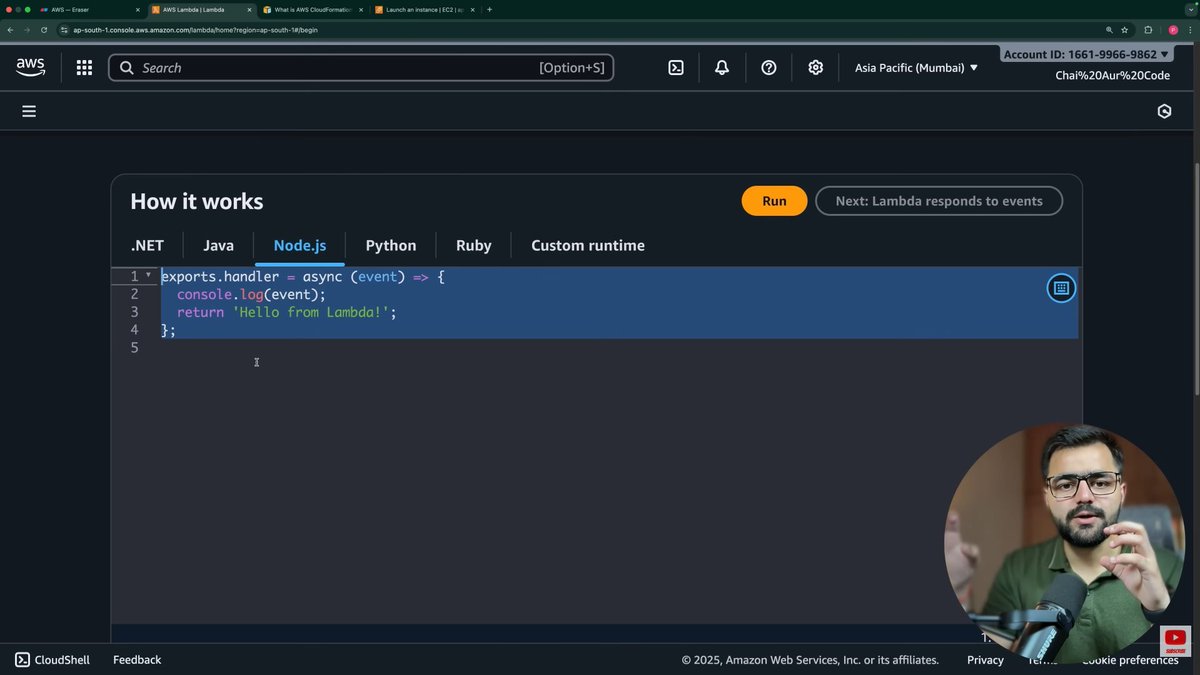
Got an overview of AWS today
Covered:
> IAM, EC2 (Security Groups, Elastic IP), Load Balancers
> S3, ECR, ECS, EKS
> CloudWatch, CloudTrail
> RDS, DocumentDB, ElastiCache
> SQS, SNS, SES
> CloudFormation
> CloudFront, API Gateway, Route 53
> Lambda, Bedrock + AgentCore

SYSTEM DESIGN - PHASE 2
NoSql Databases:
NOSQL databases are mostly based on key-value store, document DB, GraphDB.. Data is denormalized by default in their application code.
Most NoSQL stores lack true ACID transactions and favor eventual consistency.
NOSQL databases runs on the BASE principals which means - Basically Available, Soft State, Eventually Consistent.
In Order to choose which Database is better for you is totally depends on your usecase tho you ve got to do some research and understand your usage pattern.
Key-Value-Store:
A key-value store generally allows for O(1) reads and writes and is often backed by memory or SSD.
Data stores can maintain keys in lexicographic order, allowing efficient retrieval of key ranges. Key-value stores can allow for storing of metadata with a value.
Key-value stores provide high performance and are often used for simple data models or for rapidly-changing data, such as an in-memory cache layer.
Since they offer only a limited set of operations, complexity is shifted to the application layer if additional operations are needed.
A key-value store is the basis for more complex systems such as a document store, and in some cases, a graph database.
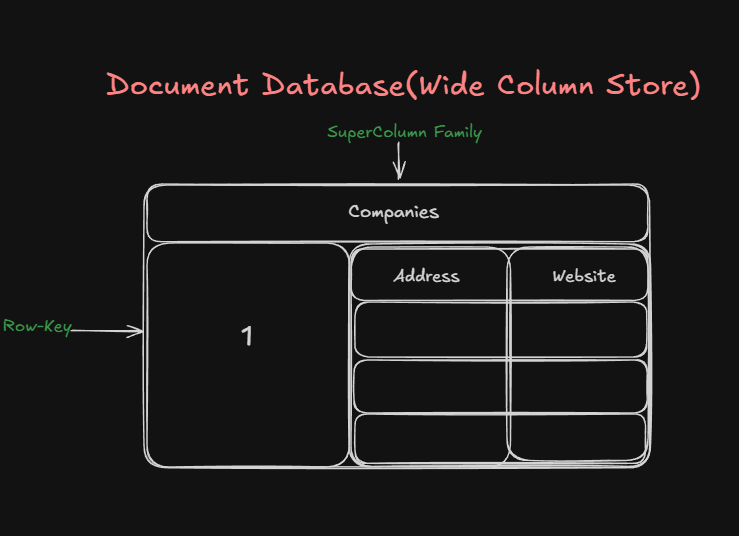
DocumentDB:
A document store is centered around documents (XML, JSON, binary, etc), where a document stores all information for a given object.
Document stores provide APIs or a query language to query based on the internal structure of the document itself.
Note - many key-value stores include features for working with a value's metadata, blurring the lines between these two storage types.
Documents are organized by collections, tags, metadata, or directories. Although documents can be organized or grouped together, documents may have fields that are completely different from each other.
Some document stores like MongoDB and CouchDB also provide a SQL-like language to perform complex queries. DynamoDB supports both key-values and documents.
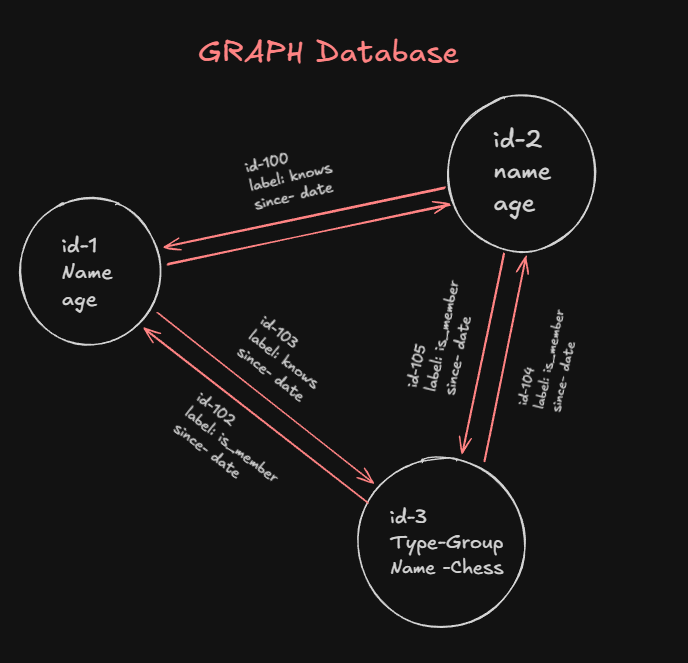
GRAPH Database :
Graph Database are mostly useful when you have more relationships in your application just like a social media application like INSTAGRAM.
What is GraphDatabase?
In a graph database, each node is a record and each arc is a relationship between two nodes.
Graph databases are optimized to represent complex relationships with many foreign keys or many-to-many relationships.
Graphs databases offer high performance for data models with complex relationships, such as a social network.
They are relatively new and are not yet widely-used,
it might be more difficult to find development tools and resources. Many graphs can only be accessed with REST APIs.
So this was the small thread or post whatever you can call it about NOSQL databases, Its been a while since i posted these but yeah lets do it one by one.
Thank you for your time and reading :)

Storage & Databases:
> S3 = object storage (files, images, videos). Buckets are like drives. Pay for stored data + requests.
> RDS = managed relational databases (Postgres, MySQL). Use for structured SQL data.
> DocumentDB (or DynamoDB) = managed NoSQL (like Mongo). Use when schema is flexible.
> ElastiCache = in-memory cache (Redis/Memcached) to speed reads.

20 system design concepts using AWS :
1. Client server model :
You deploy your application in EC2 instance and configure a load balancer
The user(client) hits the ALB domain and the request goes to EC2(server) , the server sends the response back to the client
2. Load balancer :
Sits in front of the servers and distributes the traffic among them ,performs health checks to ensure servers are up and running
3. Caching:
Use AWS Elasticache, DynamoDB accelerator(DAX) and add a caching layer in front of your DB so your application can fetch the data from the cache thereby improving the response time and reduce the load from the database
4. Databases :
💡SQL(Relational):
Use AWS RDS for SQL or PostgreSQL
💡 NoSQL :
Use DocumentDB, DynamoDB for unstructured data
5. Horizontal scaling:
Add more machines (servers) to handle the traffic.
Eg -> you have 2 EC2 instances running, add 2 more to the scaling group
6. Vertical scaling:
Increase the machine size to handle the load.
Eg -> Your application is running on EC2 instance of type m4.xlarge, upgrade the instance type to m4.2xlarge
7. Replication :
Keep copies of data or services to improve reliability and read performance. Enable RDS multi region replication, enable S3 replications
8. CDN (Content Delivery Network) :
Use AWS Cloudfront to cache and serve static assets (like images, CSS) from edge locations near users.
9. Asynchronous Processing :
Use message queues (AWS MSK, RabbitMQ, SQS) or background jobs for long-running tasks.
10. Redundancy:
Use multi AZ,multi region deployment for ECS, EKS ,RDS
11. Failover:
Use AWS Route 53 feature called failover routing to switch records between primary and secondary endpoint in case of failover
12.Disaster recovery:
Use disaster recovery strategy to switch between regions.
Eg -> If your application is running from us-east-1, have a DR strategy setup for us-east-2.
13. Authentication :
Use AWS cognito , api-gateway authorizers or IAM /STS based authentication
14. Container orchestration:
Use AWS ECS,EKS to deploy your applications as containers.
15. API Gateways:
Use API Gateways for exposing APIs securely, api gateway handles rate limiting, authentication etc.
16. Rate limiting:
Use API Gateway throttling, AWS WAF for rate limiting
17. Observability:
Use AWS Cloudwatch for logs, OpenTelemetry for tracing
18. Monolith:
Running your application in a single server (EC2)
19. Microservice:
Running your application in ECS, using load balancers, messaging queues for communication.
20. Encryption:
Encrypt data in rest using KMS keys,Server-Side Encryption for s3
Encrypt data in transit using using SSL/TLS, HTTPS,VPNS

🚀 Just wrapped up the first iteration of my system architecture!
✅ Frontend → Amplify
✅ APIs → ECS
✅ Load Balancers (2): APIs & Services
✅ Streaming → Kafka (MSK)
✅ Orchestration → Airflow (MWAA)
✅ Databases → RDS, DocumentDB, MemoryDB
✅ Recommendation Engine → Gorse
✅ Monitoring → Prometheus, Grafana, Loki
✅ Everything inside a secure VPC


Great news for MongoDB users, @awscloud has launched DocumentDB Serverless with MongoDB-compatibility. It can handles multi-tenant as well as mixed workflow that allows for seamless integration.
Checkout their blog to know more:
https://t.co/HcJp9zeH8p
#DevOps #AWS #DocumentDB

I am providing free value every day for 30 days:
this is day 6
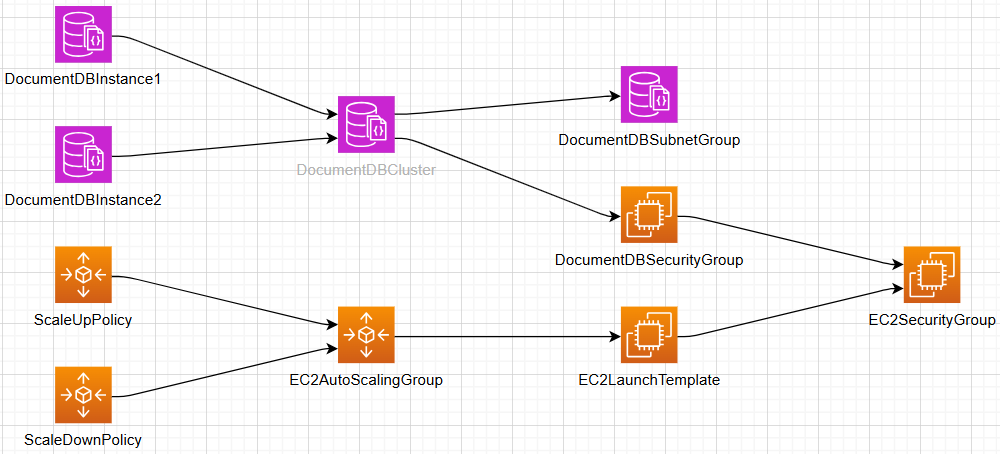
This CloudFormation template builds a VPC with autoscaling EC2 Instances across multiple subnets connected to a replicated documentDB cluster (MongoDB compatible)
With this you can launch your startup fast on AWS
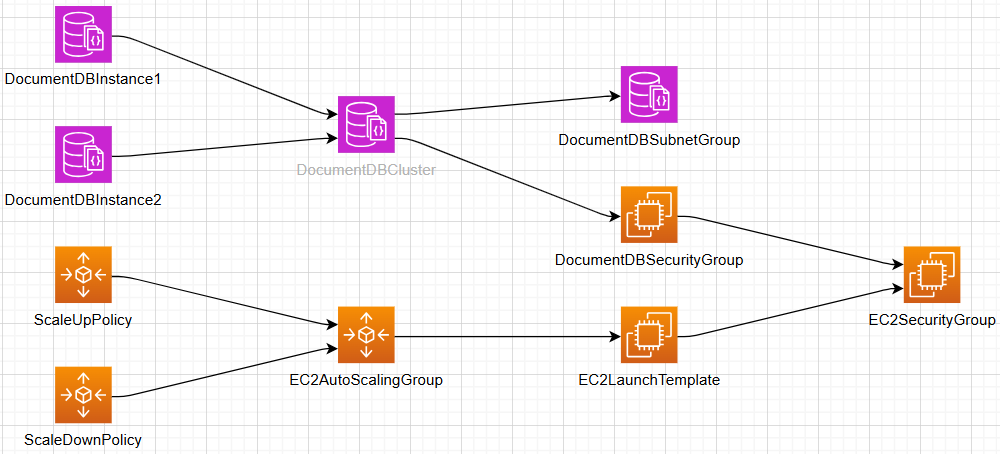
I am providing free value every day for 30 days:
this is day 6
This CloudFormation template builds a VPC with autoscaling EC2 Instances across multiple subnets connected to a replicated documentDB cluster (MongoDB compatible)
@marclou I know you love yourself some MongoDB

@GuptaTarav node.js, vue3, DocumentDB (mongo), AWS
@woocassh I'm working on a project management app. So I used an ECS cluster, a VPC, DocumentDB Vector database. A keycloak instance for handling auth. Making sure everything was secure and affordable was a challenge. I built everything with terraform so I can just re-use it now.

@JToe2017 MongoDB itself is nothing horrible, just the hype with DocumentDB and how many bad decision happened because of it
@Potato___Dragon MongoDB itself is nothing horrible, just the hype with DocumentDB and how many bad decision happened because of it

Last comes to my favorite AWS
AWS offers a lot of plans, the most popular way is thru AWS founder credits called AWS activate. AWS is a hub with a lot of essential features. It's a must have to build.
Some of my favorites are:
AWS S3
EC2
Amplify
DocumentDB
AWS Bedrock

@Robert_Watkin_ Building a small cli tool to get behind AWS VPC in one go without any public instances (100% secure).
(private RDS, OpenSearch, DynamoDB DocumentDB, etc.)

@DavidFerend @arcastrodev DocumentDB is only partially compatible with MongoDB, so you'll need to do a estimated pricing comparison between AWS DocumentDB vs Self-hosted MongoDB, not counting Atlas since it's even more expensive. MongoDB will require more maintenance, but you also get more flexibility.

@GrindNexus MongoDB for documentDB
Great free tier to get started and has support for storing and searching vectors/embeddings… great for LLMs context.

@targetMetadata Sounds like a cache. If entries have a TTL -> Elasticache could be a good fit. If you need to keep the entries, DynamoDB can also work really well (and moreover serverless) if your search criteria is PK. If you need complex criteria, then DocumentDB or OpenSearch can work too.

Which database is suitable if i have to store result of an API call which has reporting data. One option i could think of is documentDB, if i can store the response as JSON. Any suggestions pls

Hi! I have a full-stack application running on an EC2 instance deployed with docker-compose, I want to migrate from EC2 to ECS. Do you have any resources to share about running a self-managed MongoDB on ECS?
I don't want to use DocumentDB
Last Seen Hashtags on Sotwe
女高
Seen from United States
Bhabhi #nude
Seen from Pakistan
nolimits()***************************************************************************************************************************************************************************
BBC
Seen from United States
familyporn
Seen from South Africa
Femboy cute
Seen from Indonesia
야노
Seen from Korea
SMG4
Seen from United Kingdom
小宮有紗
Seen from Argentina
ริมทาง
Seen from Thailand
Most Popular Users

Elon Musk 
@elonmusk
240M followers

Barack Obama
@barackobama
118.6M followers

Cristiano Ronaldo
@cristiano
114.4M followers

Donald J. Trump
@realdonaldtrump
111.7M followers

Narendra Modi
@narendramodi
106.9M followers

Rihanna
@rihanna
98.6M followers

NASA
@nasa
92.1M followers

Justin Bieber
@justinbieber
91.7M followers

KATY PERRY
@katyperry
89.9M followers

Taylor Swift
@taylorswift13
83.9M followers

Lady Gaga
@ladygaga
75.4M followers

Virat Kohli
@imvkohli
73.3M followers

Kim Kardashian
@kimkardashian
70.8M followers

YouTube
@youtube
68.6M followers

Neymar Jr
@neymarjr
66.3M followers

Bill Gates
@billgates
65.2M followers

Selena Gomez
@selenagomez
63M followers

The Ellen Show
@theellenshow
62.1M followers

CNN
@cnn
61.7M followers

X
@x
60.6M followers