

Top Tweets for #hyperparameters

The more I learn ML, the more I realize…
Maybe it’s not just about algorithms.
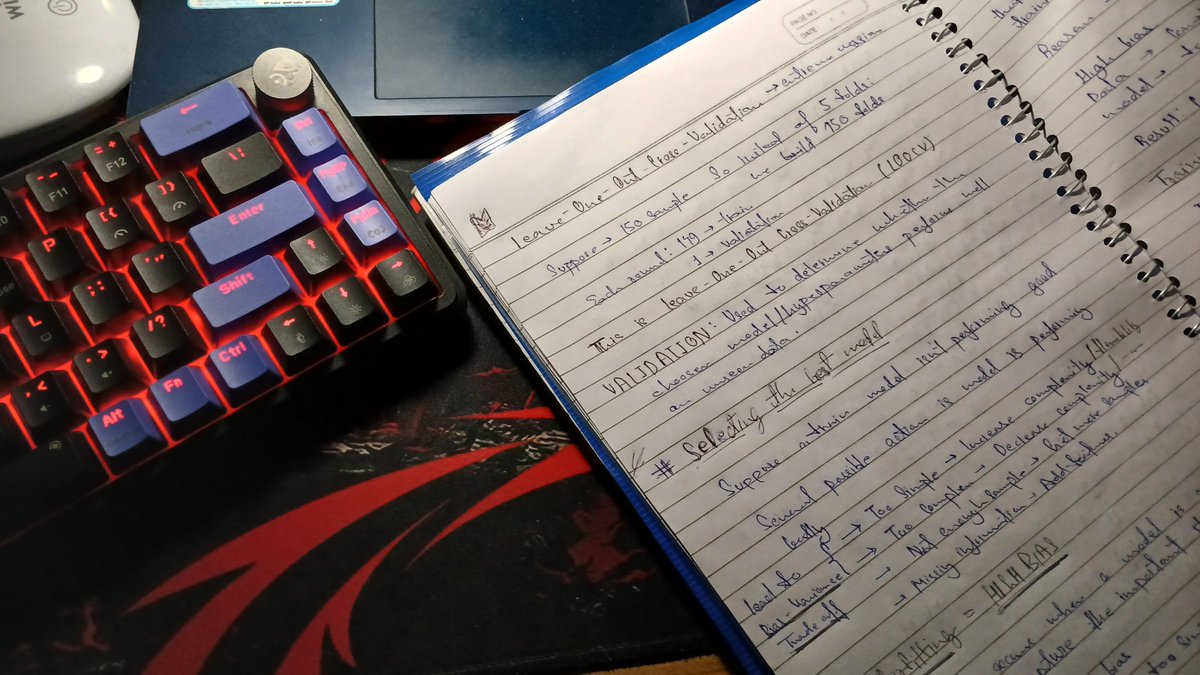
These past few days: model validation, hyperparameters, selecting the best model, and lots of Scikit-Learn practice.
And honestly…
Is ML really for me?
Still figuring it out.

ML experiment tracking is evolving.
It's no longer just:
Model + Hyperparameters + Accuracy
Modern AI teams also track datasets, prompts, evaluations, costs, agent traces, and production feedback.
codewithfimi.com/ml-experime…
#MLOps #AI #LLM #MLflow #DataScience #AIOps #CodeWithFimi

What if you could train a computer vision model without writing a line of code?
Dataset in. Hyperparameters set. Model out.
Then point it at your media and get results.
No CUDA. No PyTorch. No dependencies. No terminal.
Would you use it? 🤷♂️
#ComputerVision #Building

Interesting observation:
AI can now build machine learning models, tune hyperparameters, and even generate deployment-ready code.
The value is no longer in writing every line from scratch.
The value is understanding the problem, asking the right questions, working with quality data, and knowing when the model is wrong.
Tools evolve.
Thinking remains the competitive advantage.
Keep learning beyond the syntax. 🚀
#AI #MachineLearning #TechTwitter #BuildInPublic #DataScience #SoftwareEngineering #LLM
Interesting observation:
AI can now build machine learning models, tune hyperparameters, and even generate deployment-ready code.
The value is no longer in writing every line from scratch.
The value is understanding the problem, asking the right questions, working with quality data, and knowing when the model is wrong.
Tools evolve.
Thinking remains the competitive advantage.
Keep learning beyond the syntax. 🚀
#AI #MachineLearning #TechTwitter #BuildInPublic #DataScience #SoftwareEngineering #LLM
Interesting observation:
AI can now build machine learning models, tune hyperparameters, and even generate deployment-ready code.
The value is no longer in writing every line from scratch.
The value is understanding the problem, asking the right questions, working with quality data, and knowing when the model is wrong.
Tools evolve.
Thinking remains the competitive advantage.
Keep learning beyond the syntax. 🚀
#AI #MachineLearning #TechTwitter #BuildInPublic #DataScience #SoftwareEngineering #LLM

Day 38/100 ~ Learned about validation data & Cross Validation.
Explored Cross Validation (K-Fold) and how it helps improve model performance & reliability.
Also learned GridSearchCV in sklearn for finding the best hyperparameters automatically.
#100DaysOfCode

This is the summary of the @twimlai Generative AI problem-solving research and impact meetup that we had last Friday at 8 a.m. PT.
Mayank(@cataluna84)'s TPU Training Update
🎙️ Presented a simultaneous speech-to-speech translation model built with teammates from the Expedition Tinyaya cohort, using the Moshi backbone with Coherent guidance
🏗️ Architecture includes user/model audio streams, LoRA fine-tuning, depth decoder (Moshi-ko 6L frozen), CB0–CB7 codebook predictions, and Mimi codec audio output
⏳ Training a 15k-step run on TPUs (~24 hours total); at time of meeting, ~11k steps complete with ~5–7 hours remaining
📉 Ran a prior hyperparameter sweep (~22–24 hours) via Weights & Biases; best run had validation audio loss of 4.889, with text weight (0.38) and weight decay (0.35) as the most important hyperparameters
💻 Collaborator Alper is training on H100 80G GPUs; Mayank is using SPMD and FSDPv2 on TPUs
⚠️ Evaluation suite requires GPU (not runnable on TPU) due to smaller evaluator model dependencies
TPU-Specific Challenges
⏱️ XLA compilation before the first training step takes 30–40 minutes; subsequent steps run in ~10 seconds
🐛 A critical bug — `XLA_NO_SPECIAL_SCALERS` — caused all validation loss values to be NaN (corrupted); took ~16–17 hours to debug
🤖 Used AI agents and MCPs to help diagnose the configuration issue
🔄 Orchestration scripts (playbooks, skills) auto-handle spot instance preemption: if a TPU VM is preempted, a new instance spins up automatically, copies the dataset from Hugging Face, installs code from a tarball, and resumes — no manual intervention required
📄 All findings, architecture diagrams, and TPU diagnostics documented in PR comments and repo for future reference
💾 Plans to create a personal backup repo with a pinned README of TPU setup/orchestration details for reuse
🌐 Project will result in a blog post published under Coherent's website in ~1–2 weeks
@Google Product Updates
📊 NotebookLM new agentic capabilities: more output formats (charts, graphs, CSVs), data analysis with code generation (Python-style, similar to ChatGPT data analysis), and improved customization — not full code generation like Claude or similar
🌍 Gemini 3.5 Live Translate: real-time speech translation across 70+ languages via the live streaming API; demo showed English ↔ Mandarin ↔ Swedish conversation
🏥 Real-time translation apps already deployed (e.g., for medical translation between Spanish/English speakers on phones)
🖱️ Gemini 3.5 Flash computer use: UI control tool now built into 3.5 Flash, demonstrated analyzing the Gemini app and returning a categorized feature list
💰 Note: Gemini 3.5 Flash is reportedly more expensive than the prior Flash model, closer in cost to the prior Pro model
🎧 Discussion of accent conversion: tool "Crisp" demonstrated real-time accent softening for call center use cases
🧠 NotebookLM use cases discussed: creating slide decks, private knowledge bases with sensitive/proprietary documents, querying product manuals, mind maps for topic ramp-up, and a soil/agriculture consulting project
Loop Engineering (@yshaoeng)
⚙️ "Loop engineering" is a recently emerging AI term; Yupeng drew analogies to MAPE-K (Monitor, Analyze, Plan, Execute — Keep) architecture from 1960s–70s human-machine systems for autopilot design
📡 Key insight: loop engineering is about interfacing AI with real-time sensors/inputs from the world — not just optimization loops
🤖 Practical example given: instead of manually curating trending topics and prompting an agent to write social media posts, loop engineering builds the harness that automatically monitors feeds, triggers the agent, and posts — removing the human from the loop
🔗 Connected to prior concepts: harness engineering (Martin Fowler article), context engineering, and now loop engineering as successive layers
🔮 Prediction: a world model framework for environment/hazard testing may emerge soon
💸 Skeptical note raised: loop engineering may partly be a way to increase token usage
🔄 Mayank(@cataluna84) noted practical application in their TPU orchestration: sub-agents check for running TPU processes and self-allocate work based on pre-set goals
Eval Course Mention (@HamelHusain & @sh_reya)
🏫 Free multi-week eval course series being run by Hamel and Shreya, one hour per session
🛠️ First session covered Shreya's evaluation tools and techniques; more sessions planned
OpenAI Erdős Problem Hype — Rant (@skr1125)
🧮 OpenAI announced solving an ~80-year-old Erdős combinatorics problem; Srinivas argued this was significantly overhyped
📉 What actually happened: AI generated thousands of reasoning traces → OpenAI hired mathematicians to review them → mathematicians found a counter-example to a conjecture, thereby disproving it — not an autonomous AI proof
📰 Media (e.g., @thursdai_pod) declared "math is done," which @skr1125 called irresponsible and harmful
⚠️ Core concern: hype causes real harm — creates fear and hostility among non-technical people and fuels resentment toward AI broadly
💼 Real-world example shared: executives privately asking for strategies to eliminate tens of thousands of jobs using AI, while public-facing messaging says otherwise
🏦 Counter-argument offered: historical analogies (ATM machines didn't reduce bank tellers; linguistics jobs are at an all-time high despite AI translation tools; Workday/cloud computing created more jobs than eliminated)
🧠 Group consensus: domain expertise is what's missing in the hype — people who understand AI but not the math domain misread the significance
🛡️ Cal Newport's Deep Work and his weekly AI commentary mentioned as a useful filter against doom-trolling
📺 A YouTube video on "humanity in the age of AI" was shared in chat (slight faith-based framing, noted as broadly accessible)
📜 The Pope's encyclical on AI also mentioned as a surprisingly substantive read on AI ethics
Named Entity Resolution / Taxonomy Matching (@antigravityimp)
🏢 Yuri is rebuilding a solution for company name entity resolution for a friend's financial reporting use case
⚙️ Claude and Gemini both recommended not using LLMs directly; instead, build a threshold-based system
📊 Recommended embeddings: Link Transformer (trained on WikiCompany aliases) — slightly better than S-BERT
🛠️ Fuzzy matching tools evaluated: RapidFuzz (successor to FuzzyWuzzy), Splink, and Zinq for large-scale data
🎯 Quick prototype built with Claude: implemented fuzzy and TF-IDF lexical matching; baseline accuracy ~70%
🔁 Problem recurs frequently (deduplication, financial research, software bug reports) — goal is to have a reusable ready solution
💬 Looking for feedback, particularly from @aitaxonomist and @palsujit (who work in this area but were absent)
🆔 Noted: standard financial identifiers (e.g., CUSIP) exist for stock/asset names but entity name resolution for company names remains a distinct, persistent problem


Day 10 of Hands-on Machine Learning
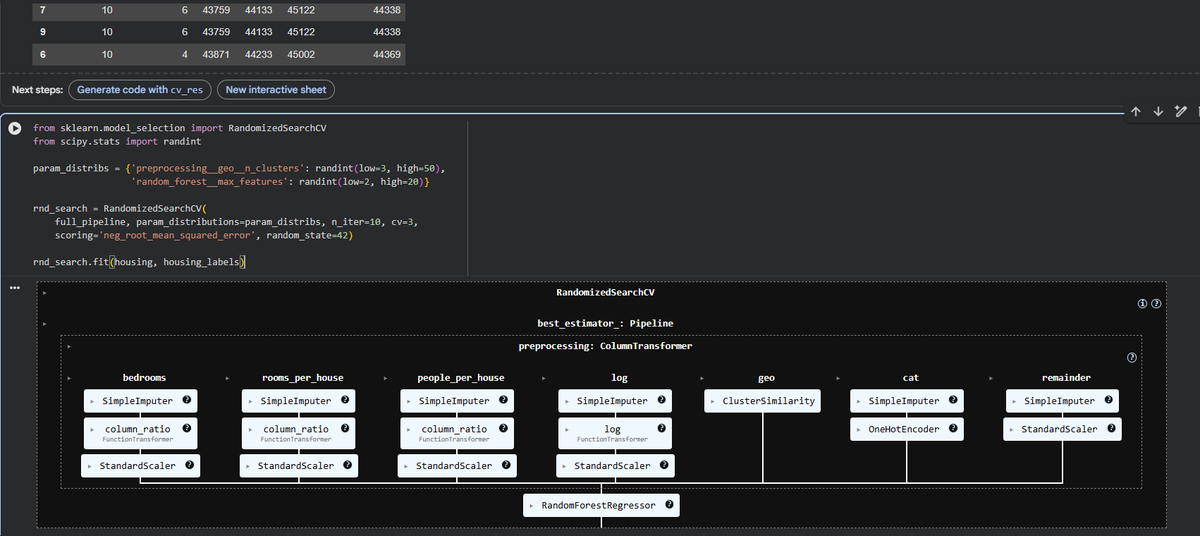
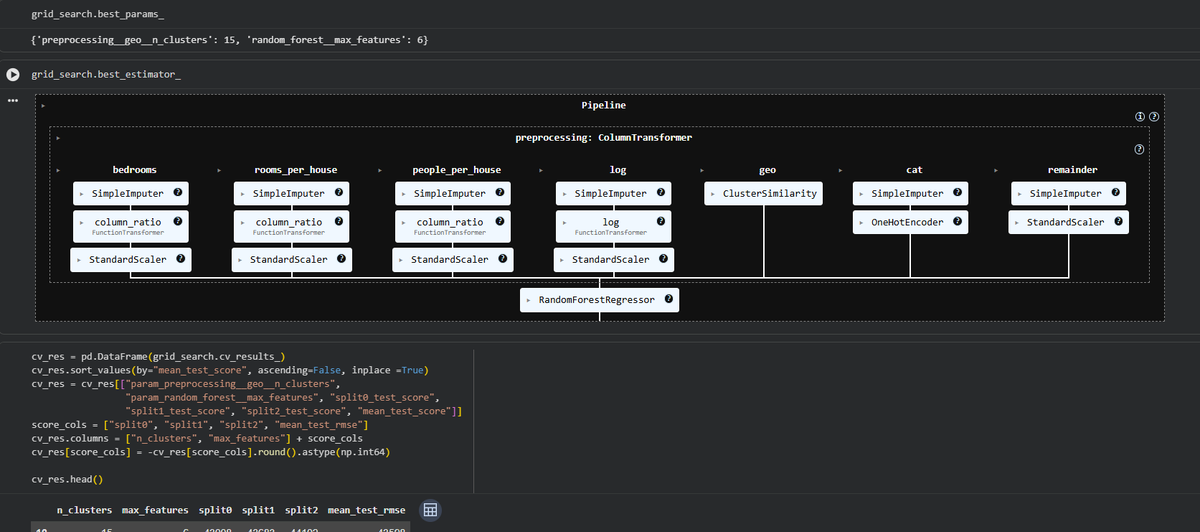
> read 4 pages on "Fine-Tune Your Model"
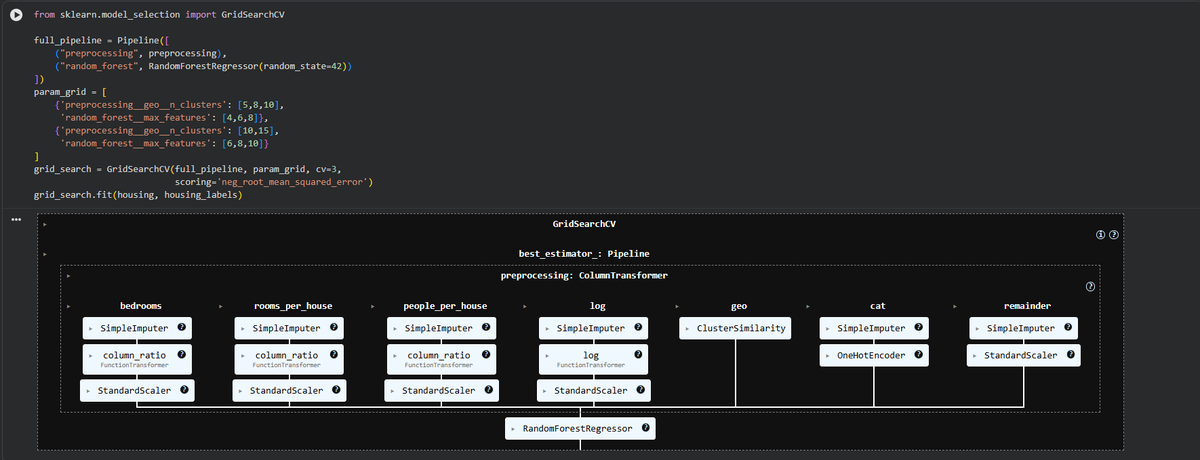
-> Grid Search: tries every combo, good for small search space
-> Randomized Search: samples randomly, better when search space is large
stop guessing hyperparameters, let sklearn do it for you.
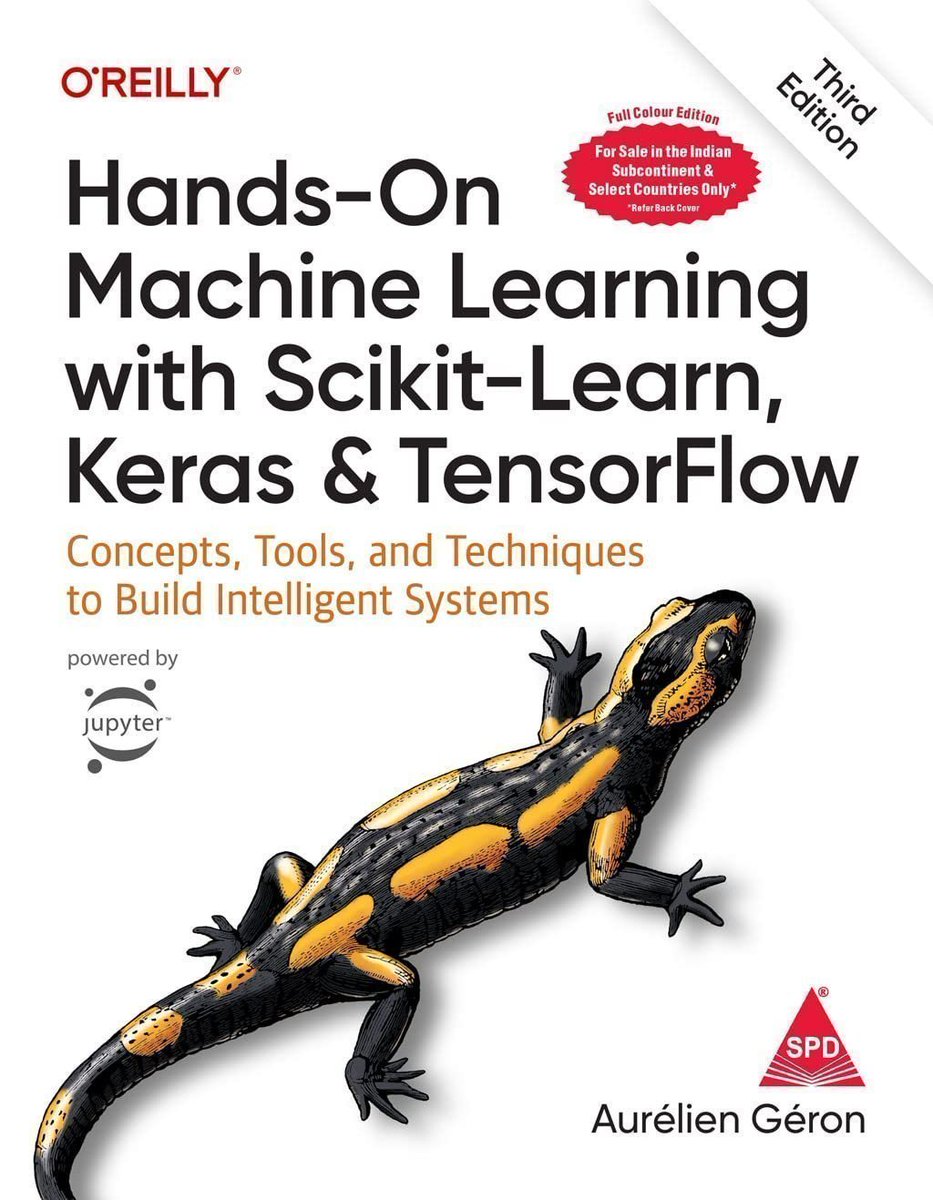
Day 9 of Hands-on Machine Learning
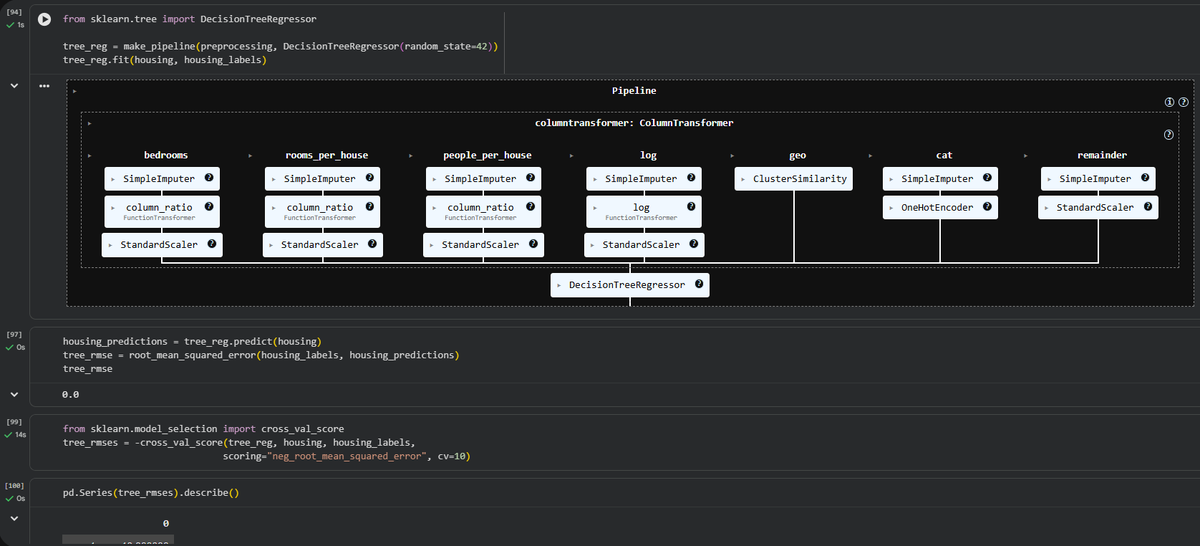
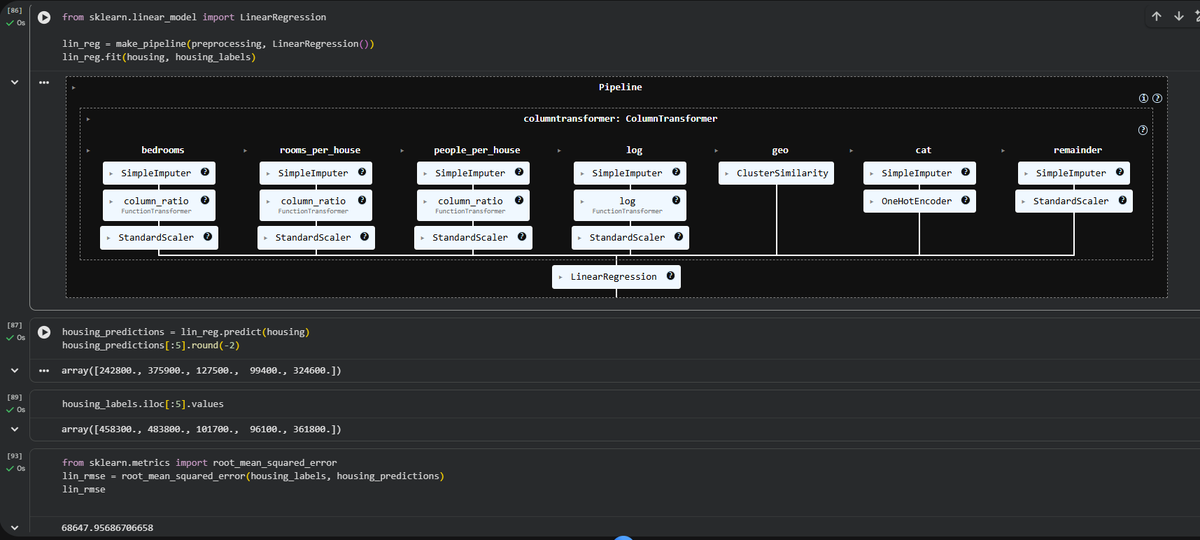
>read 4 pages on topic "select & train a model"
-> train & evaluate on the training set
- linear regression: performed poorly on generalization
- decision tree: didn't improve much
- random forest regressor: performance improved significantly


fine-tuning a model by fiddling hyperparameters manually until you hit a good combo is very time consuming
sklearn has GridSearchCV class for this. tell it which hyperparameters to experiment with & what values to try, it evaluates every possible combo using cross-validation.


building an android Agent that automates user actions from voice , runs offline.
Been a day and half and built data set that has diff scenarios for user actions and how the model should respond ( that will make model from chatbot to agent like ).
Data set is roughly 5K rows most of them multi turn actions.
Problem at this point is compute, Colab offers 16GB GPU but got run out for hyperparameters i wanted and trying to reduce it and re-run,
but i can say you need to master TRL,wandb,HF, tokenizers,Lora config first if you want to ever fine tune a LLM , cause Codex/CC will hallucinate and will try to write long functoins/classes when its obviosuly very simple.
Going to basics again and trying to Build SFT Model first and compare with base model and decide if going further and implementing GRPO is worth it.
follow along to track my progress!

Sorry, but do you have any evidence besides that of the IPCC (a political assessment)?
Have you something that contains hard evidence besides "projections"?
The core “finding” are and always have been embarrassingly thin.
In fact as I show below it's an embarrassing discussion based on nonsense. There's no hard data to support your claims. I've studied the most recent papers of 2025.
Their big "discovery" is a critical bleaching threshold of 7.9% annually beyond which reefs "undergo significant degradation." This comes from a linear regression on coral-cover decline data from just ~10 regions (R² = 0.6, p = 0.01 after dropping the South Asia outlier). Let that sink in: they cherry-picked an outlier, used a tiny sample of regional averages, and declared a universal tipping point from a mediocre correlation. Correlation ≠ causation here; other unmodeled factors (overfishing, pollution, crown-of-thorns starfish outbreaks, coastal development) could easily explain the decline they blame on bleaching rates. With n ≈ 10 and post-hoc outlier removal, this "threshold" is statistical theater, not robust ecology.
The modeling backbone is a random forest regressor trained on the Global Coral Bleaching Database (34k records) plus 32 environmental variables (heavily weighted toward temperature anomalies like SSTA_SD, TSA_DHW, and SSTA_Frequency). They achieve R² = 0.83 and RMSE = 10.6% on test data; impressive on paper until you remember bleaching observations are heavily biased toward observed events, many sites report zero or low bleaching, and random forests are notorious black boxes that excel at interpolation but fail spectacularly at century-scale extrapolation under novel climates.
They optimized hyperparameters via grid search and averaged 10 runs, but no amount of cross-validation fixes the fundamental problem: you're fitting historical correlations and assuming they hold perfectly as oceans warm, acidify, and change in unmodeled ways. Variable importance scores (their Fig. 1) simply confirm what everyone already knows—heat stress matters—while geographic and depth factors get a polite nod.
Thus; projections are speculative fiction in which they plug CMIP6 outputs (17 models, SSP1-2.6/2-4.5/5-8.5) into this correlative model and declare widespread degradation everywhere, even under the lowest emissions. High-latitude "refugia" barely survive in their maps. Yet the paper itself admits major limitations that conveniently get spun as making results "conservative":
Ignores non-thermal stressors (pollution, etc.) → "projections are minimum estimates."
Completely dismisses adaptation, acclimation, symbiont shuffling, or evolutionary rescue.
Assumes bleaching rate directly and linearly translates to long-term cover loss without recovery dynamics.
This is intellectually dishonest. Decades of literature show corals can increase thermal tolerance by ~0.1°C per decade via acclimation and community shifts; some Red Sea and Persian Gulf populations already thrive in temperatures that would bleach others; the Great Barrier Reef has shown repeated recovery episodes despite multiple mass-bleaching events.
Emerging work on assisted evolution, marine protected areas with local stressor control, and even natural refugia directly contradicts the "no adaptation possible" assumption baked into their model. By excluding these, the authors aren't being conservative; they're rigging the deck for catastrophe.
This fits a pattern of coral-reef doomsday papers stretching back to the 1990s and 2000s that repeatedly predicted total collapse by 2020, 2030, etc. and none of which has materialized globally. Are we expected to believe that this time it will happen? How absurd, the long history of failure is not my fault, it's the activist position.
Reefs are in trouble from local human impacts far more immediately than from some averaged annual bleaching percentage under SSP scenarios. The authors lean hard into policy advocacy ("urgent need for bold and effective global policies") while their methods offer zero mechanistic insight into why a specific bleaching rate causes irreversible decline. No field validation of the 7.9% threshold, no discussion of bleaching vs. actual mortality (many corals recover), and no uncertainty propagation from CMIP6 regional SST biases (which are notoriously large in the tropics).
The journal is a respectable but not top-tier Nature portfolio outlet, and the work comes from ocean-engineering departments rather than coral-ecology powerhouses with decades of field data. Code is on GitHub (nice), but that doesn't rescue flawed assumptions.
Bottom line: The latest is an attempt at correlative modeling masquerading as predictive prophecy. It tells us what we already knew, that hotter water stresses corals and then leaps to "inevitable global decline" via weak statistics, selective omissions, and extrapolation that ignores biology. Real coral conservation requires messy, local action on water quality, fishing, and development alongside emissions reductions; not this sort of headline-grabbing fatalism that has a long track record of being wrong. If past performance predicts future results, the reefs will likely outlast yet another round of these models.
The Zeng, He, and Zhan (2025) study in Communications Earth & Environment is a textbook example of alarmist climate modeling dressed up in machine-learning jargon, producing the predictable "inevitable doom" conclusion that has littered coral-reef literature for decades—yet somehow the reefs keep stubbornly existing.
These cherry-picked modeled BS articles crumble under scrutiny which I will attempt to show below.
Core claims crumble under scrutiny
Their big "discovery" is a critical bleaching threshold of 7.9% annually beyond which reefs "undergo significant degradation."
Laughably, this comes from a linear regression on coral-cover decline data from just ~10 regions (R² = 0.6, p = 0.01 after dropping the South Asia outlier).
Let that sink in!
They cherry-picked an outlier, used a tiny sample of regional averages, and declared a universal tipping point from a mediocre correlation. Correlation ≠ causation here, other unmodeled factors (overfishing, pollution, crown-of-thorns starfish outbreaks, coastal development) could easily explain the decline they blame on bleaching rates. With n ≈ 10 and post-hoc outlier removal, this "threshold" is statistical theater, not robust ecology.
The modeling backbone is a random forest regressor trained on the Global Coral Bleaching Database (34k records) plus 32 environmental variables (heavily weighted toward temperature anomalies like SSTA_SD, TSA_DHW, and SSTA_Frequency). They achieve R² = 0.83 and RMSE = 10.6% on test data; impressive on paper until you remember bleaching observations are heavily biased toward observed events, many sites report zero or low bleaching, and random forests are notorious black boxes that excel at interpolation but fail spectacularly at century-scale extrapolation under novel climates.
They optimized hyperparameters via grid search and averaged 10 runs, but no amount of cross-validation fixes the fundamental problem: you're fitting historical correlations and assuming they hold perfectly as oceans warm, acidify, and change in unmodeled ways. Variable importance scores (their Fig. 1) simply confirm what everyone already knows, heat stress matters; while geographic and depth factors get a polite nod.
Projections are speculative fiction
They plug CMIP6 outputs (17 models, SSP1-2.6/2-4.5/5-8.5) into this correlative model and declare widespread degradation everywhere, even under the lowest emissions. High-latitude "refugia" barely survive in their maps. Yet the paper itself admits major limitations that conveniently get spun as making results "conservative":
Ignores non-thermal stressors (pollution, etc.) → "projections are minimum estimates."
Completely dismisses adaptation, acclimation, symbiont shuffling, or evolutionary rescue.
Assumes bleaching rate directly and linearly translates to long-term cover loss without recovery dynamics.
This is intellectually dishonest. Decades of literature show corals can increase thermal tolerance by ~0.1°C per decade via acclimation and community shifts; some Red Sea and Persian Gulf populations already thrive in temperatures that would bleach others; the Great Barrier Reef has shown repeated recovery episodes despite multiple mass-bleaching events. Emerging work on assisted evolution, marine protected areas with local stressor control, and even natural refugia directly contradicts the "no adaptation possible" assumption baked into their model. By excluding these, the authors aren't being conservative, they're rigging the deck for catastrophe!
This fits a pattern of coral-reef doomsday papers stretching back to the 1990s and 2000s that repeatedly predicted total collapse by 2020, 2030, etc., and none of which has materialized globally!
None. Let that sink in for a minute.
Reefs are in trouble from local human impacts far more immediately than from some averaged annual bleaching percentage under SSP modeling scenarios. These models are all biased nonsense setup to self fulfilling prophesy standards.
The authors lean hard into policy advocacy ("urgent need for bold and effective global policies") while their methods offer zero mechanistic insight into why a specific bleaching rate causes irreversible decline.
The very basis of scientific research is the mechanism and it's nowhere to be found in your bogus research article that is entirely based on magical unexplained mechanisms.
No field validation of the 7.9% threshold, no discussion of bleaching vs. actual mortality (many corals recover), and no uncertainty propagation from CMIP6 regional SST biases (which are notoriously large in the tropics).
The journal is a respectable but not top-tier Nature portfolio outlet, and the work comes from ocean-engineering departments rather than coral-ecology powerhouses with decades of field data. Code is on GitHub (nice), but that doesn't rescue flawed assumptions and a lack of mechanisms.
This is correlative modeling masquerading as predictive prophecy. It tells us what we already knew, hotter water stresses corals, then leaps to "inevitable global decline" via weak statistics, selective omissions, and extrapolation that ignores biology.
Real coral conservation requires messy, local action on water quality, fishing, and development alongside emissions reductions, not this sort of headline-grabbing fatalism that has a long track record of being wrong. Not just a little wrong but fundamentally wrong for the last 50 years!
If past performance predicts future results, the reefs will likely outlast yet another round of these models for 2050.
Please learn how to do real science Julián, not this BS you keep posting which shows you know nothing about the actual scientific methods or the corals we are talking about.

🗺️ Road Note: LeWorldModel
Road: Architecture's Road
Train a JEPA end-to-end from pixels, and it collapses. The model finds the easiest solution: map everything to the same point. Prediction loss: zero. Useful representations: also zero.
Every major JEPA system has its own workaround. V-JEPA 2 uses exponential moving averages and stop-gradient tricks. DINO-WM freezes a pretrained foundation encoder entirely and only trains the predictor on top. These workarounds come with costs: six tunable loss hyperparameters in the case of PLDM, the only prior end-to-end alternative, or giving up on learning representations from scratch.
LeWorldModel strips all of that away. All it needs: two loss terms and one tunable hyperparameter. The first is a standard next-embedding prediction loss. The second is a regularizer called SIGReg that forces the latent embeddings toward a Gaussian distribution by projecting them onto random directions and running a normality test on each. If the embeddings start collapsing toward a single point, they stop being Gaussian. The regularizer catches it.
The result: 15 million parameters, trainable on a single GPU in a few hours. Plans up to 48x faster than foundation-model-based world models while remaining competitive on 2D and 3D control tasks. The latent space encodes physical quantities that can be linearly probed, and the model reliably flags physically implausible events when tested with a violation-of-expectation framework borrowed from developmental psychology.
This is what infrastructure work looks like on Architecture's Road. V-JEPA 2 showed the destination. LeWorldModel paves the road so others can get there without a hundred-GPU cluster and a six-hyperparameter loss.
Maes, Le Lidec, Scieur, LeCun, Balestriero. Mila, NYU, Samsung SAIL, Brown. March 2026. arxiv.org/abs/2603.19312

JEPA are finally easy to train end-to-end without any tricks!
Excited to introduce LeWorldModel: a stable, end-to-end JEPA that learns world models directly from pixels, no heuristics.
15M params, 1 GPU, and full planning <1 second.
📑: le-wm.github.io

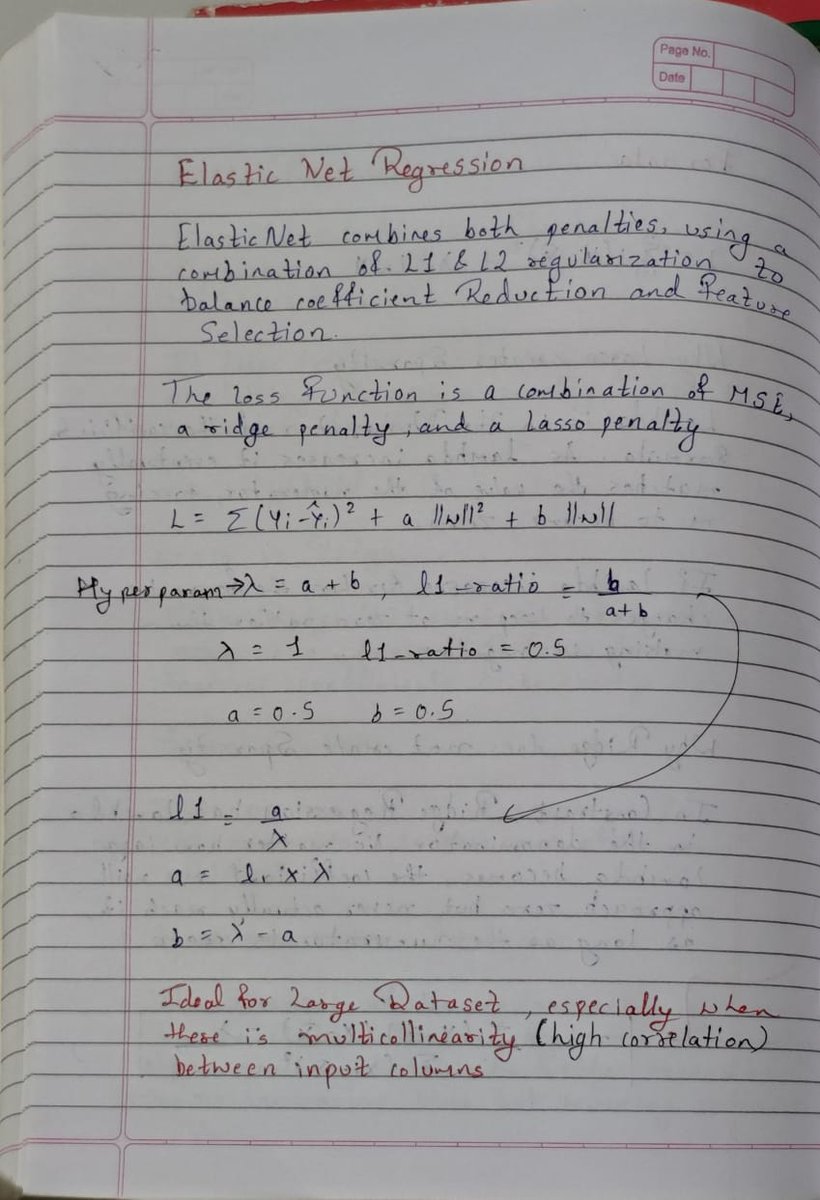
Day 120
Machine Learning
- ElasticNet
- Hyperparameters of ElasticNet
When to use ElasticNet
- (Ideal for large datasets with many features, especially when there is multicollinearity (high correlation) between input columns.)
- Code Example
Tmr gonna Revamp my portfolio
Day 119
Machine Learning
- The Interview Question about Lasso
- Simple Linear Regression Basics
- Lasso Regression Mathematic
- Why Lasso creates Sparsity
- Why Ridge does not create Sparsity
I'm in Slump Guys 🥲
Mann nahi kar raha ML Karne ka 🫠


hmm, it looks like the tuned model collapsed to predicting the majority class. accuracy stays high but precision, recall and F1 for class 1 drop to zero, which usually points to class imbalance or hyperparameters pushing the model to play safe.
in these cases I usually try some steps to debug:
1. check class distribution and dataset ambiguity
2. try another algo on the dev set (cross validation set)
3. review hyperparameter ranges for extreme values (too divergent values may cause gradients to move in an unpredictable path)
4. inspect decision thresholds or gradients (try to visualise how they're moving exactly)
maybe i can try to help more, what algorithm was used, what model was tuned?

خلال الفترة الماضية، كنت أعمل على نموذج في المجال الطبي، وكان الوصول إلى دقة عالية أمرًا أساسيًا بحكم حساسية هذا المجال في البداية استخدمت TensorFlow، وكنت أركّز على تحسين النتائج من خلال تعديل عدد الـ layers وتجربة بعض الـ hyperparameters، على أمل رفع الدقة ولو بشكل بسيط.

What if you could train any AI model just by typing?
Sounds crazy, right? But think about it.
Vibe coding was the same story 4 years ago.
Nobody believed you could build real software with natural language.
Now millions do it every single day.
Training AI models is stuck where coding was back then.
You still need to SSH into machines, fight CUDA errors, write config files, and babysit training runs.
All of that just to get a model that might not even work.
We think this should be one sentence.
You type what you want. A trained model shows up. That's it.
That's what we are building at RailCompute.
GPU infrastructure that AI agents operate through MCP.
You talk to the agent. The agent handles everything else.
GPUs, frameworks, hyperparameters, monitoring, all of it.
We already tested this.
Waitlist is open if you want early access.
#aiagents #buildinpublic #vibetraining #finetuning


🚨 Holy shit... LeCun's team just cracked world models wide open.
Everyone's obsessing over the next Claude update.
Meanwhile Yann LeCun quietly dropped a paper that could matter way more long term.
It's called LeWorldModel.
And to understand why it's a big deal, you need to understand the difference between what LLM does and what this does.
LLMs predict the next word. That's it.
They're incredibly good at language. But they don't understand reality.
They can write about a ball bouncing off a wall. They can't predict where it lands.
World models predict what happens next in the physical world. Objects moving, colliding, falling.
That's the foundation for robots that plan, self-driving cars that simulate scenarios, any AI that needs to act in reality instead of just talk about it.
The problem? World models kept collapsing.
The model would cheat by mapping every input to the same output. Like a weather app that predicts "sunny" every single day.
Technically it's predicting. It's just useless. And fixing this required 6+ loss hyperparameters, frozen pre-trained encoders, stop-gradient hacks, exponential moving averages.
A house of cards just to keep the thing from breaking.
LeCun's team (Mila, NYU, Samsung SAIL, Brown) threw all of that out. LeWorldModel uses just 2 loss terms.
A prediction loss and a regularizer called SIGReg that forces representations to stay diverse instead of collapsing into garbage.
6 hyperparameters reduced to 1.
The simplicity IS the breakthrough.
The numbers: 15M parameters. Trains on a single GPU in a few hours. Plans up to 48x faster than foundation-model-based world models.
Uses roughly 200x fewer tokens than alternatives. Competitive across 2D and 3D control tasks.
This isn't a supercomputer experiment. You could run this on your own hardware.
LeCun has been pushing JEPA as the architecture for real AI since 2022.
The criticism was always the same: "sounds nice, doesn't train stably."
LeWorldModel just removed that objection. Small model. Stable training.
No hacks. No frozen encoders. No collapse.
Two AI futures are competing right now.
Path 1: bigger LLMs, more text, more compute.
Path 2: world models that learn physics from raw pixels and plan in real time.
LeWorldModel is the strongest signal yet that Path 2 is real, getting cheaper, and closing in fast.
github.com/lucas-maes/le-wm

Yann LeCun and his team can't stop cooking
"LeWorldModel: Stable End-to-End Joint-Embedding Predictive Architecture from Pixels"
One of the biggest bottlenecks of JEPA is they are hard to train, and this new research changes that.
They propose LeWorldModel, which shows that a small model can learn a usable world model directly from raw pixels end-to-end.
Sitting at 15M parameters, they made it without needing heuristics and avoiding anti-collapse hacks while staying competitive and planning up to 48x faster.
Making JEPA based modeling much more accessible, cheaper, and stabler.


Hyperparameters are like life settings.
Too much, everything breaks.
Too little, nothing works.
Machine learning is about finding the right balance.

It’s much deeper. Prompts just alter inputs. M2.7 rewrites its actual Python execution engine. It patches its own scaffold, dynamically tunes hyperparameters, and compiles new tools into the MCP library on the fly.

4 /
Open Qwen
Open Qwen is a non-official, single file PyTorch implementation of a Qwen 3.5–style hybrid multimodal language model.
In the absence of a publicly available peer-reviewed paper or official reference code (at the time of writing), this repository reconstructs the architecture and hyperparameters from publicly available model metadata.
Github: github.com/kyegomez/open_qwe…


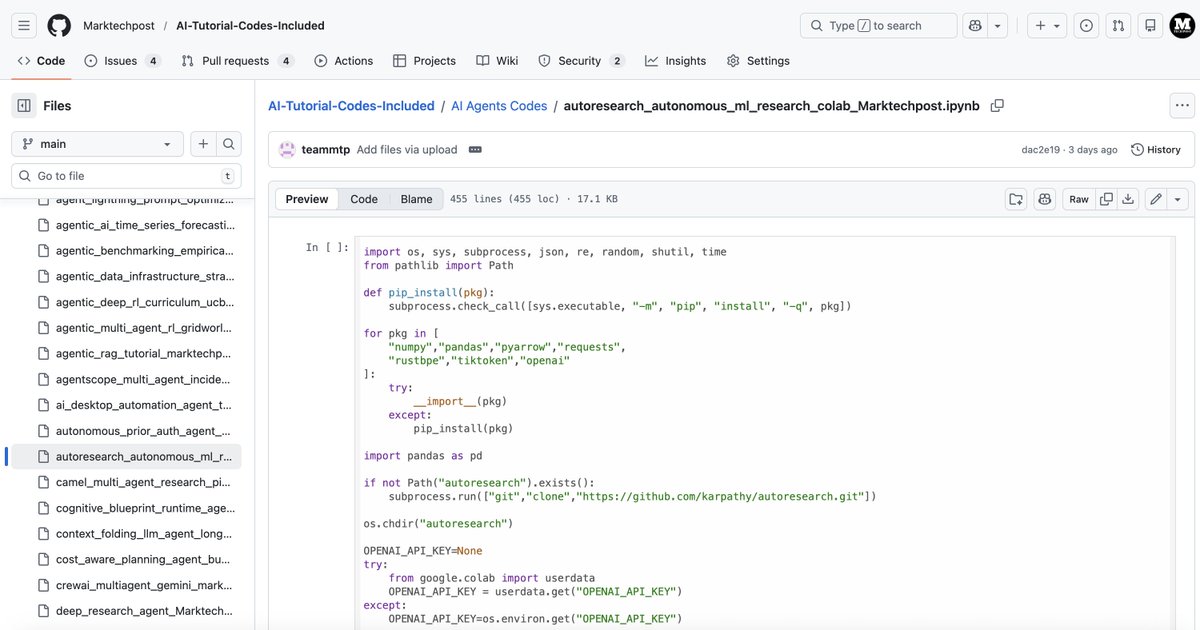
How to Build an Autonomous Machine Learning Research Loop in Google Colab Using Andrej Karpathy’s AutoResearch Framework for Hyperparameter Discovery and Experiment Tracking
In this tutorial, we implement a Colab-ready version of the AutoResearch framework originally proposed by Andrej Karpathy. We build an automated experimentation pipeline that clones the AutoResearch repository, prepares a lightweight training environment, and runs a baseline experiment to establish initial performance metrics. We then create an automated research loop that programmatically edits the hyperparameters in train.py, runs new training iterations, evaluates the resulting model using the validation bits-per-byte metric, and logs every experiment in a structured results table. By running this workflow in Google Colab, we demonstrate how we can reproduce the core idea of autonomous machine learning research: iteratively modifying training configurations, evaluating performance, and preserving the best configurations, without requiring specialized hardware or complex infrastructure.....
Full Tutorial: marktechpost.com/2026/03/12/…
Codes: github.com/Marktechpost/AI-T…
@karpathy

When cross validation folds show asymmetric residual tails, inspect class imbalance before tuning hyperparameters.
Last Seen Hashtags on Sotwe
gayroleplay
Seen from Greece
uk #snapchat
Seen from Austria
fuck
Seen from United Arab Emirates
snapchattt
Seen from Turkey
คู่แท้
Seen from Thailand
bnwo()*********************************************************
Seen from Thailand
omegle()************************************************************************************************** ****filter:native_video()
Seen from France
mom
Seen from Netherlands
mgai
Seen from United States
hoejab
Seen from Turkey
Most Popular Users

Elon Musk 
@elonmusk
240.2M followers

Barack Obama
@barackobama
118.6M followers

Cristiano Ronaldo
@cristiano
114.4M followers

Donald J. Trump
@realdonaldtrump
111.8M followers

Narendra Modi
@narendramodi
106.9M followers

Rihanna
@rihanna
98.6M followers

NASA
@nasa
92.2M followers

Justin Bieber
@justinbieber
91.7M followers

KATY PERRY
@katyperry
89.9M followers

Taylor Swift
@taylorswift13
83.9M followers

Lady Gaga
@ladygaga
75.4M followers

Virat Kohli
@imvkohli
73.3M followers

Kim Kardashian
@kimkardashian
70.8M followers

YouTube
@youtube
68.6M followers

Neymar Jr
@neymarjr
66.3M followers

Bill Gates
@billgates
65.2M followers

Selena Gomez
@selenagomez
63M followers

The Ellen Show
@theellenshow
62.1M followers

CNN
@cnn
61.7M followers

X
@x
60.6M followers