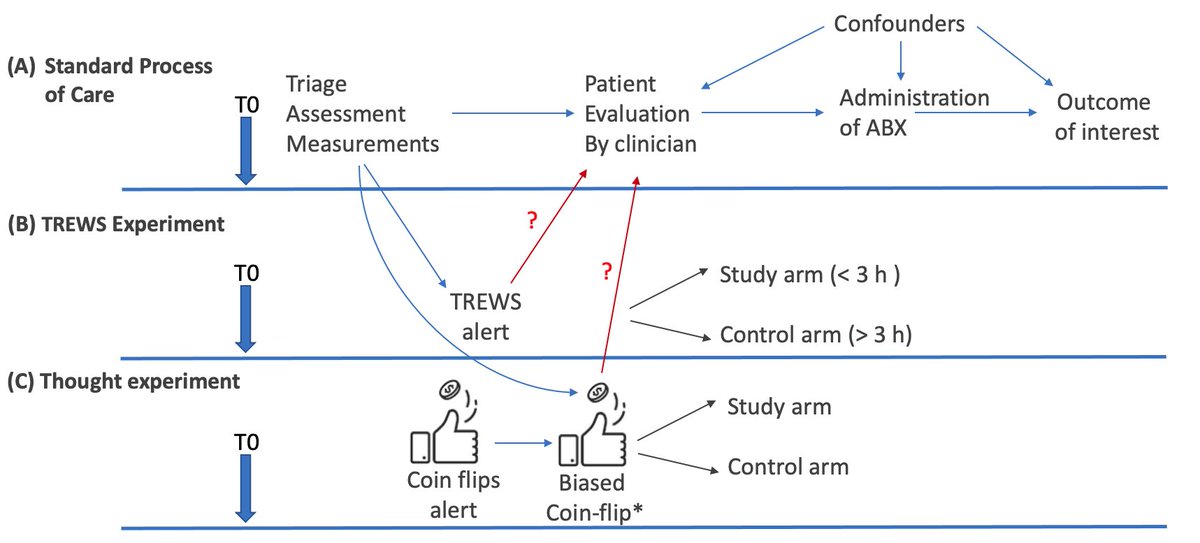
Note the essential difference between @ylecun's way of of "training a causal model" and Causal Inference (CI) way of doing it. The former has action NAMES (eg, a(t), a(t-1)), the latter does not. In the latter, outcomes are caused by EVENTS, eg, "my uncle died from a car accident", and actions are specified by the immediate events they establish, eg. "He made sure his seatbelt is ON". I am curious how @ylecun learns that accidents and diseases cause deaths.
1/4 Deployment of COMPOSER AI platform was associated with a 1.9% absolute reduction (17% relative decrease) in in-hospital #sepsis mortality, a 5.0% absolute increase (10% relative increase) in sepsis bundle compliance, and a 4% reduction in 72h SOFA change after sepsis onset.
Deep neural networks, as you probably know, are sandwiches of linear regressions with elementwise nonlinearities between each layer.
The core contribution of “Attention is All You Need,” which led directly to the LLM/GPT explosion,
is to throw some *logistic* regressions in there
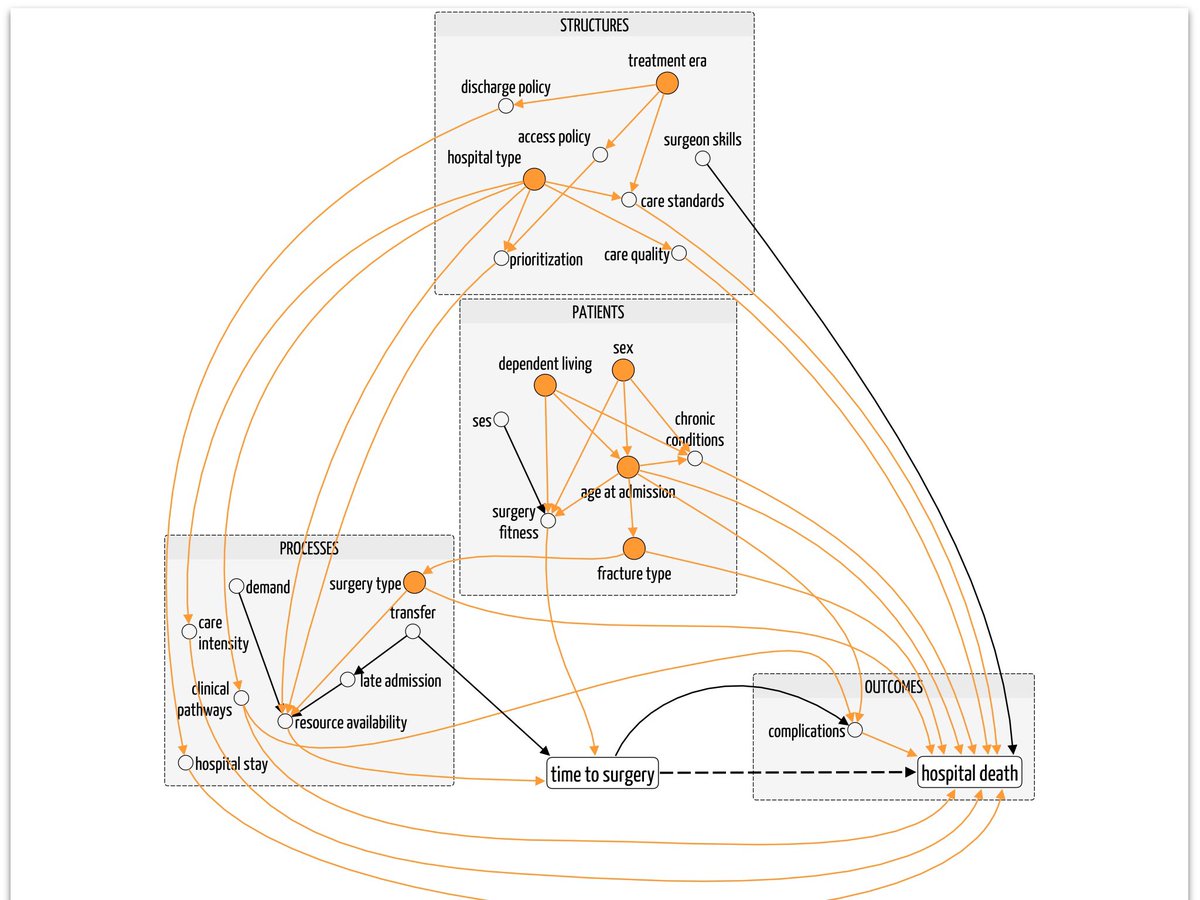
The most interesting challenge in teaching DAGs is developing competence in moving between levels of abstraction. My approach is "Concepts before data".
Abstraction emphasizes some aspects of reality while ignoring others, right? I start with categories of factors rather than variables in the data set.
In the more abstract DAG on the left, the nodes represent broad categories, such as the components of the Donabedian framework for studying healthcare.
As we add detail, we break down the categories into factors, mapping them to concepts. The same DAG on the right has a different level of abstraction, allowing for #CausalInference by closing "back doors."
Introducing DAGs along the spectrum of abstraction illustrates the choice of the appropriate level.
#DAGs #Abstraction #ConceptsBeforeData
Moving from Google Brain to OpenAI, one of the biggest changes for me was the shift from doing individual/small-group research to working on a team with several dozen people. Specifically, working on a bigger team has led me to think more about UX for researchers. Some examples:
1. Great tooling accelerates research. Subpar tools hamper researchers by introducing unnecessary friction into thinking and analysis. Even small improvements like reducing clicks and scrolls can significantly increase researcher's productivity. Visualizations become particularly vital when working with multi-task models, helping to better evaluate tradeoffs between different models.
2. Simple design is key for a the success of an evaluation benchmark. For example, GLUE/SuperGLUE, as well as MMLU/GSM8K have a single number (higher is better), and everyone wants it to go up. They are easy to understand, download, and evaluate. Other benchmarks (e.g., BIG-Bench, probably one of the great benchmarks of the past two years IMHO) can have advantages such as much broader coverage, but are basically impossible to run and a pain in the ass to analyze. For Google's PaLM paper, I heard one engineer's full-time job was just to run BIG-Bench...
3. Strong documentation enables scaling communication without involvement. Imagine if you have to chat with someone to explain how something works. They have to wait for you to reply, and you have to stop your work to message them. This takes up two people's time. With good documentation, you don't have to be involved at all, and the other person doesn't have to wait for your responses, which accelerates both people a lot.
Great article by our #AWS partner featuring the Amazon Research Award winner @spshash & the brain behind our #sepsis#AI & quality improvement efforts @UCSDHealth:
https://t.co/4kk8aUAyfg
not associational (" Is it possible that smoking CAUSES ..."); statistics texts do not normally ask causal questions. In summary, GPT-4 understanding is at the level of a well-read statistics instructor -- Amazing in its breadth! But still Rung-1.
4/4
Academic job seekers often think that because they didn't get a job one year, or didn't get a particular job, there's something they should change in their application. That's often a mistake. Here are some reasons you maybe didn't get the job that are beyond your control(thread)
I have not talked with Einstein or Bohr.
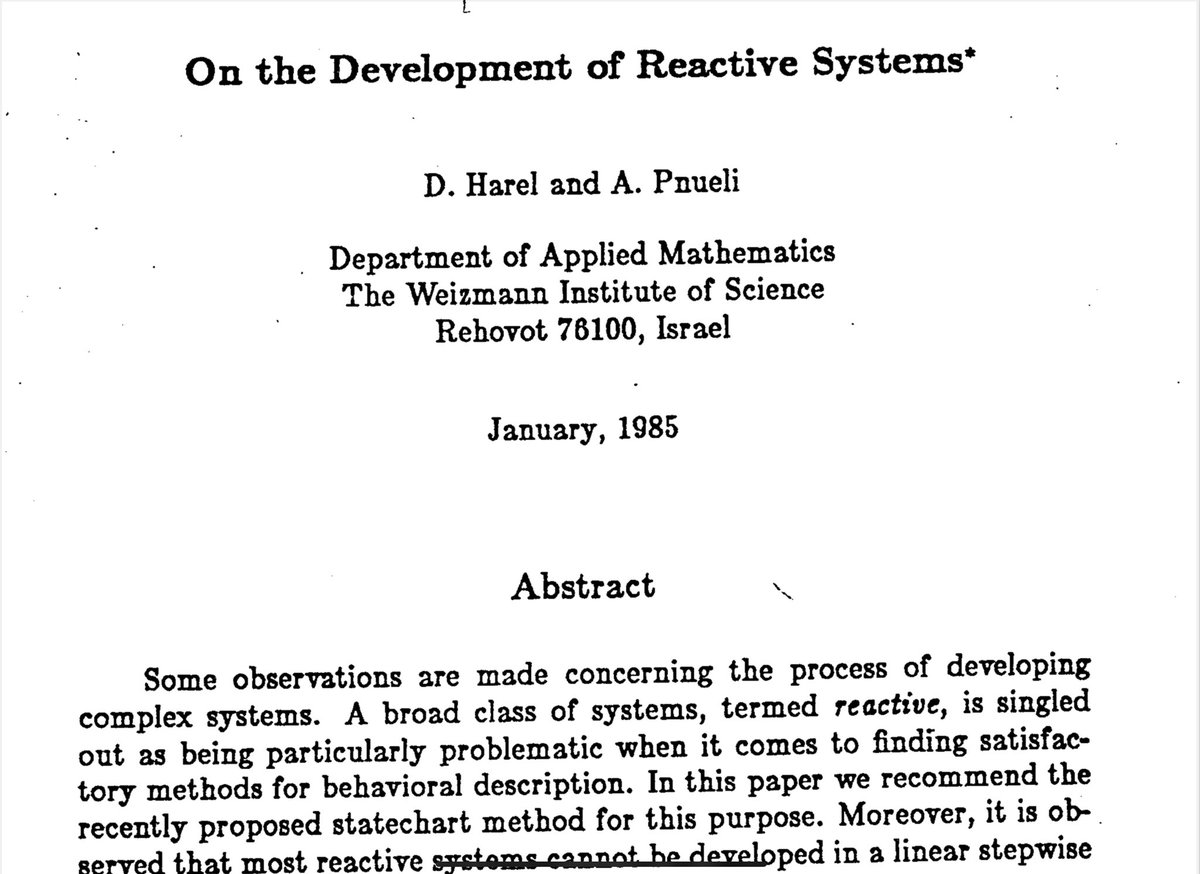
But I have been fortunate to communicate with equal giants: David Harel @AnsellHarel and Judea Pearl @yudapearl
One showed me that dynamics can be anewtonian, and the other taught me that #causality can be afisherian.
🙏🏻
The way you think about the exponential function is (probably) wrong.
Don't think so? I'll convince you. Did you realize that multiplying 𝑒 by itself π times doesn't make sense?
Here is what's really behind the most important function of all time:
Para profundizar en el debate, recomiendo este paper de Borondo, Borondo, Rodriguez-Sickert & @cesifoti en el que demuestran a través de simulaciones que la estructura de las redes son una restricción fundamental para la meritocracia de las sociedades https://t.co/nuiFpeRhW4
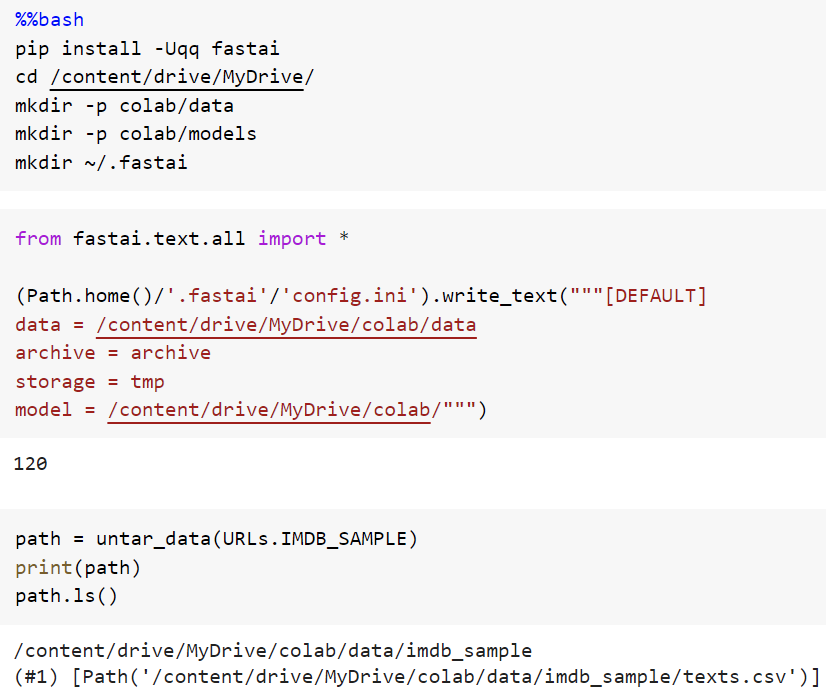
Do you use Google Colab and fastai? If so, here's a nifty trick to automatically load and save all models and data to Google Drive:
https://t.co/m63PBpIAUr
1/5 Is Hebbian plasticity the brain's trick to make self-supervised learning work? Our new preprint led by @manu_halvagal takes a deep dive into that question and reveals some surprising connections https://t.co/LVl9KKnEvh 🧵👇
2022 𝗰𝗼𝘂𝗿𝘀𝗲 𝗱𝗮𝘁𝗲𝘀 𝗵𝗮𝘃𝗲 𝗯𝗲𝗲𝗻 𝗲𝘀𝘁𝗮𝗯𝗹𝗶𝘀𝗵𝗲𝗱! The 2 courses (Computational Neuroscience & Deep Learning) will happen in parallel for 3 weeks, starting July 11th and ending July 29th. The portal for students and TAs applications opens on March 28th [1/2]