Research scientist @UCSDHealth working on improving healthcare delivery using machine learning.
Formerly: PhD @GeorgiaTech, @MSFTResearch, @qualcomm_in
How can ML help hospitals detect sepsis? Using a model built by @UCSDHealth research scientist @spshash, clinicians have an early warning of patients predicted to develop sepsis in the next four hours. Learn how #AmazonResearchAwards helped scale the life-changing service.
4/5 In an ER setting, ordering of blood culture is often followed by administration of antibiotics, therefore it's not clear if providers will wait for a AI risk score to initiate treatments for sepsis. Moreover, all cases without a clinical suspicion of sepsis will be missed!
Very excited to share our latest work showing improvement in sepsis-related outcomes (in-hospital sepsis related mortality, sepsis bundle compliance and 72h SOFA change) after real-world deployment of COMPOSER AI platform! 1/2
Can a novel #DeepLearning algorithm to predict #sepsis in the emergency department improve care?
Researchers from @UCSDHealth show proper implementation of the model can save lives of sepsis patients and improve quality metrics.
https://t.co/pVLoAqZNdr
One of the few studies in the field of sepsis related predictive analytics reporting improvement in outcomes after real world deployment of an AI based deep learning model for early sepsis prediction. 1/2
1/3 Healcisio's AI Reduces Sepsis Mortality By Nearly 20%: NIH Funded Healcisio Collaboration Advances the Development o... https://t.co/hqeCQwLPeV #AI#Sepsis#MedTwitter
2/4 The composer platform leverages #FHIR and #AWS cloud to enable real-time predictive analytics for various clinical scenarios, such as sepsis, respiratory failure, and deterioration, among others. It also integrates with existing #EHR systems and clinical workflows.
1/4 Deployment of COMPOSER AI platform was associated with a 1.9% absolute reduction (17% relative decrease) in in-hospital #sepsis mortality, a 5.0% absolute increase (10% relative increase) in sepsis bundle compliance, and a 4% reduction in 72h SOFA change after sepsis onset.
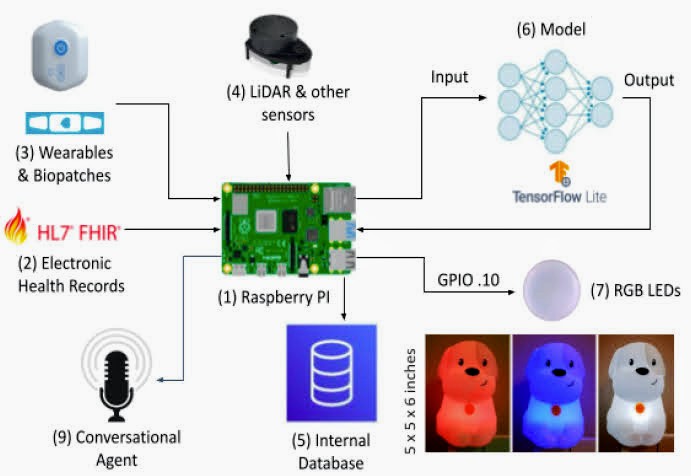
MCoPet (Mobile Companion Pet) can now talk in different languages, communicate with #EHR via #FHIR, connect to #wearables & #IoT devices, and analyze a host of inclusive and insightful personal health-related data via #ArtificialIntelligence.
Great article by our #AWS partner featuring the Amazon Research Award winner @spshash & the brain behind our #sepsis#AI & quality improvement efforts @UCSDHealth:
https://t.co/4kk8aUAyfg