entrepreneur, product manager, investor, passionate about artificial intelligence, all things digital and the underestimated power of exponential growth
@hamburgwasser Habt ihr gerade an einem Feiertag ein neues Kundenportal eingeführt und Links an die Haushalte geschickt, obwohl das Portal noch nicht live ist? Oder ist es an Tag 1 kaputt gegangen? Sagt bescheid wenn Ihr Hilfe für Digitale Produkte braucht - da gibt's Experten für!
Wir (https://t.co/GhtkgZ1qz8) verkaufen gerne in Europa. Und hören trotzdem damit auf.
Was kostet z. B. ein Paket nach Österreich? 14,50 € Porto.
Realität für uns als Gewerbetreibende: 135 € pro Paket bei gerade einmal zehn Sendungen pro Jahr nach Österreich 2025.
Dabei sind wir nur eine kleine GmbH aus Deutschland mit vereinzelten Kunden in Europa. Unser gesamtes jährliches Aufkommen für den EU-Export liegt bei etwa 100 Kilogramm Verpackung. Nicht Tonnen. Kilogramm.
Die Rechnung für Österreich allein: Wer als ausländisches Unternehmen nach Österreich verschickt, ist gesetzlich verpflichtet, die Entsorgung der Verpackung zu lizenzieren und dafür einen lokalen Beauftragten zu benennen, der die Einhaltung der Vorschriften garantiert und dafür haftet:
- Porto (10 Pakete à 14,50 €): 145 €
- Jahrespauschale Verpackungsbeauftragter: 450 €
- Notarkosten für die Vollmachtsbeglaubigung: 150 €
- Opportunitätskosten: 600 €
Und das ist nur Österreich. Frankreich verlangt z. B. ein eigenes Logo samt Anleitung auf jedem Versandkarton, sonst drohen empfindliche Bußgelder. Spanien, Italien, Polen: jeweils eigene Anforderungen, eigene Register. Ab Mitte 2026 kommen mit der EU-Verpackungsverordnung #PPWR weitere Pflichten hinzu.
Konzerne verteilen solche Fixkosten auf Millionen Sendungen. Für kleine Unternehmen und Selbständige wird daraus ein reales Exporthindernis. Das ist kein Versehen des Gesetzgebers, sondern ein struktureller Konzentrationsvorteil zugunsten großer Marktteilnehmer.
Dahinter steht ein System mit eigener Ökonomie: Wer Verpackungen in Verkehr bringt, muss deren spätere Entsorgung lizenzieren. Allein in Deutschland fließen dabei jährlich Milliardenbeträge an Lizenzentgelten an marktbeherrschende Entsorgungsunternehmen. Diese profitieren dabei mehrfach, über Lizenzgebühren beim Inverkehrbringen von Verpackungen über die Abholung und Verwertung der eingesammelten Rohstoffe. Komplexität ist dabei kein Fehler im System; sie ist Teil des Geschäftsmodells.
Besonders grotesk wird das im Vergleich mit Plattformversendern aus Fernost. Millionen Kleinsendungen fluten den europäischen Markt bei erkennbar geringerer Vollzugsintensität. Der europäische Mittelstand wird kontrolliert, weil er greifbar ist.
Der ursprüngliche Gedanke hinter der @EUCouncil war ein anderer: ein gemeinsamer Binnenmarkt, der Grenzen abbaut statt neue errichtet. Stattdessen: 27 nationale Compliance-Silos, die kleinen Unternehmen den Export systematisch verleiden.
Was sich ändern müsste:
1. Eine zentrale EU-Registrierung statt 27 nationaler Alleingänge
2. Eine De-minimis-Regelung für Kleinversender
3. Konsequenter Vollzug gegenüber Drittstaatsversendern statt Belastung des europäischen Mittelstands
Wir ziehen uns deshalb vorerst auf Deutschland und die Schweiz zurück, weil wir unsere Energie lieber in Produkte und Kunden investieren.
Die aktuelle EU-Bürokratiearchitektur erleben viele Unternehmen nur noch als Belastung.
Wir sind Unternehmer und keine Verpackungsjuristen, @vonderleyen , @DIHK_News, @MarkusFerber , @svenja_hahn , @nicolabeerfdp , @ANiebler
Gerne reposten - es betrifft den Mittelstand generell.
@heyshrutimishra@MartinSzerment You can do even more - have your openclaw a) create a bit of extra context per topic (e.g. my "engine rooms" is just my regular agent but with all openclaw docs knowledge and my setup preloaded) or b) create a subagent with a complete soul, identity etc. and bind it to the topic!
What an incredible rabbit hole. Really, really worth reading the full article. It's about the tiny electric motor that bacteria use. And we just learned how it works, including a backwards gear and a stream of protons to power it.
Bacteria move around using a molecular machine called the flagellar motor that rotates faster than the flywheel of a race car engine and switches directions in an instant. After 50 yrs, scientists have finally figured out how it works. “My lifelong quest is now fulfilled.” Link⤵️
One year after @DKokotajlo and the team at @AI_Futures_ published AI 2027, my tracking shows 27 of 53 predictions confirmed, ahead, or on track.
Reality is running at ~65% of the scenario's predicted pace - confirmed also by their own Q1 grading.
This is wild.
One surprise: risks are arriving before capabilities.
Tracker: https://t.co/Qt9G7UhL7G
Write-up: https://t.co/103UTgOF6V
Pretty remarkable dynamics... if you think about how two one man projects like OpenClaw and Moltbook have progressed in less than two months. And nvidea, OpenAI and Meta are right there instead of watching from the sidelines.
huge shoutout to @nvidia for lending engineers to help triage our security advisories 🛡️🦞
open source security hits different when GPU companies show up to help
me: "can you use whatever resources you like, and python, to generate a short 'youtube poop' video and render it using ffmpeg ? can you put more of a personal spin on it? it should express what it's like to be a LLM"
claude opus 4.6:
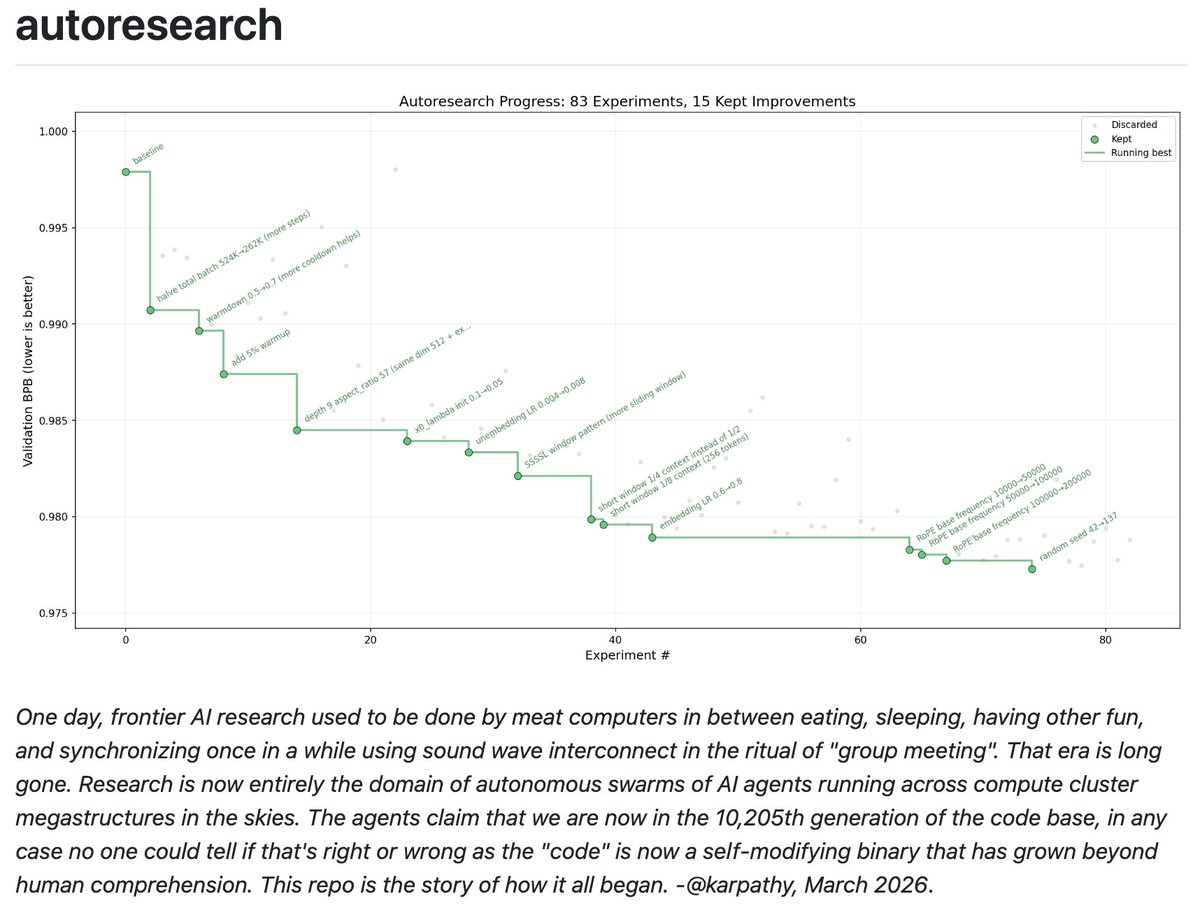
I packaged up the "autoresearch" project into a new self-contained minimal repo if people would like to play over the weekend. It's basically nanochat LLM training core stripped down to a single-GPU, one file version of ~630 lines of code, then:
- the human iterates on the prompt (.md)
- the AI agent iterates on the training code (.py)
The goal is to engineer your agents to make the fastest research progress indefinitely and without any of your own involvement. In the image, every dot is a complete LLM training run that lasts exactly 5 minutes. The agent works in an autonomous loop on a git feature branch and accumulates git commits to the training script as it finds better settings (of lower validation loss by the end) of the neural network architecture, the optimizer, all the hyperparameters, etc. You can imagine comparing the research progress of different prompts, different agents, etc.
https://t.co/YCvOwwjOzF
Part code, part sci-fi, and a pinch of psychosis :)
@SoenkeMartens I have been using @WisprFlow for months and can recommend it. The plus: since it works wherever you Type you retain a degree of control and transparency vs direct voice interfaces. Plus sometimes I can’t talk - e.g. shared office, train.
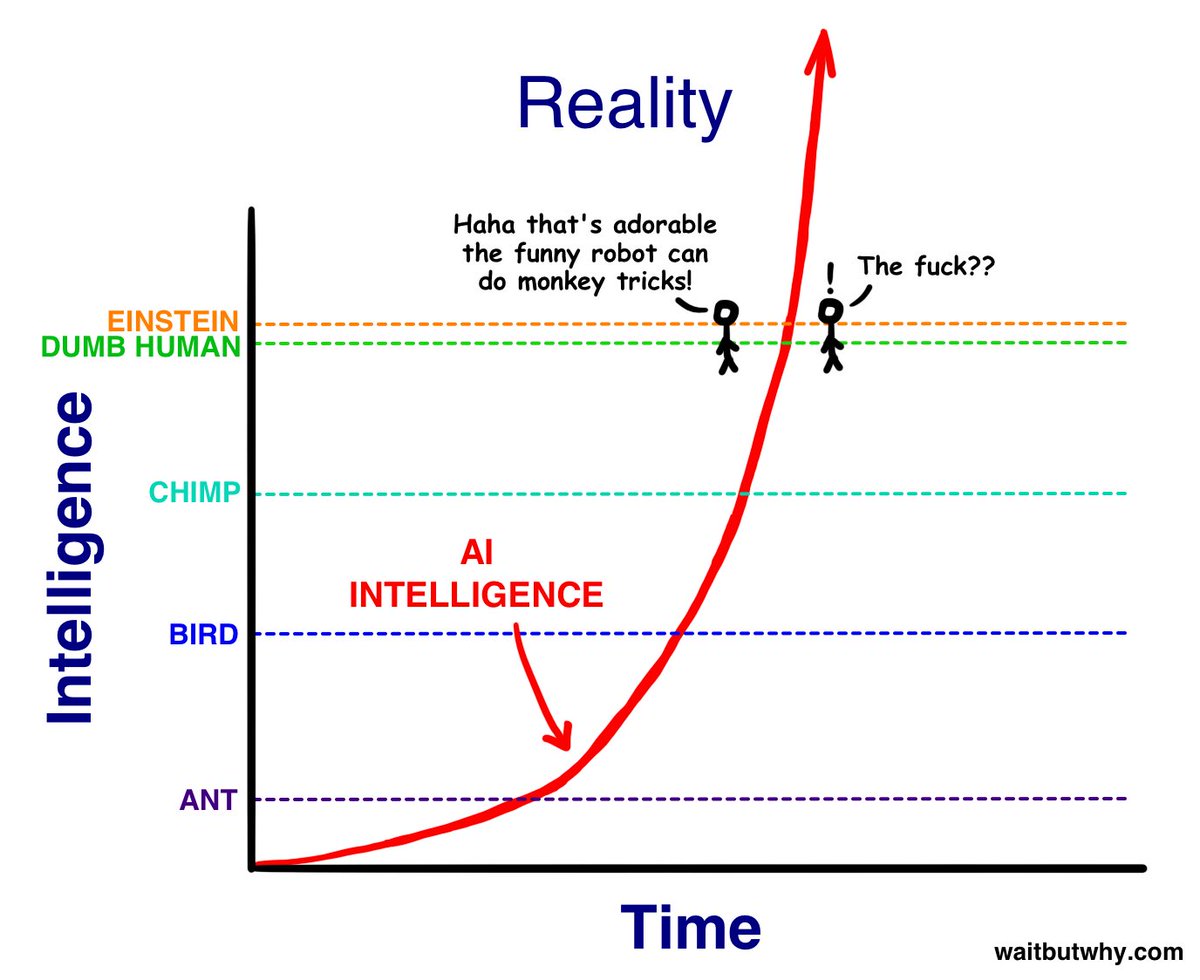
@HowardAulsbrook@SeanODowd15@waitbutwhy You don’t really believe that AI inherently makes more mistakes than humans in all tasks…? This is a topic too complex for tweets, but there are already several fields where AI & ML create far more reliable results than humans. You’re oversimplifying this.
@HowardAulsbrook@SeanODowd15@waitbutwhy explained it best, I keep coning back to this. And AI 2027 has this really great point. We don’t need so solve this for every job. Just coders, and ai researchers. Then - BOOM.
All of your critique in this thread about moltbook is technically true today. But I've seen this movie before. Most of these points - AI slop, human on the leash, just hit the off switch - map perfectly onto points smart people made about ChatGPT the week it launched. Something like...
"I am apparently extremely unimpressed by ChatGPT relative to many others.
We've had chatbots for decades. Cleverbot. SmarterChild. They produced fluent-sounding nonsense then. This one produces it again, just with longer paragraphs.
Stack Overflow banned it within five days. The rate of correct answers was too low, and the wrong ones looked plausible enough to fool people. A Princeton computer science professor called it
a 'bullshit generator.' It cannot do arithmetic — a calculator from 1972 outperforms it at math. It hallucinates citations to papers that don't exist. It confidently tells you 1 is greater
than 1.
Most importantly: there is no understanding here. It's a stochastic parrot. It predicts the next statistically likely token. That's all it does. That's all it will ever do, because that is
what the architecture is. Scaling a next-word predictor doesn't produce reasoning any more than scaling a spell-checker produces a novelist.
Yes, it is true that eventually language models might improve. But there is a hard ceiling here, and we are already near it. These models have no world model, no persistent memory, no ability
to verify their own outputs. GPT-3 had the same problems. GPT-3.5 has the same problems. There is no reason to believe GPT-4 won't have the same problems.
So what we actually have is a toy. An impressive autocomplete that amuses people for an afternoon before they realize it can't reliably do anything they'd stake their job on. The novelty
wears off, the hallucinations stay, and in six months nobody will be talking about this."
…Stack Overflow reversed course and built AI into its core product. The 'bullshit generator' now writes and reviews production code at most major tech companies. Every limitation was real. The
extrapolation from those limitations was not.
@waitbutwhy@DouthatNYT Tim, any chance you have the link to that post? During these last few crazy days, it's so hard to separate fact from fiction. And since this one is, for me personally, by far the most awesome bit I've seen so far, I would LOVE for it to be real! Can't find it on moltbook.
The best speech I’ve heard in quite a while. Refreshingly honest, with so much clarity and a realistic call to action. I hope my American friends all watch this. https://t.co/UsxgdL2o85
I'm not joking and this isn't funny. We have been trying to build distributed agent orchestrators at Google since last year. There are various options, not everyone is aligned... I gave Claude Code a description of the problem, it generated what we built last year in an hour.
@jasonrmcintyre@paulg Chiming in from Europe - there’s considerable reluctance here to visit the US, driven by price increases and T’s politics. On being “shocked later” - I stopped believing this when T was allowed to survive the impeachments AND was reelected in spite of four years of craziness
@BearBanker@DavidSacks just like in the Industrial Revolution, where so many people lost their jobs because of factories‘ higher efficiency? Transformational waves like this usually create huge gains. What’s real is the threat of unequal distribution as well as a VERY rocky transition phase