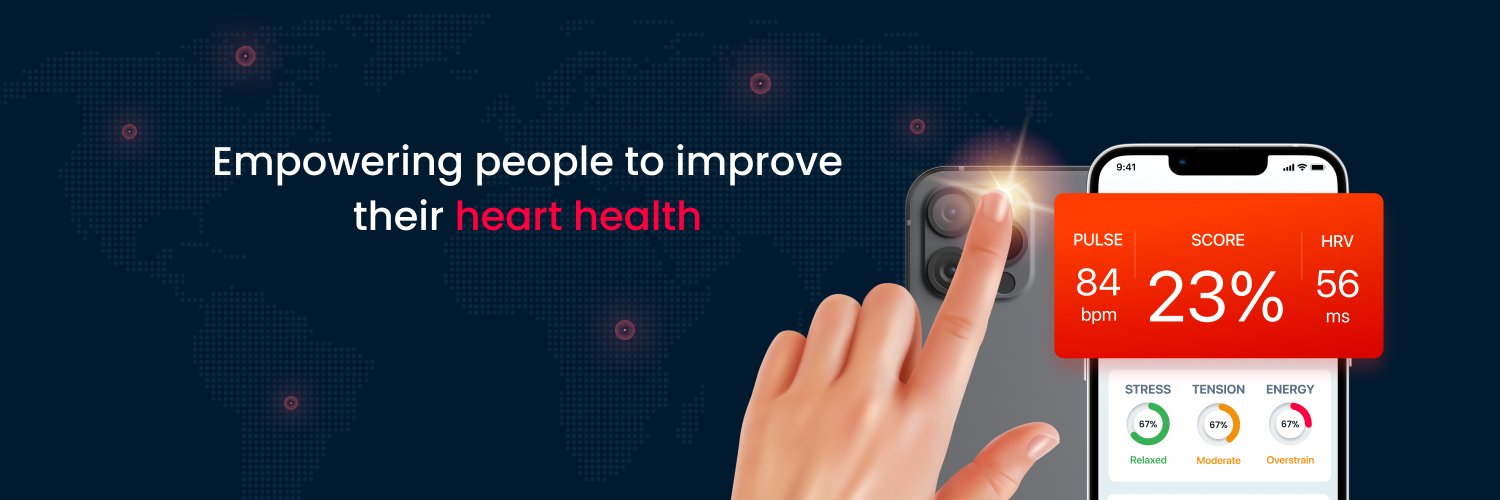
🙌#WhoWeAre: An international #IT company founded in 2020 in Boston, Massachusetts, with around 20 employees worldwide. We developed the Heartify #iOS app, the fastest-growing aluminum-based #heart#health product that lets you know about heart-related issues and conditions🫀
@DearS_o_n The difference between athletes and everyone else isn't talent - it's recovery discipline. Your HRV tells you exactly whether yesterday's training built you up or broke you down. Most people train hard and recover randomly. Athletes train hard and recover on purpose.
@AyusWellness Slow controlled breathing does something measurable - it amplifies respiratory sinus arrhythmia, which is one of the strongest drivers of HRV. 5-6 breaths per minute hits the resonance frequency for most people. You can track the shift in real-time.
@DearS_o_n Your body was sending warnings long before that hospital bill. HRV drops weeks before a stress-related health crisis. It's literally a leading indicator of breakdown. Most people check their portfolio daily but never check the one asset that makes everything else possible.
@CraigBrockie Heart palpitations is the tell. Magnesium is a cofactor for parasympathetic signaling - depleted Mg means tanked vagal tone and crushed HRV. Add glycinate and watch overnight RMSSD climb 15-20% in a week. Stress depletes the thing that handles stress.
@thegarybrecka The vagal stimulation from cold is the underrated part. Cold water on the face triggers the dive reflex - instant parasympathetic activation. You can see RMSSD spike within minutes. It's one of the fastest ways to shift your autonomic state without any supplement or device.
@Outdoctrination HRV data backs this up perfectly. Chronic cortisol flattens RMSSD - parasympathetic tone tanks. But the nuance most miss: a sharp morning cortisol spike is protective. It's the flat midday elevation that tracks with depression and crushed autonomic function.
@SamaHoole A 30% relative risk reduction sounds dramatic until you learn it's 3% to 2.1% absolute over 10 years. Meanwhile autonomic dysfunction - visible in HRV - predicts cardiac events independently of lipids and nobody screens for it.
@SahilBloom Early bright light anchors your cortisol awakening response - the morning spike that's supposed to happen. Get that timing right and your HRV recovers faster by evening. Most people's cortisol curve is flat because they skip this signal entirely.
@hubermanlab@RichieJDavidson This is exactly what shows up in HRV data. Experienced meditators don't have lower stress responses - they recover faster. The parasympathetic rebound after a stressor is measurably sharper. Your nervous system doesn't get calmer, it gets more resilient.
@ElieJarrougeMD The part nobody explains - chronic hyperinsulinemia keeps your sympathetic nervous system running hot 24/7. You can literally watch it in HRV data. RMSSD craters when metabolic health deteriorates. The heart knows before the lab work does.
@DrKristieLeong Anthocyanins don't just lower blood pressure - they boost endothelial nitric oxide, which directly affects vascular compliance. You can actually see the shift in HRV data within days of consistent intake. Criminally underrated compound.
A 48bpm resting heart rate doesn't mean high HRV. Resting HR reflects sympathovagal balance. RMSSD measures parasympathetic capacity. They are not the same variable - and every wearable company conflates them.
@thegarybrecka One nuance - RMSSD measures parasympathetic readiness, not resilience. Someone with high HRV can still have terrible VO2max. It's a readiness signal, not a fitness score. Two different systems that get conflated constantly.
@BrandonLuuMD The RMSSD dip from early illness looks identical to overtraining on wearables. The tell is the overnight pattern - training recovery rebounds by N3 sleep, but illness drops sustain across all stages because cytokines keep sympathetic tone elevated.
@DoctorTro The gap isn't avoiding CAC - it's that nobody monitors the autonomic stress response driving plaque progression in real time. RMSSD drops measurably during chronic stress. We debate whether to look at the damage while ignoring what's creating it.
RMSSD peaks during N3 sleep - deep sleep is when parasympathetic tone is highest, not REM. If your overnight HRV is consistently low, check your sleep stage distribution. Total sleep time is the wrong variable.
1-2 drinks suppresses vagal nuclei directly. RMSSD is down 20-30% by morning. Most wearables attribute the dip to training load. The mechanism is the ethanol, not the workout.
@thegarybrecka Missing piece on the breathwork: it needs to hit 0.1 Hz, about 10 sec per full breath. That frequency drives cardiovascular resonance. Faster or slower and you lose the vagal effect.
@bensmithlive 6 breaths/min works because it hits 0.1 Hz resonance, where baroreceptor feedback maximally amplifies vagal tone. The rate matters more than the inhale/exhale ratio. Most protocols get that backwards.
@foundmyfitness Recovery is where most people have no objective feedback loop. You can feel fine and still be autonomically suppressed. HRV after training is the fastest signal that your body actually recovered, not just that the soreness went away.