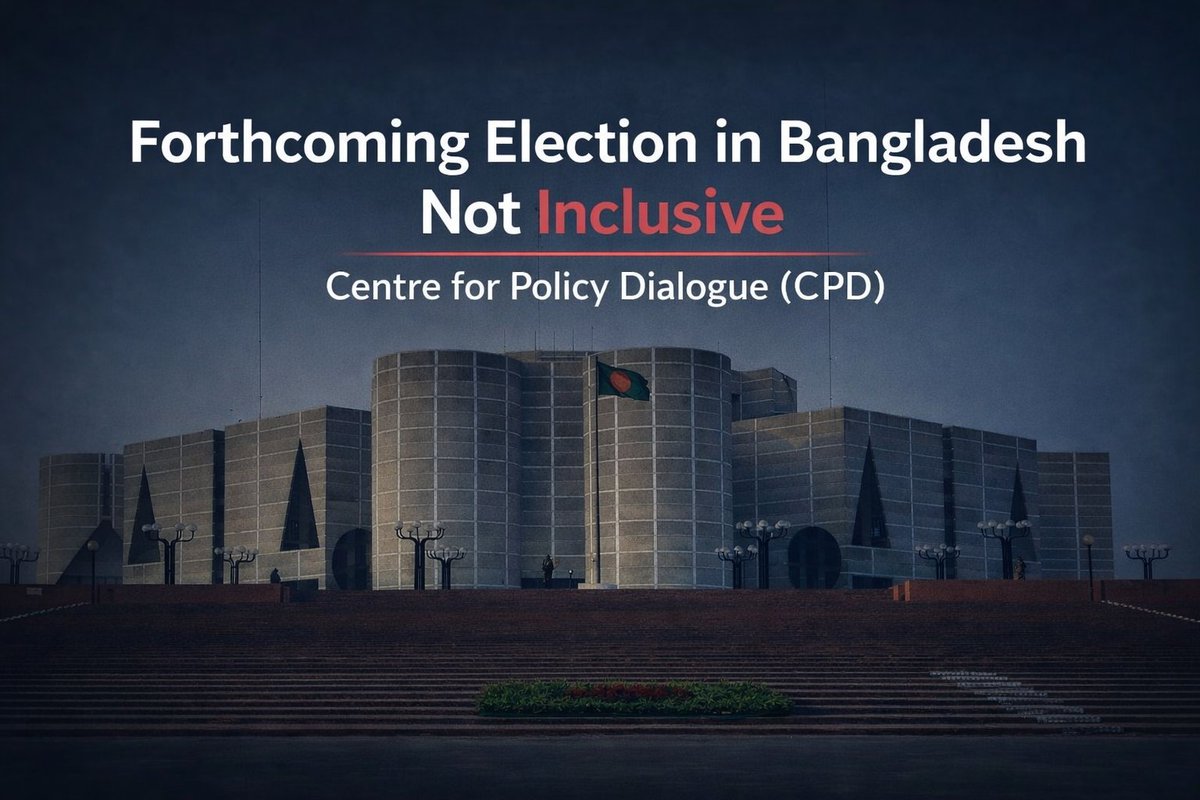
Disregarding the opinions and participation of a significant segment of the electorate risks undermining the credibility of the upcoming parliamentary election, according to the Center for Policy Dialogue (CPD).
One of Bangladesh’s leading policy think-tanks, the Center for Policy Dialogue (CPD) has expressed concern that the forthcoming parliamentary polls will not be inclusive.
Speaking on the issue, CPD Research Director Khandker Moazzem noted that all recent opinion surveys consistently indicate that the vote bank of the #AwamiLeague, currently barred from participating in the election by the #Yunus-led Interim Govt, would be decisive in determining the outcome of the Feb 2026 polls.
Moazzem argued that the exclusion of the Awami League effectively disenfranchises a substantial segment of the electorate. Voters aligned with the party will be unable to cast ballots in accordance with their political preferences, and any participation by them would fail to represent their genuine will.
In this context, CPD warned that disregarding the views and participation of such a large portion of voters would inevitably raise serious questions about the credibility, legitimacy, and representative nature of the election.
@bbcbangla report:
https://t.co/c9JW14Ry0s
....
#BangladeshCrisis #Democracy
Yet another senior #AwamiLeague leader dies in prison, underscoring the dangerous conditions facing #Bangladesh's political detainees under the Interim Govt led by Muhammad #Yunus.
Ramesh Chandra Sen, a veteran AL politician and former minister, died on Saturday while in #custody at Dinajpur District Jail. The 83 y/o politician reportedly fell ill early in the morning and was transferred to Dinajpur Medical College Hospital, where doctors pronounced him dead shortly after arrival.
Ramesh Chandra Sen’s death has intensified concerns about the treatment of detained politicians in Bangladesh under the current Interim Govt. He is the 40th AL-affiliated individual to die in jail custody since the Interim Govt assumed power.
Like many others, R C Sen was arrested immediately following the fall of the AL Govt in Aug 2024, in connection with a Jul–Aug 2024 violence case. Despite the absence of credible evidence linking him to the alleged crimes, and despite his advanced age and serious health conditions, he was repeatedly denied bail and remained incarcerated for nearly one and a half years.
The deaths of Awami League leaders and activists in custody share two disturbing common features: Allegations of abuse or torture while in custody and/or denial of timely and adequate medical care, particularly for detainees with pre-existing health conditions.
According to the #humanrights org. Ain o Salish Kendra (ASK), 112 people died in prisons across Bangladesh between Aug 2024 and Dec 2025. Of these, at least 40, that is 35.7% of the total decased, were individuals affiliated with the Awami League, a strikingly disproportionate figure by any standard.
Despite credible allegations of torture, denial of medical care, and the unusually high number of political detainees among prison deaths over the past 18 months, the Interim Govt has not initiated a single investigation or inquiry.
This is in direct violation of both Bangladeshi law and the country's int'l human rights obligations, which mandates impartial investigations into each and every custodial death.
The Interim Govt’s persistent inaction reflects a troubling pattern of indifference, and potentially tacit approval, toward the ill-treatment of political prisoners, so long as they are associated with the Awami League.
...
#BangladeshCrisis @OHCHRAsia@amnestysasia@ESandersFCDO@StateDRL@PearsonElaine@hrw@volker_turk@UNHumanRights@omctorg@fidh_en@IBAHRI@HRF@EURightsAgency@IHRF_English@BonaveroIHR@justiceinfonet@Ginitastar
Yet another disturbing instance of state-sanctioned inhumanity toward political prisoners: AL activist Milon Miah denied parole to attend the funeral and burial of his deceased father.
This incident follows closely on the heels of widespread public outrage over the case of Jewel Hasan Saddam, a former Chhatra League leader from #Bagerhat, who was denied bail to attend the funeral and burial of his wife and infant son.
That tragedy sparked an unprecedented outpouring of grief and solidarity across social media. In response to the backlash, the Interim Govt, along with district jail and admin officials, rushed to issue statements attempting to justify the denial on “technical grounds.”
The latest case makes it painfully clear that the earlier incident was not an error, oversight, or anomaly. Instead, it reflects a deliberate and systematic policy: the denial of even the most basic humanitarian considerations to political prisoners, including the right to bid farewell to deceased loved ones.
Milon Miah, an #AwamiLeague activist from #Kishoreganj, was arrested in Dec 2024 in connection with a July–Aug 2024 violence case. Like thousands of others swept up in hundreds of similar cases, he was repeatedly denial of bail.
Once he did manage to get bail, he was “shown arrested” in another case, effectively nullifying judicial relief and enabling indefinite detention.
This practice of "shown arrested" in other cases when bail is granted has become one of the principal tools through which the current administration continues to incarcerate political opponents without resolution.
Milon had been trying to see his father on his deathbed, who then succumbed to cancer after months of illness. Despite application by Milon’s family to the District Magistrate, the authorities refused to grant him parole, that is, a temporary, supervised release under police guard to attend the burial and funeral of a loved one.
News:
https://t.co/VEe98Uiixu
This denial was not a matter of public safety or legal impossibility; parole exists precisely to accommodate such exceptional and deeply human circumstances.
A state that refuses compassion even in moments of death does more than punish individuals, it degrades its own moral authority. Denying political prisoners the chance to mourn, to perform last rites, or to say goodbye is not justice. It is cruelty, normalized through bureaucracy and justified through silence.
For shame Nobel Peace Laureate Muhammad #Yunus.
....
#BangladeshCrisis #HumanRights @amnestysasia@ESandersFCDO@StateDRL@hrw@volker_turk@Ginitastar@UNHumanRights@omctorg@OHCHRAsia@HRF
Are #Elections Without the #AwamiLeague “Fair” and “Legitimate”? A response to David Bergman.
In his recent article for the @dailystarnews, journalist @TheDavidBergman addresses a crucial question facing #Bangladesh today: whether a national election conducted without the participation of the Awami League (AL) can be considered “fair” and “legitimate.”
Bergman’s central argument is that the alleged involvement of AL activists and leaders in the July–August 2024 violence justifies the party’s exclusion from the electoral process, at least temporarily. To support this position, he employs a thought experiment, substituting the AL and Bangladesh with the #LabourParty and the U.K. His conclusion is that, were similar allegations made against Labour, it too would have been excluded from elections in the UK.
This analogy, and the justification built upon it, is deeply problematic for several reasons.
1. The Absence of Judicial Determination
The AL, as a political party, has not been convicted of any crime by a court of law. Its exclusion from the electoral process was not the result of a transparent, independent judicial proceeding, but rather an executive decision taken by the Interim Govt. The ban was enacted through amendments to the Anti-Terrorism Act, whose legality, intent, and procedural integrity have themselves been widely questioned.
In democratic systems governed by the rule of law, the disqualification of a major political party requires an exceptionally high legal threshold. That threshold has not been met in this case.
2. The Political Context of the Ban
The ban followed protests mobilised by political forces closely aligned with the Interim Govt, particularly #JamaatEIslami, the #NCP, and other #Islamist groups. Notably, these same groups are now constituents of the Jamaat-led 11-party alliance preparing to contest the upcoming election.
This raises a serious concern that the exclusion of the AL is less about accountability and more about political engineering: the removal of the principal ideological and electoral rival of this alliance.
3. Collective Punishment and Individual Culpability
Holding an entire political party responsible for the alleged crimes of some of its members amounts to collective punishment. Under int’l law, criminal responsibility is individual, not collective. If specific AL leaders or activists are accused of serious crimes, they should be investigated and prosecuted individually through due process. Disqualifying millions of voters by banning the party they support, without individualized findings of guilt, undermines both justice and democratic representation.
4. False Equivalence with the U.K.
The comparison between Bangladesh and the UK is a textbook case of false equivalence. The two countries differ profoundly in their historical trajectories, institutional resilience, and political cultures. The UK does not carry the legacy of multiple military coups, the assassination of two former presidents (including its founding leader), or a violent struggle for independence marked by a #genocide in which one of today’s major political actors was complicit. Nor has the UK experienced state-sponsored grenade attacks aimed at eliminating an entire party’s leadership or the systematic targeting of religious #minorities based on voting patterns.
5. Legitimacy is More Than Procedure
Electoral legitimacy is not derived solely from the mechanical act of voting. It rests on meaningful political competition, inclusive participation, and the ability of voters to choose freely among all major political alternatives. Even if an election is conducted peacefully and efficiently, the absence of a principal political force raises unavoidable questions about representativeness and consent.
If Bangladesh is to move toward a stable and democratic future, it must do so through due process, political pluralism, and respect for the electorate, not through the elimination of inconvenient opponents.
…
Why the Int’l Community Should Be Alarmed at the Rise of #JamaatEIslami in #Bangladesh.
A recent @washingtonpost article sparked controversy after a U.S. diplomat based in #Dhaka, speaking off the record to reporters, outlined why #Washington is not particularly concerned about the resurgence of Jamaat in Bangladesh. According to the diplomat, economic leverage would act as a restraining force, preventing Jamaat from pursuing #extremist policies.
At best, this assessment is naive. At worst, it reflects a deeply flawed understanding of Jamaat; an understanding shaped by years of persistent lobbying and strategic rebranding by the #Islamist party. It underestimates both the ideological rigidity of Jamaat and the limits of economic deterrence against religiously motivated political movements.
The history of Jamaat is not ambiguous. Its leaders and members were deeply complicit in the 1971 #genocide carried out by the #Pakistani Army. Equally well known is Jamaat’s legacy of extremist campus politics through its student wing, #Shibir.
Yet many Western diplomats now appear reassured by the party’s public statements since Aug 2024, which carefully project a more “moderate” image.
Taking Jamaat at its word, however, is risky. Here’s why:
1. Public moderation has not translated into ideological change.
Despite repeated pledges of moderation, Jamaat’s grassroots rhetoric and behavior tell a very different story. Its support base remains overwhelmingly composed of ultra-religious conservatives who seek the imposition of strict Islamic norms on society.
2. Minority rights remain fundamentally threatened.
Jamaat’s stance toward vulnerable religious minorities offers a critical test of whether the party has truly changed. In November 2025, the party confirmed that, if elected, it would declare #Ahmadiyyas non-Muslim in Bangladesh; an act that would institutionalize discrimination and place an already vulnerable community at heightened risk.
3. Women’s rights and safety would face serious regression.
The party’s vision for women’s role in society has been laid bare by its own announcements. Jamaat has proposed reducing women’s working hours from eight to five hours if elected, reinforcing traditional gender roles rather than equality. More tellingly, not a single female candidate was endorsed among its 224 candidates, an unmistakable signal of how women are viewed within the party’s political structure.
Jamaat activists reportedly refused to campaign for a female candidate of their ally #NCP because she was deemed “insufficiently covered” in her posters. Concerns about women’s safety in public spaces are equally justified. Jamaat supporters secured the release a misogynist assailant who attacked a female student due to the victim “not being dressed modestly.”
Online harassment of women by Jamaat supporters has become a defining feature of contemporary Bangladeshi political discourse.
4. Cultural heritage and historical memory are at risk.
Over the past year and a half, Jamaat and its allies like NCP have attacked hundreds of historic and cultural landmarks. Sites associated with the 1971 Liberation War have been singled out with particular hostility, reflecting the party’s longstanding discomfort with Bangladesh’s secular nationalist foundations.
It must also be emphasized that Jamaat’s resurgence is not organic, nor is it the outcome of a genuinely competitive democratic process. Instead, it has unfolded within a highly exclusionary political environment, one in which Jamaat’s principal ideological rival, the #AwamiLeague has been systematically neutralized.
For the int’l community, the question is not whether Jamaat has learned to speak the language of moderation, but whether it has abandoned the ideology that has defined it for decades. The evidence suggests it has not.
Ignoring that reality may prove far more costly than diplomats currently assume.
….
#BangladeshCrisis @Chellaney@CJBdingo25@paulocasaca1
What’s becoming clear now is that the so-called “opportunistic transition” in Bangladesh was never about democracy restoring itself - it was about rebalancing beneficiaries.
The initial removal of Hasina served multiple actors at once: the BNP, Jamaat, and external sponsors all gained from the erasure of the Awami League. But once AL was eliminated, the internal hierarchy of favor revealed itself - and Islamists moved from partners to preferred.
That shift is now becoming a problem for BNP itself. A force useful for destabilization is rarely allowed to become dominant - unless it is more pliable, more ideologically disposable, and more dependent on permanent exception.
It is no coincidence that the viralization of the leaked clip came from within the BNP ecosystem, nor is it accidental that ex-diplomats now rush to normalize what was said as “how diplomacy works.” Both positions are opportunistic, not oppositional.
One side weaponizes the leak to settle intra-opposition scores; the other defends the system that made such conversations possible in the first place. Different tactics, same architecture.
Regime change does not require ideological coherence - only temporary alignment. Once power is redistributed, yesterday’s beneficiaries begin fighting over scraps, while the public remains excluded from authorship but trapped in consequence.
This is not an accident. This is the design.
@JonFDanilowicz@ZulkarnainSaer@naomi2009@joybd1971@Tkbaul@rayhanrashid@sumon_tarek@Tomalika2016@Redowanshakil@aerojihan@BabarHoneyX@GaziSangita
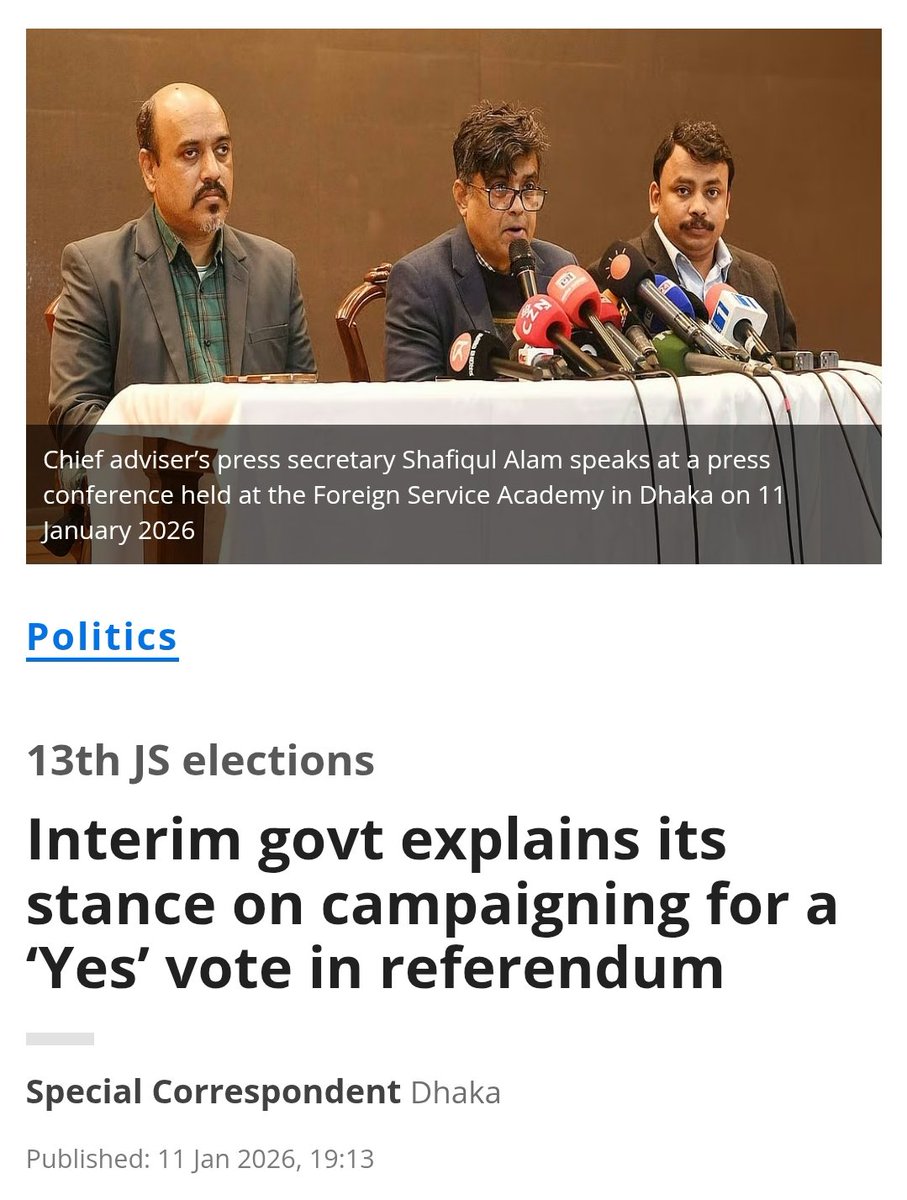
When an unelected interim government campaigns for a YES vote, using public funds, state platforms, and promotional media, neutrality is no longer eroded; it is abandoned. This stops being a referendum and starts becoming state-manufactured consent.
As reported by @bdnews24com, @ProthomAlo, and others, the Interim Government has publicly defended its decision to promote a YES vote on the July Charter, releasing government-produced clips, “educational” videos, and campaign-style materials funded by the public exchequer. This is not neutral voter information, it is outcome advocacy by the authority administering the vote.
In any democratic standard, a referendum requires the state to enable choice, not steer it. When the same executive that controls administration, messaging, and resources openly endorses one outcome, the playing field collapses. YES becomes the sanctioned position; dissent is quietly stigmatized.
This has consequences beyond the referendum itself. An interim government that normalizes using state machinery to shape public consent today signals how it may behave during the general elections meant to follow.
Unelected custodians derive legitimacy only from restraint. Once that restraint is gone, so is trust.
This is not popular will.
This is not democratic persuasion.
This is a managed plebiscite.
@TI_Global@CIVICUSalliance@UNHumanRights@EU_Commission@ICNLaw
#Bangladesh #RuleOfLaw #DemocraticBacksliding #Referendum #Elections
#Bangladesh in 2025 was an exceptionally dangerous year for #journalists, underscoring a rapidly deteriorating environment for press freedom under the #Yunus-led Interim Govt.
According to the 2025 Human Rights Report by Ain O Salish Kendra (AsK), at least 381 incidents of harassment and/or persecution of journalists and #media workers were documented between January and December 2025. These figures speak volumes about the systematic pressure faced by the media and the shrinking space for independent journalism in the country.
Among these, 23 cases involved torture, harassment, or direct threats by law enforcement agencies, highlighting the role of state actors in undermining press freedom. At least 20 journalists received explicit death threats, while 123 journalists are currently facing criminal cases filed in apparent retaliation for their reporting.
Physical violence against journalists remained widespread: at least 118 media workers were assaulted or physically attacked while carrying out their professional duties.
Report: https://t.co/n8XtO3Zxrn
The use of anti-terrorism laws to arrest and detain journalists emerged as a disturbing new “feature” of media repression in 2025. Prominent among these cases were the arrests of journalists Monjurul Alam Panna and Anis Alamgir, the latter of whom remains behind bars, raising serious concerns about arbitrary detention and abuse of counterterrorism legislation to silence critical voices.
Another alarming development was the targeted attack on media institutions themselves. The offices of leading national dailies @ProthomAlo and @dailystarnews were vandalised, looted, and set on fire by politically empowered mobs.
Beyond the physical destruction, these mobs sought to dictate editorial decisions, effectively attempting to control how stories and political developments were reported.
Pressure on broadcast media intensified as well.
Following threats by a group calling itself the “July Revolutionary Alliance” to besiege the offices of three television stations, at least three broadcast journalists lost their jobs, simply for asking difficult and legitimate questions to Cultural Affairs Adviser Mostofa Sarwar Farooki.
These incidents reflect a climate where intimidation and mob pressure increasingly dictate journalistic boundaries.
The patterns observed in 2025 cannot be viewed in isolation. They build upon a wave of high-profile targeting of journalists that began immediately after the fall of the previous govt. Journalists detained in the latter half of 2024 in connection with questionable Jul–Aug 2024 violence cases, including Farzana Rupa, Shakil Ahmed, Mozammel Babu, and Shyamal Dutta, remained incarcerated throughout 2025.
In addition, hundreds of journalists continue to be implicated in what rights groups describe as false or politically motivated cases, severely impacting their freedom, livelihoods, and ability to work.
Taken together, these developments reveal a deepening crisis for press freedom in Bangladesh. The continued harassment, criminalisation, and intimidation of journalists in 2025 point to an environment where independent reporting is increasingly treated as a threat rather than a democratic necessity.
….
#BangladeshCrisis #PressFreedom #MediaFreedom @pressfreedom@CPJAsia@RSF_inter@MediaFreedomC@Irenekhan@volker_turk@UNHumanRights@ifjasiapacific@StateDRL@ESandersFCDO@hrw@amnestysasia@HRF@IBAHRI@EURightsAgency@UN_Spokesperson
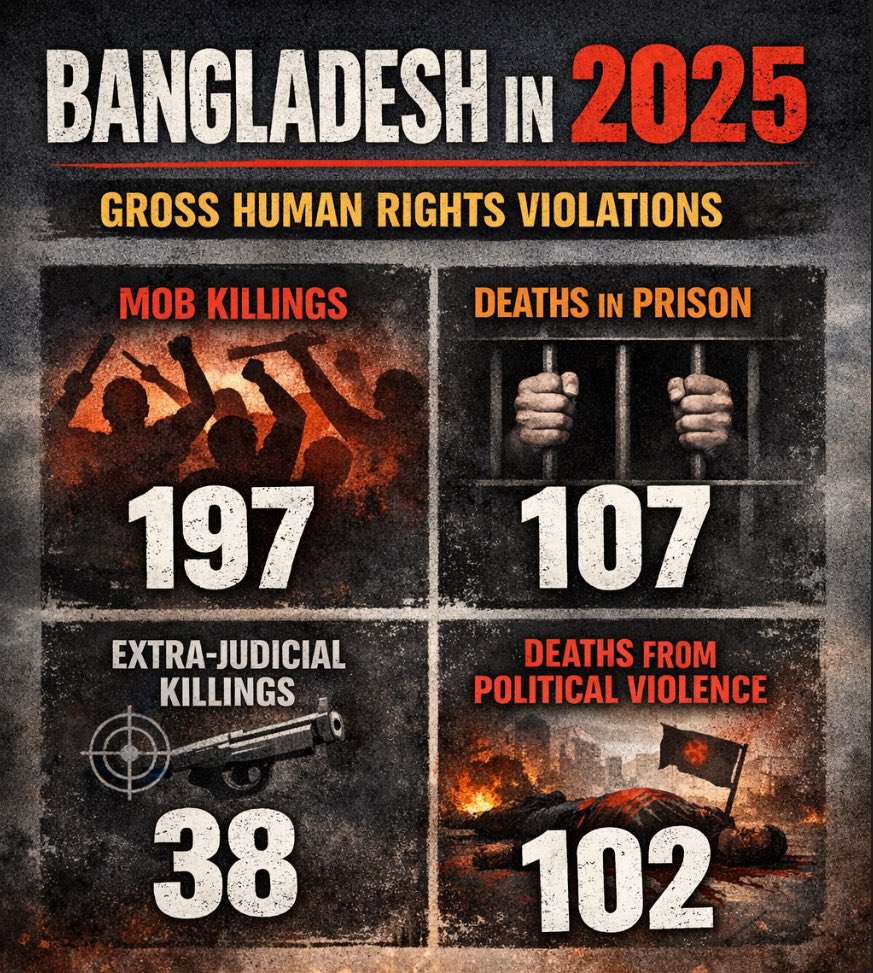
2025 marked an alarming deterioration of the human rights situation in #Bangladesh, with a sharp rise in deaths resulting from mob violence, political clashes, custodial abuse, negligence, and extra-judicial killings.
According to the 2025 Human Rights Report by Ain O Salish Kendra (AsK), deaths by mob beatings rose dramatically to 197 in 2025, representing an almost 54% increase from the 128 recorded deaths in 2024. Notably, the majority of the mob killings of 2024 occurred after August, highlighting a pattern of lawlessness and vigilantism since the #Yunus-led Interim Govt took over.
Deaths in prison also surged at an alarming rate. Between January and December 2025, 107 prisoners died in custody, marking an almost 65% year-on-year increase from the 65 custodial deaths reported in 2024.
What makes these deaths particularly disturbing is the high number of political detainees among the victims. At least 24 leaders and activists of the #AwamiLeague died in prison during 2025. Families of the deceased have alleged torture in custody, deliberate denial of medical treatment, and gross negligence by prison authorities, raising serious concerns about systemic abuse and impunity within custodial institutions.
Extra-judicial killings continued unabated throughout the year, often under the guise of so-called “crossfires”. AsK recorded at least 38 such killings in 2025. Of these, 26 victims died as a result of torture during alleged shootouts or while in the custody of joint security forces, while 12 others were killed while under the direct custody of law enforcement agencies at various police stations. These incidents underscore the persistent use of lethal force by security and law enforcement personnel outside the bounds of due process.
Political violence remained widespread and deadly. In at least 401 reported incidents of such violence in 2025, 102 people were killed and more than 4,000 injured. The majority of these incidents stemmed from intra-party conflicts within the #BNP, while others involved violent clashes between BNP and other political groups, including the #JamaatEIslami.
Taken together, these figures point to a deepening human rights crisis in Bangladesh, characterised by erosion of the rule of law and growing impunity for violence. The data from 2025 reflects not isolated incidents, but systemic failures that demand urgent accountability, independent investigations, and meaningful reforms to protect people’s lives and rights.
Report: https://t.co/n8XtO3Zxrn
….
#BangladeshCrisis #BDin2025 @amnestysasia@StateDRL@ESandersFCDO@PearsonElaine@meeganguly@HRF@hrw@IBAHRI@EURightsAgency@BonaveroIHR@paulocasaca1
In 2025, #Bangladesh witnessed a series of assaults on its cultural scene that went beyond disagreements or protests. The rage was raw and physical, and often justified in the language of morality rather than law. Baul singers bore the brunt of "hurting religious sentiment."
Music concerts were called off for mob vandalism, including on the occasion of the Pahela Baishakh. Long-standing cultural institutions, such as Chhayanaut and Bangladesh Udichi Shilpigosthi, saw their archives and instruments reduced to ashes during moments of political volatility.
This did not happen all at once. It did not happen everywhere. But over the course of the year, a pattern has emerged that is difficult to ignore.
These incidents were not isolated, nor were they entirely spontaneous. They followed a pattern and resulted from a mindset that considers cultural expression as something negative, to be policed, corrected, or completely suppressed, rather than tolerated or even debated.
The perpetrators, in many cases, were not formal political actors. They were loosely organised vigilante groups or mobs mobilised through local networks. Their strength did not lie in structure or legitimacy, but in a sense of vindication, moral superiority, and confidence that these attacks would carry few consequences and that if any administrative action were taken at all, it would be, at best, sluggish.
What makes 2025 distinct is not merely the number of such incidents, but their nature. Earlier years also witnessed threats, intimidation, and sporadic disruption. This is not new in Bangladesh. However, what makes the difference in 2025 is the moral high ground on which such attacks were carried out. Cultural institutions were not just pressured; they were burned. Music was not merely criticised; it was forcibly stopped. Folk traditions were not debated; they were silenced.
Baul singers, for instance, represent one of Bangladesh's most syncretic traditions—rooted in music, spirituality, dissent, and a refusal to be easily categorised. Similarly, public concerts, student-organised programmes, and secular cultural festivals represent spaces where plurality and collective presence intersect. Attacks on these traditions are not isolated incidents. They are symbols of a society that is increasingly becoming intolerant of diversity and acceptance.
Cultural institutions carry symbolic weight. When archives burn, and instruments are vandalised, the damage is not limited to structures and objects. These are attacks on collective memory, continuity of national heritage and the idea of culture—something inherited and carried forward through generations, rather than dictated through force.
The role of the state in this context cannot be ignored. In several instances, cultural events were delayed, restricted, or cancelled due to "security concerns." Permissions were withheld. Conditions were imposed. Law enforcement arrived too late or—in some cases—stood by as mobs unleashed mayhem. While often justified as caution, this pattern had a concerning effect: it shifted risk away from perpetrators, while putting the onus on artists and organisers.
This institutional failure was not limited to public events. In November, the Ministry of Primary and Mass Education revoked the posts for music and physical education teachers across the country's primary schools—positions that had only recently been created. While framed as a technical correction, the message it sent was clear: the administration has succumbed to pressures from religious groups.
Read more: https://t.co/8lxZ4zCSul
#BangladeshCrisis #CultureUnderAttack #Bangladeshin2025
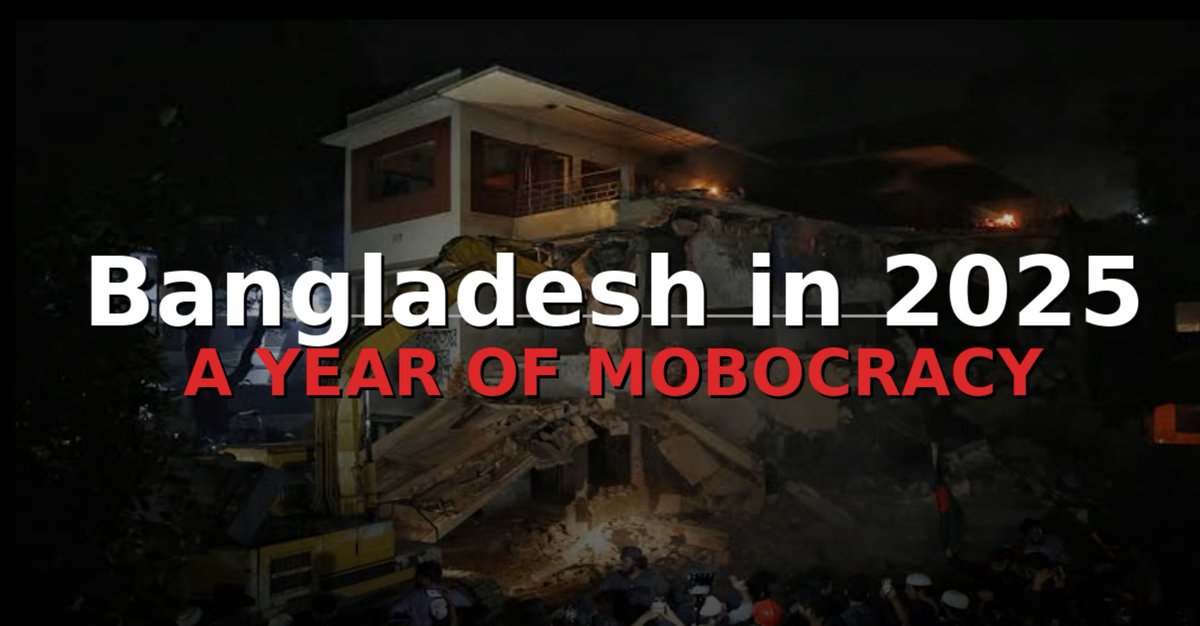
With a seven-fold increase in deaths caused by #mob violence, 2025 will be remembered as the year #Bangladesh descended into #mobocracy.
Between Jan 1 and Dec 25, 2025, at least 196 people were killed in incidents of mob violence across Bangladesh, according to data compiled by Ain O Salish Kendra (AsK) and reported by Daily Kaler Kontho.
This marks a dramatic escalation, nearly seven times higher than the number of deaths recorded in similar incidents five years earlier.
The victims came from across society. They included political activists and leaders, individuals accused (often without evidence) of criminal acts, religious minorities, and people alleged to have “hurt religious sentiments.” In many cases, accusations circulated rapidly through rumors or social media, triggering instant collective violence with no attempt at verification or legal recourse.
Criminologists and human rights observers point to several interlinked factors behind this alarming surge. Chief among them are: inaction or delayed responses by law enforcement agencies, political patronisation and protection of the perpetrators, a general breakdown of law and order, and a deep erosion of public trust in the justice system.
Together, these conditions created an environment where mobs felt empowered to act as judge, jury, and executioner, often in broad daylight and without fear of consequences.
Mob violence was not limited to attacks on individuals. Political and religious establishments were repeatedly targeted. The Bangabandhu Memorial Museum was attacked twice, underscoring the symbolic nature of the violence. Sufi shrines across the country also came under sustained assault by Islamist mobs operating under the banner of “Touhidi Janata”.
It was only after Dec 2025, when the offices of two of the country’s most prominent newspapers, @ProthomAlo and the @dailystarnews, were vandalised and set on fire, that the #Yunus-led Interim Govt appeared to take more serious action. Even then, troubling questions remained unanswered: How were mobs able to loot, burn, and destroy property for hours without intervention? Where were the security forces, and why did response mechanisms fail so completely?
Equally conspicuous was the selective nature of state response throughout the year. When victims of mob violence were perceived to be linked to the #AwamiLeague, the govt’s silence and in cases apparent tolerance, was particularly stark. In multiple waves across 2025, homes and properties belonging to AL leaders, activists, and supporters were attacked, often systematically. Legal repercussions for perpetrators were rare to nonexistent, reinforcing the perception that violence against certain groups had become politically permissible.
By the end of the year, the message was unmistakable: mob power had replaced rule of law. The normalization of collective violence, selective enforcement, and political shielding of attackers has left Bangladesh facing a profound crisis of governance; one that threatens not only public safety, but the very foundations of justice, pluralism, and democratic accountability.
….
#BangladeshCrisis #Mobocracy
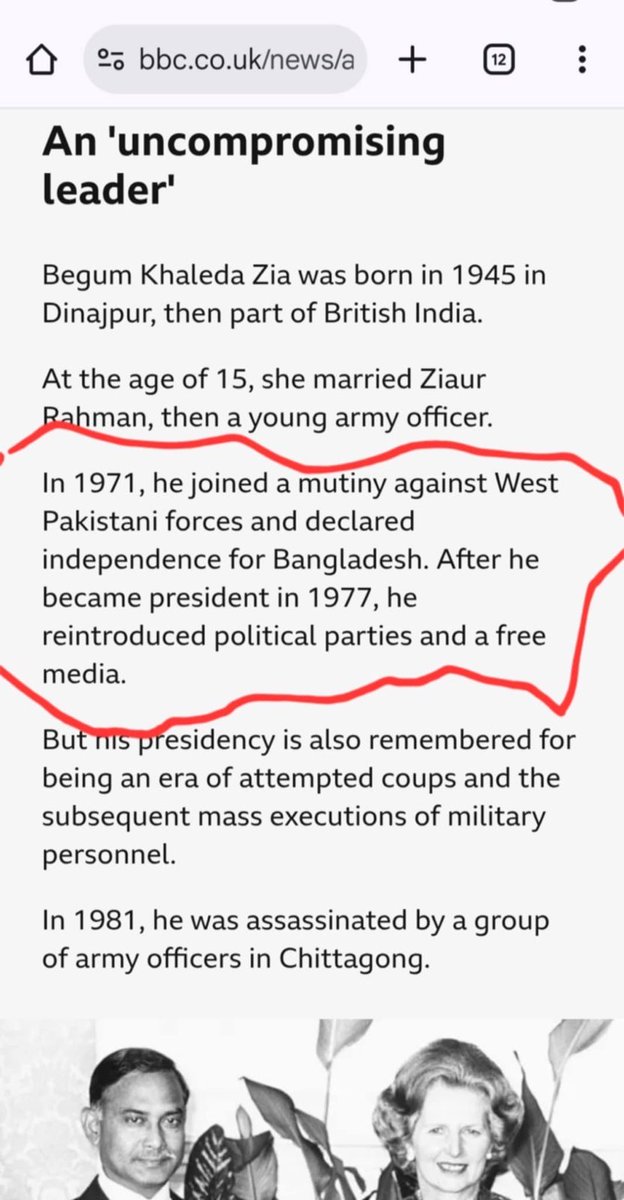
@BBCWorld@qadirkallol How dare you mention the independence of Bangladesh as "mutiny" and Zia as a person who declared independence in this report? https://t.co/SIPFNoKIsy
🧵 When an unelected Chief Adviser campaigns for a YES vote, and a “neutral” watchdog like @TIBangladesh urges the same outcome, neutrality collapses. This isn’t popular will - it’s elite-driven manufacturing of consent. #Bangladesh#JulyCharter#Democracy