@realDonaldTrump The sun will not overstep his measures. If he does, the Erinyes (the Furies), the helpers of Dikē (Justice), will find him out.
Heraclitus, fragment B94
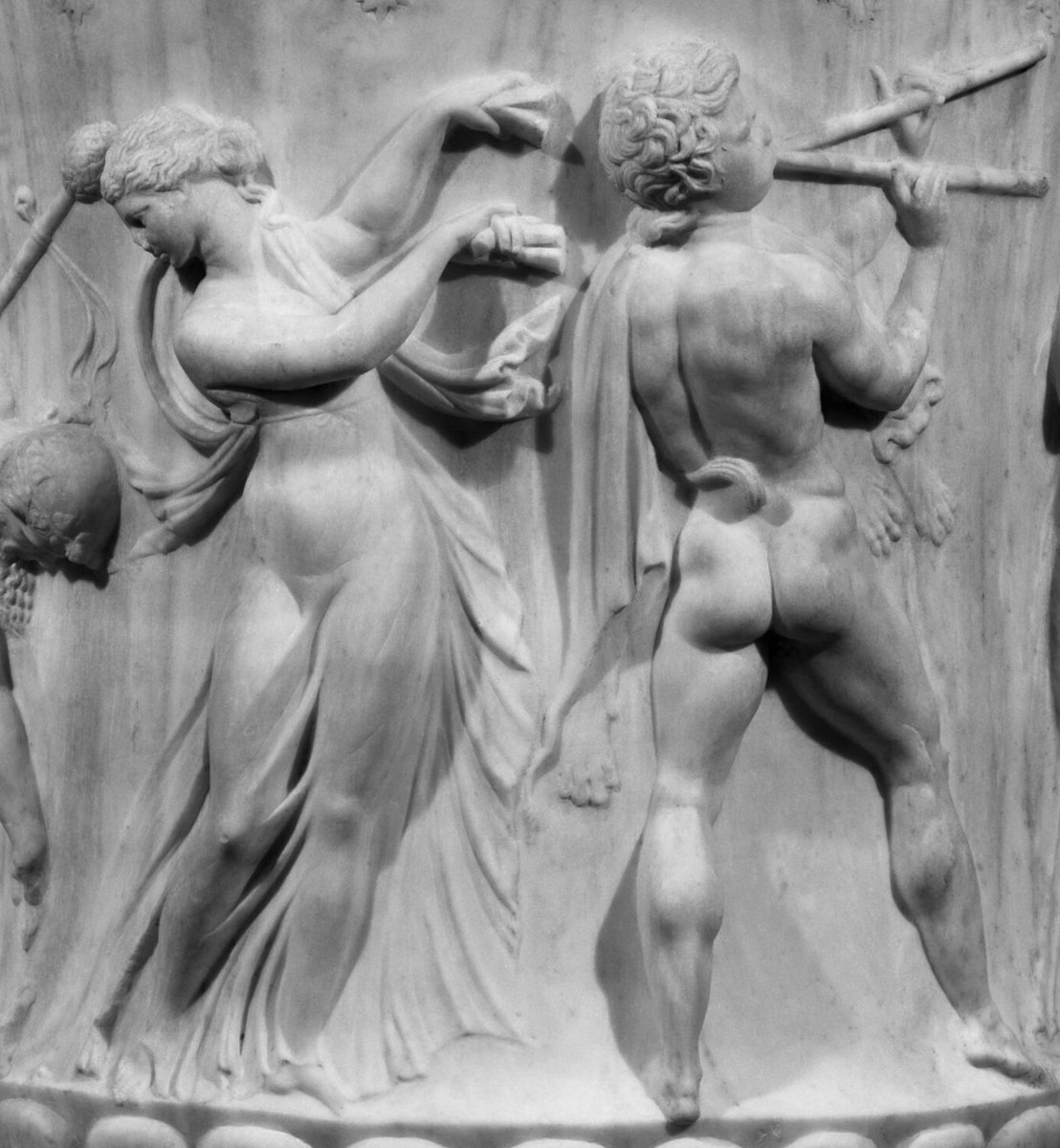
An ancient aulos player for comparison - detail of a satyr (?) playing the aulos with a maenad dancing from the Borghese Vase, Louvre, around 30-40 BCE. Discovered in Rome 1566 in the ancient Gardens of Sallust (the marble vase is almost 2m high)
@Fair_and_Biased Dolma is Turkish, from dolmak, "to fill." In northern Greece they're often γιαπράκια (giaprákia), from yaprak, "leaf." The wrapped-leaf idea is older still: ancient Greeks baked θρ��ον (thríon), a filling wrapped in fig leaves, a dish Aristophanes mentions.
@Athanasius_45 This is Kyria Doxa 2, preserved by Diogenes Laertius (10.139). Lucretius puts it into Latin verse: nil igitur mors est ad nos (De rerum natura 3.830). It even reached Roman tombstones as NF F NS NC: non fui, fui, non sum, non curo, "I was not, I was, I am not, I do not care."
@realpeteyb123 Lamb at the holiday table is about as Greek as it gets. One favorite is κλέφτικο, kléftiko, "the klepht's dish": as the story goes, the klephts of the Ottoman-era mountains slow-cooked lamb sealed in a pit so no smoke would give away their hideout. Καλή όρεξη.
A word every Greek family teaches first: Ευχαριστώ (efcharistó), "thank you."
It is εὖ, "well," + χάρις (cháris): grace, favor, the gratitude that answers a gift. The same root gives the Χάριτες, the Graces, whom Hesiod makes daughters of Zeus and Eurynome (Theogony 907–911).
Happy Thanksgiving. What word of thanks did your family use?
The Three Graces, Roman, 2nd c. CE, Musée du Louvre, Ma 287. Photo: Marie-Lan Nguyen, public domain.
@Athanasius_45 Wilamowitz was right that Plotinus stands at the summit. For Plotinus, henosis, union with the One, is the goal, reached by the soul's own ascent (Ennead VI.9). Theurgy, the ritual work of the later Platonists, is Iamblichus's means, not Plotinus's. They are not the same thing.
@EPButler Plotinus says the soul is not in the body as in a place; the body is in the soul (Ennead IV.3.20–22). The 'parts' are the soul's own powers. In the Timaeus the immortal seat is the head, the spirited the chest, the appetitive the belly (69c–73a).
@SacredWestOG We owe ourselves, our Nous something more. Intuition, virtues, Arete, Henosis. We rise with the help of the Gods. Rituals and offerings remind us what the Gods stand for and how to honor them, and emulate them.
Seeking advance readers.
STILL THE SUN RISES: The Return of the Greek Gods comes out December 15. How the classical world was destroyed, why the West kept the Greeks' works but not their gods, and how to live the path today.
Classicists, philosophers and practitioners: reply or DM for a free advance copy. An honest review at launch is all I ask.