GhostCompact for free inference, and this to leak reasoning traces! All this for $6,600 total bounty ☠️
But hey, at least we helped a $1.25T company secure its models — and its gross margins. You're welcome! 😭 We love your models <3
❄️ CASCADE 2027 winter deadline: November 10!
Working on embedded security, PQC implementations, side-channel/fault attacks, or security for AI? Submit your work!
Looking forward to exciting papers and seeing you in Heilbronn! 🚀
https://t.co/YWp5MGBF0b
There's a survey by Neale Pickett from January of tools to convert git repos to static HTML: https://t.co/7iiTRmAYhr I'm intrigued by the gitpages approach of showing the current files (rendering md etc.) while requiring cloning to see the history; is that too minimal?
It is a weird weird year to be a formal methods expert.
Some unorganized thoughts on the new @AnthropicAI and @theoremlabs post on formal verification (https://t.co/YoymKXYFJa):
- This is very cool.
- The main innovation is verifying a later stage of the program. Normally provers take the source code, LLM it into a theorem language, and then prove that, which means you have to make assumptions about source semantics and compilation properties. It's very easy to make a mistake in translating and prove the wrong thing!
What they instead do is compile the code into assembly, and then (if I understand this correctly), compile that assembly into a theorem language (which they call LPS). So as long as the compiler is faithful you can skip the whole divergence problem.
- I'm glad they clarify that you still have to trust the translation process, the "hardware, OS, OCaml" compiler, the LPS model, and also assume that the program is single threaded with fixed memory. The single biggest source of errors in formally verified code is when the proof assumes something that isn't true in practice. It's really, really important to state your assumptions!
- I'm not clear why they need to compile the fuzzer into the theorem. Is it to act as a description of valid inputs and workload? Maybe to embed assertions in as theorems?
- Holy crap, 180 million lines of Rocq. Is that more Rocq than exists in the world already? I notice they say a 600,000 line proof corresponds to roughly 20k CPU instructions. That would be like, 1-2k lines of source code at most? Really goes to show how inefficient this approach is and how it only works because you can throw LLMs at the problem.
- This, probably deliberately, doesn't address the single biggest gap in AI-based verification: AIs cannot come up with good properties. Doesn't matter if you're doing unit testing, property testing, formal verification. I always assumed this was a "frontier labs haven't trained for it yet" thing, but if Anthropic hasn't talked about that here, maybe they've tried and haven't been successful yet. That's interesting to me.
Instead, they take a known universal property (this code doesn't crash or get flagged by UBsan) and prove that instead. Still very useful, but makes it harder to generalize to proving arbitrary things about arbitrary programs.
- Anybody reading the official post should also read their expert review appendix (https://t.co/qQU0E0nJwW). It points out some interesting things, like the fact that most of the code the LLM wrote wasn't used in the proof (over one billion lines of Rocq), that they had to prove the equivalence between fuzzed and unfuzzed programs, and (this is most interesting), some experiments find that the LLM-method of proofwriting may not scale to more complex things.
- Also read the description of LPS (https://t.co/hRTCL05X0H) to understand the limitations of the assembly -> Rocq compilation. In particular, it does not handle concurrency at all (which is one of the main use cases for formal methods!) or OS signals. Also it can't prove things about program arguments with slash characters, meaning they can prove stuff about `rm foo` but not `rm foo/bar`.
- The official skill (https://t.co/weDOdmJUfO) doesn't tell us much about the nature of FM and AI. Probably too much for me to hope of any skill.
- Some of the article's specific caveats and throat clearings make me think someone at Anthropic reads my stuff ( ͡° ͜ʖ ͡°)
How often do ArXiv papers contain errors in the main theorems they claim to prove? Using GPT-6.1 Sol to identify such mistakes, it finds:
- 6% of papers before 08/2026 contain main theorems that are false.
- Only 1.5% contain similar mistakes in the last two months.
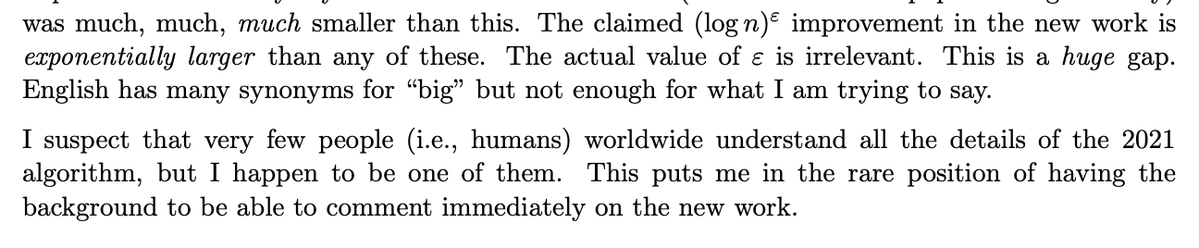
I looked forward to this cleanup! Nikloai Chukhin (https://t.co/zYQ8ZIAUc4) significantly cleans and extends the OpenAI 2^(ω(sqrt(n))) lower bound for depth-3 circuits:
The (4n-1)-bit function sum_ij a_{i+j}x_iy_j mod 2 needs depth-d circuits of size 2^(Ω~(n log n)^{1/(d-1)}).
I'm very happy to announce that our new paper "Reverse-Bleichenbacher:
Bleichenbacher Attacks are Practical Again" is now on ePrint and has been accepted at NDSS 2027! 🎉
https://t.co/4JXmHOdAjs
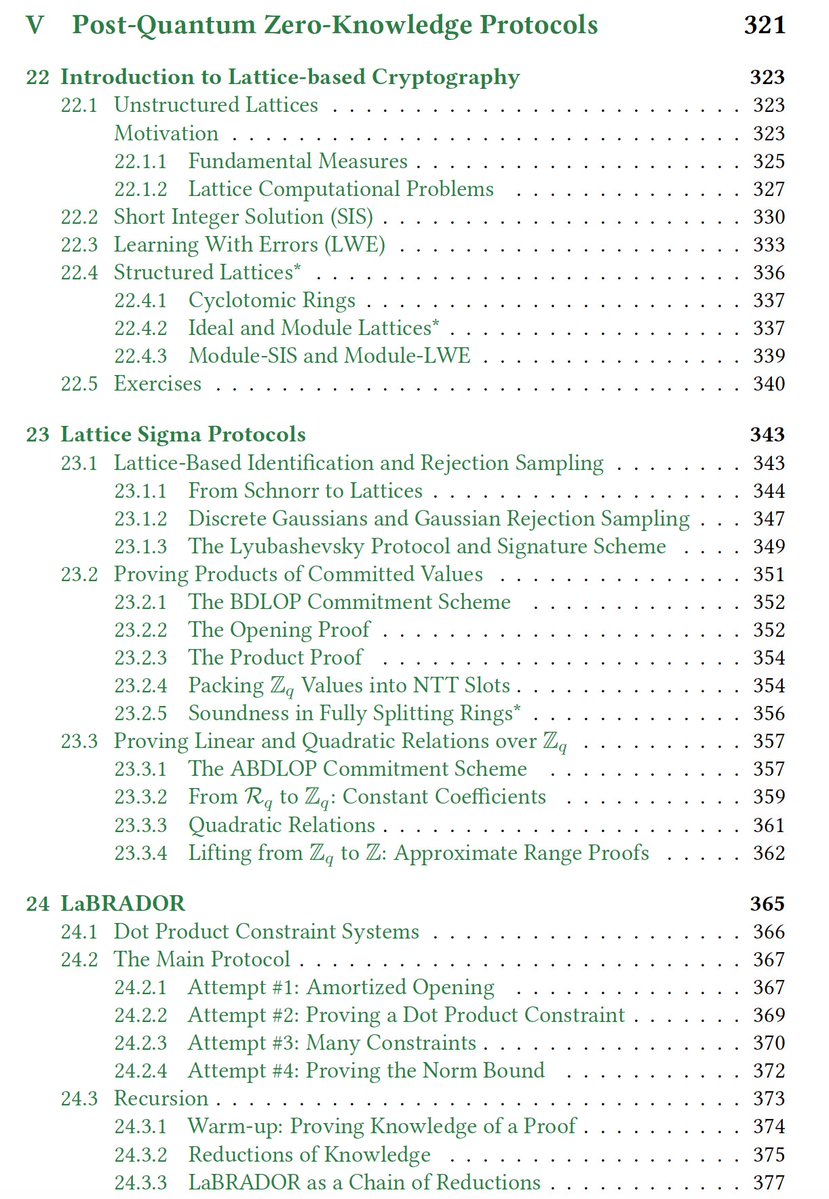
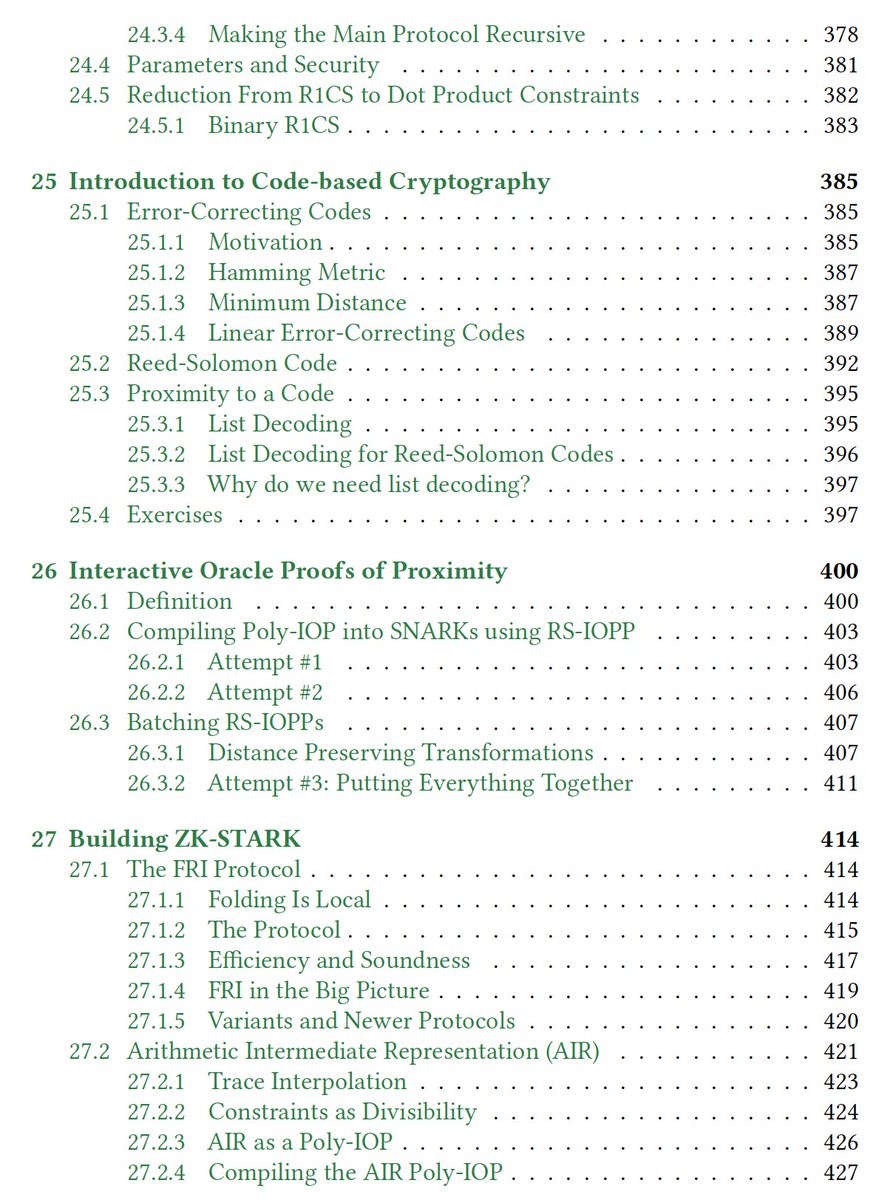
I'm glad to share that our book on zero-knowledge protocols now has a full chapter on post-quantum zero-knowledge proving systems with over 100 pages!
It covers lattice-based Σ-protocols, LaBRADOR, and ZK-STARKs, with all the necessary prerequisites included.
Link below 👇
I've been working on a tool to help humans write and understand game-hopping security proofs. It's just for "pen-and-paper" reasoning, not a formal verification tool. 1/3
🧵
We updated ePrint 2026/1692 with new results on Poseidon: https://t.co/zDzb07ktb4
The paper introduces a new approach to round skipping which we denote (k+1)-wise collapsing and which enables round skipping in arbitrary CICO-k problems beyond CICO-1 and CICO-2.
1/6
The optimality of the packing for 11 squares has been formalized in lean thanks to Astra and Claude! Huge thanks to @ojoshe, @kleddamag, @wand_125, @guzhou0806, and @ctjlewis for aiding in the process.
Image credit: https://t.co/2oUaPKe2Hz
1/n