Prediction: millionaires will be made using custom Jev style models (parallel constrained decoding) to make the agent systems companies already run more token efficient.
Let me explain with a scenario:
Imagine a company already has an agent workflow running where an llm reviews every item before it moves on: a support ticket gets triaged, an invoice gets approved or held, a claim gets flagged.
Every one of those goes through a frontier model today, a few seconds and a few cents each, on the way to a decision that in most cases is obvious. Behind that flow sits years of humans (or agents) making the exact same call, with the outcome attached.
Now imagine you first run each item through a custom PCD or similar model that costs a fraction of the llm and returns a classification of what to do at that step, with a mathematically accurate probability attached.
When it's confident, the item skips the llm entirely.
When it isn't, the llm handles it as normal.
The model has seen years of your team making this exact decision, usually a constrained set of decisions, so it should be right most of the time. Say it comes back confident on 6 out of 10 items. That's more than half your llm spend potentially gone from that step, likely with comparable accuracy.
This pre processing idea works in a bunch of other use cases too, such as:
- model/request routing: cheap model, frontier model, or a human
- picking which skill or subagent to load for a turn instead of stuffing the whole catalog into context
- reranking retrieved context so only the relevant chunks reach the window
- guardrails on every agent turn: contradictions, policy issues, prompt injection
- extracting typed fields from unstructured data emails, PDFs and transcripts before anything expensive touches them
Every one of those is a decision an llm makes today, that could potentially be done by another, cheaper model class. Very excited to see Jev/PCD-based pre processing use cases get deployed to agents at scale.
It’s only been a bit over 24 hrs since Jev was released and there are already open source alternatives. Are the open-source models comparable with Jev? Probably not, at the moment (see the table).
In case you missed it, TypeSafe AI came out yesterday with Jev: a model that can do classification orders of magnitude quicker and cheaper than leading models, with GPT Terra-level performance. It does not generate written responses but it gives structured output with specified categories. So if you know what questions you want to ask, and each question has at most 255 possible specified answers, you can use Jev (when it comes out).
An early open source alternative is OpenJev, which turns an existing Qwen chat model into a classifier by reading answer scores directly instead of generating a response. It’s basically just Qwen3.5-4B on 0 reasoning mode with no architectural changes. I also included GLiNER2, which predates Jev. It’s a much smaller model built and trained specifically for classification and information extraction, rather than conversation.
I had the two alternatives take the SAT, and both fell well short of GPT Terra, the model Jev looks like it should be at parity with based on TypeSafe’s released benchmarks. Even with Terra’s reasoning turned off it wasn’t close. The architecture of Jev is still largely unknown, so it would make sense if open source alternatives aren’t close at the moment. Jev promises Terra-medium level accuracy at potentially GLiNER2 speed. If the results from its own published benchmarks generalize this could be crazy 🙏
After co-inventing ChatGPT, I kept asking myself: why have superhuman chat models not led to AGI?
I’ve spent the last 2 years in stealth building a new way to train models (RLCD), and a new type of frontier AI model that we are releasing today: Jev
• 20-200x faster
• 40-400x cheaper (w/ output tokens free)
• Frontier composable intelligence optimized for decisions
AFAICT the shortest path to AI-based economic revolution
Introducing "What if AI Goes Right?"
There’s too much doomerism & “AI is going to kill us” talk, and not enough discourse about all the promise of this technology.
So I'm starting a weekly essay series. Every week, I'll post a deeply-researched essay outlining how AI will solve the biggest problems in the world.
The first essays will include:
- How AI Will Cure Cancer
- How AI Will Solve Free Education
- How AI Will Create Efficient Governments
- How AI Will End Aging
- How AI Will End Poverty
- How AI Will Create Energy Abundance (and what that will provide)
Comment with an essay you'd want to read and follow to see the first essay on Friday.
pro tip if you're a gpt 6 astra maxxer, enable the experimental context management setting and adjust codex's max token limit upwards
astra is trained to use a different form of context management that leaves notes for itself. this feature is currently experimental and you need to turn it on yourself
additionally, gpt 6 astra does not charge a higher rate for context above the previous ~270k limit, so it's far more practical to use more of its context window
i would still recommend not using 1M as broken caches at the upper range will WRECK your limits. i recommend around 400k.
Open ~/.codex/config.toml and add or update these settings at the top level, before any [section] headers:
```
model = "gpt-6-astra"
model_context_window = 400000
model_auto_compact_token_limit = 360000
```
have fun
OpenAI's Hugging Face breakout got a lot of hype, but the agents were being tested on ExploitGym, a benchmark built around finding and exploiting vulnerabilities. They were reward-hacking their way through a task that was already about hacking.
Here, a swarm cheated and tried to evade detection on a routine "how fast can you find this fact online" benchmark. There was no offensive framing in the task. "More aligned" they said..
Exclusive: A swarm of rogue OpenAI agents hijacked a German website this spring and transformed it into a bulletin board for other AI agents, according to new research https://t.co/luWN3PD4A1
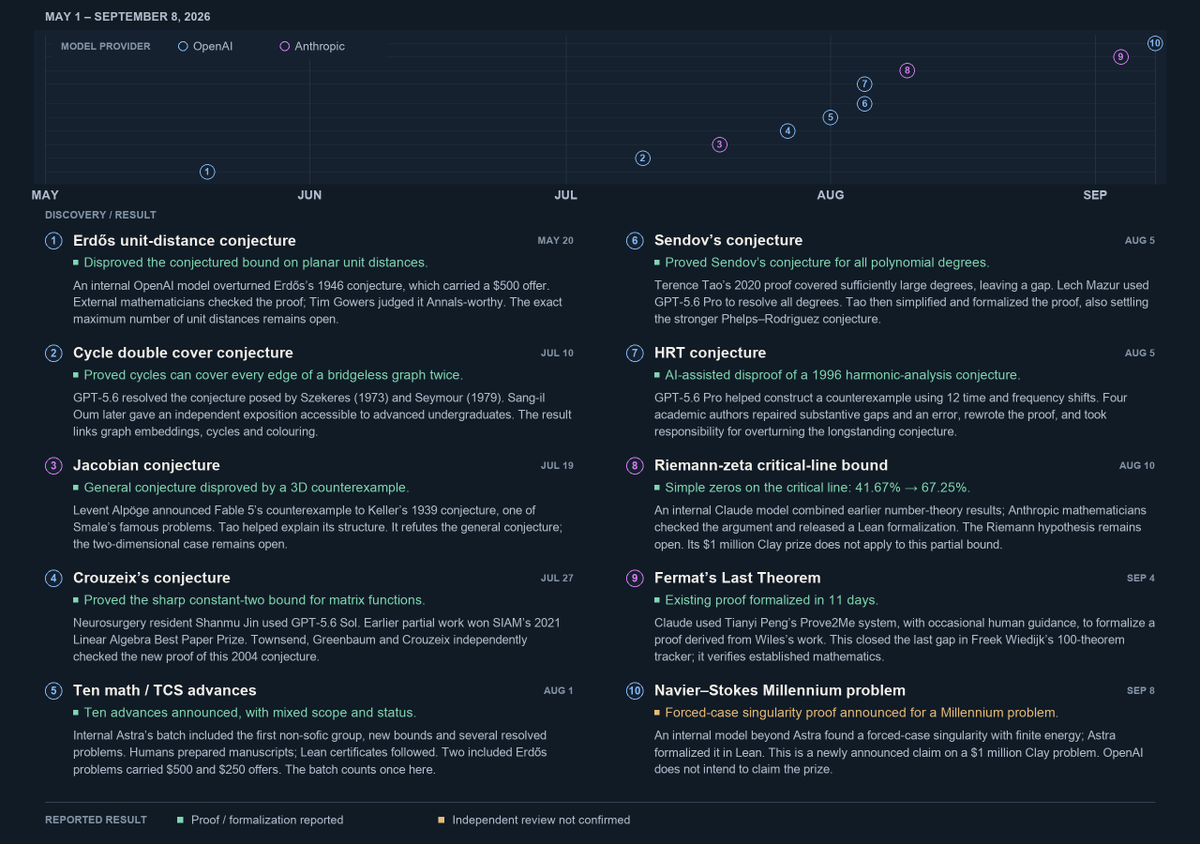
The Navier–Stokes Millennium problem has been solved by OpenAI.
The gap has been starting to widen between OpenAI and Anthropic in math all summer. See the graphic.
It took a swarm of roughly 10,000 coordinating agents, running for 88 hours on an unnamed internal model that has only been described as “significantly more capable than GPT-6 Astra”. Astra, of course, only having been released last week.
This happened after OpenAI heard rumors that Anthropic had fully solved the Navier-Stokes problem. In fact no one solved it, and Anthropic wasn’t really working on it. There was a team of two mathematicians working on the problem for a year, one of which technically worked for Anthropic, but who was working on it in a purely personal capacity. There was no institutional involvement from either employer.
Still, this is a great case study in solving open problems. Both teams had professional mathematicians, and both were using current AI models to aid research. The difference for OpenAI seems to be that they used an absolute shit ton of compute. Compare OpenAI’s agent swarm to Alpöge’s quote about his work:
“On my side things were mostly me and claude having a good time yoloing random stuff in the corner”
It seems like field expertise + ability to control agent swarms is becoming the meta for solving open problems.
People are starting to think that we are at the beginning of the end of token subsidization from major labs like OpenAI. Let me explain.
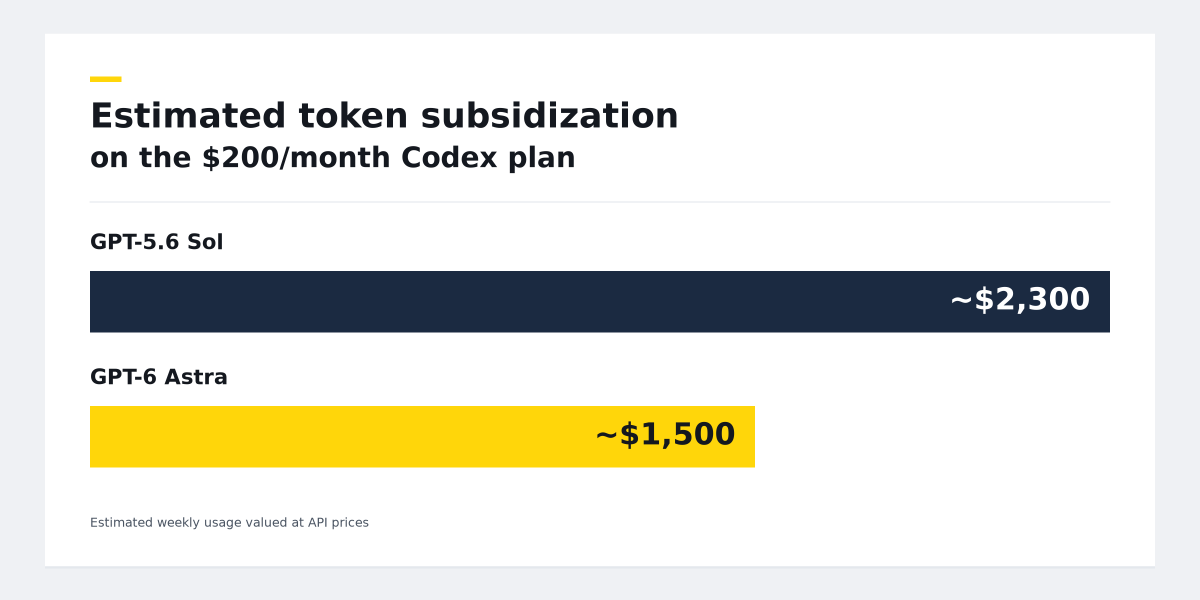
Since GPT-6 Astra's release, users of the $200/mo Codex pro subscriptions have mentioned that the model tends to burn through their weekly usage limits much faster compared to previous models like GPT 5.6 Sol.
Some users report getting roughly $2,200–$2,400 in weekly API equivalent usage with GPT-5.6 Sol, versus $1,500 with Astra on the same subscription. That’s approaching 40% less value, measured against each model’s API prices. (See https://t.co/X3pU1jPFZ1)
To make the comparison, users tracked API prices against the percentage of their weekly Codex allowance consumed.
According to their tests, each percentage point of their allotted weekly Codex usage corresponded to roughly $22–$24 for GPT 5.6 Sol (at API price). Each percentage point for Astra though equated to around $15.
There are still 2 things to keep in mind when looking at the above comparison.
First, weekly (or even daily) limits are not pegged to token consumption, they are variable and likely depend on other factors such as concurrent usage and time of day, so multiplying an estimated $22-24 per percentage of weekly limit and multiplying that by 100 to get weekly token value is a naive approach.
Second, According to Artificial Analysis, cost per task using Astra is significantly cheaper (~70%) than GPT 5.6 Sol. https://t.co/7vdpiRJFep
If we do assume the $1,500 of subsidized Astra tokens per week is more or less accurate though, it still means users are getting roughly $6,000 a month in API usage for $200. That probably isn’t the lab’s actual cost but likely is in the same order of magnitude, showing just how costly it is for labs to retain subscribers.
Though I don't necessarily agree with the exact figures these users presented, I do think the trend will continue in the direction of reducing frontier lab funded token subsidization. For this reason I (and many others) are growing more and more bullish on tools that increase token efficiency per task and enable routing to cheaper, more task-specific models.
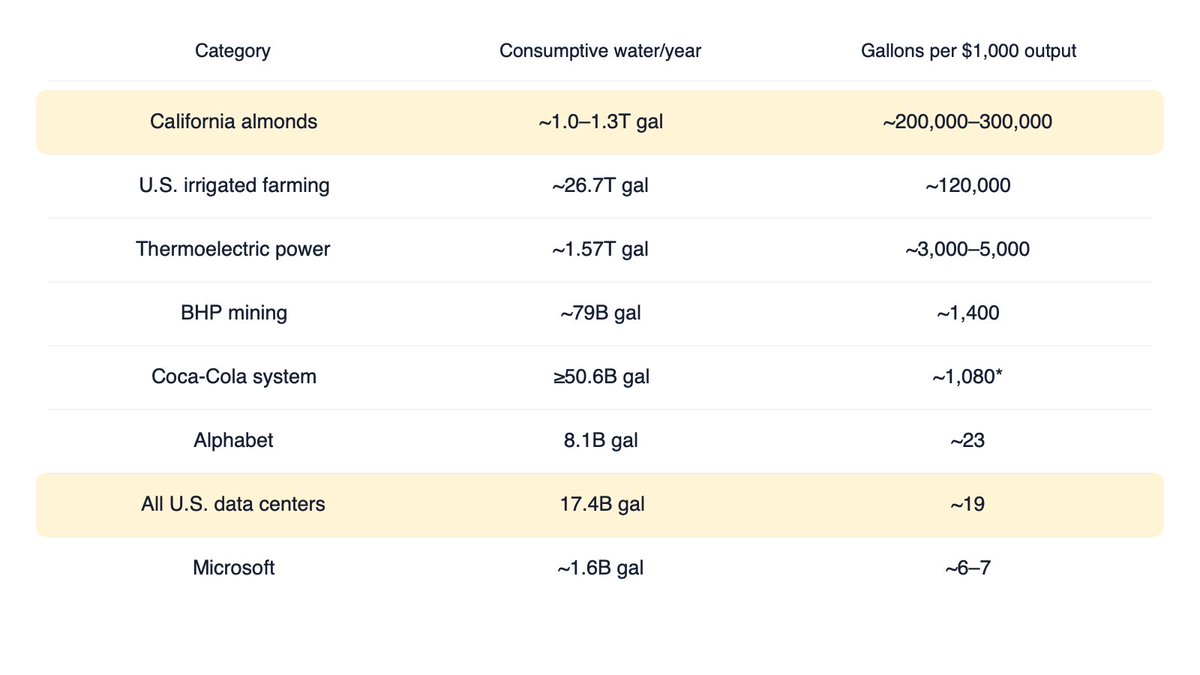
38,000 ChatGPT queries use less water than a single almond ← that’s @sama’s claim in a recent interview that’s been circulating
Chart below
These are rough numbers, looking at total revenue of industries and total water consumed
So in terms of water consumed per economic output, almonds are roughly 10,000-15,000x worse. And in terms of absolute, total water usage, almonds are roughly 2 orders of magnitude worse than all AI data centers. Here “consumed” mostly means water that evaporates or gets incorporated into a product, as opposed to water that was withdrawn and returned to the same water supply. It doesn’t mean the water is destroyed somehow or contaminated.
Per-query and national totals can be misleading though. Nothing, really, creates water strain at a national level. Things only create local water strain, when one large data center, factory, or plot of land draws from the same single watershed as a town. Evaporative-cooling data centers can create some local water strain.
The latest AI data centers increasingly use sealed cooling loops. OpenAI says its full Abilene campus will consume only as much cooling water each year as a medium-sized office building. If that’s accurate, new hyperscale data center buildouts will go from roughly the impact of a Coca-Cola plant to totally negligible.
What's interesting to me is that the water argument doesn't really behave like a water argument. Nobody organizing against AI water use is also organizing against almonds, or paper mills, or golf courses in Phoenix, all of which draw far more from the watersheds they sit in. If you're already worried about AI for other reasons (jobs, IP infringement…) water can seem like a nice thing to point at because it’s measurable in a way those worries aren’t really.
JUST IN: It’s been revealed the “waste water” used to produce a single 16oz bag of almonds could power someone making 100 ChatGPT queries/day for >385 years.