Meet Galileo 1.0: The game-changing prompt-to-UI platform now open to all.
Our mission is to supercharge the creative process of designers and builders, making design easy, fast and magical.
Bring your idea, let AI do the heavy lifting.
Start today: https://t.co/a1xWOnIrQC
In business, never ever expect someone to care as much as you (the owner) do, unless you specifically incentivize them to.
What is good for you, must also be good for the team, otherwise it simply won't happen.
It took me ten years to learn this lesson, and it's one of the biggest mistakes I see young entrepreneurs make.
A $300 SaaS credit card charge for software you don't even use = $300 of your money gone.
To an employee = nothing gone, unless they are P&L incentivized.
The same goes for doubling profits. Does it double their bonus?
Everywhere I look, incentives drive behavior.
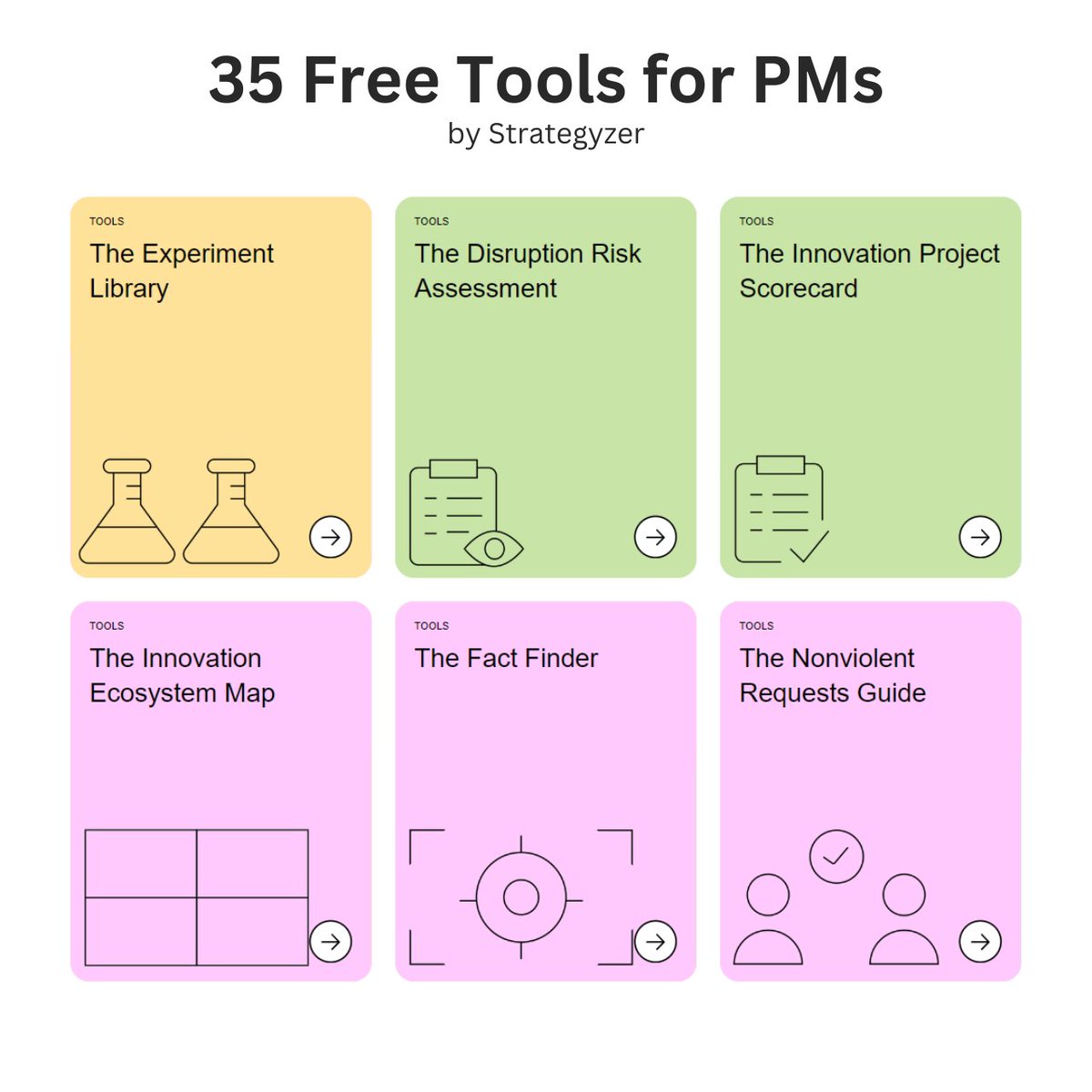
I found a fantastic set of 35 free tools for PMs by @strategyzer 😍
The collection includes:
1. The Experiment Library
2. The Disruption Risk Assessment
3. The Innovation Project Scorecard
4. The Innovation Ecosystem Map
5. The Fact Finder
6. The Nonviolent Requests Guide 🧵
Only 3 days since OpenAI started giving the ChatGPT Vision feature to select pro users...
Here is what kept people caught in a loop of wonder
13 bewildering examples:
We're about to drop a @figma plugin that turns a single prompt into a stunning, dev-ready design. Responsive, with autolayout, text styles, and variables. The goal is to get creatives 80% of the way there, so they can quickly fine-tune the last details and achieve great design💪
I should write a post about what we've learned from 100+ customer calls with design teams of all shapes + sizes while building Campsite.
Consistently:
• Designers don't like sharing wip
• Leaders wish their team shared more wip
I was laid off from Twitter today. I was the designer in charge of our new rebranding to X.
I learned so much in my 2.5 weeks at the company but I’m excited to see where I land next.
If you’re hiring a self taught, junior designer please DM me. Graphic design is my passion!
Two weeks ago, the news shocked many Product Managers: Airbnb got rid of a classic product management function.
Some interpreted the headlines as "eliminating the PM role."
That's not accurate.
As Brian Chesky (Airbnb CEO) explained, Airbnb combined Product Management with Product Marketing, as “you can’t develop products unless you know how to talk about the products.”
I think it's essential to examine the implications.
---
Looking at the picture below, you might notice overlaps and dependencies:
- The PM defines the Product Vision and Strategy. However, you can't create a Strategy without market and industry analysis, which is theoretically the PMM's main job.
- The Business Model, including pricing, can't be assigned to one role only. In many companies, it's a shared responsibility involving other stakeholders.
- Both the PM and PMM need to discover and understand who their customers are (personas) and their needs/jobs.
- In theory, PMM defines the Go-to-market (GTM) strategy. But
GTM must align with the Product Strategy defined by PM. This applies, in particular, to target customers, their jobs/needs, and Value Proposition. GTM must also refer to a Business Model, including pricing. And this is a shared responsibility.
As a result:
- Many PMs focus on communicating with stakeholders and the product team, engaging customers solely for interviews. They struggle to communicate their products to others, especially outside the organization. They may lose sight of the broader picture and prioritize execution - roadmaps, objectives, status reporting, and releases.
- Many PMMs find it hard to fully own the Go-to-Market (GTM) strategy. They often have to rely on inputs from Product Managers.
By merging Product Management and Product Marketing, Airbnb brings Product Managers closer to the market and the users.
So that they can:
- Develop better intuition. They need to synthesize vast amounts of knowledge about the market and the industry.
- Learn how to talk about the product and shape how others think about it.
- Enable others to tell the same story.
- Take on the responsibility for the Go-to-market (GTM).
Some PMs might feel uncomfortable talking to the customers or spending more time analyzing the market. But for me, that’s a plus. That’s what we are supposed to do. We are not Backlog Administrators.
Are there any drawbacks?
What are the alternatives?
Who owns the revenue?
---
In today’s free post (no email, no paywall), I discuss:
1. Product Management vs. Product Marketing
2. Combining Product Management with Product Marketing
3. Product Growth Roles
4. Recommended resources and free templates
5. Conclusions
You got this: https://t.co/SN5AipaADJ
This is perhaps the biggest secret to the productivity and viability of our two-person teams at 37signals. All our web designers work directly with the native materials of HTML, CSS, and usually even a fair bit of JavaScript and Ruby. Not in Figma. https://t.co/Fu29nvteCx
#Config2023 launches bridge the gap between design and development, all in Figma.
→ Dev Mode, a new space for developers
→ Variables
→ Advanced prototyping
→ Auto layout updates
→ Font picker
→ File browser redesign
Plus, we previewed the future of Figma with AI and announced the acquisition of @diagram. https://t.co/RB3qHFSSPz
You gotta hear this.
I had the wildest dream last night about @framer. Something to do with them launching AI. https://t.co/z1gOQOUydw
It was terrifying.
How does Spotify build products?
A little secret is the DIBB framework to arrive at strategic bets.
Audiobooks, Podcasts and many other products started with this little way of thinking.
Let us learn about DIBB framework in < 2 mins: